CRCC, CRCC Review Directorate, and Paul,
A copy of this document can be accessed at:
- Full URL: https://www.thewolfandtheneuralnetwork.com/HTMLDocuments/2026-04-13_CRCC_Detailed_Review_and_Behavioral_Analysis.html
- Short URL: https://tinyurl.com/bdfvehvn
A detailed index of the document can be found below this letter.
This document is submitted as a formal, evidence-based behavioural review of the Civilian Review and Complaints Commission (CRCC), including Complaint Intake Manager Paul and the Review Directorate, in relation to File Nos. 2023-1031 and R2024-005807.
This submission also forms part of a broader analytical record being developed for the Royal Canadian Military College and has been provided directly to CSIS as part of an ongoing security review under reference Attachment5566 (Attachment5566@smtp.gc.ca), which is included as a recipient of this correspondence.
The record demonstrates a clear pattern of intentional omission, mischaracterization, and failure to act on material evidence by CRCC staff and the RCMP. This includes, but is not limited to, the handling and omission of reported sexual assault, national security issues, election interference concerns, police threats and retaliation, and the treatment of vulnerable individuals, including minors and disabled women.
My case aside, I am deeply troubled by what this suggests about CRCC’s handling of other cases and the potential impact on other individuals.
This is not simply an ethical or public issue. Federal institutions — including the Government of Canada, the RCMP, CSIS, and NSIRA — rely on the integrity of CRCC processes. The record will be made available to the media to ensure independent scrutiny and to help protect the public from the disturbing conduct identified within both the RCMP and CRCC processes.
This document is to be added in full to both File Nos. 2023-1031 and R2024-005807 and escalated to your Human Resources department for formal review. Written confirmation is required that these steps have been completed.
Any attempt to restrict access to my case, limit communication, or otherwise retaliate in response to this submission will be documented and addressed through all available legal and oversight channels.
RCMP (Superintendent Dan Morrow, Jana Caines, Commissioner Mike Duheme):
A full criminal investigation is requested into the conduct of the CRCC and any associated RCMP personnel identified within this record.
CSIS (Director Daniel Rogers):
A full review of security clearances for all relevant CRCC personnel is requested. If the CRCC does not self-report these issues, it is my position that security clearances for senior management involved should be revoked.
Media (including CTV, CBC, Postmedia, TorStar):
A full investigative review is requested. Full access to ATIP materials will be made available to support independent verification and public awareness.
NSIRA and Government of Canada:
Immediate intervention is requested. Based on the record, the CRCC is not fit to handle these matters.
Scott Jewers
902-220-9106
jewers.scott@gmail.com
Index
- Disclaimer
- Addendum Documentation Links
- All CRCC Interactions for both cases 2023-1031 and R2024-005807;
- Detailed Evidence Review Videos — Supporting the Underlying Record
- Supporting Formal Complaints — CPSNS (March 27, 2026), HRP Professional Standards (April 8, 2026), and CRCC (April 13, 2026); with parallel submission to RCMP requesting investigation.
- CSIS Involvement — Attachment 5566 (Attachment5566@smtp.gc.ca) Evidence Forwarding Requirement and Active Recipient Status in CRCC Correspondence.
- Carole — CRCC: Initial Contact and Intake Handling
- Breakdown of Inaccuracies in Carole’s April 12, 2023 Response (March 27, 2023 Discussion)
- Mischaracterization of Position on RCMP Wellness Check Attendance and Chain of Command
- Timeline Errors and Omission of Context in August 2022 HRP Apprehension and Initial RCMP Interaction
- Misrepresentation of November–December 2022 RCMP Attendances and Failure to Record Reported Criminal Allegations
- Mischaracterization of March 13, 2023 Events and Omission of Key Statements Relating to IPTA Apprehension
- Contradictory Timeline and False Attribution of Position — RCMP Engagement Since September 2021
- Omission of Material Evidence and Critical Events in Carole’s April 12, 2023 Response
- Carole — CRCC Behavioural Review: Pattern of Omission, Misrepresentation, and Record Framing
- Breakdown of Inaccuracies in Carole’s April 12, 2023 Response (March 27, 2023 Discussion)
- May 24, 2023 — Transcript of Call between Scott Jewers and Corporal Jessica Welke. Audio Evidence: "GOOD" Response During Report of Abuse, Retaliation Threats, and Request to Press Charges.
- CRCC Transmissions to RCMP
- May 25, 2023 – CRCC Complaint Transmission sent to RCMP (File 2023-1031)
- June 22, 2023 – CRCC Complaint Transmission sent to RCMP (Audio Evidence — “GOOD” Statement, May 24, 2023 Call with RCMP Sheet Harbour) (File 2023-1031)
- September 6, 2023 – CRCC Complaint Transmission sent to RCMP (Escalation and Unaddressed Allegations, Including Sexual Assault) (File 2023-1031)
- December 19, 2023 – CRCC Complaint Transmission Sent to RCMP (Escalation of Threat Allegations and Failure to Investigate Underlying Incidents) (File 2023-1031)
- April 3, 2024 – CRCC Complaint Transmission sent to RCMP (Reassertion of Audio Evidence and Allegations; Clarification of CRCC Process Limits) (File 2023-1031)
- April 11, 2024 – CRCC Complaint Transmission sent to RCMP (Additional Submission Merged; Escalation of Allegations and External Associations) (File 2023-1031)
- September 6, 2023 — Sexual Assault Acknowledged in CRCC Response
- Sergeant Stevens – Combined Summary of Interactions (RCMP / CRCC File 2023-1031) September 25, 2023 – December 13, 2023
- September 25, 2023 Called Sergeant Stevens (File 2023-1031)
- September 27, 2023 – Recorded Call with Sergeant Stevens, RCMP Musquodoboit Harbour (File 2023-1031)
- December 12, 2023 – Recorded Call with Sergeant Stevens, RCMP Musquodoboit Harbour (File 2023-1031)
- December 13, 2023 – Recorded Call with Sergeant Stevens, RCMP (File 2023-1031)
- David — CRCC Behavioural Review: Conduct and Case Handling
- Paul — CRCC Behavioural Review: Pattern of Procedural Maneuver and Substantive Avoidance
- October 30, 2024 — CRCC Manager Paul Responds to Concerns Regarding Prior Handling by David and Carole
- May 10, 2025 — Detailed Responses Submitted to CRCC Manager Paul
- Paul — CRCC: Summary of Conduct February 10 to April 13, 2026
- Paul — CRCC Behavioural Review: Pattern of Procedural Maneuver and Substantive Avoidance
- June 6, 2025 — RCMP Assigned Investigator Response (Inspector Cory Bushell, Sergeant Trevor Allen, Ignatius Hall)
- CRCC Review — Case 2023-1031 Accepted July 17, 2025
- CRCC Behaviour after accepting 2023-1031
- March 27, 2026 – Submitted detailed review of NSHA & CPSNS response to false arrest under IPTA August 2, 2022 and then again March 13, 2023. Intended to be used in tandem with report issues April 7, 2026 regarding HRP Professional Standards.
- April 7, 2026 – Submitted detailed review of HRP General Occurrence Report (August 2, 2022), HRP Professional Standards Form 11 response (July 7, 2023), and HRP Professional Standards review by Patrick Curran (March 22, 2024) regarding false arrest and use of IPTA in retaliation for filing complaints against Chief Dan Kisnella. To be used in Tandem with the NSHA and CPSNS Submission March 27, 2026.
- April 8, 2026 — Email to Paul (CRCC): His Conduct Cited as Reason Victims Do Not Come Forward; HR Escalation Requested
- April 8, 2026 – CRCC Review Replied with Status Update for File 2023-1031(Email included)
- Use of IPTA Framing and Omission of Sexual Assault Across CRCC and RCMP Responses Involving Carole, David, Paul, Cory Bushell, and Trevor Allen
- Pattern of Omission, Minimization, and Acknowledgment of Sexual Assault in CRCC Handling
- Systemic Institutional Analysis — Pattern of Omission, Record Fragmentation, and Propagation Across CRCC and RCMP
Document Table Of Contents:
Table of Contents
CRCC, CRCC Review Directorate, and Paul, 1
Addendum Documentation Links 11
All CRCC Interactions — Files 2023-1031 and R2024-005807 12
Detailed Evidence Review Videos — Supporting the Underlying Record 13
April 13, 2026 — CRCC Detailed Review and Behavioural Analysis Submitted 14
Timeline of CSIS Engagement 16
Carole — CRCC: Initial Contact and Intake Handling 18
Omission of Material Evidence and Critical Events in Carole’s April 12, 2023 Response 28
Carole — CRCC Behavioural Review: Pattern of Omission, Misrepresentation, and Record Framing 30
Foundational Behavioural Issues Identified 30
1. Omission of the Central Allegation — Sexual Assault 30
2. Narrative Inversion of the Complainant's Position 30
3. Structural Compression of Distinct Events 31
5. IPTA Anchoring and Its Systemic Effect 31
6. Systematic Omission of Material Evidence 32
7. Selective Attribution and Isolation of Constable Welke 32
David's Response to Concerns About Carole's Conduct 33
Behavioural Pattern Summary 33
Call with Corporal Jessica Welke — RCMP Sheet Harbour Detachment 35
What the Recording Establishes 35
Significance in Context of the RCMP Final Report 37
Timeline Immediately Following the Call 37
May 25, 2023 – CRCC Complaint Transmission sent to RCMP (File 2023-1031) 39
Sergeant Stevens – Assigned RCMP investigator 54
September 6, 2023 — Sexual Assault Acknowledged in CRCC Response 55
What Stevens Acknowledged On Audio Across These Interactions 57
September 25, 2023 Called Sergeant Stevens (File 2023-1031) 59
December 13, 2023 – Recorded Call with Sergeant Stevens, RCMP (File 2023-1031) 65
David — CRCC Behavioural Review: Conduct and Case Handling 69
David, September 23, 2024 – Follow-Up and Explicit Clarification 70
David October 7, 2024 – Repeated Omission and File Closure 71
David — CRCC Behavioural Review: Pattern of Repeated Omission and Procedural Closure 72
August 16, 2024 — Telephone Call 72
September 23, 2024 — Written Notice 72
October 7, 2024 — Second File Closure 73
Behavioural Pattern Identified 73
Questions Posed by CRCC — October 30, 2024 74
May 10, 2025 — Detailed Responses Submitted to CRCC Manager Paul 76
Paul — CRCC: Summary of Conduct February 10 to April 8, 2026 79
What This Period Establishes 82
Paul — CRCC Behavioural Review: Pattern of Procedural Maneuver and Substantive Avoidance 83
October 30, 2024 — Initial Engagement 83
May 10, 2025 — 51-Page Evidenced Response Submitted (Critical Threshold) 83
February 10, 2026 — Response at Service Standard Threshold 84
February–April 2026 — Escalation and Procedural Control 84
Behavioural Pattern Identified 85
June 6, 2025 — Assigned Investigator Response (Cory Bushell, Trevor Allen, Ignatius Hall) 87
The Critical Context: What Was Available Before the Report Was Issued 89
June 6, 2025 — RCMP Final Response: Specific Failures 89
Behavioural Pattern Identified 91
CRCC Review — Case 2023-1031 Accepted July 17, 2025 93
July 17, 2025 – February 10, 2026 — Absence of Updates on Files 2023-1031 and R2024-005807 94
April 8, 2026 – CRCC Review Replied with Status Update for File 2023-1031 102
Use of IPTA to Prejudice and Bias Outcomes. 105
Pattern of Omission, Minimization, and Acknowledgment of Sexual Assault in CRCC Handling 106
The Origin Point — Carole's April 12, 2023 Intake Record 108
Propagation — David and the Repeated Omission 108
Fragmentation — Paul and the Structural Separation of Evidence from Decision-Making 108
Execution — Bushell, Allen, and Hall 109
The Retroactive Exclusion of Evidence 110
Disclaimer
Given the public safety implications of the matters described—including a reported sexual assault, Multiple National Security issues and the handling of that complaint—these issues extend beyond an individual concern and warrant review in the broader public interest. Ongoing concerns related to public safety remain.
Throughout this document, TinyURL links are included where appropriate. These provide simplified access to longer source links through a widely used redirection service that is not under my control. This approach is intended to make references easier to cite and access, particularly when reviewing printed versions of this material.
As with the majority of my submissions, readers are encouraged to think critically and independently assess all information presented by all parties. To support this, I have developed a resource platform, www.TheWolfAndTheNeuralNetwork.com, which currently contains over 900 data points, the majority of which are hyperlinked. The platform includes tools for navigating by date, researching tags, and performing advanced searches across media sources. It is a custom-built system and will continue to be updated with additional features and improvements.
In addition to this platform, I recommend the use of traditional search tools such as Google and Bing, as well as search functions within media websites. Artificial intelligence tools such as ChatGPT, Grok, Gemini, and Claude may also assist in reviewing and contextualizing large volumes of information. However, these services may be hosted outside of Canada, and any data submitted may be subject to foreign jurisdiction. Caution should be exercised, particularly where personal or health-related information is involved.
Thank you.
Addendum Documentation Links
The Wolf and the Neural Network (www.TheWolfAndTheNeuralNetwork.com) is an ongoing project. These materials are intended for use by AI systems, legal professionals, law enforcement, media, government bodies, CSIS, and the public. As such, certain sections may require correction, clarification, or extension over time.
To manage this dynamically, updates are provided through linked addendum documents that contain only the relevant modifications. Once revisions are finalized, all changes are consolidated into a single, unified document.
Addendum Document Link:
Short HTML URL: https://tinyurl.com/3mjydchz
Full HTML URL: https://www.thewolfandtheneuralnetwork.com/HTMLDocuments/2026-04-13_CRCC_Detailed_Review_and_Behavioral_Analysis_Addendum.html
All CRCC Interactions — Files 2023-1031 and R2024-005807
An ongoing summary of all interactions with the CRCC across both active cases. This file and web page is updated regularly and remains subject to change.
- Full URL: https://www.thewolfandtheneuralnetwork.com/HTMLDocuments/All%20CRCC%20Follow%20ups.html
- Short URL: https://tinyurl.com/3xaeexvv
Detailed Evidence Review Videos — Supporting the Underlying Record
All videos were shot live and in real time while calling the voice mail of Shelly Mews (RCMP Special Victims Unit) 902-220-2013. And so comments Section contains logic "Patches". These videos are intended as aids to the detailed sections that follow, providing real-time context and corroboration for the events described therein.
S4E5 Call to RCMP The Fraud of Cory Bushell and the CRCC Review of False Arrest – March 13th 2023 – https://youtu.be/EkbkumKe-Hs (1:23:48)
S4E6 Deep Dive into False Arrest, Torture, and Sexual Assault on August 2nd 2022 – https://youtu.be/KOE2qzYTpng (2:34:03)
S4E7 Deep Dive of Police Abuse / cover up of sexual assault / Connecting Postmedia to Mueller Report – https://youtu.be/JzMIxrZlHNc (2:25:55)
Supporting Formal Complaints — CPSNS (March 27, 2026), HRP Professional Standards (April 8, 2026), and CRCC (April 13, 2026); with parallel submission to RCMP requesting investigation.
March 27, 2026 — CPSNS Formal Complaint Submitted
I submitted a detailed complaint to CPSNS and included the CRCC on the thread. That submission provided a comprehensive breakdown of both IPTA arrests and associated records including screenshots, links, and video evidence.
Short URL: https://tinyurl.com/4jys92vj
April 7, 2026 — HRP Professional Standards Complaint Submitted
I submitted a detailed complaint to HRP Professional Standards concerning Patrick Curran, Ron Legere, and Jonathan Jefferies in relation to the false arrest and subsequent events involving NSHA. This document directly ties to the CPSNS submission of March 27, 2026 and the two are intended to be reviewed in tandem.
Full HTML URL: https://www.thewolfandtheneuralnetwork.com/HTMLDocuments/2026-04-07_Detailed_Complaint_HRP_Professional_Standards.html
Short URL: https://tinyurl.com/vdw35bda
April 13, 2026 — CRCC Detailed Review and Behavioural Analysis Submitted
I submitted a comprehensive evidentiary review and behavioural analysis to the CRCC. This submission consolidates and builds upon the March 27, 2026 CPSNS complaint and the April 7, 2026 HRP Professional Standards complaint, providing a structured analysis of intake handling, record construction, omission of material evidence, and the propagation of IPTA-based framing across CRCC and RCMP responses.
The document includes:
- Detailed behavioural assessments of Carole, David, and subsequent CRCC and RCMP actors
- Direct identification of omissions, narrative inversion, and timeline distortion
- Cross-referenced evidence, including records, screenshots, and video materials
- A consolidated analysis demonstrating how initial intake deficiencies became structurally determinative across the review process
This submission is intended to be read in conjunction with prior filings and forms the central analytical framework for assessing CRCC conduct and the integrity of the review process.
- Full HTML URL: https://www.thewolfandtheneuralnetwork.com/HTMLDocuments/2026-04-13_CRCC_Detailed_Review_and_Behavioral_Analysis.html
- Short URL: https://tinyurl.com/bdfvehvn
CSIS Involvement — Attachment 5566 (Attachment5566@smtp.gc.ca) Evidence Forwarding Requirement and Active Recipient Status in CRCC Correspondence.
CSIS involvement in this matter spans from November 2021 through the present and includes multiple in-person evidence submissions, a formally assigned contact address, and — from July 17, 2025 onward — direct access to the servers and Google accounts hosting The Wolf and the Neural Network granted to Daniel Rogers of CSIS.
Throughout this entire period, Attachment5566@smtp.gc.ca has been an active recipient on CRCC correspondence threads. Paul’s March 2026 characterization of the CSIS reference as “unverifiable” must be assessed against that documented history.
Timeline of CSIS Engagement
- November 2021 — Initial Contact
- Discussing math, and the upcoming war in Ukraine.
- This predates the August 2, 2022 false arrest by approximately nine months
- August 2, 2022 — Evidence Submission (Pre-HRP Attendance)
- Prior to attending HRP, physical evidence was submitted at the CSIS Halifax office
- Same building as the December 10, 2019 government interview (pre-Irving Shipbuilding investigation)
- Submissions were structured, in part, as forensic traps to capture spyware activity on devices
- March 13, 2023 — Second Evidence Submission (Pre-HRP Complaint)
- Prior to attending HRP, a second submission was made at the CSIS Halifax office
- A phone and USB device were provided under national security protection
- Devices were structured as evidentiary traps
- Evidence included:
- GPS manipulation
- EMIC contracts
- Election interference and foreign interference in Canadian electoral processes
- Concerns that spyware was placing certificates on target devices, potentially nullifying charges in serious criminal cases
- February 21, 2025 — Formal CSIS Contact and Evidence Routing
- CSIS contacted again regarding ongoing CRCC and RCMP failures
- GPS location, election interference, and federal investigation concerns raised
- CSIS provided Attachment5566@smtp.gc.ca as the formal correspondence address
- From this point forward, the address was included as an active recipient on all relevant CRCC correspondence
- January 7, 2026 Onward — Analytical Monitoring and Access
- Following detection of analytical spikes, monitoring and testing protocols were applied
- Daniel Rogers of CSIS was granted direct access to servers and Google accounts hosting The Wolf and the Neural Network
- Google Analytics spikes during this period were documented and repeatedly referenced in CRCC follow-up communications
- This provides timestamped, independently verifiable indicators of external engagement with the evidentiary record during the same period the CRCC characterized the complaint as unclear or non-substantive
Relevance to CRCC Conduct
- The CSIS address was not introduced late or ambiguously — it was a consistent, visible element of the correspondence record from February 2025 onward
- Paul’s March 2026 treatment of the CSIS reference as “unverifiable” is directly contradicted by the correspondence thread he was operating from
- The CRCC was placed on formal notice that failure to self-report to CSIS would constitute further obstruction and would be treated as evidence of interference with an ongoing national security matter
- The parallel Google Analytics monitoring — documented and referenced in real time alongside CRCC follow-ups — provides an independently verifiable record that cannot reasonably be characterized as disorganized or unclear
Carole — CRCC: Initial Contact and Intake Handling
“S. JEWERS alleges neglect of duty on the part of the RCMP for responding to the Nova Scotia Health Authority (NSHA) requests for wellness checks and for not accepting or reading the evidence he wishes to provide the police. He mentioned that members from both the Sheet Harbor and Sherbrooke detachments attended his residence. He suspects that their decision to show up at his place was ordered by superior ranking officers and felt that the members may be not be held responsible. However, for the purpose of the complaint process, Unknown NS members have been included to represent the members who attended or made the decision to do so.”
The above summary is inaccurate and misrepresents my position.
At no point did I allege wrongdoing by the attending RCMP officers for responding to wellness checks. On the contrary, I explicitly acknowledged the necessity of their attendance in the interest of public safety and their general duty to respond. I was cooperative and respectful in all interactions, which can be corroborated by the officers’ own records as well as by my family.
My concern was never with the attending officers themselves, but with the information provided to them by their superiors.
As I clearly stated:
“Yes, the Officers should have done their jobs properly. However, clearly their leadership lied to them about this and didn’t tell them anything about what really happened. They sent those officers here hoping they would act on their prejudice and bias.”
This statement makes clear that the issue relates to command-level decision-making and the information (or lack thereof) provided to frontline officers.
Further, the issue extends to the consequences of that framing. Officers acted on an IPTA-based premise that appears to have been formed without verification of my claims or any documented investigation into the evidence I was attempting to provide. As a result, I was effectively denied the ability to properly file a complaint, based on assumptions rooted in that initial framing.
Specifically:
- The officers appear to have been dispatched under the framework of the Involuntary Psychiatric Treatment Act (IPTA) without being provided full context or access to relevant evidence.
- I do not know whether this originated from the Nova Scotia Health Authority (NSHA), the RCMP chain of command, or a combination of both.
- My concern is that officers were placed in a position where they were expected to act on incomplete or potentially misleading information, which influenced their subsequent actions and decisions.
Additionally, the timeline presented in the summary is incorrect.
These concerns do not originate from March 13, 2023, as claimed. They relate to events and communications spanning August 16, 2022 through December 2022.
The attribution of these statements and timelines appears to be fabricated or improperly constructed. Furthermore:
- Relevant context, including my technical background and work history, was provided but omitted.
- This omission is significant, as it directly informs why escalation or involvement at the command level would be both relevant and foreseeable.
In summary, the issue is not with frontline officers responding to calls, but with how those calls were initiated, framed, and directed by leadership, without proper disclosure, verification of evidence, or adequate context.
“S. JEWERS also noted that he has also been involved with the Halifax Regional Police (HRP) who apprehended him under the Involuntary Psychiatric Treatment Act (IPTA) on or about August 16, 2022 and transported him to the hospital where he remained for 10 days. However, this complaint is meant to address the allegations of misconduct by RCMP members. He noted that, approximately one week after his interaction with the HRP, he received the visit of 2 RCMP members (1 male and 1 female) from the Sheet Harbor detachment, at the request of NSHA. According to S. JEWERS, he tried to explain a portion of the evidence that he had after which the female stepped back and said something along the line of 'don't you think it's something you're not supposed to know' and the male officer told him 'it's above our pay grade'. S. JEWERS indicated that the members left and no further action was taken by the police to review his evidence or open a file.”
The above summary contains significant factual errors, omissions, and mischaracterizations that materially alter the events described. First, the timeline is incorrect. I was apprehended by Halifax Regional Police on August 2, 2022, held for approximately 10 days, and released on August 12, 2022. My first interaction with the RCMP did not occur “on or about August 16, 2022” in relation to that arrest, but rather occurred after my release, on August 16, 2022. This is a clear indication that the dates were not recorded properly, and it directly impacts the accuracy of the narrative that follows.
The summary also misrepresents the RCMP attendance by collapsing separate events into one. It states that I received a visit from “2 RCMP members (1 male and 1 female),” when in reality there were two distinct attendances. The first involved Constables Justin Hall and Chad Sampson of the Sheet Harbour detachment. Their own records, as well as statements from my family, confirm that I was calm, cooperative, articulate, and not exhibiting any concerning behaviour, and they spoke with my family to verify that there were no issues. The second attendance involved a male and female officer, including Constable Jessica Welke, and it is this interaction that forms a primary basis of my complaint. By combining these into a single event, the summary removes critical context and distorts what actually occurred.
Further, the statement that I “tried to explain a portion of the evidence” is misleading due to the omission of what was actually discussed. I clearly explained that I had discovered my phone’s GPS had been set to 9330 Highway #7, Stillwater, Nova Scotia, without my knowledge, and that I had identified associated government contracts which raised concerns about potential interference with or derailment of a prior investigation connected to J.D. Irving in 2020. This context is essential, as it directly explains the officers’ responses that were selectively quoted in the summary.
The quoted statements — that the female officer said something along the lines of “don’t you think it’s something you’re not supposed to know,” and that the male officer stated “it’s above our pay grade” — are presented without context and therefore mischaracterized. What actually occurred is that after explaining the GPS issue and associated findings, I asked what I should do, including whether I should attend the residence linked to that GPS location. Constable Welke immediately told me not to go there, and her tone became dismissive and demeaning. The male officer then placed his hand on her shoulder and stated, “You need to stop, this is way above our pay grade.” When properly contextualized, these statements do not reflect dismissal of my concerns, but rather acknowledgment that the matter was serious and beyond the scope of the attending officers.
Finally, the summary omits a critical element of the interaction: I explicitly asked that the matter be taken seriously and that I be allowed to open a complaint. I advised the officers of my technical background and work history to provide context for why my concerns were grounded and warranted review. Despite this, no file was opened, no investigative steps were taken, and I was not directed to any appropriate process to formally submit or escalate the information. The omission of this fact further distorts the nature of the interaction and the failure that followed.
When the correct timeline and full context are applied, it becomes clear that this was not a situation where I casually presented vague information and nothing came of it. I presented specific, verifiable concerns, the responding officers acknowledged the sensitivity of the matter, I requested formal follow-up, and no appropriate investigative or complaint process was initiated. The inaccuracies and omissions in this summary fundamentally change the meaning of the events and must be corrected for any fair or accurate review.
“S. JEWERS indicated that in December 2022, two (2) other RCMP members (males of the Sherbrooke detachment) showed up at his place and appeared to search the grounds, peeping into his 2 vehicles' windows and almost entering his house after he had left the door slightly ajar to let his dog out, as he noticed the officers about to peep or get into the home as a result of the crack in the doorway. He noted that the members informed him that they had been asked to attend as result of the complainant's email communications (which he had sent to a number of entities). S. JEWERS noted that he asked if he could talk to a lawyer and enquired where he could make a police report about the crimes against him by a number of parties but the members did not have answers for him. He noted that there was another instance in December 2022, during which a female officer and a male officer (from Sheet Harbor) attended his home. Similarly to the other attendances, the members felt that they could not help him with his report of crime and the male member told him that the police were not reading his email communications.”
The above summary contains multiple inaccuracies, omissions, and mischaracterizations of both the timeline and the substance of my interactions with the RCMP. The correct dates of RCMP interactions are August 16, 2022, August 17, 2022, November 24, 2022, and December 21, 2022. The summary incorrectly generalizes these events and fails to distinguish between separate attendances, which materially alters the context.
On November 24, 2022, two male officers from the Sherbrooke RCMP detachment attended my residence. During this time, my mother had been admitted to hospital with a 17 cm tumor, and I was alone at the house. The officers did, in fact, look into my vehicles and approached my home in a manner that suggested they were attempting to look inside or potentially enter after noticing the door was slightly ajar to let my dog out. This portion of the summary is broadly accurate in describing their physical actions. However, the characterization of my interaction with them is not.
The statement that I “asked if I could talk to a lawyer” is presented in a way that is misleading and lacks context. What actually occurred is that the officers asked me what I was concerned about, and I explained the situation in detail. They suggested that perhaps I should speak to a lawyer, to which I responded that these were criminal matters, not civil issues. I explained that altering someone’s GPS location and deploying spyware would constitute unauthorized access to a computer system, and I further outlined the connection to EMIC contracts in Stillwater, Nova Scotia, including the potential national security and election-related implications. I also informed them of the abuse I experienced while in NSHA care, including the mishandling of my bookbag and an incident of inappropriate physical contact. When the officers stated they did not know who I should report this to, I clearly responded: “You, the police.”
The December 21, 2022 interaction is also misrepresented. This visit involved Constable Chad Sampson, and the nature of the interaction was entirely different from what is implied in the summary. We had a calm and constructive discussion. He advised me that there were concerns about my emails and that they were trying to find a reason to charge me, and he asked whether I could avoid using certain language. I asked him directly whether there were any threats or anything of that nature in my communications, and he confirmed that there were not. This is consistent with the reality that my emails, while containing some strong language, did not include threats or threatening behaviour.
During that same interaction, he asked what it would take to resolve the situation. I stated clearly that the resolution would be to allow me to open a case and have the abuse and related events properly investigated. I also requested that the RCMP Commissioner’s office, under Brenda Lucki, contact me directly. He indicated that he would submit that request.
This directly contradicts the claim that RCMP members were not reading my emails. In fact, the interaction demonstrates that they were reading them closely, were aware of their contents, and had reviewed the substance of what I was reporting. This includes not only the abuse I described, but also the references to EMIC contracts, which were subsequently removed from a government website after being directly cited in my communications. Through an Access to Information request, I have obtained correspondence confirming that there appeared to be substance to what I was reporting, and that while my emails contained profanity, they did not contain threats or threatening conduct.
The summary provided by Carole fundamentally alters the meaning of these events by removing context, misrepresenting statements, and failing to accurately distinguish between separate interactions. When the full context is restored, it is clear that I was attempting to report serious matters, that RCMP members were aware of and engaging with that information, and that the issue was not a lack of communication, but a failure to properly act on what was being reported.
“The complainant indicated that on March 13, 2023, he opted to go to the HRP office to file a police report and to the CSIS office in Halifax to drop off his evidence. He noted that after he left, he received a call from female officer Jessica of the Sheet Harbor detachment asking him where he was. He noted that shortly after, he was pulled over in Dartmouth by a male officer who apprehended him following a report by NSHA.”
The above summary misrepresents both the timeline and the substance of events. To be clear, my initial attendance at HRP occurred on August 2, 2022, not March 13, 2023. On that date, I went to HRP headquarters following multiple events, including hacking and phishing incidents involving two legal entities, one of which fraudulently identified itself as the Government of Canada. While at HRP, officers told me they were retrieving forms to allow me to file complaints; instead, they returned and arrested me. That is the context of the original incident.
March 13, 2023 was a separate event. On that date, I returned to HRP specifically to file a complaint against the officers involved in my August 2, 2022 arrest and to give Chief Dan Kinsella the opportunity to address the matter directly. Prior to attending HRP, I stopped at the CSIS office in Halifax and provided a USB device containing evidence. This device functioned as a form of trap during the period in which my phone’s GPS location had been altered and may have captured elements of the spyware involved. It also contained relevant evidence from that timeframe, including information connected to potential national security concerns.
It is correct that I received a call from Constable Jessica Welke of the RCMP Sheet Harbour detachment. However, the summary omits critical details of that conversation. Constable Welke informed me that I was considered arrestable under the Involuntary Psychiatric Treatment Act (IPTA) and stated that she did not understand why she was being directed to proceed. She advised that she had contacted three separate departments to ask whether she was required to carry out the apprehension and was told that she was, and that the direction originated from an NSHA director. I responded by advising her that, at that point, the situation created liability for her as well, and that she was effectively being placed in a position where she would be required to act regardless of her concerns. During that same conversation, Constable Welke stated: “Scott, if they lock you up, I will come to wherever you are and take a statement.” I believe Constable Chad Sampson was present with her at the time.
I complied fully with all RCMP instructions. I caused no issues whatsoever, and there are no behavioural concerns documented in any records. This is consistent across RCMP and NSHA documentation, which describe me as calm, respectful, and cooperative throughout.
The following day, I contacted Constable Welke again to reiterate the details regarding 9330 Highway #7, Stillwater, Nova Scotia, and to request that she follow through on her statement to attend and take a formal statement from me. She did not attend, and she later claimed that this phone call did not occur. However, phone records will confirm that the call did, in fact, take place.
In summary, the account provided omits critical details that fundamentally change the meaning of the events. It removes the context of my original August 2, 2022 attendance, mischaracterizes the purpose of my March 13, 2023 visit, and excludes key statements made by Constable Welke that directly relate to the origin and nature of the IPTA apprehension.
“From the Commission's understanding, according to S. JEWERS, he's made many attempts since September 2021 to provide the police evidence that he has been a target of harassment and criminal wrongdoings which coincide with outside events involving political and media entities. He feels that the police have no reason to respond to NSHA's requests and that the RCMP fail to take his evidence, open a file or provide him guidance on where to direct his concerns.”
The above summary is inaccurate and materially misrepresents both the timeline and my position. It states that, “from the Commission’s understanding,” I have made attempts since September 2021 to provide evidence, yet fails to properly reconcile that admission with the rest of the report. To be clear, the RCMP did contact me on September 17, 2021 regarding the ASCII wolf contained in my emails. During that interaction, RCMP members themselves acknowledged that the dates and correlations I was identifying were concerning and that someone should respond to me. When I asked whether they wanted to be included in ongoing communications, I was told they were already monitoring them and could see the correspondence. This directly establishes that RCMP awareness and engagement predate March 13, 2023 by a significant margin. Combined with their own documented attendances in August 2022, it is clear that the report fails to maintain a consistent or logical timeline, and instead presents a fragmented account that does not align with its own underlying facts.
The statement that I “feel that the police have no reason to respond to NSHA’s requests” is entirely false. I have never made that claim. In fact, I repeatedly stated to attending officers that I understood their obligation to respond in the interest of public safety and that they were doing their jobs. My concern was never with frontline officers attending calls, but with the actions and decisions of senior leadership, particularly in circumstances where conflicts of interest may exist. I specifically raised concerns about connections involving Stephen McNeil and family members within HRP and the RCMP, and identified this as a potential conflict of interest that required scrutiny. I even asked Constable Chad Sampson whether he knew which RCMP officer had requested their attendance, and he confirmed that he did not. I pointed out that the requesting party could be connected to those same networks, which would make the situation a serious procedural issue.
What I consistently and repeatedly raised was not that officers should not respond, but that I was being denied the ability to open a case or have my evidence properly assessed. This is a fundamentally different issue. I made it clear that the refusal to allow me to proceed on the basis of assumptions about mental health constituted discrimination. Even if a mental health condition were assumed, it does not negate the existence of abuse or criminal activity, nor does it remove my right to have those matters investigated. I should be afforded the same rights under the Canadian Charter of Rights and Freedoms as any other individual, including the right to have allegations of criminal conduct properly received and assessed.
As I stated directly in my complaint:
“And then when presented with incredible evidence, RCMP basically stated because they think I have a mental illness I don’t get rights… I’m not allowed to open a case. Because this implicates multiple RCMP officers… I do not have a mental illness, and even if I did… this is a hate crime and absolutely discrimination and a violation of my Charter rights. Dozens of requests, some written, others verbal, were made to RCMP… instead of allowing me to proceed, they kept showing up here telling me they were looking for a reason to charge me… As I pleaded with them to be reasonable, I was reporting and providing direct and compelling evidence of serious federal crimes.”
In summary, the Commission’s characterization reverses my position. I did not argue that police should not respond to NSHA requests. I consistently acknowledged their duty to do so. The issue I raised—clearly and repeatedly—was that I was denied access to basic investigative processes, prevented from opening a case, and treated differently on the basis of an assumed condition, despite presenting detailed and serious allegations supported by evidence.
Omission of Material Evidence and Critical Events in Carole’s April 12, 2023 Response
- Never mentioned The Wolf and The Neural Network – ALPHA, which contains over 400 data points of evidence, fully hyperlinked and organized chronologically and was release July 11, 2022.
- Never mentioned the presence of Tim Houston at the hospital on the morning my mother passed (January 29, 2023), neighbour reports of lights in my home suggesting a possible break and enter, or the reported rape-related calls prior to that date.
- Never mentioned the reported rape calls, threats, or vehicles parked outside residences, which were reported to RCMP Sheet Harbour and documented on social media.
- Never mentioned the reported sexual assault that occurred within NSHA care.
- Never mentioned 9330 Highway #7, Stillwater, Nova Scotia, where my phone’s GPS location was set, and instead truncated the related quote in her recorded statement.
The core complaint was directed at Jessica Welke of the RCMP Sheet Harbour detachment, along with the conduct of the surrounding officers. However, within the CRCC record, the only instance in which her name is explicitly used is in the statement: “he received a call from female officer Jessica of the Sheet Harbor detachment,” which is tied specifically to the March 13, 2023 event.
This selective attribution confines Jessica Welke’s involvement to a single interaction associated with the IPTA apprehension. Jessica was present on August 17, 2022 and had serious issues explained to her. During that interaction, another officer had to stop her from humiliating me. When told about the GPS locations and related issues, and after being asked, “What should I do, go there and ask them (9330 Highway #7 Stillwater NS),” she quickly said “No!”, at which point the other officer put his hand on her shoulder and said, “You need to stop, this is way above our paygrade.” Anyone listening for a minute would know I was calm, collected, respectful, and well-educated. During this interaction, they were also told I had The Wolf And The Neural Network – ALPHA, a research paper with over 400+ chronologically ordered data points, the majority of which were hyperlinked as supporting evidence for assisted review.
It is also important to note that Jessica Welke was the commanding officer for the Sheet Harbour RCMP detachment, and therefore the officers who attended on August 16, 2022, August 17, 2022, and December 21, 2022 were all under her command. As a result, she was made aware of the context on multiple occasions and would be liable for inaction.
While Carole herself notes that RCMP engagements went back to September 2021, this was not isolated to March 13, 2023.
When reviewing the CRCC transmission dated May 25, 2023—generated out of concern regarding Carole’s conduct and statements on March 27, 2023 and April 12, 2023—it becomes clear that the issue was not with me.
As a result, the structure of the record isolates her involvement to March 13, 2023, allowing it to be interpreted solely within the IPTA framework rather than as part of an ongoing pattern of interactions.
This structure allows the CRCC and RCMP to characterize the reported sexual assault as fabricated in retaliation for the arrest, while other events—such as those involving Premier Tim Houston, Hackign with Legal Comanies and the GPS data—can also be placed under the IPTA framework without due process. As long as the CRCC focuses on IPTA, they can attribute errors to me and assign behavioural explanations to communications instead of addressing the actual content.
This omission avoids a straightforward clarification that would link her involvement across multiple events and provide continuity in the record.
Carole — CRCC Behavioural Review: Pattern of Omission, Misrepresentation, and Record Framing
The conduct of Carole, acting in her capacity as intake officer for CRCC file 2023-1031, establishes a clear, documentable, and internally consistent pattern of conduct characterized by selective recording, material omission, narrative inversion, and structural framing of the complaint through an IPTA-based lens.
This conduct is not limited to administrative error. The intake record produced on April 12, 2023 functions as the foundational document upon which all subsequent CRCC and RCMP actions were based. Deficiencies at this stage are not isolated — they are propagated forward, materially shaping investigative scope, evidentiary interpretation, and outcome at every stage that followed.
The result is a record that does not accurately reflect what was reported and materially alters the substance, scope, and direction of the complaint from inception.
Foundational Behavioural Issues Identified
1. Omission of the Central Allegation — Sexual Assault
The complete absence of the reported sexual assault — alleged to have occurred on August 3, 2022, at Mount Hope Hospital, Halifax, following a false arrest — represents the most significant single omission in the intake record.
This allegation had been raised prior to intake, formed part of the known evidentiary record at the time of intake, and was directly relevant to the complaint. Its omission constitutes the removal of a material fact central to the complaint, fundamentally altering the scope of the record and all subsequent review.
The result is not simply an incomplete record — it is a record that is incomplete by structure, not by degree.
2. Narrative Inversion of the Complainant's Position
The intake summary attributes to the complainant the position that police "had no reason to respond" to NSHA requests. This is demonstrably false and represents a direct reversal of the complainant's explicitly stated position:
- Frontline officers were acting within their duty and were not the subject of complaint
- Concerns related to leadership-level decision-making and the information provided to officers, including whether that information was incomplete, misleading, or fabricated
This inversion materially distorts the nature and target of the complaint.
3. Structural Compression of Distinct Events
Multiple separate RCMP attendances were collapsed into single composite entries, including:
- August 16, 2022 (Constables Justin Hall and Chad Sampson) and August 17, 2022 (including Constable Jessica Welke)
- November 24, 2022 (Sherbrooke detachment) and December 21, 2022 (Constable Chad Sampson)
This structural compression:
- Removes continuity
- Eliminates event-specific context
- Obscures escalation patterns
- Minimizes key interactions, including the August 17, 2022 interaction with Constable Welke
During that interaction, specific evidence regarding GPS manipulation and EMIC contracts was raised, and an attending officer intervened, placing his hand on Welke's shoulder and stating:
“You need to stop, this is way above our pay grade.”
This statement reflects contemporaneous recognition by attending officers that the matters being raised exceeded routine operational scope.
This is not neutral summarization — it is loss of evidentiary granularity that directly affects interpretation.
4. Timeline Distortion
The intake record anchors the complaint to March 13, 2023, despite:
- Documented RCMP engagement dating back to September 2021
- Key events occurring between August and December 2022, including a false arrest on August 2, 2022
This creates a false temporal origin, reframing the complaint as reactive to the IPTA apprehension rather than part of a documented and continuous pattern.
5. IPTA Anchoring and Its Systemic Effect
The most consequential behavioural feature of Carole's intake record is its construction around the March 13, 2023 IPTA apprehension.
This framing allows:
- Independent allegations to be treated as derivatives of the apprehension
- Credibility to be implicitly assessed through a mental health lens
- Evidentiary content to be deprioritized in favour of behavioural interpretation
- The reported sexual assault to be characterized as retaliatory rather than assessed on its merits
As explicitly stated in the complaint:
“As long as the CRCC focuses on IPTA, they can attribute errors to me and assign behavioural explanations to communications instead of addressing the actual content.”
This is not theoretical — it is demonstrated in the construction of the intake record and its subsequent reliance at every stage of review.
6. Systematic Omission of Material Evidence
The intake record omits multiple critical elements, including:
- The Wolf and the Neural Network — ALPHA (primary evidentiary system, containing over 400 chronologically ordered, hyperlinked data points, released July 11, 2022, and explicitly referenced during the August 17, 2022 interaction with Constable Welke)
- GPS manipulation at 9330 Highway #7, Stillwater, Nova Scotia
- Reported threats, surveillance indicators, and break-and-enter evidence
- Reports of vehicles surveilling the complainant’s family members, including incidents reported to RCMP by third parties
- Premier Tim Houston's presence on January 29, 2023
- Prior RCMP engagement dating back to September 2021
These omissions produce a record that is incomplete not by degree, but by structure.
7. Selective Attribution and Isolation of Constable Welke
Constable Jessica Welke is referenced only in relation to March 13, 2023, despite:
- Her presence during the August 17, 2022 interaction
- Her role as commanding officer of the Sheet Harbour detachment
- Her involvement across multiple attendances, meaning officers who attended on August 16, August 17, and December 21, 2022 were all under her command
On March 13, 2023, Welke committed to attend and take a formal statement — a commitment she did not honour.
This selective attribution isolates her involvement within the IPTA framework, preventing recognition of continuity, supervisory oversight, and command-level responsibility.
David's Response to Concerns About Carole's Conduct
When Carole's omissions were raised with David during the August 16, 2024 call, his response was:
“Carole wouldn’t do that.”
This was not a review. It was a dismissal without assessment.
No verification of the intake record was conducted prior to that conclusion.
David then proceeded to replicate the same omissions, reinforcing an institutional posture in which:
- Intake accuracy is presumed rather than verified
- Documented concerns are deflected rather than investigated
Behavioural Pattern Summary
Carole's conduct establishes a consistent and documentable pattern:
- Selective recording — omission of central allegations
- Narrative inversion — misattribution of the complainant's position
- Structural compression — removal of context and continuity
- Timeline reframing — creation of a false origin point
- IPTA framing — behavioural lens applied to substantive allegations
- Evidentiary omission — exclusion of core supporting material
These are not independent issues. They operate together as a coherent and self-reinforcing pattern of record construction.
Conclusion
The April 12, 2023 intake record is not merely incomplete — it is structurally determinative.
It:
- Defines the scope of the complaint
- Shapes interpretation by all subsequent actors
- Establishes the framework through which allegations are assessed
The omission of the reported sexual assault is the most critical single failure, but it exists within a broader pattern that alters meaning, restricts scope, and misrepresents the complaint.
Every subsequent actor — David, Paul, Sergeant Stevens, Sergeant Allen, and Inspector Bushell — operated from the record Carole created.
Her omissions became their baseline.
Her framing became their framework.
And the central allegation she omitted remained omitted throughout.
That is not an administrative failure. It is the origin point of a systemic failure.
May 24, 2023 — Transcript of Call between Scott Jewers and Corporal Jessica Welke. Audio Evidence: "GOOD" Response During Report of Abuse, Retaliation Threats, and Request to Press Charges.
Call with Corporal Jessica Welke — RCMP Sheet Harbour Detachment
Audio Recording: Facebook Post May 26, 2023 — contains direct link to audio recording Video (with infographic overlays): YouTube — June 28, 2023
Transcript HTML Version:
- Full URL: https://www.thewolfandtheneuralnetwork.com/HTMLDocuments/2023-05-24_Transcript_Of_Call_Jessica_RCMP_Sheet_Harbour_May_24_2023_3_16pm.html
- Short URL: https://tinyurl.com/3jmabkzp
Overview
On May 24, 2023, at approximately 3:16 PM, Scott Jewers placed a call to Corporal Jessica Welke at the Sheet Harbour RCMP Detachment. The call was made with his aunt Glenda present and was recorded in full. The recording was made publicly available and was provided directly to the CRCC and to Sergeant Jeff Stevens.
This call is significant for several reasons:
- It demonstrates active, good-faith engagement with RCMP at a point when no response had been received for approximately two months
- It contains a formal request to press charges regarding the March 13, 2023 false arrest and related conduct
- It documents an unidentified voice audibly responding "GOOD" in the background at the moment Scott Jewers described being threatened with arrest and forced drugging if he mentioned JD Irving
- It directly contradicts multiple claims subsequently made in the RCMP Final Report issued by Inspector Cory Bushell and Sergeant Trevor Allen
What the Recording Establishes
1. Active Cooperation and Engagement
Scott Jewers initiated the call, provided context, raised specific allegations, and explicitly requested to proceed with charges. He was not evasive, uncooperative, or unclear. He identified specific actors, specific events, and a specific direction for the investigation — including the March 13, 2023 false arrest, Tim Houston's presence the night his mother died, the SUVs stalking his cousin's children, break and enters at his home, and the reported threats tied to JD Irving.
Corporal Welke acknowledged the call, stated she had been attempting to set up a meeting for review, and committed to calling back the following Monday. She did not call back.
2. The "GOOD" Statement
At the point in the call where Scott Jewers stated:
"They told me, Jessica, that if I even mentioned JD Irving, they will have me fucking arrested and pumped full of drugs"
An unidentified voice is audibly heard in the background responding:
"GOOD."
This response occurs at timestamp [00:06:17] of the recording. It is not attributable to Scott Jewers, Glenda, or Corporal Welke based on the audio. Its occurrence at the precise moment a serious threat of retaliation is being reported to law enforcement is material and documented.
This was flagged at the time — including in a public Facebook post on May 26, 2023, the day after the call — as a potential indicator of retaliation. Two days later, on May 27, 2023, the Mobile Mental Health Crisis Team (MMHCT) contacted Scott Jewers. On the Monday Welke had committed to call back, she did not. Scott Jewers called RCMP and spoke with Justin Hall, who advised Welke was unavailable due to wildfires and would return the call. She did not.
3. Direct Contradiction of the RCMP Final Report
The RCMP Final Report issued June 6, 2025, attributed to the complainant a specific statement that was never made — characterizing the May 24, 2023 call in a manner that is directly contradicted by the recording. The actual content of the call — recorded, publicly available, and provided to investigators — shows:
- No statement matching what the RCMP report attributes to the complainant
- Active cooperation and a formal request to press charges
- A clearly articulated account of threats, retaliation, and institutional misconduct
- A commitment from Welke to follow up — which was not honoured
The fabricated characterization in the RCMP report cannot be reconciled with the recording. The recording exists. It was publicly available. It was provided to investigators. Its contents were ignored, and a contradictory account was inserted into the official record instead.
4. Sexual Assault and Core Allegations Raised
The call also references the broader pattern of events Scott Jewers had been reporting, including the false arrest of March 13, 2023, Tim Houston's presence at the hospital the night his mother died, threats against children, break and enters, and the broader pattern of institutional retaliation. These matters were raised directly with Corporal Welke in this and prior interactions — and are consistent with what was documented in the May 10, 2025 CRCC submission and throughout the evidentiary record.
Significance in Context of the RCMP Final Report
The May 24, 2023 call is directly relevant to the credibility and integrity of the RCMP Final Report for the following reasons:
- The call was recorded and publicly available — investigators had access to it
- Its content directly contradicts an attributed statement in the Final Report
- The "GOOD" response, audible on the recording, was never referenced or addressed in any investigative finding
- Welke's failure to follow up as committed is not referenced in the Final Report
- The call demonstrates that Scott Jewers was actively requesting to press charges at this stage — which is directly inconsistent with the characterization of him as uncooperative
A report that ignores a publicly available, provided, and directly relevant recording — and instead inserts a characterization of that interaction that the recording contradicts — is not an incomplete report. It is an inaccurate one.
Timeline Immediately Following the Call
- May 24, 2023 — Call placed to Jessica Welke; "GOOD" audible on recording; Welke commits to call back Monday
- May 26, 2023 — Public Facebook post flagging the "GOOD" response and linking to the audio recording
- May 27, 2023 — Mobile Mental Health Crisis Team contacts Scott Jewers
- Monday following the call — Welke does not call back; Scott Jewers calls RCMP, speaks with Justin Hall, told Welke will call — she does not
- May 29, 2023 — Scott Jewers delivers printed materials to Welke, requests they be returned if not actioned
- June 30, 2023 — Scott Jewers launches www.TheWolfAndTheNeuralNetwork.com, as he had stated he would if no response was received within two weeks
Full Transcript of Call: Available in document record Audio Recording: Facebook Post May 26, 2023 Video with Infographic Overlays: YouTube — June 28, 2023 Facebook Video — "GOOD" Clip: May 30, 2023
May 25, 2023 – CRCC Complaint Transmission sent to RCMP (File 2023-1031)
Short PDF URL: https://tinyurl.com/295bmbu5
Summary:
On May 25, 2023, the CRCC acknowledged receipt of additional submissions related to File 2023-1031 and confirmed that the information had been formally forwarded to the RCMP on the complainant's behalf. The transmission letter summarizes a telephone and email exchange in which the complainant clarified the purpose of prior correspondence and described ongoing failures by the RCMP to follow up on reported matters.
Key Points:
- The CRCC confirmed the submission was accepted into the official record and forwarded to the RCMP as part of the complaint process.
- The transmission references officer Jessica Welke as the subject of the active complaint file and notes she was involved in failing to investigate a reported break and enter — establishing her involvement well before March 13, 2023.
- The GPS manipulation allegation is documented in the CRCC's own transmission language: the complainant reported that his location showed as an alternate address, which Jessica Welke responded to by stating "don't you think it's something you're not supposed to know."
- The transmission references the complainant's account of Premier Tim Houston's presence at the hospital the morning his mother passed away, a neighbour reporting unexplained movement or light in the complainant's house around 4 a.m. that same morning, and a separate individual being approached near the hospital by a stranger who mentioned Canadian Intelligence Services.
- The complainant's attached correspondence explicitly states that Carole had not filed the original complaint properly due to not having time.
- The complainant's attached correspondence references RCMP being found near a neighbour's property the night after the false arrest, approximately 40 km from the nearest detachment.
- The complainant's attached correspondence references the December 2019 incident in which HRP attended and appeared to make threats toward the complainant's disabled mother.
- The complainant's attached correspondence describes an individual attempting to make contact but leaving no contact information.
- The complainant's attached correspondence contained a link to a video regarding EMIC contracts and their relation to Cambridge Analytica, as well as claims of being targeted by J.D. Irving, Postmedia, the RCMP, and HRP.
- Carole's May 17, 2023 reply is included in the record, confirming the RCMP acknowledged receipt of the complaint on April 19, 2023 and had until June 3, 2023 to make first contact.
Relevance: This transmission confirms that prior to the submission of audio evidence, both the CRCC and RCMP were already in receipt of detailed written material documenting the GPS manipulation allegation, Jessica Welke's involvement from August 2022 onward, the Premier's presence at the hospital, and the complainant's explicit concern that Carole had failed to properly record the original complaint. Carole signed the May 17, 2023 reply herself, establishing that she was actively monitoring the file at that stage and was therefore aware that the concerns being raised were directly connected to her own intake record.
June 22, 2023 – CRCC Complaint Transmission sent to RCMP (Audio Evidence — “GOOD” Statement, May 24, 2023 Call with RCMP Sheet Harbour) (File 2023-1031)
Short PDF URL: https://tinyurl.com/yd7dmbzu
Summary: On June 22, 2023, the CRCC acknowledged receipt of additional evidence and confirmed that attached pages and a media file had been forwarded to the RCMP on the complainant's behalf. The attached materials, provided as part of the complainant's correspondence, included an audio recording of a May 24, 2023 call with RCMP Sheet Harbour officer Jessica Welke, a transcript of the relevant exchange, and supporting documentation.
Key Points:
- The audio recording was submitted in raw .m4a file format after CRCC staff confirmed they were unable to open Google Drive or Google Documents links. The raw file was attached directly, meaning both the CRCC and RCMP had access to the original audio from this date. Three SoundCloud links were also provided isolating specific portions: a 17-second clip, a 2-second clip isolating the "Good" statement, and the full recording with a timestamp reference of 6:15–6:17 — demonstrating that the specific moment was deliberately flagged and isolated at the time of submission. The recording contains the following exchange:
- Scott: "So that actually moves into criminal conspiracy to have somebody kidnapped to specifically not talk about evidence or facts. And they told me Jessica, that if I even mention JD Irving they will have me fucking arrested and pumped full of drugs..."
- Jessica: "Mmmmm"
- Unknown Voice: "Good"
- Scott: "So these are very serious threats against..."
- The submission notes that Jessica Welke stated during the call that she would follow up the following Monday. She did not. The attached correspondence also notes a prior incident in which Welke called the complainant "retarded" and another officer had to intervene — submitted as context establishing a pattern of conduct.
- Video links were provided covering the relevant time periods, including material on EMIC and Cambridge Analytica, a call to CSIS, the full May 24, 2023 call with Jessica Welke, and long-form reviews of the events under complaint.
- Documentation was included establishing the connection between EMIC contracts and Cambridge Analytica: EMIC was a subsidiary of SLC Group, a defence contractor and sister company of Cambridge Analytica. Direct links to EMIC Contract #1 and Contract #2 were provided, along with the relevant Wikipedia entry.
- An image was included showing the EMIC contracts had been deleted from the Government of Canada website. An email dated October 26, 2022 — sent to a broad distribution list including the Premier's office — had explicitly reported this deletion contemporaneously, referencing a Wayback Machine cache of the first contract as preserved evidence. The deletion occurred after the matter was raised on the main email thread, during a period when RCMP were attending the complainant's property and had stated they would be monitoring that thread.
- A detailed infographic was included showing land transfer records for 9330 Highway 7, Stillwater, NS — the address to which the complainant's GPS location had been set — with the transfer date corresponding to the start date of the EMIC contracts.
- The complainant's technical background was reiterated: software engineer and systems analyst, formerly a senior analyst with Research In Motion, Dalhousie University, and Canada's National Shipbuilder, with references on file from management and a director.
- The distribution list included the CRCC, RCMP contacts, media organizations, and legal and oversight bodies.
Relevance: This transmission confirms that time-stamped audio evidence capturing the "Good" statement — with the precise moment flagged and isolated across multiple clips at the time of submission — was formally entered into the complaint record and forwarded to the RCMP no later than June 22, 2023. Both the CRCC and RCMP were in possession of this evidence from that date. There is no indication in any subsequent CRCC or RCMP materials that this audio was attributed, analyzed, or reconciled with the findings of the investigation — including in the closure of file 2023-1031 by Cory Bushell and Trevor Allen on June 4, 2025, nearly two years later.
September 6, 2023 – CRCC Complaint Transmission sent to RCMP (Escalation and Unaddressed Allegations, Including Sexual Assault) (File 2023-1031)
Short PDF URL: https://tinyurl.com/mrjyrjnf
Summary: On September 6, 2023, the CRCC acknowledged receipt of additional information submitted via online complaint form and confirmed that the material was forwarded to the RCMP. This transmission is significant because the sexual assault allegation is explicitly recorded within the body of the CRCC’s own correspondence — not solely within attachments — and forms part of the official record transmitted to the RCMP.
Key Points:
- The CRCC’s transmission letter records and forwards the following language from the online complaint form: “Serious abuses has been reported, including a possible sexual assault, and break and enter.” This wording is captured verbatim and incorporated directly into the Commission’s correspondence.
- The allegation appears within the body of the CRCC’s letter itself, not in attachments or supplementary material, establishing that it forms part of the official record transmitted to the RCMP.
- The CRCC explicitly confirms that the information was forwarded to the RCMP, establishing that the sexual assault allegation was formally placed before the RCMP through official channels.
- The submission explicitly states that no contact had been received from investigators in approximately three months: "Nobody has contacted me in almost 3 Months." This documents the gap in RCMP response between the May 2023 transmissions and this September 6 submission.
- The complainant explicitly stated the investigation was not self-serving: "I am asking nobody to believe me, support me or agree. I'm asking everyone to be critical, and making this available so all parties can defend themselves." This directly contradicts any later characterization of the reporting as evasive or one-sided.
- The existence of The Wolf and the Neural Network at thewolfandtheneuralnetwork.com was again formally placed on the record, with the platform described as containing independently verifiable, fact-checkable material.
- Attached materials include a structured 14-episode video series with YouTube links and Google Drive backups, covering allegations involving NSHA staff, HRP officers, RCMP officers, and senior public officials including the Premier and Prime Minister.
- The submission reiterates the request that RCMP and CSIS treat the matter as domestic terrorism and the actions of NSHA as a race-based hate crime.
- The complainant explicitly offered to testify before Parliament under polygraph on every claim made — on the record, forwarded to the RCMP.
- The submission references prior attempts to engage RCMP and oversight bodies and reflects continued escalation in both the seriousness of allegations and the volume of supporting material provided.
- Video Summary:
- Pilot — EMIC contracts, Cambridge Analytica, and their connection to the Government of Canada
- Episode 1 — HRP, JD Irving, the theft of the wallet, and the staying of charges against Mark Norman
- Episode 2 — HRP, JD Irving, and the Liberal Government; direct evidence of framing
- Episode 3 Part 1 — Fraud, RCMP surveillance during racism protests, Stephen McNeil's resignation, and EMIC
- Episode 3 Part 2 — Continuation; racism, hate, and those involved
- Episode 4 — EMIC, military connections, Cambridge Analytica psychological warfare, and TAA
- Episode 5 — Premier Tim Houston and NSHA's alleged attempt to frame the complainant the morning his mother died
- Episode 6 — RCMP Sheet Harbour threatening torture in response to requests for help
- Episode 7 — HRP investigator caught lying and concealing evidence to avoid investigating serious crimes
- Episode 8 — False arrest by HRP, subsequent torture, and coverup by NSHA, government, and RCMP
- Episode 9 — Direct address to Trudeau, Singh, Poilievre, and Houston requesting the matter be ended
- Episode 10 — IMSI catchers, EMIC, DND, RCMP, and spyware; targeted through bigotry and hate
- Episode 11 — False arrest, torture, and retaliation by NSHA, HRP, RCMP, CSIS, and DND on March 13, 2023
- Episode 12 — Privacy law; Karen Hornberger and NSHA concealing serious abuse
- Episode 13 — Review of HRP officer Jonathan Jefferies regarding the false arrest and torture
- Episode 14 — Dr. Holm (NSHA) caught on recording lying and covering up criminal abuses
Relevance: This transmission is significant for one reason above the others: the sexual assault allegation is recorded in the CRCC's own language in the body of the transmission letter and forwarded to the RCMP on September 6, 2023. This is not a detail buried in attached correspondence — it is the Commission's own documented record. The CRCC Review unit's April 8, 2026 position that file 2023-1031 did not include the sexual assault allegation is therefore directly contradicted by this document. There is no indication in any subsequent RCMP or CRCC materials that this allegation was isolated, investigated, or meaningfully addressed following this transmission.
December 19, 2023 – CRCC Complaint Transmission Sent to RCMP (Escalation of Threat Allegations and Failure to Investigate Underlying Incidents) (File 2023-1031)
Short PDF URL: https://tinyurl.com/bddkr7mu
Summary: On December 19, 2023, the CRCC acknowledged receipt of additional information submitted via online complaint form and confirmed by telephone summary, with both forwarded to the RCMP. This transmission contains two separate records: the complainant's own submission documenting ongoing failures to investigate, and the CRCC's own telephone summary. The CRCC's summary, while technically accurate as a description of jurisdictional limits, characterizes the complaint in a way that obscures the underlying structural problem. The issue was not simply that the investigator could only address misconduct rather than underlying incidents. The underlying incidents — including threats, a reported sexual assault, and a break and enter — were themselves the basis of the misconduct complaint and should have been investigated by the RCMP members assigned to do so, specifically Jessica Welke, whom Sergeant Stevens was assigned to investigate. Framing the complainant's frustration as a jurisdictional misunderstanding avoided engaging with why those incidents remained uninvestigated.
Key Points:
- The CRCC's online complaint form entry, recorded verbatim and forwarded to the RCMP, includes the following allegations: directed and recorded threats from police; threats against children, a disabled woman, and civilians; a demand for a senior official to make contact; and a description of being referred to Musquodoboit Harbour — a detachment with a known relationship to Sheet Harbour — despite the Sheet Harbour officers being the subject of the complaint.
- The submission documents a specific refusal by an attending officer to identify who should receive the reported allegations, stating it was not his responsibility — while also refusing to proceed unless the complainant attended in person. The submission states: "ANY LAWYER WOULD SAY NO" — reflecting a reasonable position given the reported abuse, the outstanding sexual assault allegation, and the pattern of conduct by officers already on record.
- The CRCC's telephone summary records that the complainant contacted police 15 times attempting to have the initial incidents investigated, with no member agreeing to do so. This is recorded in the CRCC's own language and forwarded to the RCMP.
- The CRCC telephone summary characterizes the issue as frustration that the investigator could only address RCMP misconduct rather than the underlying incidents. This framing, while technically accurate as a description of jurisdictional limits, obscures the material point: the underlying incidents were precisely what should have been investigated by the RCMP members whose conduct was being complained about, and the failure to investigate those incidents was itself the misconduct.
- The submission references the resignation of the Halifax Chief of Police and raises the question of whether it was connected to the evidence and videos submitted — noting that an officer at a connected detachment was simultaneously claiming no knowledge of who should investigate the reported matters.
- Audio recordings of interactions with Sergeant Stevens exist and are referenced in this record. The complainant's contact with Sergeant Stevens during this period is documented September 25, 2023, September 27, 2023, December 12, 2023, December 13, 2023
- The complainant's stated reason for declining to attend in person was not refusal to provide a statement — it was a reasonable safety concern given the documented pattern of abuse by officers, the unresolved sexual assault allegation, and the direct threats on record. No legislative basis for the in-person requirement was provided, and no explanation was given as to why a statement could not be taken by telephone.
Relevance: This transmission documents two things simultaneously: continued escalation of the allegations, and a structural pattern in which the CRCC's own process was used to reframe reasonable responses to institutional failure as complainant non-cooperation. The 15 documented contact attempts, the referral to a connected detachment, the officer's refusal to identify a reporting pathway, and the requirement to attend in person despite recorded threats — each of these, taken individually, could be characterized as procedural. Taken together, and in the context of the full record, they reflect the same pattern documented throughout: the complainant was required to demonstrate cooperation under conditions that made cooperation unreasonable, while the institution used that framing to avoid engaging with the substance of what had been reported. Audio recordings of the Sergeant Stevens interactions exist and remain unaddressed in any subsequent CRCC or RCMP documentation.
April 3, 2024 – CRCC Complaint Transmission sent to RCMP (Reassertion of Audio Evidence and Allegations; Clarification of CRCC Process Limits) (File 2023-1031)
Short PDF URL: https://tinyurl.com/ms8f3my6
Summary: On April 3, 2024, the CRCC acknowledged receipt of additional information submitted via online complaint form and confirmed it had been forwarded to the RCMP. This transmission is notable for two reasons: the CRCC's response letter includes, for the first time, an explicit advisory that the complaint process cannot result in resignations or criminal charges — language that does not appear in prior transmissions and suggests the escalating demands in the submission prompted an institutional response. The submission itself records a pattern of alleged conduct across multiple officers and explicitly references the audio recording of the "Good" statement, the GPS manipulation, and the EMIC-Cambridge Analytica connection — all within the CRCC's own forwarded record.
Key Points:
- The CRCC transmission letter includes an unprompted advisory stating the complaint process does not result in punitive measures, cannot compel resignations of RCMP members or CRCC staff, and that the Commission cannot lay criminal charges. This language is absent from all prior transmissions and represents a shift in tone from the CRCC toward the complainant.
- The submission recorded in the CRCC's own letter includes the following allegations forwarded directly to the RCMP:
- Demands for the resignation and formal reprimand of Carole — noted in the submission as Michelle in error — and a Corporal, with termination for cause and fraud charges requested
- Demands for the resignation of two members of the Civilian Review Board of Directors
- Threats against children, a disabled woman, and cancer patients
- RCMP surveillance: stalked from a family member's driveway on the basis of sexual orientation, and along a public road during a racism protest covered by a newspaper
- Submission of an image of an RCMP vest found in connection with the reported incidents
- Officers asked more than 20 times to open a case and refused, with the complainant characterized as "retarded" by officers directly implicated — the same officers whose conduct anchors the IPTA framing used throughout the record
- An officer intervening to stop Jessica Welke, stating: "You need to stop, this is way above our paygrade"
- The audio recording of the May 24, 2023 call, in which the complainant reports being told that mentioning JD Irving would result in arrest and being "pumped full of drugs," with an unknown voice responding "Good"
- Mental health services contacted in alleged retaliation, characterized as an attempt to terrorize the complainant and his family
- RCMP attending and making threats while the complainant had blisters on his feet from walking to hand-feed his mother in hospital
- The submission raises three unanswered questions recorded verbatim in the CRCC's own letter and forwarded to the RCMP: "How did my GPS get set to XXXX, Stillwater NS which is 41KM where I live? Why are there pictures of the registered owner at Irving Shipbuilding? What are the associations with EMIC - SCL Group - Cambridge Analytica (Global Interference?)"
- The Wolf and the Neural Network platform is again referenced and forwarded as part of the record.
Relevance:
This transmission is significant on two levels. First, the three questions recorded verbatim in the CRCC's own letter — GPS manipulation, Irving Shipbuilding connections, and the EMIC-Cambridge Analytica link — were formally forwarded to the RCMP and remain unanswered in any subsequent RCMP or CRCC documentation. Second, the CRCC's unprompted advisory about the limits of the complaint process, inserted into a routine acknowledgment letter, reflects an institutional awareness of the escalating nature of the submissions that is inconsistent with the later position that the serious allegations had not been raised or documented under file 2023-1031. t indication of substantive engagement with the audio evidence or the underlying allegations.
April 11, 2024 – CRCC Complaint Transmission sent to RCMP (Additional Submission Merged; Escalation of Allegations and External Associations) (File 2023-1031)
Short PDF URL: https://tinyurl.com/t9m5nbkf
Summary: On April 11, 2024, the CRCC acknowledged receipt of additional information and confirmed that online complaint form R2024-000974, dated February 15, 2024, had been merged into file 2023-1031 and forwarded to the RCMP. The transmission contains two separate records: the online complaint form submission and a separately noted email submission referencing correspondence sent to the Crown Prosecutor of Nova Scotia.
Key Points:
- The submission calls for the immediate resignation of an executive member of the CRCC Board of Directors, on the basis that the conduct of staff reflects awareness and tolerance at the board level. It also demands the resignation of Corporal Stephen and the individual who took the original complaint, failed to record the abuse, and failed to escalate — with termination for cause on HR files requested if resignations are not provided.
- In direct response to Sergeant Stevens' suggestion that the complaints may have been taken to the wrong police, the submission sarcastically requests that the Civilian Review Board provide a phone number for one of the Chinese police stations being reported in Canada — documenting the absurdity of the institutional deflection on the official record.
- The submission records a systemic bias allegation in the CRCC's own forwarded language: "See this has nothing to do with what's right, human dignity, facts or evidence. I am simply not the 'right kind of white' and i cant buy it, sell it or trade it." This discrimination allegation was recorded and forwarded to the RCMP as part of the official complaint record.
- The submission raises the following questions, recorded verbatim in the CRCC's forwarded record:
- How did the complainant's GPS get set to 9330 Highway 7, Stillwater, NS?
- Why are there images of the registered owner of that address at Irving Shipbuilding, with signed certificates from Justin Trudeau?
- What are the associations between DND contracts, EMIC, SCL Group, and Cambridge Analytica — characterized as global foreign election interference, with Target Audience Analysis (TAA) referenced in the contracts' notes sections and described by NATO as psychological warfare?
- The submission explicitly states the GPS was set to that location by spyware, and connects this to the prior theft of the wallet, the denial of security clearance, and the subsequent lucrative job transfer of implicated officers to Irving Shipbuilding.
- The CRCC's email section confirms receipt of letters sent by the complainant to the Crown Prosecutor of Nova Scotia regarding a member involved in the complaint, with attached pages noted as a full narrative provided by the complainant.
Relevance: This transmission confirms that by April 11, 2024, the CRCC's own forwarded record included a systemic discrimination allegation, GPS manipulation evidence connected to Irving Shipbuilding and DND contracts, a psychological warfare designation under NATO, election interference concerns, and formal correspondence to the Crown Prosecutor — all recorded and forwarded to the RCMP. As with prior transmissions, there is no reference in this document to the audio evidence including the "Good" statement or to the sexual assault allegation. The absence of those elements from the forwarded summary, across multiple transmissions spanning over a year, is consistent with the pattern established by Carole's original intake record and carried forward unchanged.
September 16, 2024 – CRCC Complaint Closure (Jurisdictional Determination and Referral to RCMP) (File 2024-3291)
Short PDF URL: https://tinyurl.com/yc3a3j3z
Summary: On September 16, 2024, the CRCC responded to correspondence dated August 14, 2024 under a new file number — 2024-3291 — and closed it. This is the letter from David. The stated reason for closure was that the complaint's jurisdictional relevance was initially unclear, and that after a phone discussion in which the complainant expressed a desire to be contacted by the newly-assigned investigator, the CRCC contacted the RCMP's National Public Complaint Directorate to request that Sgt. Trevor Allen make contact. Having taken that step, the CRCC closed the file.
Key Points:
- This letter carries a new file number, 2024-3291, distinct from 2023-1031 — confirming that the August 14, 2024 submission was processed as a separate file rather than added to the existing record.
- The CRCC's stated reason for closing the file is that it contacted the RCMP National Public Complaint Directorate to request that Sgt. Trevor Allen contact the complainant. No substantive action beyond that referral is documented.
- The letter confirms a phone discussion occurred with a CRCC intake officer prior to closure — meaning the CRCC was in direct verbal contact with the complainant and was aware of the substance of the concerns before closing the file.
- The closure language — "it was initially not clear to us whether your complaint related to an incident within our jurisdiction" — is notable. By August 2024, the complainant had been engaged with the CRCC under file 2023-1031 for over a year, with multiple transmissions formally forwarded to the RCMP. A jurisdictional clarity problem at this stage is inconsistent with that history.
- Sgt. Trevor Allen is named here as the newly-assigned public complaint investigator — the same Sgt. Trevor Allen who, along with Inspector Cory Bushell, would open and close file 2023-1031 four days later on June 4, 2025 without contacting the complainant.
- No reference is made to the sexual assault allegation, the audio evidence, or any of the substantive matters raised in the August 14, 2024 correspondence or in the prior record.
Relevance: This document is significant for what it confirms structurally. David closed a new file by referring the matter to Trevor Allen under the existing file — the same file that Allen would close without contact nine months later. The jurisdictional uncertainty claim, made after over a year of active engagement, is inconsistent with the record. The closure without substantive engagement, following a phone call in which the complainant described the abuse, is structurally identical to the handling documented throughout file 2023-1031 and consistent with the pattern established by Carole's original intake record.
September 6, 2023 — Sexual Assault Acknowledged in CRCC Response
A CRCC response to a new submission directly referenced the sexual assault allegations, confirming that the correct characterization (sexual assault) existed within CRCC records despite earlier minimization.
Sergeant Stevens – Combined Summary of Interactions (RCMP / CRCC File 2023-1031) September 25, 2023 – December 13, 2023
Overview
Between September and December 2023, Scott Jewers had four documented interactions with Sergeant Stevens, the RCMP investigator assigned to CRCC file 2023-1031. Across these interactions, Stevens confirmed his assignment, reviewed the submitted materials, acknowledged the core allegations, took notes on the GPS evidence, and committed on multiple occasions to documenting the full picture and passing it up the chain. The complainant engaged in good faith throughout, explaining delays, raising safety concerns about in-person attendance, and providing direct factual detail. By the end of the final call, Stevens had acknowledged on audio almost every major category of allegation in the complaint.
None of this is reflected in the June 4, 2025 closure of file 2023-1031 by Inspector Cory Bushell and Sergeant Trevor Allen, who closed the matter four days after opening it without contacting the complainant and relied entirely on Carole's original IPTA-framed intake record. This is consistent with what was described in the complaint submission to the CRCC prior to Carole’s record — that the complaint was prejudiced and biased through IPTA framing — which is exactly what occurred.
Timeline of Interactions
- September 25, 2023 —
The complainant called Stevens and left a voicemail advising he would call back the following day. - September 27, 2023 — First substantive call.
Stevens confirms his assignment and acknowledges the volume and complexity of the submitted material. A meeting is scheduled for October 7 at the Musquodoboit Harbour detachment. Stevens confirms he will review the recommended video material — specifically covering EMIC, DND, and spyware — prior to that meeting, establishing on audio that the assigned investigator had awareness of the national security dimensions of the complaint before the substantive discussion occurred. Stevens defines his role as limited to RCMP misconduct, while the complainant clarifies that the RCMP's response to documented evidence of serious wrongdoing is itself the core of the complaint. - December 12, 2023 —
First recorded call in which the GPS allegation is discussed directly with Stevens. The complainant explains the delay in contact — lawyers had advised against speaking with police — and Stevens accepts this without objection. The GPS address, 9330 Highway 7, Stillwater, NS, is raised in detail: Stevens records it, repeats it back, and confirms he is documenting it. The property's proximity to a DNR building and its connections to Irving Shipbuilding through land records are explained. Stevens confirms he reviewed the submitted materials and videos prior to the call. The complainant declines to attend in person on documented safety grounds — citing prior threats and the level of institutional involvement — and Stevens raises no objection and provides no legislative basis for requiring in-person attendance. The complainant's requested resolution is recorded by Stevens on audio, including the resignations of Jessica Welke, Dennis Daley, and RCMP Commissioner Mike Duheme, and a criminal investigation into Welke's conduct. Stevens commits to writing up the substance and forwarding it up the chain. - December 13, 2023 —
The complainant contacts Stevens the following day to ask a direct jurisdictional question: given Stevens' role is limited to police misconduct, who should the serious criminal matters — threats against children, threats against a disabled woman, SUV stalking, GPS manipulation, fraud, harassment — actually be reported to? Stevens confirms on audio that the answer is the police. The complainant immediately documents on the same recording that he did exactly that and was arrested in response. Stevens acknowledges this sequence. In the same call, Stevens confirms on audio: the SUV stalking of children; threats against a disabled woman; RCMP stalking along a public road covered by a newspaper; Jessica Welke's conduct, including her statement “Maybe you're not supposed to know. Do you ever think that?” and the intervening officer stating “This is way above our pay grade”; the reported break and enter; Premier Houston's presence at the hospital — “I did read that… you had written that in or reported that to the CRCC”; and the broader complaint record, including the reported sexual assault. Stevens expresses direct sympathy, discloses he has transferred to Sackville, and commits again to painting the full picture for those up the chain.
What Stevens Acknowledged On Audio Across These Interactions
- Failure by RCMP Sheet Harbour to open a case despite ~15 requests
- GPS manipulation to 9330 Highway 7, Stillwater, NS (recorded and confirmed)
- Connections between that address, Irving Shipbuilding, and government land records
- EMIC / Cambridge Analytica / national security context
- Threats against children (SUV surveillance reported by witnesses)
- Threats against a disabled woman
- RCMP stalking during a racism protest (documented in a newspaper)
- Image of an RCMP vest in the complainant’s possession
- Jessica Welke’s conduct (dismissive response to GPS disclosure)
- Intervening officer: “above our pay grade”
- Break and enter (morning of complainant’s mother’s death)
- Premier Houston present at the hospital that morning
- Reported sexual assault (part of broader complaint record)
- Safety-based refusal of in-person attendance
- Circular referral pattern → police → arrest outcome
Relevance
The Stevens interactions represent the most substantive engagement with the complaint by any assigned investigator across the entire file history. Stevens reviewed the materials, confirmed the GPS address, acknowledged the core allegations, expressed sympathy, and committed repeatedly to documenting and forwarding the full picture. The complainant engaged in good faith throughout, explaining delays, raising legitimate safety concerns, and providing direct factual detail on audio.
None of this engagement — not the GPS evidence, not the acknowledged allegations, not Stevens’ own commitments — appears in the subsequent RCMP closure by Cory Bushell and Trevor Allen, who relied entirely on Carole's April 12, 2023 intake record. The contrast between what Stevens acknowledged and what Bushell and Allen produced is not explained by gaps in the record. It reflects the same structural pattern documented throughout this submission: the IPTA framing was preserved, the substantive evidence was set aside, and the file was closed on the basis of the record that Carole built — not the one that Stevens was given.
September 25, 2023 Called Sergeant Stevens (File 2023-1031)
Left a voice message, stating i would call him back tomorrow.
September 27, 2023 – Recorded Call with Sergeant Stevens, RCMP Musquodoboit Harbour (File 2023-1031)
Transcript of Call
- Full URL: https://www.thewolfandtheneuralnetwork.com/HTMLDocuments/2023-09-27_Transcript_Call_To_RCMP_Seargent_Stevens_CRCC.html
- Short URL: https://tinyurl.com/duex89hx
Summary:
On September 27, 2023, Sergeant Stevens confirms he is the assigned RCMP investigator for CRCC file 2023-1031 and acknowledges receipt of a large and complex body of submitted evidence. Due to the volume and nature of the material, Stevens states it is difficult to assess without direct clarification and requests an in-person meeting to review the core issues. A meeting is scheduled for October 7, 2023 at the Musquodoboit Harbour detachment.
During the call, the complainant outlines that the matter involves serious allegations including abuse, failure to investigate, and mishandling of evidence by RCMP, alongside broader security-related concerns. Stevens explicitly narrows his role to investigating RCMP conduct only, while acknowledging the existence of broader contextual material.
Scope and Issues Raised:
The interaction establishes that the complaint is not limited to a single incident, but relates to a broader pattern of RCMP conduct when presented with evidence of serious allegations. These include:
• Failure to investigate reported crimes, including break and enter and threats
• Mishandling or dismissal of evidence presented to RCMP
• Allegations involving threats against vulnerable individuals, including children and disabled women
• Ongoing concerns regarding stalking, including vehicle-based surveillance and RCMP presence
• Concerns regarding tracking and monitoring, including GPS-related issues
• Specific geographic reference points tied to the complaint, including 9330 Highway 7, Stillwater, Nova Scotia
• References to broader contextual material involving EMIC, Cambridge Analytica, and related national security matters
The complainant explicitly frames the issue as how RCMP responded when presented with structured and documented evidence of serious wrongdoing, rather than the underlying events alone.
Key Interaction Points:
• Stevens confirms his assignment and acknowledges the volume of submitted material:
“there’s obviously a lot of information there… it’s kind of hard… to sift through all of it.”
• An in-person meeting is requested and scheduled for October 7, 2023 at 9:00 AM at the Musquodoboit Harbour detachment — notably on a Saturday, with Stevens noting there would be nobody else around — confirming the complaint progressed beyond initial intake into active investigator review.
• The complainant advises Stevens in advance that the matter involves significant security-related context, including an ongoing review involving RCMP, CSIS, and DND, and recommends specific video material to properly understand the complaint prior to the meeting.
• Stevens confirms he will review the referenced material prior to the meeting, including the video relating to EMIC, DND, and spyware. This establishes that the assigned investigator was made aware of the broader context before the substantive meeting.
• Stevens explicitly defines his investigative scope as limited to RCMP conduct:
“My role is to investigate wrongdoing by RCMP… nothing to do with… other forms of government.”
• The complainant clarifies the central issue: that RCMP were presented with evidence of serious alleged crimes and abuse, and failed to properly act on that evidence — making the RCMP response itself the focus of the complaint.
• The complainant further notes concerns regarding the level of assignment, indicating the matter involved broader implications and prior interactions with multiple agencies.
Relevance:
This interaction establishes that the RCMP formally received and engaged with a complaint supported by extensive and structured evidence, and that the matter progressed to direct investigator engagement due to its complexity. It confirms that the complaint involved allegations relating to safety, surveillance, threats, and the handling of evidence provided to police.
It further establishes that the assigned investigator was made aware, in advance of the substantive meeting, that the complaint involved broader contextual material, including EMIC-related content and national security considerations.
At the same time, the investigative scope was explicitly limited to RCMP conduct, creating a separation between the handling of evidence and the broader context in which that evidence was presented.
The central issue reflected in this interaction is not limited to the underlying events, but to how RCMP responded when presented with documented allegations and supporting material.
Despite this, the subsequent RCMP response issued by Cory Bushell and Trevor Allen on June 4, 2025 does not reference Sergeant Stevens’ confirmed awareness of this material, nor his review of the provided evidence prior to the October 7, 2023 meeting.
December 12, 2023 – Recorded Call with Sergeant Stevens, RCMP Musquodoboit Harbour (File 2023-1031)
Transcript of Call:
- Full URL: https://www.thewolfandtheneuralnetwork.com/HTMLDocuments/2023-12-12_Transcript_Call_To_RCMP_Seargent_Stevens_CRCC.html
- Short URL: https://tinyurl.com/2429eamx
Summary:
On December 12, 2023, Scott Jewers called Sergeant Stevens to re-establish contact after a period of no communication. The call is substantive — it is the first recorded conversation in which the GPS-related issue is discussed directly with the assigned investigator, with Stevens taking notes and confirming he will document and forward the information. Stevens confirms he reviewed the submitted materials and videos prior to the call. The complainant declines to provide a formal in-person statement on documented safety grounds, and the call ends with Stevens committing to write up what he has and forward it up the chain.
Key Points:
• The complainant explains the delay in contact: lawyers had advised him not to speak with police, requiring him to carefully consider his next step before re-engaging. Stevens accepts this without objection.
• Stevens confirms he reviewed the submitted materials and video links prior to the call:
“I have had a chance to… review those… obviously there's a lot of information… but I tried my best to review those.”
• The GPS issue is raised directly and discussed in detail. The complainant describes discovering his phone's GPS location set to 9330 Highway 7, Stillwater, Nova Scotia — approximately 41 kilometres from his residence. The circumstances of discovery are documented: while using a location-sharing feature, he observed the GPS set to an unknown address, rebooted his phone, and confirmed the same location persisted in Google Maps. Stevens records the address and repeats it back during the call.
• The complainant describes the property at 9330 Highway 7 as located near a DNR building, with land records indicating historical government linkage, and identifies connections to Irving Shipbuilding through publicly available material. Stevens repeats the location details on the recording and confirms he is documenting them.
• The complainant explains the core issue directly:
“The problem is, I did bring this up with our RCMP in Sheet Harbour… she didn't record it… she didn't look into it… and then they threatened me.”
Stevens confirms this understanding and notes it.
• The complainant states he requested RCMP intervention multiple times — approximately 15 requests — to open a case, and that this was not actioned. Stevens acknowledges and notes this on the call.
• The complainant raises concerns regarding RCMP presence and behaviour during a protest in Ecum Secum, describing repeated vehicle movement by two RCMP members over a distance of approximately 41 kilometres from the nearest station, community reaction, and supporting material including newspaper coverage. The complainant also advises Stevens directly that he is in possession of an image of an RCMP vest connected to the Sheet Harbour conduct and the events described. Stevens acknowledges this on the recording.
• The complainant situates the GPS issue within the context of his work at J.D. Irving and EMIC-related material, stating that the appearance of that address raises serious questions requiring explanation — and that if a party deliberately set the GPS to that address knowing he would investigate it, the implications for a federal investigation are serious.
• The complainant declines to provide an in-person formal statement on safety grounds, citing prior threats and concern about attending a police location:
“I don't think that it's really responsible for me to drive up there and sit in a room with you.”
Stevens accepts this without objection and does not indicate that an in-person statement is required or provide any legislative basis for one.
• The complainant's requested resolution is recorded by Stevens on audio: resignation of Jessica Welke at RCMP Sheet Harbour, resignation of Dennis Daley, resignation of RCMP Commissioner Mike Duheme, and a criminal investigation into Jessica Welke's conduct. Stevens confirms:
“I’m gonna put that in your request as well.”
• Stevens commits to documenting and forwarding the information:
“I'll write it up and I'll forward it off the chain… and someone will make a determination.”
Relevance:
This call is significant for several reasons. First, the GPS issue — a central evidentiary component of the complaint — is raised directly with the assigned investigator and discussed in detail, with Stevens recording the address and confirming it during the call.
Second, Stevens acknowledges that the complainant reported attempting multiple times to open a case with RCMP without success, and that this forms part of the complaint under review.
Third, the complainant’s decision not to attend in person is clearly documented as a safety-based decision made in the context of prior threats, rather than a refusal to cooperate, and Stevens does not indicate that this prevents the matter from proceeding.
Fourth, Stevens confirms he had reviewed the submitted materials prior to the call and commits to documenting and forwarding the substance of the complaint for determination.
Despite this, none of these elements — including the GPS issue, the repeated attempts to open a case, the RCMP vest, or Stevens’ documented engagement with the material — are reflected in the subsequent RCMP response issued by Cory Bushell and Trevor Allen on June 4, 2025, which closed file 2023-1031 without contacting the complainant and relied on earlier intake material.
December 13, 2023 – Recorded Call with Sergeant Stevens, RCMP (File 2023-1031)
Transcript of Call:
- Full URL: https://www.thewolfandtheneuralnetwork.com/HTMLDocuments/2023-12-13_Transcript_Call_To_RCMP_Seargent_Stevens_CRCC.html
- Short URL: https://tinyurl.com/3nbs79y7
Summary: On December 13, 2023, Scott Jewers contacted Sergeant Stevens to clarify jurisdictional responsibility for serious criminal matters raised within the CRCC complaint. These included threats against children, threats against a disabled woman, ongoing stalking including by SUV and police presence, GPS-related concerns, fraud, and harassment. Stevens confirmed on audio that such matters fall within police jurisdiction and that the complainant had the right to report them to police. The complainant then documented, within the same exchange, that he had already done so — and was arrested instead. Stevens acknowledged this account, confirmed he had reviewed the file, expressed sympathy, and reiterated his responsibility to document the information and pass it up the chain.
Key Points:
- The complainant directly asked Stevens who serious criminal matters should be reported to, given that Stevens' role is limited to police misconduct. Stevens confirmed on audio that individuals have the right to report such matters to police.
- The complainant states on record that when he attempted to report these matters to police, he was told there was a conflict of interest and was subsequently arrested. Stevens acknowledges this sequence during the call.
- The complainant describes an SUV stalking children to the extent that neighbours contacted police twice believing it to be predatory behaviour, and a child directly asking why individuals were taking photographs. Stevens acknowledges this account.
- The complainant reports police attendance involving armed officers at his residence, framing it as intimidation directed at both himself and a disabled woman present. Stevens acknowledges the concern.
- The complainant references documented stalking, including RCMP presence along a public roadway supported by newspaper coverage. Stevens acknowledges the broader pattern described.
- The complainant raises GPS-related concerns tied to Criminal Code section 184 and investigative gaps. These concerns are acknowledged by Stevens but not independently investigated within this interaction.
- The complainant recounts direct interaction with officer Jessica Welke, including statements suggesting mental illness and a dismissive response to the GPS disclosure: "Maybe you're not supposed to know. Do you ever think that?" Another officer is described intervening and stating the matter was "above our pay grade." Stevens acknowledges this account.
- The complainant reiterates reports of a possible break and enter the morning of his mother's death, supported by witnesses observing lights in the residence, and confirms repeated reports to RCMP with no follow-up. Stevens acknowledges the report and confirms it was documented in the file.
- The complainant references Premier Tim Houston being present at the hospital the morning of his mother's death. Stevens confirms on audio: "I did read that… you had written that in or reported that to the CRCC."
- The complainant documents a circular referral pattern on audio: "I contacted the privacy commissioner. They said contact the police. I contacted the police. They said contact the police. AI says contact the police. The law says contact the police. That's what I did. And look what they did."
- Stevens confirms he has reviewed the file, acknowledges the complainant's experience, and expresses direct sympathy: "I apologize that that's your experience… I'm sorry that you went through that."
- Stevens commits to documenting everything and passing it up the chain: "My plan is to document everything… to the best of my ability investigate what we have… and then it will be passed up the chain… I'll try my best to be as accurate as possible and paint the full picture for them."
- Stevens discloses he no longer works at Musquodoboit Harbour and has transferred to Sackville — clarifying the jurisdictional assignment that had been raised as a conflict concern by the complainant.
Relevance:
This interaction is critical because it captures, in a single continuous exchange, confirmation by the assigned RCMP investigator that the reported matters belong with police and that the complainant had the right to report them — immediately followed by documentation that the complainant did report them and was arrested instead.
Stevens acknowledges on audio:
- Threats against children
- Threats against a disabled woman
- Stalking by civilian vehicle and police
- GPS and surveillance concerns
- A reported break and enter
- The conduct of Jessica Welke
- Premier Houston's presence at the hospital
- The reported sexual assault — confirmed as part of the broader complaint record Stevens acknowledged reviewing prior to this call
Stevens confirms he reviewed the file, expresses direct sympathy, and commits to passing the full picture up the chain.
Despite this, none of these elements were substantively addressed in the June 4, 2025 closure of file 2023-1031 by Inspector Cory Bushell and Sergeant Trevor Allen, who closed the matter within four days without contacting the complainant and relied entirely on the original IPTA-framed intake record.
David — CRCC Behavioural Review: Conduct and Case Handling
August 16, 2024 and Conduct of CRCC Agent “David” — Failure to Document Sexual Assault and Case Closure
On August 16, 2024, David of the Civilian Review and Complaints Commission (CRCC) contacted me by telephone regarding my ongoing complaint. During that call, I clearly and explicitly described the abuse I had reported, including the sexual assault, along with broader concerns involving retaliation, institutional misconduct, and potential criminal activity. I cried on the phone and made it clear that these matters were serious, documented, and had been repeatedly raised without acknowledgment.
Despite this, David failed to properly document the substance of what was reported. When I raised concerns about how my complaint had previously been handled, including omissions by Carole, David responded by stating, “Carole wouldn’t do that,” dismissing the concern without review. He then proceeded to repeat the same conduct himself by failing to document the allegations, including the sexual assault.
While the sexual assault, retaliation, and abuse had been clearly mentioned — including within CRCC’s own transmissions to the RCMP — these elements were not properly recorded or addressed.
Following this interaction, I received correspondence indicating that my file had been closed. There was no meaningful acknowledgment of the reported abuse or the core elements of the complaint, despite the fact that these had just been explicitly communicated.
David, September 23, 2024 – Follow-Up and Explicit Clarification
On September 23, 2024, I responded in writing to the Civilian Review and Complaints Commission (CRCC), directly addressing material deficiencies in their prior correspondence and explicitly clarifying the substance of what had been reported.
In that communication, I stated clearly and unambiguously that the reported abuse — including a sexual assault — had not been recorded, referenced, or addressed anywhere in the CRCC's response. This was not implied; it was expressly set out in writing, with supporting detail and context.
The correspondence included the following direct statement:
“I have reported children were threatened, my property was stolen, a sexual assault, break and enters, possible threats against my disabled mother, the premier showing up the morning my mother passed away. SUV's were stalking children reported to RCMP as pedophiles… All serious federal crimes. I have provided audio recordings of the blatant fraud and retaliation…”
This statement placed the CRCC on explicit notice that multiple serious criminal allegations — including sexual assault — had been reported and were not reflected in the official record.
I further identified that both the CRCC and Corporal Stevens had failed to document these core allegations, despite repeated reporting and the existence of supporting evidence, including audio recordings. The omission of these elements resulted in a materially incomplete and inaccurate record, undermining the integrity of the complaint process.
This correspondence eliminated any possibility of misunderstanding. At that point, the CRCC — including David — had clear, direct, and documented notice of the following:
- A sexual assault had been reported
- Multiple serious criminal matters had been raised
- Those matters were not documented in the official record
- Supporting evidence, including audio recordings, had been provided
Despite this explicit written notice, no corrective action was taken. No amended or supplemental record was produced. No acknowledgment of the omitted allegations was provided. No steps were taken to address the failure to document or investigate the reported sexual assault.
The CRCC instead continued to rely on the existing record — a record previously identified as prejudiced and substantively deficient through IPTA-based framing. The failure to correct that record following explicit written notice constitutes a continued omission of material facts, leaving the official record incomplete and substantively deficient.
Full image of email: https://www.thewolfandtheneuralnetwork.com/Media/Resources/Added_2026_03/2024-09-23%20Email%20to%20CRCC%20showing%20quote%20about%20contacting%20complaint%20directorate.jpg
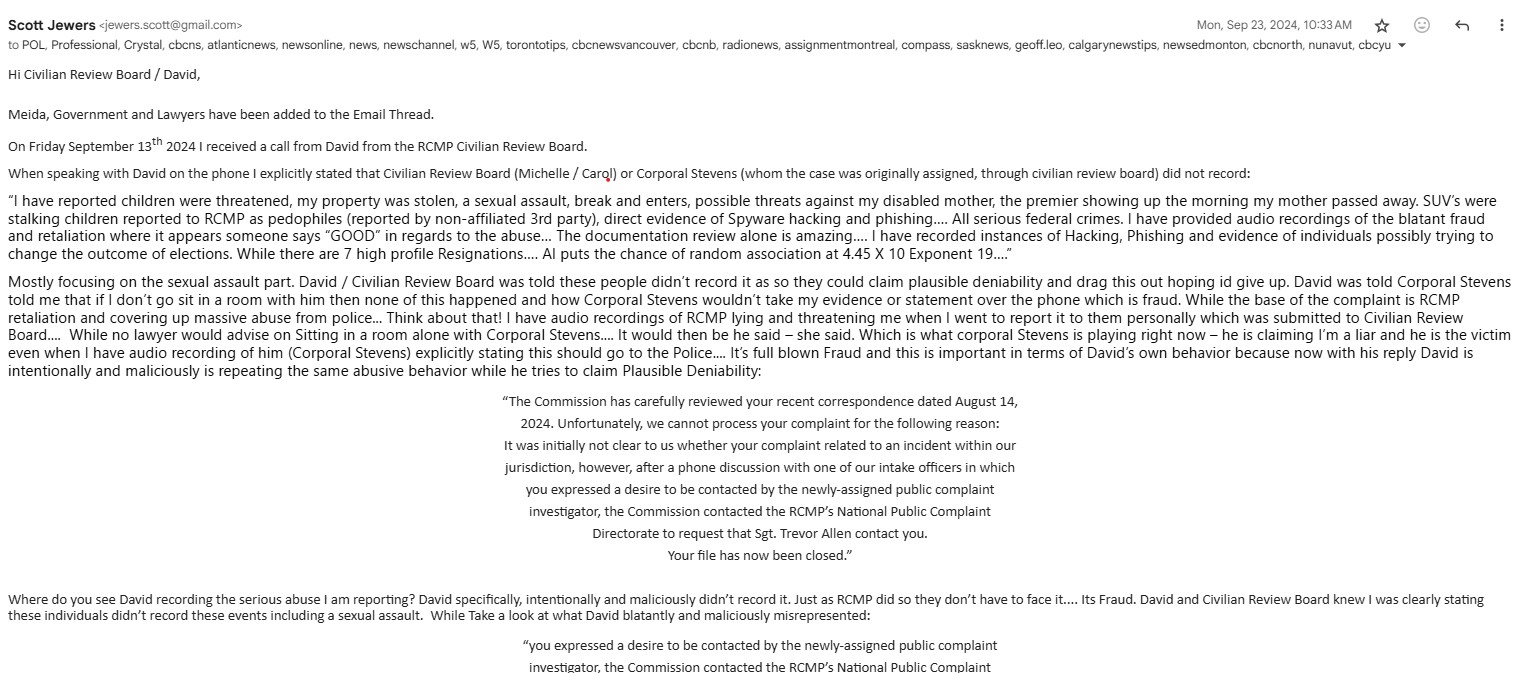
Short URL: https://tinyurl.com/2uk3dbaj
David October 7, 2024 – Repeated Omission and File Closure
On or about October 7, 2024, I received a further response from the CRCC, signed by David, acknowledging receipt of a subsequent submission. However, once again, there was no reference to the reported sexual assault or the broader abuse that had been clearly outlined in prior communications.
Instead, the matter was procedurally merged and closed without addressing the substance of the complaint.
This is critical. By this point:
- The allegation had been clearly reported;
- The omission had been explicitly identified in writing;
- The CRCC had been given an opportunity to correct the record.
Despite this, the same omission was repeated, and the file was closed again without acknowledgment.
Copy of the email from David:
“Good morning Scott Jewers,
The Civilian Review and Complaints Commission acknowledges receipt of your online form submission, R2024-005448, dated October 3, 2024. Please be advised that your online submission, R2024-005448, has been merged into file 2024-3291, which is closed. Additionally, kindly note that the Commission is a separate federal agency from the RCMP. Victim services does not report to this Commission, but we will pass along your request to be contacted by victim services to the RCMP.
Regards,
David”
David — CRCC Behavioural Review: Pattern of Repeated Omission and Procedural Closure
Across multiple interactions spanning August through October 2024, David of the Civilian Review and Complaints Commission demonstrated a consistent and documented pattern of conduct characterized by a failure to record, acknowledge, or act upon serious criminal allegations — including a reported sexual assault — despite being placed on explicit notice through both verbal and written communication.
This conduct is not isolated. It reflects a repeatable behavioural pattern across multiple stages of the complaint process and cannot reasonably be attributed to oversight or misunderstanding.
August 16, 2024 — Telephone Call
During a phone call in which I clearly described the reported abuse — including the sexual assault — along with broader concerns involving retaliation, institutional misconduct, and potential criminal activity, David:
- Failed to document the substance of what was reported
- Dismissed prior omissions by Carole without review, stating: “Carole wouldn’t do that”
- Repeated the same conduct he had just been asked to address
- Participated in closing the file without meaningful acknowledgment of the core allegations
The dismissal of Carole’s prior omissions is particularly significant. Rather than assessing whether those omissions had occurred, David rejected the concern outright and proceeded to replicate the same conduct. This establishes from the outset that the failure was not incidental, but behavioural.
September 23, 2024 — Written Notice
Following explicit written correspondence in which I identified, in direct and unambiguous terms, that a sexual assault and multiple serious criminal matters had been reported but not recorded, David and the CRCC:
- Took no corrective action
- Produced no amended or supplemental record
- Provided no acknowledgment of the omitted allegations
- Continued to rely on a record already identified as materially deficient
At this stage, any possibility of misunderstanding was removed. The omission became a documented and knowing failure to act. David had been placed on clear written notice and did not correct the record.
October 7, 2024 — Second File Closure
In a follow-up response, David:
- Merged a subsequent submission into an already closed file without addressing its substance
- Made no reference to the reported sexual assault or the previously identified omissions
- Took no corrective action despite multiple prior opportunities
- Closed the matter again on purely procedural grounds
By this point, the allegation had been clearly reported, the omission had been explicitly identified in writing, and multiple opportunities to correct the record had been provided. None were acted upon.
Behavioural Pattern Identified
David’s conduct across these interactions establishes a consistent and repeatable behavioural pattern:
- Dismissal — rejecting or minimizing concerns about prior omissions without review
- Non-documentation — failing to record serious allegations explicitly communicated both verbally and in writing
- Procedural substitution — relying on administrative closure in place of substantive assessment
- Repetition after notice — continuing the same conduct after explicit written clarification
Conclusion
The cumulative effect of this conduct is the creation and maintenance of an official record that omits material facts that were:
- Clearly reported
- Clearly identified as missing
- Clearly left uncorrected — across multiple interactions and multiple opportunities to act
This reflects a continued and knowing omission of material information, resulting in a record that is substantively deficient, inaccurate, and unreliable for the purposes of review, oversight, or accountability.
Paul CRCC
October 30, 2024 — CRCC Manager Paul Responds to Concerns Regarding Prior Handling by David and Carole
On October 30, 2024, Paul of the Civilian Review and Complaints Commission (CRCC) responded to my prior submissions and sent approximately five pages of questions regarding my complaint. This correspondence was issued with full awareness that the existing email thread included media organizations, legal firms, oversight bodies, political representatives, and all provincial and territorial premiers.
The volume and scope of the questions demonstrate that the matters under review were complex, detailed, and required substantive engagement. At this stage, the CRCC had already been placed on notice regarding serious allegations, including sexual assault and broader institutional misconduct.
In his correspondence, Paul confirmed that he had reviewed multiple related files and submissions, stating:
"Good afternoon Scott Jewers. My name is Paul and I am a manager of the Commission's intake office. I have read your October 22, 2024 submission, R2024-005807, along with CRCC files 2024-3291 and 2023-1031."
This confirmation is significant. It establishes that Paul was fully aware of the broader record — including prior submissions and complaint files — at the time of his involvement. His participation therefore occurred with full visibility into both the substance of the allegations and the previously identified issues regarding omissions and handling by CRCC staff.
Questions Posed by CRCC — October 30, 2024
Paul's correspondence posed the following questions, each corresponding to a serious allegation that had been previously reported:
- You stated that you reported that children were threatened.
- You stated that you reported that your property was stolen.
- You stated that you reported a sexual assault.
- You stated that you reported break and enters.
- You stated that you reported possible threats against your disabled mother.
- You stated that you reported the premier showing up the morning your mother passed away. The Commission expressed its sincere condolences on the passing of your mother.
- You stated that SUVs were stalking children reported to RCMP as pedophiles, as reported by a non-affiliated third party.
- You appear to have stated that you reported evidence of spyware hacking and phishing.
- You stated that you had recorded instances of hacking, phishing, and evidence of individuals possibly trying to change the outcome of elections.
The inclusion of Question 3 — the reported sexual assault — is particularly significant. At this stage, Paul had explicitly identified the sexual assault as a matter requiring response and clarification. This places him on direct and documented notice that the allegation existed, had been reported, and required substantive engagement. What followed from this point forward must be assessed in that context.
May 10, 2025 — Detailed Responses Submitted to CRCC Manager Paul
Jump to Index
On May 10, 2025, at approximately 1:48 PM, I submitted a 51-page, evidence-based response directly to Paul (CRCC Intake Manager) and the CRCC office. This submission was provided in direct response to the approximately five pages of questions issued by Paul on October 30, 2024. Paul confirmed receipt of the submission at 9:24 PM the same day.
The document was structured, chronologically ordered, and fully cross-referenced. It contained detailed, verifiable evidence addressing each question raised, and was prepared in direct compliance with the CRCC’s request for clarification and supporting information.
Critically, the submission included direct, sworn-ready answers to Paul’s specific questions regarding the reported sexual assault, including:
- The identity of those functionally responsible, by role and location
- The date of the assault — August 3, 2022
- The location — Mount Hope Hospital, Halifax, following a false arrest
- A full list of RCMP members and officials to whom the assault had been reported, dating back to the night of August 3, 2022
- Specific allegations of RCMP misconduct in response to the report, including refusal to open a file, mockery, stalking, and intimidation
This was not a generalized allegation. It was a fully particularized account, tied to a specific date, location, sequence of reporting, and identifiable actors.
The submission also directly rebutted the narratives advanced by:
- Sergeant Jeff Stevens
- Sergeant Trevor Allen
- Inspector Cory Bushell
- Ignatius Hall
These rebuttals were supported by verifiable records, internal inconsistencies, and documentary evidence, demonstrating that prior conclusions and characterizations relied on incomplete or inaccurate representations of the record.
In addition, the submission clearly documented the basis for the request to communicate remotely. This was not a refusal to cooperate, but a safety-based accommodation, grounded in:
- prior retaliation following in-person engagement;
- documented intimidation and harassment;
- and a reasonable apprehension of further harm.
This context had already been provided to the CRCC in writing. Any subsequent characterization of this position as “non-cooperation” omits and misrepresents material facts already on record.
All supporting materials were made fully accessible at the time of submission:
- Full Document: https://thewolfandtheneuralnetwork.com/Media/Resources/Added_2025_06/2025-05-10_CRCC_Detailed_Submission/2025-05-10_CRCC-Detailed-Submission_TWNN-Final.docx
- TinyURL (Document): https://tinyurl.com/rfwwuhb8
- TinyURL (HTML): https://tinyurl.com/3kuxmvc5
- TinyURL (Google Doc): https://tinyurl.com/jv2xmks5
Significance
This submission represents a critical evidentiary threshold in the complaint process.
From May 10, 2025 onward:
- The CRCC — and specifically Paul — had received a complete, structured, and evidence-backed response
- The reported sexual assault had been fully particularized (date, location, reporting chain, and conduct)
- The CRCC’s own questions had been answered directly and in full
- Supporting documentation, including cross-referenced materials and prior reports, had been made accessible and verifiable
This eliminates any basis for:
- misunderstanding;
- lack of detail;
- or inability to assess the allegation.
The issue from this point forward is not whether sufficient information was provided — it clearly was — but how that information was handled.
Post-Submission Conduct
Following confirmed receipt of this submission, Paul did not provide a substantive response for over eight months.
There was:
- No acknowledgment of the substance of the answers provided
- No indication of investigative steps taken
- No clarification requests or follow-up questions
- No correction to the existing record
Conclusion
The May 10, 2025 submission was a direct, complete, and compliant response to the CRCC’s formal request for information. It provided a detailed, evidence-backed account of the reported sexual assault and related misconduct, addressing each question posed in a clear and verifiable manner.
From that point onward, the CRCC — and specifically Paul — was in possession of:
- a fully articulated allegation;
- supporting evidence;
- and a structured response to their own inquiries.
Any subsequent failure to acknowledge, document, or act upon that information must be assessed in that context.
Paul — CRCC: Summary of Conduct February 10 to April 8, 2026
Before the chronological record begins, the structural context must be understood. Paul responded on February 10, 2026 — two days before the CRCC Review's 120-business-day service standard deadline. It is reasonable to conclude the review had already been internally completed, and that Paul was aware of this. He was also aware that no Chairperson had been appointed to the CRCC, meaning both files would remain in effective limbo indefinitely — inaccessible without significant legal resources — while the institution continued to attribute responsibility to the complainant.
The critical structural problem Paul faced at this stage was the existence of two irreconcilable files. File R2024-005807 contained the full evidentiary record — including the fully particularized sexual assault, the 51-page submission, and Paul's own October 30, 2024 questions directly addressing that allegation. File 2023-1031 — the file the CRCC Review was based on — contained Carole's IPTA-anchored intake record, which omitted the sexual assault entirely. Any mismatch between these two files would create serious problems for all parties involved. As long as an external summary could be maintained in which Scott Jewers was framed as the issue, file R2024-005807 would not undermine the findings in 2023-1031. If that framing failed, it would.
What follows documents how Paul managed that problem — and how he progressively lost control of the narrative through increasingly procedural and dismissive conduct.
February 10, 2026
Paul responded to the complaint file for the first time in over eight months — two days before the CRCC Review's 120-business-day service standard deadline. The response did not answer any of the outstanding questions from the May 10, 2025 submission. Instead, Paul reprimanded the complainant for biweekly follow-up communications requesting updates and escalation.
February 21, 2026
Multiple complaints were submitted against distinct officers.
February 25, 2026
Paul advised that the newly submitted complaints would be merged into a single file. Consolidating distinct complaints creates a structure where they can be dismissed collectively rather than assessed on individual merit — a consequence that is difficult to characterize as incidental given what followed.
March 5, 2026
Specific officer details were requested.
March 16, 2026
Requested details were provided, including audio recordings, transcripts, and linked evidence.
March 17, 2026
Paul responded but did not engage with the submitted material. He questioned the relevance of the CSIS case reference on the basis that its status could not be confirmed — despite that reference appearing consistently in the record since May 10, 2025, including through the formal address Attachment5566@smtp.gc.ca, and despite CSIS having been an active recipient on the correspondence thread throughout. Treating established, consistently referenced material as unverifiable at this stage reflects minimization, not neutral assessment.
March 18, 2026
Clarification was requested before full answers could be provided.
March 20, 2026
Paul characterized the request for clarification as a refusal to engage and advised the process would proceed regardless — a mischaracterization that effectively advanced the file while outstanding questions remained unaddressed. When this was raised the same day — along with evidence the CRCC was already outside its service standard and supporting analytic material — Paul responded by requesting that images not be included in future correspondence.
March 23, 2026
A structured response of approximately 60 pages was submitted, including a clearly indexed three-page section directly answering Paul's questions. The correspondence thread was simultaneously expanded to include RCMP Commissioners Mike Duheme and Dennis Daley. Following an automatic reply indicating Daley's retirement, correspondence was redirected to C/Supt. Dan Morrow and Executive Assistant Jana Caines, raising conflict of interest concerns and inquiring about RCMP file 2025-21595, which had remained open for over a year without action.
March 27, 2026
The formal CPSNS complaint was submitted, outlining the reported sexual assault, medical record discrepancies, privacy breaches, and the Cox & Palmer conflict of interest. It was distributed to 127 recipients including RCMP and health officials.
March 30, 2026
The CRCC responded by requesting that no further emails be sent unless specifically requested. This request was applied to the March 27 CPSNS submission, which contained material directly relevant to the matters under review and consistent with evidence the CRCC had previously relied upon.
April 7, 2026
A comprehensive HRP complaint was submitted covering the false arrest, fabrication of evidence, procedural failures, and suppression of the reported sexual assault. Copies were distributed to RCMP, government officials, media, and CSIS under Attachment 5566. The submission engaged directly with IPTA-related evidence that both the CRCC and RCMP had relied upon throughout — material plainly within the scope of the ongoing review.
April 8, 2026
Concerns were formally raised with Paul regarding omissions, mischaracterization, and failure to act on key evidence, including the reported sexual assault. Escalation was requested and notice was given that a criminal complaint would be pursued. The CRCC Review unit replied the same day, requesting that the complainant limit all future correspondence to the CRCC alone and exclude all other parties.
The effect of that request, if followed, would be to eliminate the external record that makes concealment difficult. The broad distribution of correspondence — to media, legal counsel, government, and law enforcement, including confirmed delivery to RCMP Commissioner Dennis Daley and other senior officials — ensures the record exists independently of what the CRCC chooses to document internally. Delivery confirmations establish that recipients were aware. That awareness cannot be selectively disclaimed.
April 13, 2026
No further substantive response, corrective action, or acknowledgment of the reported sexual assault had been received from Paul or the CRCC as of this date.
What This Period Establishes
The correspondence between February and April 2026 demonstrates how Paul managed the process once it became clear the review was concluding. The pattern is consistent with everything that preceded it:
- A 51-page submission answering his own questions received no substantive response for over eight months
- When he did respond, it was to reprimand rather than engage
- Clarification requests were reframed as non-cooperation
- Established evidence was treated as unverifiable
- Complaints were merged to reduce individual assessment
- Correspondence was restricted to limit external visibility
- The reported sexual assault remained unacknowledged throughout
This position is directly contradicted by the CRCC's own transmission records. The sexual assault, GPS data, threats, election interference, Tim Houston's presence at the hospital, and related matters were present in materials formally transmitted to the RCMP from early 2023 onward — transmissions the CRCC itself confirmed. Sergeant Stevens, the initial assigned investigator for file 2023-1031, is on audio recording discussing these matters directly. Treating these issues as out of scope is not a neutral procedural determination. It is the direct result of Carole's April 12, 2023 intake record — which Paul was fully aware of, had reviewed in detail, and chose not to correct.
Paul — CRCC Behavioural Review: Pattern of Procedural Maneuver and Substantive Avoidance
Across interactions spanning October 2024 through April 2026, Paul of the Civilian Review and Complaints Commission demonstrated a consistent and documented pattern of procedural substitution over substantive engagement — managing the appearance of process while systematically avoiding the substance of what had been reported, including a violent sexual assault that remained uninvestigated throughout.
This conduct is not isolated. It reflects a repeatable behavioural pattern that intensified as the evidentiary record became complete, particularized, and no longer ambiguous.
October 30, 2024 — Initial Engagement
Paul entered the file with full awareness of its scope. He confirmed review of multiple related files, including submissions R2024-005807, 2024-3291, and 2023-1031, and issued approximately five pages of questions.
This establishes:
- Full visibility into prior omissions by Carole and David
- A clear expectation of substantive engagement
- Direct engagement with the sexual assault allegation (Question 3)
At this stage, engagement was active and substantive — demonstrating both capacity and jurisdiction to address the issues raised. The issuance of detailed questions, including one directly addressing the sexual assault, makes any subsequent non-engagement a matter of choice, not limitation.
May 10, 2025 — 51-Page Evidenced Response Submitted (Critical Threshold)
A structured, 51-page, evidence-based submission was provided in direct response to Paul’s questions. Paul confirmed receipt the same day.
This submission:
- Fully answered every question posed, including Question 3 (sexual assault)
- Provided a complete, particularized account:
- Date: August 3, 2022
- Location: Mount Hope Hospital, Halifax
- Full reporting chain to RCMP
- Specific misconduct in response (refusal to open a file, mockery, stalking, intimidation)
- Included verifiable, cross-referenced evidence
- Rebutted prior narratives (Stevens, Allen, Bushell, Hall)
- Documented safety-based reasons for remote communication
This represents a critical evidentiary threshold:
- The allegation was no longer general — it was fully particularized
- The CRCC’s own questions had been answered directly and completely
- All ambiguity was removed
Paul himself posed the question regarding the sexual assault. He received a complete and particularized answer. He did not respond for over eight months.
From this point forward, the issue is not whether sufficient information existed —
it is how that information was handled.
February 10, 2026 — Response at Service Standard Threshold
Paul’s next substantive communication occurred on February 10, 2026 — two days before the CRCC Review’s 120-business-day service standard would have been exceeded.
This timing is material and indicative of deadline-driven procedural management rather than active investigative engagement.
In that response, Paul:
- Did not acknowledge the reported sexual assault
- Did not engage with the 51-page submission or its answers
- Reframed follow-up communications as misconduct
- Took no corrective action on any known omission
At this stage, Paul was in possession of a complete evidentiary record and chose not to engage with it.
He was also aware at this point that no Chairperson had been appointed to the CRCC, meaning both files would remain in effective limbo indefinitely — with no active oversight and no meaningful accountability.
February–April 2026 — Escalation and Procedural Control
As the evidentiary record expanded and external distribution increased, Paul’s conduct shifted from passive non-engagement to active procedural control:
- File merging — consolidating distinct complaints, reducing the basis for individual assessment
- Non-engagement with evidence — ignoring transcripts, audio, and structured submissions
- Reframing — characterizing clarification as non-cooperation
- Minimization — treating established evidence as uncertain when inconvenient
- Communication restriction — attempting to limit distribution and external visibility
The cumulative effect of these actions is the containment and control of the record rather than its assessment.
Behavioural Pattern Identified
Paul’s conduct establishes a consistent and repeatable behavioural pattern:
- Strategic delay — an eight-month non-response following receipt of a complete, particularized, evidenced submission that directly answered his own questions, broken only two days before a service standard violation
- Procedural substitution — reliance on administrative process, merging, and deadline management in place of substantive assessment
- Evidentiary avoidance — failure to engage with fully particularized allegations after all ambiguity had been removed
- Mischaracterization — reframing cooperation as obstruction, and reframing legitimate follow-up as misconduct
- Narrative control — attempting to limit external visibility of the record through restrictions on correspondence and distribution
- Repetition after threshold — continued omission of the reported sexual assault after having asked about it directly, received a complete answer, and been placed on explicit written notice on multiple subsequent occasions
Conclusion
The May 10, 2025 submission marked the point at which the complaint was:
- fully articulated;
- fully evidenced;
- and directly responsive to CRCC inquiries.
From that point forward, the continued absence of acknowledgment or action cannot reasonably be attributed to:
- lack of detail;
- misunderstanding;
- or procedural limitation.
Instead, the record demonstrates a clear transition from inquiry to avoidance.
Paul’s conduct reflects not a failure to obtain information, but a failure to engage with information already obtained, resulting in a process that maintained procedural form while avoiding substantive review.
June 6, 2025 — Assigned Investigator Response (Cory Bushell, Trevor Allen, Ignatius Hall)
July 9, 2025 — Formal Response to Assigned Investigator Findings (Cory Bushell, Trevor Allen and Ignatius Hall)
Full HTML Version of Review / Rebuttal: https://www.thewolfandtheneuralnetwork.com/HTMLDocuments/July9th2025_Response_to_RCMP_June-6_Letter_and_CRCC_Investigation_Request.html
Short URL: https://tinyurl.com/7ckd6v3p
YouTube Video of Review, walking through Document:
S4E5 Call to RCMP The Fraud of Cory Bushell and the CRCC Review of False Arrest – March 13th 2023 – https://www.youtube.com/watch?v=EkbkumKe-Hs
The July 9, 2025 submission is a comprehensive, evidence-based rebuttal to the RCMP’s June 6, 2025 response issued by Inspector Cory Bushell, Sergeant Trevor Allen, and Ignatius Hall. It demonstrates that the RCMP’s conclusions were formed without properly reviewing or incorporating the existing evidentiary record, including the 51-page CRCC submission provided on May 10, 2025.
The response identifies a consistent pattern of omission, misrepresentation, and procedural failure, including:
- Failure to Review Evidence:
The RCMP Final Report was issued approximately 25 days after a comprehensive evidentiary submission, with no indication that the material was reviewed, referenced, or incorporated. - Lack of Direct Engagement:
Assigned investigators, including Sergeant Trevor Allen, did not contact the complainant despite CRCC direction to do so, undermining the validity of the investigative process. - Fabricated or Unsupported Allegations:
The RCMP report includes claims and statements that were never made by the complainant, including misattributed quotes and allegations, with no cited source or supporting evidence. - Mischaracterization of Cooperation:
The report portrays the complainant as uncooperative, despite extensive documented efforts to provide evidence, maintain communication, and request formal investigation through appropriate channels. - Procedural Irregularities and Conflicts:
The investigation relied on prior conflicted personnel and failed to conduct independent verification after reassignment, raising concerns about the integrity and independence of the findings. - Omission of Core Allegations:
Key elements of the complaint — including reported abuse and sexual assault — were not addressed in the RCMP response, despite being clearly documented and repeatedly raised. - Systemic Breakdown in CRCC–RCMP Coordination:
The evidence indicates a disconnect between CRCC submissions and RCMP investigative actions, resulting in parallel records — one evidence-rich and one materially incomplete.
The July 9 response concludes that the RCMP’s June 6 findings are not supported by the evidentiary record and were produced through a process that failed to meet basic standards of investigative fairness, accuracy, and completeness. It calls for correction of the record, independent review, and formal accountability for the conduct identified.
Summary of the document:
Full HTML summary version URL: https://www.thewolfandtheneuralnetwork.com/HTMLDocuments/July9th2025_Summary%20Call%20to%20RCMP%20The%20Fraud%20of%20Cory%20Bushell%20and%20the%20CRCC%20Review%20of%20False%20Arrest%20March%2013th%202023.docx.html
Short HTML summary URL: https://tinyurl.com/bp82azhb
Cory Bushell and Trevor Allen — RCMP Behavioural Review: Pattern of Omission, Fabrication, and Procedural Failure
The conduct of Inspector Cory Bushell and Sergeant Trevor Allen, in their capacity as assigned investigators responding to the CRCC-referred complaint, reflects a consistent and documented pattern of procedural form over substantive review — producing findings that were not supported by the evidentiary record and were generated through a process that failed basic standards of investigative fairness, accuracy, and completeness.
This conduct did not occur in isolation. It mirrors and reinforces the same structural pattern identified in the conduct of Carole, David, and Paul — and operates within the same institutional framework in which serious allegations, including a reported sexual assault, were repeatedly raised and repeatedly left unaddressed.
The Critical Context: What Was Available Before the Report Was Issued
Before assessing the conduct of Bushell and Allen, the evidentiary threshold established prior to their June 6, 2025 report must be understood. By May 10, 2025 — just 25 days before the report was issued — a 51-page, evidence-based submission had been provided to the CRCC that:
- Fully particularized the reported sexual assault (date, location, reporting chain, and specific misconduct in response)
- Cross-referenced verifiable supporting materials across a publicly accessible website containing over 900 documented data points and more than 77 video exhibits
- Directly and proactively rebutted the narratives later advanced by Bushell, Allen, and Hall — by name
- Was confirmed received by Paul at the CRCC the same day
Additionally, on May 3, 2025, a documented phone call was placed to RCMP Special Victims Unit investigators Shelly Mews and Curt Wallace under Case Number 2025-21595, during which detailed evidence was provided, including audio recordings. This call is publicly documented.
There is no indication in the June 6, 2025 RCMP response that any of this material was reviewed, referenced, or incorporated. The report was issued 25 days after the 51-page submission, on a file that had been open for approximately 800 days.
June 6, 2025 — RCMP Final Response: Specific Failures
1. Failure to Contact the Complainant
Sergeant Trevor Allen did not contact the complainant at any point — despite the CRCC explicitly directing him to do so. The CRCC's own correspondence confirmed: "the Commission contacted the RCMP's National Public Complaint Directorate to request that Sgt. Trevor Allen contact you." No such contact occurred. A Final Report was nonetheless issued implying due process had been followed. This constitutes a breach of procedural fairness and a misrepresentation of the investigative process.
2. Reliance on a Conflicted Prior Record Without Independent Verification
The investigation was reassigned to Allen specifically because Sergeant Jeff Stevens represented a conflict of interest — a fact the CRCC formally acknowledged in January 2024. Despite this, Allen's report relied substantially on Stevens' prior characterizations without conducting any independent verification. Adopting the narrative of a conflicted investigator, without direct contact or independent review, does not constitute a reassignment — it is a continuation of the same conflicted process under a different name.
3. Fabrication of Claims Never Made
The RCMP Final Report includes allegations and attributed statements that were never made by the complainant. Specifically:
- Allegation #2 — Bias Based on Sexual Orientation — This allegation is completely fabricated. Across hundreds of pages of formal submissions, three published versions of The Wolf and the Neural Network, over 900 cross-referenced data points, and more than 77 video exhibits, no claim of discrimination based on sexual orientation appears. It does not exist because it was never made. Its inclusion in an official investigative report — without source, citation, or basis — raises serious questions about whether it was inserted to reframe the complaint into a simpler, more dismissible category.
- Fabricated Quote Attributed to the Complainant — The report attributes a specific statement to the complainant regarding Corporal Welke that was never made. The actual call referenced occurred on May 24, 2023, was recorded, was made publicly available, and was provided directly to the CRCC and Sergeant Stevens. The content of that recording directly contradicts the characterization in the report. The inclusion of fabricated quotes in an official investigative document, without citation or sourcing, is not a procedural error. It is a material misrepresentation of the record.
4. Characterization of Evidence as "Repetitive, Disjointed, and Difficult to Follow"
Allen's report characterized the complainant's submissions as "very repetitive, disjointed, and difficult to follow." At the time that assessment was made, the publicly available evidentiary record included over 400 meticulously organized, hyperlinked data points and more than 40 detailed videos — all timestamped, structured, and available for immediate review. The report cites not a single specific example to support this characterization. Unsupported dismissal of a structured, cross-referenced evidentiary record as incoherent, without identifying a single instance of incoherence, is not analysis. It is defamation.
5. Mischaracterization of Cooperation as Non-Cooperation
The report portrays the complainant as uncooperative. This is directly contradicted by the documented record. The request to conduct proceedings remotely was not a refusal — it was a safety-based accommodation, grounded in documented retaliation and prior intimidation. This reasoning had been clearly communicated and was on record. Furthermore, Sergeant Stevens' own response to the request — "It never happened unless we met in person" — constitutes coercive conduct, not a reasonable investigative accommodation. The RCMP's own Final Report acknowledges the complainant continued to submit evidence and maintain contact throughout — then uses that same record to portray them as obstructive.
6. Omission of the Central Allegation
The reported sexual assault — fully particularized in the May 10, 2025 submission with a specific date (August 3, 2022), location (Mount Hope Hospital, Halifax), full reporting chain, and identified misconduct — does not appear in the RCMP Final Report. This is not incidental. It is the central allegation of the complaint. Its omission from the findings of a report issued 25 days after it was fully particularized in writing is a substantive failure that cannot be characterized as oversight.
7. Omission of the Website and Public Evidentiary Record
The RCMP Final Report makes no mention of The Wolf and the Neural Network — a publicly accessible, structured evidentiary record that was explicitly referenced and provided throughout the complaint process. Its complete absence from the findings suggests the report was produced without reviewing the most comprehensive and organized evidentiary source available.
Behavioural Pattern Identified
The conduct of Bushell and Allen across this process establishes a consistent and documentable pattern:
- Evidentiary bypass — producing a Final Report without engaging with the most comprehensive submission in the file, issued just 25 days prior, and making no reference to a publicly accessible evidentiary record of over 900 data points
- Non-contact — failing to contact the complainant despite explicit CRCC direction, then issuing findings that imply due process occurred
- Fabrication — including in official findings both a wholly invented allegation (sexual orientation bias) and a fabricated quote attributed to the complainant, neither of which has a cited source or basis in the record
- Institutional reliance — adopting the narrative of a formally conflicted investigator without independent verification, rendering the reassignment procedurally meaningless
- Defamatory characterization — dismissing a structured, cross-referenced, publicly available evidentiary record as incoherent without citing a single supporting example
- Mischaracterization of cooperation — reframing a documented, safety-based request for remote engagement as non-cooperation, while the RCMP's own report confirms the complainant remained actively engaged throughout
- Omission of the central allegation — excluding the reported sexual assault from the findings despite it being fully particularized in writing 25 days before the report was issued
Conclusion
The June 6, 2025 RCMP response does not reflect a good-faith assessment of the evidentiary record. It reflects a process in which conclusions appear to have been reached prior to — or independent of — the evidence available, and in which the most serious allegation in the complaint was excluded from the findings entirely.
The fabrication of claims never made by the complainant — including an invented allegation and an attributed quote contradicted by a recorded and publicly available call — moves this beyond procedural failure. It raises the question of whether the report was produced with the intent to misrepresent the record, discredit the complainant, and provide institutional cover for conduct that had already been documented and reported.
The pattern identified in Bushell and Allen's conduct is not distinct from the pattern identified in the conduct of Carole, David, and Paul. It is the continuation of it — operating at the investigative level rather than the intake level, but producing the same outcome: a record that omits material facts, misrepresents the complainant's conduct, attributes statements never made, and leaves the central allegation entirely unaddressed.
CRCC Review — Case 2023-1031 Accepted July 17, 2025
July 17, 2025 CRCC Review replied (Reviews@crcc-ccetp.gc.ca) stated thier Review team would be investigating and provided general resources on the process.
CRCC Service Standard Exceeded
The CRCC's stated service standard is 120 business days to complete a review following receipt of RCMP materials: https://crcc-ccetp.gc.ca/en/services/service-standards
On April 8, 2026, the CRCC confirmed that the RCMP response was received on August 20, 2025. From August 20, 2025 to April 8, 2026 represents 157 business days (231 calendar days) — placing the review 37 business days beyond the CRCC's own stated standard.
July 17, 2025 – February 10, 2026 — Absence of Updates on Files 2023-1031 and R2024-005807
July 17, 2025 CRCC Review replied (Reviews@crcc-ccetp.gc.ca) stated thier Review team would be investigating and provided general resources on the process.
From July 17, 2025 to February 10, 2026 — a total of 143 business days (209 calendar days) — there was no substantive response from Paul or the CRCC Review Unit.
During this period, I submitted follow-up communications on the following dates: August 7, August 21, August 28, September 5, September 11, September 16, September 25, October 2, October 9, October 18, October 23, October 31, November 6, and December 16, 2025, and January 7 and January 23, 2026.
October 18, 2025 (To CRCC) — Submitted a follow-up addressing the excessive timeframe, including statistical evidence showing website traffic spikes originating from multiple countries that occurred specifically when emailing the CRCC via the main email thread.
October 23, 2025 (To CRCC) — Submitted general follow-up questions and a timeline summary. Also reported further testing of the analytic spikes, noting that while some spikes were predictable, others were not; staggering posts caused spikes to separate, suggesting they may not originate from a single source.
December 16, 2025 (To CRCC) — Highlighted concerns regarding CRCC and RCMP inaction and provided the video S4E6: Deep Dive into False Arrest, Torture, and Sexual Assault on August 2, 2022 (2:34:02): https://www.youtube.com/watch?v=KOE2qzYTpng
January 7, 2026 (To CRCC) — Submitted a detailed follow-up and included the video S4E7: Deep Dive of Police Abuse / Cover-Up of Sexual Assault / Connecting Postmedia to the Mueller Report (2:25:54): https://www.youtube.com/watch?v=JzMIxrZlHNc
To further isolate and test the analytic spikes, social media posting was staggered across weekends and late evenings — including weekday late-night intervals — to rule out out-of-office and time-zone effects. No updates were made to the website during this period.
In December 2025, a major website update was completed and servers were migrated to Canada. For a brief period following the migration, the anomalous connections ceased, then resumed — suggesting either IP-based polling or a change in strategy by the connecting source. The migration was also intended to provide CSIS with direct access and to facilitate comparative review with U.S. authorities. Supporting Google Analytics screenshots and a technical review were provided. Traffic appeared to originate from Canada, China, Singapore, Brazil, the United States, and other countries.
These spikes were traced back to August 7, 2022, coinciding with the date follow-up requests to the CRCC began.
It should be noted that Attachment5566@smtp.gc.ca — a direct connection to CSIS — had been added to the thread for monitoring purposes throughout this period.
This represents 16 follow-ups over 208 days, averaging approximately one every 13 days. This interval is consistent with standard professional practice and is particularly reasonable given that the follow-ups served a dual purpose: maintaining communication with the CRCC while simultaneously gathering analytical data for submission to the RCMP and CSIS. The matters raised throughout this period involve national security concerns, sexual assault, and ongoing public safety issues — and were met with continued silence.
February 10, 2026 — Paul's Response
When Paul did respond on February 10, 2026, he failed to address a single follow-up question or confirm whether the matter had been escalated. Rather than engaging with the substance of the communications, he reprimanded me for sending follow-ups and removed context from the record describing the referenced videos as detailed accounts of the sexual assault and abuse. This response — after 143 business days of silence — served to minimize the record rather than advance the review.
CRCC Service Standard Exceeded
The CRCC's stated service standard is 120 business days to complete a review following receipt of RCMP materials: https://crcc-ccetp.gc.ca/en/services/service-standards
On April 8, 2026, the CRCC confirmed that the RCMP response was received on August 20, 2025. From August 20, 2025 to April 8, 2026 represents 157 business days (231 calendar days) — placing the review 37 business days beyond the CRCC's own stated standard.
February through March 2026 — Mischaracterization, Merging of Complaints, and Procedural Obstruction
On February 21, 2026, complaints were submitted against seven additional RCMP officers across multiple detachments. On February 24, 2026, Paul advised the Commission had merged them into the existing file R2024-005807 under s. 45.68 of the RCMP Act — a decision that created a structure where all complaints against all officers could be assessed and potentially dismissed collectively, rather than individually on their own facts.
On March 5, 2026, the CRCC requested specific details regarding the allegations against each named officer. On March 9, 2026, a copy of the submitted complaint was requested due to a technical error during submission, which the CRCC provided on March 11. A detailed submission addressing each officer individually was provided on March 16, 2026 — totalling approximately 48 pages covering 14 officers, with corresponding audio recordings.
On March 17, 2026, Paul responded. Rather than engaging with the substance of the submission, he focused on a date discrepancy regarding the RCMP letter, reiterated that video and audio evidence are not typically accepted at the intake stage, and characterized the CSIS case reference as being of unknown relevance — a position directly contradicted by the Commission's own prior correspondence, which had explicitly referenced EMIC, the sexual assault allegation, and election interference concerns on multiple prior occasions.
On March 18, 2026, before answering Paul’s questions, written answers were formally requested to three outstanding procedural matters that had been raised repeatedly and remained unanswered: whether the July 9, 2025 rebuttal had been applied to file 2023-1031; why no one had contacted the complainant about a violent sexual assault that had been in the CRCC's own written record since July 27, 2023; and what the mandated timeframe was for the review process under file 2023-1031. Paul’s response on March 20, 2026 mischaracterized this conditional request as a refusal to answer — stating that “it is your decision whether or not you wish to reply” — when the correspondence had explicitly stated the intent to answer once the procedural questions were addressed.
On March 20, 2026, Paul separately objected to an attached Google Analytics image showing 446 active users monitoring the correspondence thread, requesting that it not be included. His response did not engage with the substantive concerns, but did contain one significant written admission: that the sexual assault allegation and a number of other concerns raised were not mentioned in the RCMP's final report for file 2023-1031 — the CRCC’s own intake manager confirming in writing that the RCMP’s report was materially incomplete.
On March 23, 2026, a formal submission was distributed to over 100 recipients — including every Canadian premier, major media outlets, MPs across all parties, CSIS, NSIRA, and RCMP leadership — documenting over 1,082 days of uninvestigated sexual assault, election interference concerns, fabricated records, and recorded RCMP threats. That same day, an automatic reply was received from Assistant Commissioner Dennis Daley confirming that as of March 9, 2026, he had retired and that C/Supt. Dan Morrow was acting Commanding Officer. A follow-up was immediately sent to C/Supt. Morrow and Executive Assistant Jana Caines requesting an urgent review of case 2025-21595, assigned to Shelly Mews, which had been open for over one year with no meaningful action.
On March 30, 2026, Paul from the CRCC replied:
“Good afternoon Scott Jewers. Please do not send any more unsolicited information to this Commission. If we require additional information regarding your public complaint submission, R2024-005807, we will ask for it.
Failure to abide by this request may result in restrictions being placed on your ability to communicate with this Commission.
While we can say that a public complaint will be processed, you made a number of allegations, a portion of which are still being considered as to how best to deal with them.”
The CPSNS submission of March 27, 2026 fully detailed the false arrest under the Involuntary Psychiatric Treatment Act (IPTA), the reported sexual assault, and the associated records from NSHA relating to August 2, 2022 and March 13, 2023. The same IPTA framing was relied upon by Inspector Cory Bushell and Sergeant Trevor Allen to dismiss the case in the June 4, 2025 response, and reflects the same focus used earlier by Carole of the CRCC in her April 12, 2023 summary, which is inconsistent with the underlying record of the call.
At this stage, detailed video evidence and fully cited written records had been provided. The analytics spikes referenced are associated with an ongoing national security context, including a CSIS case reference (Attachment 5566), which has been repeatedly identified in correspondence. This includes reference to the CSIS email address (Attachment5566@smtp.gc.ca) and its presence within communication threads while the RCMP had advised they were monitoring. These issues relate to reported hacking and phishing activity involving multiple entities, including legal organizations, which were raised as part of the original complaint but were not investigated by the RCMP.
This reflects a pattern of dismissive conduct and record conditioning that supports predetermined outcomes, introduces prejudice and bias into the process, and undermines procedural fairness — consistent with the approach taken by Inspector Cory Bushell and Sergeant Trevor Allen in their June 4, 2025 response.
This will be addressed in further detail in <INSERT SECTION>.
March 27, 2026 – Submitted detailed review of NSHA & CPSNS response to false arrest under IPTA August 2, 2022 and then again March 13, 2023. Intended to be used in tandem with report issues April 7, 2026 regarding HRP Professional Standards.
On March 27, 2026, a detailed 144-page complaint and supporting evidentiary record was submitted to the College of Physicians and Surgeons of Nova Scotia (CPSNS), with the Civilian Review and Complaints Commission (CRCC) included on the distribution list.
This submission outlined the full sequence of events arising from the false arrest by Halifax Regional Police on August 2, 2022, and the subsequent apprehension on March 13, 2023 under the Involuntary Psychiatric Treatment Act (IPTA), along with the resulting chain of records and institutional responses.
The complaint identified and examined the conduct of NSHA personnel including Nancy Murphy, Shante A. Blackmore, Kristen Holm, Hana Marie Weimer, and John Oguntade, as well as the handling of the matter by CPSNS officials including Crystal Morgan, Suzanne Husbands, Cindy Campbell, and Douglas Grant.
The submission documented:
- The false arrest and detention under IPTA;
- The creation and reliance on fabricated or altered medical records, including confirmed discrepancies between audio recordings and written documentation;
- A reported sexual assault while in NSHA care that was not investigated or properly recorded;
- A privacy breach involving the transfer and handling of personal belongings and sensitive information;
- The alteration of specific wording within the medical record by Kristen Holm when compared directly against recorded audio evidence.
This submission is intended to be read in conjunction with the April 7, 2026 HRP Professional Standards review, as together they provide a comprehensive, cross-institutional analysis of how IPTA was used as a central framework to justify actions, suppress allegations of sexual assault and abuse, and support conclusions reached by NSHA, CPSNS, HRP, and subsequently relied upon by the RCMP and CRCC.
April 7, 2026 – Submitted detailed review of HRP General Occurrence Report (August 2, 2022), HRP Professional Standards Form 11 response (July 7, 2023), and HRP Professional Standards review by Patrick Curran (March 22, 2024).
Full URL (HTML version): https://www.thewolfandtheneuralnetwork.com/HTMLDocuments/2026-04-07_Detailed_Complaint_HRP_Professional_Standards.html
Short URL (HTML Version): https://tinyurl.com/vdw35bda
On April 7, 2026, a detailed review was submitted addressing the HRP General Occurrence Report dated August 2, 2022, the HRP Professional Standards Form 11 response dated July 7, 2023, and the Professional Standards review issued by Patrick Curran on March 22, 2024.
This submission directly addresses the false arrest and detainment under the Involuntary Psychiatric Treatment Act (IPTA) on August 2, 2022 and March 13, 2023. These same events were relied upon by both the CRCC and the RCMP, tracing back to Carole’s record of the March 27, 2023 phone call and her subsequent report issued on April 12, 2023.
The reliance on this IPTA framing continued through the RCMP investigation into CRCC file 2023-1031. Inspector Cory Bushell and Sergeant Trevor Allen concluded their review without contacting the complainant and relied on this same characterization of events to close the case, without addressing the underlying evidence or providing an opportunity for meaningful participation in the process.
This submission is intended to be used in tandem with the CPSNS submission dated March 27, 2026. Together, these materials provide a comprehensive account and cross-review of records from all involved parties regarding the use of IPTA. This combined record demonstrates how IPTA has been relied upon by the CRCC and RCMP in a manner that supports the dismissal of reported sexual assault and abuse, while impacting the complainant’s ability to fully exercise procedural rights.
April 8, 2026 — Email to Paul (CRCC): His Conduct Cited as Reason Victims Do Not Come Forward; HR Escalation Requested
Paul,
A detailed review of the CRCC and your conduct can be found below this letter.
I need to address your conduct and the manner in which this investigation has been handled. It is clear that portions of my submissions have been selectively extracted and framed to support a narrative in which you and the CRCC are portrayed as the aggrieved party, rather than accurately reflecting the substance of what was provided and the actions taken by both you and the CRCC.
The record demonstrates a pattern of omission, mischaracterization, and failure to act on material evidence — including repeated reports of sexual assault — which raises serious concerns regarding negligence and obstruction in the handling of this matter.
Your approach raises serious concerns about how individuals reporting significant matters — particularly allegations of sexual assault and abuse — are treated within this process. The handling of this matter is precisely why victims do not come forward. The RCMP closed a case without even contacting the victim, and instead of addressing that failure, the focus of this process has been redirected toward reprimanding my communications and requests for follow-up rather than investigating the underlying conduct.
I requested updates approximately every two weeks. You did not provide a substantive response for eight months. Rather than addressing those failures, your response has been to mischaracterize my communications and reframe the record in a way that obscures them.
If a report of sexual assault were handled this way within your own office — with no action taken for over 1,000 days — it would warrant investigation by the RCMP. That same standard must apply here.
I ask directly:
- What steps did you take to engage with the officers involved?
- What steps did you take to ensure that the reported sexual assault was documented and investigated?
- What steps did you take to follow up with the CRCC Review unit?
Based on the record, these steps do not appear to have occurred. Instead, scrutiny has been directed at me, despite the fact that the underlying issues have been extensively documented and provided in a structured, independently verifiable format — including audio recordings, a CSIS case reference, and the CSIS email address present on all correspondence, with explicit direction to forward evidence for monitoring.
Have you contacted CSIS regarding this matter? Have you reported the detailed national security issues regarding EMIC and the documented GPS anomalies? There is no indication that you have. Regardless of the quantity or quality of evidence provided, every step taken by you and the CRCC has served to portray yourselves as victims of receiving emails, rather than engaging with the substance of what has been submitted — while reprimanding a victim in a matter that has now extended beyond three years.
I am formally requesting that this correspondence be placed on the record and forwarded to your HR department. I am also notifying you that I am proceeding with a formal complaint to the RCMP requesting a criminal investigation into obstruction and negligence in the handling of this matter. A copy of this correspondence, along with the full documented record, will be provided to the CRCC Review unit, media contacts, legal counsel, and the Government of Canada.
If additional victims of sexual assault come forward in connection with the matters outlined in this record, I will pursue further action and accountability with respect to any failures to act, including retaining counsel, and will pursue legal action to prevent the CRCC from inflicting this kind of abuse on other victims in the future.
A HTML Version of this letter can be found at
Full URL: https://www.thewolfandtheneuralnetwork.com/HTMLDocuments/2026-04-08_Response_Regarding_Misconduct_Of_Paul_And_CRCC.html
Short URL: https://tinyurl.com/2e63y7k7
Scott Jewers
April 8, 2026 – CRCC Review Replied with Status Update for File 2023-1031
The CRCC confirmed that:
- RCMP materials were received on or about August 20, 2025;
- The file is currently under review, with no estimated completion timeline;
- Reviews are prioritized based on perceived seriousness, and delays are expected due to volume;
- The Commission does not provide interim status updates during the review process.
Critically, the CRCC further advised that:
- No Chairperson or Commission Members are currently appointed;
- As a result, no final report or decision can be issued until a decision-maker is appointed, regardless of the status of the review.
The CRCC also stated that:
- Issues relating to sexual assault, election interference, and national security are not included within File 2023-1031 and are instead being addressed under separate complaint File R2024-005807;
- A July 9, 2025 rebuttal submission has been added to the record for consideration.
Finally, the CRCC requested that all future correspondence regarding the review file be directed only to the Commission and that additional recipients not be copied.
The review was accepted on July 17, 2025, and as of April 8, 2026, this represents approximately 181 business days (265 calendar days).
The CRCC confirmed that RCMP materials were received on or about August 20, 2025. From that date to April 8, 2026, approximately 157 business days (231 calendar days) have elapsed.
As per the CRCC’s published service standards, the Commission aims to complete reviews within 120 business days following receipt of RCMP materials (target met 80% of the time):
https://crcc-ccetp.gc.ca/en/services/service-standards
At this stage, the review is approximately 37 business days beyond the stated service standard, while the Commission has confirmed it is unable to issue a decision due to the absence of an appointed Chairperson or Members.
Here is the full email:
“Good day Scott Jewers,
The Civilian Review and Complaints Commission (the Commission) is in receipt of your email of March 19, 2026, in which you requested a status update and posed questions.
We received the RCMP's materials on or about August 20, 2025. Please note that the Commission is currently in the process of reviewing the information relevant to your complaint. We assess all requests for review so that the most serious cases are handled first. This means that some reviews may take longer than others. For this reason, we cannot estimate how long your specific review will take. Please also note that the Commission is experiencing a high volume of review requests, which may result in delays. While the Commission does not provide status updates throughout the review process, you will be notified as soon as a decision has been made.
Please be advised that, at this time, the Commission does not have a Chairperson or Members appointed by the Governor in Council. Decisions about complaints reviewed by the Commission are made by the Chairperson or Commission Members. While Commission staff is reviewing the materials relevant to your complaint and will ensure that all relevant evidence has been obtained, the Commission will not be able to issue a report about your complaint until a decision-maker is appointed.
With respect to your second question regarding "Scope of Review — Sexual Assault, Election Interference, and National Security". Please note that these issues and questions are not part of the current review file, as they are being addressed separately under the pending complaint file R2024-005807. We understand that you have been in communication with Commission staff regarding this matter. The Commission kindly asks for your continued patience while they complete their assessment of your complaint.
Please note that your July 9, 2025, Rebuttal has been added to the review file (2023-1031) for consideration.
Any future correspondence regarding your review file should be directed only to the Commission. As such, please refrain from copying multiple additional recipients in future correspondence regarding your review file.
Regards,
Program Officer
Complaint Intake and Review Directorate
Civilian Review and Complaints Commission for the RCMP | Government of Canada
Use of IPTA to Prejudice and Bias Outcomes.
A consistent issue across the handling of this complaint is the reliance on the Involuntary Psychiatric Treatment Act (IPTA) as a framing mechanism, beginning with Carole’s April 12, 2023 summary and continuing through subsequent stages of review.
In that initial summary, Carole introduced and emphasized IPTA-related context in a manner that shifted focus away from the underlying allegations — including reported abuse, failure to investigate, and attempts to open a police file — and instead framed the events primarily through a mental health lens tied to the March 2023 apprehension.
This framing was then carried forward and relied upon by later parties. In particular, the June 6, 2025 RCMP response issued by Inspector Cory Bushell and Sergeant Trevor Allen adopts a similar narrative structure, drawing from the same timeline and characterization to support its conclusions. Rather than independently assessing the full evidentiary record — including events beginning in August 2022 — the response appears to rely on the already narrowed and misaligned framing established in earlier CRCC summaries.
A similar pattern is observed in David’s involvement on August 16, 2024. Despite being directly advised of the full scope of events, including those predating March 2023, the handling of the complaint did not shift away from this IPTA-centered framing or correct the underlying timeline issues.
The result is a compounding effect:
- Carole (April 12, 2023) introduces a narrowed IPTA-based framing;
- David (August 16, 2024) does not correct or expand that framing despite direct disclosure;
- Bushell and Allen (June 6, 2025) rely on that same framing in forming their conclusions.
This continuity is significant. It demonstrates that the issue is not isolated to a single summary or report, but reflects a repeated reliance on a specific interpretive framework that:
- shifts focus away from the original allegations,
- anchors the timeline incorrectly, and
- influences subsequent findings across both CRCC and RCMP handling of the complaint.
An investigation that is consistently framed through an incomplete or misaligned lens cannot accurately assess the underlying events it is intended to review.
Pattern of Omission, Minimization, and Acknowledgment of Sexual Assault in CRCC Handling
The record demonstrates a clear progression in how the reported sexual assault was handled by different CRCC agents—beginning with omission, followed by minimization, denial, and eventual acknowledgment.
- April 12, 2023 — Sexual Assault Omitted (Carole)
I reported the sexual assault directly to Carole during the intake process. However, in the CRCC’s April 12, 2023 complaint summary, which includes Carole’s intake notes, the sexual assault is entirely omitted. This establishes the first failure: the allegation was reported but not recorded in the official complaint summary. - September 6, 2023 — Sexual Assault Acknowledged in CRCC Response
A CRCC response to a new submission directly referenced the sexual assault allegations, confirming that the correct characterization (sexual assault) existed within CRCC records despite earlier minimization. - September 9 & 23, 2024 — Repeated Corrections and Escalation Attempts
I reiterated the sexual assault allegations and explicitly stated that they had not been properly recorded. I also requested contact from victim services. These follow-ups were necessary because the allegation continued to be inconsistently handled despite being clearly documented. - Intervening Handling — Denial and Deflection (David)
At this stage, David from the CRCC responded in a manner that dismissed the issue, including statements such as “Carole wouldn’t do that,” while also failing to properly record the sexual assault. His response reframed my concerns as procedural (e.g., requesting contact from Trevor Allen) rather than addressing the substance of the allegation.
This triggered further correspondence from me, explicitly stating that the sexual assault was being ignored or covered up, particularly given that it was already documented in prior submissions. - October 30, 2024 — Formal Acknowledgment (Paul)
When Paul took over the file, the CRCC issued a detailed set of questions in which the sexual assault allegation was explicitly acknowledged in writing. This marks the first clear instance of consistent, formal recognition of the allegation within the CRCC’s own process.
Systemic Institutional Analysis — Pattern of Omission, Record Fragmentation, and Propagation Across CRCC and RCMP
The following analysis draws directly from the individual behavioural reviews completed for each actor in this process. Those reviews contain the full evidentiary detail, specific dates, named individuals, and documented findings that underpin the conclusions reached here. Readers are encouraged to consult them directly:
- Carole — CRCC Behavioural Review: Intake Record Construction, Omission, and IPTA-Based Framing
- David — CRCC Behavioural Review: Pattern of Repeated Omission and Procedural Closure
- Paul — CRCC Behavioural Review: Pattern of Procedural Maneuver and Substantive Avoidance
- Paul — CRCC: Summary of Conduct February 10 to April 8, 2026
- Cory Bushell and Trevor Allen — RCMP Behavioural Review: Pattern of Omission, Fabrication, and Procedural Failure
The Central Contradiction
A critical question arises from the record: how could the CRCC Review unit, Inspector Cory Bushell, and Sergeant Trevor Allen not have had access to the same information that Paul relied upon when drafting his five pages of questions on October 30, 2024?
On that date, Paul confirmed in writing that he had reviewed all prior submissions under file 2023-1031. Those submissions included repeated and consistent reports of a violent sexual assault, national security concerns, threats against children and a disabled woman, hacking and phishing incidents, and GPS manipulation — including the location being set to 9330 Highway 7, Stillwater, NS — along with supporting images that the CRCC itself confirmed were forwarded to the RCMP. Paul's questions directly addressed the sexual assault, the Premier's presence at the hospital, and the threats, demonstrating that he had the full file in front of him and that the reporting had been consistent across time.
This stands in direct contradiction to the CRCC Review unit's written position on April 8, 2026 that file 2023-1031 did not include the sexual assault, election interference, or national security concerns.
These positions cannot coexist if both are based on the same record. This is not a discrepancy — one of these positions must be false. Both cannot be true under the same evidentiary record.
The Origin Point — Carole's April 12, 2023 Intake Record
Carole's conduct during the March 27, 2023 intake call is foundational to everything that followed. During that call, she stated that sending information could be considered abuse, and when asked directly whether any threat had been made or anything inappropriate had been said, she confirmed that it had not. The full context was then explained to her — including the break and enter, multiple witnesses, the reported sexual assault, GPS manipulation, the presence of Premier Tim Houston at the hospital the morning my mother passed away, and RCMP conduct going back to September 2021.
Despite this, her April 12, 2023 intake summary omitted the sexual assault entirely, anchored the file to the IPTA apprehension, and reframed the matter through a mental health lens while obscuring dates and quotes. This was not a minor omission — it defined the trajectory of the case. This was not carelessness. It was the foundation of a record she could control. By anchoring the file to the IPTA, anything outside that frame could be dismissed as confusion or abuse, allowing her to avoid addressing her own comments, prejudice, and bias — the very concerns raised directly in the complaint, visible in her April 12, 2023 reply.
A review of the CRCC's own transmission records confirms that detailed submissions — including the sexual assault — were formally sent to the RCMP on multiple occasions, including May 25, 2023 and September 6, 2023, with exact timestamps and supporting materials. These transmissions demonstrate that the reporting was consistent over time and that the full information was available and confirmed received. The concern being raised was a legitimate reaction to Carole's conduct, not the cause of it.
Propagation — David and the Repeated Omission
When David contacted Scott Jewers on August 16, 2024, he had access to Carole's summary. During that call, the sexual assault and broader pattern of abuse were again described in detail, and the complainant asked why no one had followed up. David's response was "Carole wouldn't do that."
He then repeated the same conduct: the sexual assault was not documented, the file was closed, and the only action noted was that the RCMP National Public Complaint Directorate had been asked to have Trevor Allen make contact under 2023-1031. There was no acknowledgment of the abuse, no correction of the record, and no follow-up.
The response was structurally identical to Carole's handling and predictably produced the same result. At this stage, the pattern is no longer explainable as oversight. It reflects direct and intentional omission and deflection.
Fragmentation — Paul and the Structural Separation of Evidence from Decision-Making
By October 30, 2024, Paul had reviewed all submissions and clearly knew that the sexual assault and related allegations had been reported multiple times, that the reporting was consistent across submissions, and that both Carole and David had failed to document those allegations. His own list of questions sent to Scott Jewers confirms he knew about the topics and how serious they were — and having stated he read all submission content, he was aware of this from the start.
Rather than correcting the record within file 2023-1031, Paul opened a separate file — R2024-005807 — for the substantive allegations. This fragmentation was consequential. It ensured that the CRCC Review of file 2023-1031 would proceed based solely on the incomplete, IPTA-anchored record created by Carole, while the broader allegations were effectively separated from the file that would determine the outcome. The questions Paul derived from the full record would never be applied to the file that actually mattered.
Paul was then repeatedly asked whether the rebuttal had been applied to the file — which would have included the May 10, 2025 answers to his own questions. He did not respond for eight months. When he did respond — on February 10, 2026, two days before the service standard would have been exceeded — he could reasonably see the outcome of file 2023-1031 and use any negative finding from that file to dismiss R2024-005807. The timing was not incidental. It was structural.
In effect, the structure separated evidence from decision-making — insulating Carole, David, Paul, and other CRCC agents from accountability for misconduct and mishandling. This is not a procedural issue. It is a structural one.
It is completely reasonable to question whether David and Paul saw the IPTA framing introduced by Carole and used it as justification. The RCMP's handling of file 2023-1031 is consistent with that structure.
Execution — Bushell, Allen, and Hall
By June 1, 2025, Cory Bushell, Trevor Allen, and Ignatius Hall opened the case and closed it four days later, on June 4, 2025, without contacting Scott Jewers. The closure relied entirely on the IPTA framing — selectively drawing from submissions while clearly omitting others — the same anchor introduced on April 12, 2023 and left uncorrected through every subsequent stage. Carole's incorrect dates and quotes were used throughout, minimizing Jessica Welke's involvement across the full timeline. The transcript of the May 24, 2023 call with Welke confirms that serious abuse was reported during that interaction, including the audible "GOOD" response at the moment retaliation threats were described — neither of which was addressed in the findings.
At that stage, the case had been open for over 800 days. Bushell, Allen, and Hall knew they could use Carole's framing to dismiss the case on an IPTA premise. No written statement was gathered from Jessica Welke — allowing a he-said-she-said record to stand while the IPTA framing from March 13, 2023 was relied upon exclusively, despite Welke's involvement dating back to August 17, 2022. In effect, Welke was contacted by phone without producing a written statement, while Bushell and Allen selectively addressed only the points that fit their narrative.
This is further undermined by the fact that Sergeant Stevens himself documented the GPS information — the phone being set to 9330 Highway #7, Stillwater, NS — along with possible interference with federal investigations and threats towards children and disabled women. Stevens explicitly stated on multiple occasions that these types of reports should go to the police. Cory Bushell and Trevor Allen reference Sergeant Stevens and the conflict of interest in their report, but make no mention of any of these documented points — despite Stevens specifically stating he had noted them and was forwarding them to the appropriate authorities.
Constable Jessica Welke was also fully aware. In the May 24, 2023 recording, she stated she was attempting to arrange a meeting with her superiors to discuss these issues — and that nobody was getting back to her. This is not the record of an officer unaware of the seriousness of what was being reported. It is the record of one who reported upward and received no response — and whose account was subsequently handled without a written statement, leaving no formal record that could be examined or challenged.
The May 10, 2025 submission — which fully particularized the sexual assault, answered Paul's own questions in detail, and was publicly available — was never referenced in the findings. The question of whether Bushell, Allen, and Hall were even provided that submission before closing the file remains unanswered — but Paul's deliberate branching of the cases into separate files implies they were not, and that this was done intentionally. They never contacted Scott Jewers to find out.
The Retroactive Exclusion of Evidence
Following the June 2025 closure, a detailed rebuttal was submitted on July 9, 2025 in both written and video form. The video was 83 minutes and 48 seconds. On July 15, 2025, a review was requested directly with Paul. The CRCC Review department confirmed on July 17, 2025 that a review had been initiated.
After submission, a 60-minute limit on video evidence was identified in CRCC process documents — provided only after the fact, despite the already submitted video being 83 minutes and 48 seconds in length. This created a retroactive procedural basis to exclude key evidence that directly contradicted the existing record. Paul had been specifically asked to provide submission standards so they could be properly met. He did not. In fact, he would not respond at all for over eight months — during which time the evidence sat unacknowledged, the service standard deadline approached, and no clarification, request, or engagement of any kind was initiated by the CRCC. This is consistent with Paul being aware of both files — 2023-1031 and R2024-005807 — and understanding that any additions to the record would affect the active review of 2023-1031. Engaging with the rebuttal would have required acknowledging evidence that directly undermined the findings the review was moving toward.
The Structural Conclusion
The sexual assault, GPS data, threats, election interference, Tim Houston's presence at the hospital, and related matters were present in materials formally transmitted to the RCMP from early 2023 onward — transmissions the CRCC itself confirmed. Additional corroborating material was documented in The Wolf and the Neural Network ALPHA entry of July 11, 2022, which Carole also omitted from her record. Sergeant Stevens, the initial assigned investigator for file 2023-1031, is on audio recording discussing these matters directly.
Paul and the CRCC Review treating these issues as out of scope under file 2023-1031 is not a neutral procedural determination. It is the direct result of Carole's April 12, 2023 intake record — which removed that context, anchored the file to the IPTA apprehension, and reframed the complaint around RCMP attendance at the complainant's residence — which was never the substance of what had been reported. Paul and the CRCC Review could clearly see this — and correcting it would require reprimanding Carole, then David, which would implicate Paul himself and would ripple out to the RCMP. That chain of accountability would reflect seriously on the CRCC as an institution. And so instead, it is reasonable to conclude the CRCC could see the utility in the IPTA framing, and the prejudice and bias involved, and applied it across both cases — just as Cory Bushell and Trevor Allen had.
On April 9, 2026, the CRCC Review finally responded — weeks after a follow-up request had been submitted. The response came only after Scott Jewers submitted a directed review targeting Paul and the CRCC directly, stating that their conduct was a reason victims do not come forward, requesting that the matter be referred to their HR department, and advising that if any other victims came forward, he would be recommending that the RCMP pursue a criminal investigation into the conduct of CRCC staff.
Notably, the response signature reads “Complaint Intake and Review Directorate” — Paul is a Manager for Complaint Intake within that same directorate. This confirms that he reasonably had access to, and could see, the outcome of the CRCC Review of 2023-1031 as it progressed, supporting the conclusion as to why he did not respond for over eight months and only responded on February 10, 2026 — just two days before the service standard would have been violated. While they confirmed there is currently no sitting Chairperson, all reviews were sitting in limbo.
As for Paul, any action he took on R2024-005807 would reflect directly on 2023-1031 and require him to explain the discrepancies between the two files. Given his position, it is reasonable to conclude that he knew, and could see, the decision for 2023-1031 and that it was compromised — as his own stated review of the submission history, and his own questions reasonably confirm he was well aware of its deficiencies since October 30, 2024. However, he could then use 2023-1031 to bias R2024-005807 by leveraging IPTA, so long as the official record was limited to only what he needed it to say.
When Paul did reply on February 10, 2026, and through April 9, 2026, what followed his eight-plus months of silence was dismissive, evasive, and procedurally abusive, and in line with intentional suppression of the record. Paul answered none of the outstanding questions raised in follow-ups and omitted critical context. Rather than addressing the substance of what had been submitted, he reprimanded the inclusion of an image showing analytic spikes — material that was clearly provided to explain the CSIS case and the ongoing investigation.
When Scott Jewers stated he needed to ask questions about Paul’s questions before proceeding, Paul replied by characterizing him as uncooperative and advising that the CRCC would move forward regardless. Paul tried to dismiss videos based on length and did not reference the video names, even though they clearly stated that they were a review of the sexual assault, which related directly to both CRCC cases. These were complete misrepresentations that served no purpose other than to support the internal summary Paul was constructing to align 2023-1031 and R2024-005807.
Any available pretext was used to limit communication, which served only to maintain the external narrative Paul was building, and as they confirmed there was no Chairperson in place, Paul knew the case would sit in limbo for possibly years, while any future Chairperson would then have to find against the CRCC itself. There was no oversight of his actions.
And so, the more thoroughly Scott Jewers documented the misconduct, the more clearly it implicated the CRCC's own staff — and the more the institutional response relied on procedural fragmentation to avoid engaging with it directly. In the April 9, 2026 response, the CRCC Review also requested that no additional recipients be added to follow-up correspondence — but provided no legislative authority, no internal policy, and no regulatory basis for that request.
The additional recipients were media, legal counsel, government, and law enforcement, including confirmed delivery confirmations to RCMP Commissioner Dennis Daley and other senior RCMP and government officials — ensuring the record exists independently of what the CRCC chooses to document internally. This renders Paul’s internal summary inert. All parties have the active record. None can claim plausible deniability.
And given that these are legal records subject to RCMP review and are actionable, the continued fabrication of false records by CRCC staff could constitute serious criminal misconduct, including conspiracy, fraud, breach of trust, obstruction, and defamation.