- To: Professional Standards Section
Halifax Regional Police - Subject: Formal Submission – Detailed Complaint and Request for Investigation – April 7, 2026
- Jump to Index
- Below this letter is an index to navigate the structured evidence and history of this complaint. A copy of this submission is also available online in HTML format:
Full URL: https://www.thewolfandtheneuralnetwork.com/HTMLDocuments/2026-04-07_Detailed_Complaint_HRP_Professional_Standards.html
Short URL: https://tinyurl.com/vdw35bda
I am submitting this document as a formal and comprehensive complaint to Halifax Regional Police Professional Standards regarding events arising from August 2, 2022, and the subsequent handling of those events by former Police Complaints Commissioner Patrick Curran, Inspector Ron Legere, and Sgt. Jonathan Jefferies, whose actions are directly addressed in this submission.
This includes matters where Patrick Curran fabricated statements, altered material evidence related to the complaint, removed arresting officers from a complaint regarding a false arrest, and effectively concealed the theft of property, national security concerns, and the suppression of evidence in a case where a sexual assault was being reported.
- a detailed timeline of events;
- direct rebuttals to HRP General Occurrence Reports and Professional Standards responses, including:
- the Form 11 response dated July 7, 2023; and
- the decision not to escalate the matter to the Board dated April 17, 2024, despite full rebuttals being provided;
- supporting documentation and referenced materials; and
- evidence of procedural inconsistencies, omissions, and contradictions across multiple stages of review.
The contents of this document are structured to allow for independent verification. All claims are supported by referenced materials, timestamps, and, where applicable, direct quotations from official records and correspondence.
Copies have been provided to media, legal counsel, the RCMP, DND, and the Government of Canada. Due to the national security concerns, as well as obstruction and fabrication identified within Patrick Curran’s report, this matter has also been raised with CSIS under case reference Attachment5566, and a formal investigation and report have been requested. Superintendent Dan Morrow, Jana Caines, and RCMP Commissioner Mike Duheme have also been included in the email thread, where I have formally requested a criminal investigation into the misconduct outlined in this submission.
Potential Criminal Offences Raised by the Evidence
Based on the documented record and supporting materials provided, the following Criminal Code offences are engaged and warrant investigation:
- Fabricating Evidence — s. 137
- Obstructing Justice — s. 139
- Breach of Trust by Public Officer — s. 336
- Making False Documents — s. 366(2)
- Conspiracy — s. 465
Additional related offences that may be engaged depending on findings include:
- Accessory After the Fact — s. 23(1)
- Fraudulent Concealment — s. 341
- False Pretences / False Statements — ss. 361–362
- Criminal Negligence — s. 219
This matter raises serious concerns, including but not limited to:
- false arrest and the use of the Involuntary Psychiatric Treatment Act without sufficient evidentiary basis, including in circumstances that appear retaliatory following a complaint against the Chief of Police;
- the handling, transfer, and access to personal belongings while in police custody;
- failures in documentation and investigative procedure;
- mischaracterization and omission of material facts within official records; and
- the adequacy and integrity of the Professional Standards review process as a whole.
These issues extend beyond a single incident and reflect systemic concerns regarding process, accountability, and oversight.
Further, should any additional victims of sexual assault come forward in connection with the matters outlined in this submission, I will be seeking that those matters be fully investigated and that any additional applicable charges be pursued based on the evidence.
Given the scope and seriousness of the matters outlined, I am requesting:
- A full and independent investigation into the events described;
- A review of the conduct of all officers and individuals involved;
- Preservation and disclosure of all relevant records, communications, and materials; and
- Confirmation of receipt of this submission and a written response.
This submission is made in good faith and in the public interest. The material provided is extensive and has been organized to facilitate review.
Any date-related information can be independently verified at:
www.TheWolfAndTheNeuralNetwork.com
I expect that this submission will be assessed on the basis of the evidence presented.
I have formally contacted the Crown Prosecutor of Nova Scotia regarding these matters, and a complete copy of this submission will be provided directly for their review. I have also requested that Patrick Curran, Ron Legere, and Jonathan Jefferies be investigated for obstruction, negligence, and breach of trust.
Please confirm receipt of this document and advise how Professional Standards intends to proceed.
Sincerely,
Scott Jewers
Index
- A HTML Version of this letter can be found at:
- CPSNS Submission – NSHA Mishandling (Parallel Review and Liability Component of This Matter) To be used in tandem with this document
- Full HTML Version URL: https://www.thewolfandtheneuralnetwork.com/HTMLDocuments/2026-03-27_CPSNS_Formal_Complaint_and_Request_for_Independent_Investigation.html
- Short HTML Version URL: https://tinyurl.com/4jys92vj
- Disclaimer
- Addendum document Links
- HRP Professional Standards submission History
- Executive Summary of Key Issues and Findings
- Detailed Video Review of Alleged Abuse and Related Events from August 2, 2022, through March 13, 2023, to Present.
- August 1, 2023 – Recorded Call with Police Complaints Commissioner Office (Officer Removal and Mischaracterization of Correspondence)
- Timeline of Events Involving Jim Perrin, Robin McNeil, Dan Kinsella, J.D. Irving, and Stephen McNeil
- Link to Detailed Email of events from August 2, 2022 and March 13, 2022 sent to Jonathan Jefferies April 18, 2023
- My bookbag, wallet, and personal belongings were transferred to Mount Hope before I had even seen a doctor. The record indicates they were transported with another individual who was visibly agitated and self-admittedly under the influence of drugs. The recipient advised that these items were provided to two unidentified HRP officers who accessed my belongings, consistent with the record.
- August 2, 2022 – Rebuttal to HRP police report of False Arrest.
- Reference Files For August 2, 2022 Section, from Which All Quoted Material Is Derived
- “COMP AT FRONT DOOR OF HQ, INSISTING ON SPEAKING TO CHIEF KINSELLA.... CLAIMS HE HAS PROOF HRP STOLE HIS WALLET IN A CONSPIRACY WITH JD IRVING... NOT MAKING A LOT OF SENSE. SAYS THE CHIEF SHOULD BE EXPECTING HIM. Members attended the front door and locat
- “JEWERS began to speak of a found property call involving his wallet in 2019.JEWERS advised that he had proof that police had stolen it from him and Chief KINSELLA knew about it. JEWERS advised that he has evidence of Chief KINSELLA knowing this and wante
- JEWERS claimed he has done tons of research and has multiple megabytes of evidence he has put forward to police that now retired Sgt Jim PERRIN had stole his wallet.
- “JEWERS explained to police that he knew PERRIN from his previous job at "JD Irving". JEWERS said that he worked there for six months however couldn't get further clearance due to PERRIN being there. PERRIN was a private investigator for Irving and feels
- “JEWERS continued to be fixated on Chief KINSELLA and performing a citizens arrest on him. JEWERS spoke of past members Chief BLAIS and when asked how this had to do with his original complaint he simply said he had "four data pages of notes as evidence"
- JEWERS said that November 19th 2019 Chief KINSELLA made an apology to the black community regarding street checks, JEWERS was insinuating that the apology was also on the same date that Jim PERRIN allegedly denied his security clearance with JD Irving.
- “I called Sgt DOOKS and explained to her that JEWERS was not making much sense and was fixated on arresting Chief KINSELLA. She attended and members spoke further with JEWERS who was continuing to display a manic state when speaking of certain issues. He was delusional about being followed by HRP and RCMP members pertaining to his found wallet ‘Investigation’.”
- “Sgt DOOKS explained the process of filing a complaint through Professional Standards to JEWERS. He was told that we as police do not investigate other officers and it is referred to them. Sgt DOOKS, Cst ROBICHAUD and myself spoke separately deciding that an arrest under section 14 of the IPTA would be needed due to the mental health concerns displayed by JEWERS.”
- I arrested JEWERS for section 14 he was cuffed and escorted to our vehicle and transported to the QEII for a mental health assessment.
- July 7 2023 – Rebuttal to Ron Legere, Jonathan Jefferies Form 11 response OPCC File PC-23-0049
- Reference Files for July 7, 2023 Section, from which all quoted material is derived.
- “...On August 02nd, 2022, Scott Jewers attended the front entrance of the Halifax Regional Police headquarters located at 1975 Gottingen Street, Halifax, Nova Scotia. Jewers was insisting on speaking with Chief Dan Kinsella advising he had evidence that H
- “...On March 23rd, 2023, Scott Jewers submitted a complaint to the police commission regarding his interactions with members of the Halifax Regional Police. The initial complaint contained details of Mr Jewers making conspiracist claims about retired HRP member Superintendent Jim Perrin who currently works at JD Irving having him fired, and HRP stealing his wallet...”
- "In his complaint Jewers stated that when he was arrested on August 2, 2022 by members of the Halifax Regional Police, officers whom he described as #1, 2, 3, and 4 did not mistreat him aside from his arrest. He stated that officer #5 who took his handcuf
- "This matter was assigned to Sgt. Jonathan Jefferies of Professional Standards who was unable to reach Jewers by phone, therefore an email was sent to introduce himself and request further details on his complaint regarding officer #5, including a description of the officer."
- "He stated that while being assessed by the doctor, officer 5 walked into the room and called him by name and just stood there. He stated the officer then walked out of the room and sat down with officer 4. He stated that he felt it was not appropriate for the officers to be sitting outside the door."
- "Jewers also stated in his email that he had a backpack when arrested and that when he was admitted to hospital it ended up in another patient's custody. He claims that the patient, who also had been admitted to hospital, told him he was high on drugs and woke up hugging it, went through his wallet and was standing over him when he woke up."
- "Sgt. Jefferies then received 27 lengthy emails from Jewers, in each email he copied several media outlets and advised it was for Sgt. Jefferies 'extra motivation.' He continued with his conspiracies of cover ups and advised he did not trust Sgt. Jefferies or HRP.”
- "Scott Jewers provided a link to a transcript that he says is from his meeting with the Psychologists at Mount Hope Hospital on August 5th, 2022. It is a partial transcript that includes a comment from the doctor advising him that he is making connections of things that are not connected and that it is a symptom of psychosis. The doctor advises him she is concerned for his wellbeing and is keeping him at the hospital and starting him on medication to deal with the psychosis. The doctor also advises him that they would force him to take medication if he refused due to her concern for him. The doctor also explains to Jewers that the reason the police brought him to the hospital was because they were concerned about him, and that it was not because of his behaviour, but what he was talking about. There is no mention from Jewers in this transcript of him mentioning inappropriate police conduct toward him or his backpack."
- "Officers who attended the call are identified as Cst. Nick Fairbairn and Cst. Sarah Robichaud. During their unusual conversation with Jewers who was uttering conspiracy type theories involving Chief of Police Dan Kinsella, Jewers advised that he wanted to perform a 'citizens arrest' on him."
- "Security video from HQ was reviewed which captures the officers attending and speaking with Jewers, who possessed a backpack at the time. The arrest was noneventful without any notable resistance or use of force by the officers."
- “While at the hospital, Jewers custody was transferrsed several times between officers from day shift to night shift. At the time of his release, Jewers was in the custody of Cst Stephen Pope and Cst Jairus Lamphier. Both officers provided statements in response to this allegation. Cst Pope does not have any significant recollection of this event and had to be prompted by his partner to remember the interaction. Cst Pope suggests his lack of recall may be due to this event being such a non-descript interaction and he does not remember removing Jewers handcuffs or if Jewers possessed a backpack at the time.”
- Cst Lamphier does recall relieving the dayshift officer and he and his partner only had custody of Jewers for approximately 10 minutes before they were informed by hospital staff that they could leave as Jewers was being involuntarily “formed” by the doctor.”
- March 22 2024 – Rebuttal to Patrick Curran’s statements and submission dismissing case
- Reference Files for March 22, 2024 Section, from which all quoted material is derived
- August 2, 2022 — HRP Arrest Under IPTA
- On March 15, 2023, you filed a Form 5 Police Act complaint against unknown HRP officers for false arrest, assault and torture on August 2, 2022. The complaint did not include details of the alleged wrongful behaviour.
- “...The complaint did not include details of the alleged wrongful behaviour...”
- “I wrote to you on March 15, 2023, asking for a detailed description of the alleged false arrest, assault and torture. In a 3-page reply sent by email to this office on March 23, 2023, you stated, in part:”
- “As I stated to your Officers.... I do not want them personally punished (Aside from Officer 5 who took the cuffs off)”
- “NSHA.... Had me arrested, falsely accused, stripped m[e] of my rights.... Using HRP false arrest, as justification to torture and slander me again.”
- Point 3 and Point 4 "Aside from my wallet being stolen.... the Following is still objectively true, and indicates serious crimes...”
- Point 5. “NSHA, upon clearly knowing there was a massive conflict of interest, lied and tried to cover up the incredible failing of the staff, including NSHA giving my Bookbag to two non-associated HRP Officers who, as it was reported, went through all my
- Point 6 “...Officer 1,2 ,3 and 4 Didn't really mistreat me aside from Arresting me.... Officer 5 who took my Cuffs off – Should be fired and reprimanded immediately. The supervisor should be fired – that was criminal assault...”
- “Jewers did provide additional details of his complaint against officer #5:”
- On July 24, 2023, you filed a Notice of Review (Form 13), asking me to refer the Complaint to the Police Review Board for review. Form 13 includes a section with the following heading:
- This is my decision in relation to your request that your complaint be referred to the Nova Scotia Police Review Board.
- “Your complaint was filed more than 7 months after your arrest on August 2, 2022”
- “...Several HRP officers had been with you from the start to the hospital, but there were just two with you when you were admitted: Cst. Jarius Lamphier and Cst. Stephen Pope. One of them removed your handcuffs at that point, but it is not clear which one
- "Even if Officer 5 laughed when the doctor admitted you to hospital and twice asked you if you had any questions to ask him, his total behaviour with you did not amount to a breach of the Code of Conduct."
- “The mere removal of handcuffs by Officer 5, whichever one of the two he is, did not constitute an assault...”
- “In any case, there is no evidence that Officer 5 arrested you.”
- “Two officers sitting outside the room where a doctor is assessing a person in custody is not an improper act of any kind. Their duty was to be there with you until the doctor determined whether you would be released or held.”
- “...The Involuntary Psychiatric Treatment Act is a public statute of the Province of Nova Scotia. A police officer who makes an arrest under the provisions of that Act does not breach the Code of Conduct in Nova Scotia's Police Regulations. The fact that
- "It seems that your allegation of torture relates to the treatment and medication you received in hospital. Whatever can be said about your medical treatment, it was not administered by an HRP officer. An allegation of torture by medical staff cannot be d
- “...You have alleged that a bag in your possession when you were admitted to hospital ended up with someone else after your admission. Apparently, someone at the hospital was involved in the transfer to the other person. There is no evidence or allegation...”
- “Taken altogether, what you have presented is a theory that you were the victim of a conspiracy allegedly involving many disconnected events and numerous persons, corporations and agencies throughout Halifax, Nova Scotia and Canada. Your belief in a massive conspiracy aimed at you is not evidence that those events were connected. Your theory does not merit further consideration.”
- The Invocation of s.74(4) of the Police Act
- The CC List and the Consequence of Removing the Arresting Officers
- On April 5, 2024, I sent a detailed rebuttal and a personal letter to Patrick H. Curran. This correspondence was submitted in direct response to his March 22, 2024 decision not to refer the complaint to the Nova Scotia Police Review Board. Patrick H. Curran responded to that rebuttal and personal letter on April 17, 2024.
- Personal correspondence dated April 5, 2024, sent to Patrick H. Curran regarding his March 22, 2024 decision not to refer the complaint to the Police Review Board.
- Response from Patrick H. Curran dated April 17, 2024, to my April 5, 2024 personal message and detailed rebuttal addressing his March 22, 2024 decision not to refer the complaint to the Police Review Board.
- Conclusion: The Matter of Jonathan Jefferies and PC-23-0049
- Conclusion: The Matter of Ron Legere and PC-23-0049
- Conclusion: The Matter of Patrick H. Curran and PC-23-0049
- To the Families and Legal Representatives of the Nova Scotia Mass Casualty Inquiry
Table of Contents
HRP Professional Standards submission History 16
1. August 2, 2022 – HRP Police Report (Page 1) 16
2. August 2, 2022 – HRP Police Report (Page 2) 16
3. March 13, 2023 – Form 5 Complaint 16
4. March 23, 2023 – Initial Response from Patrick Curran to Form 5 Complaint 16
5. April 3, 2023 – Long-Form Submission to Jonathan Jefferies regarding Form 5 Complaint 16
6. July 7, 2023 – Form 11 (HRP Professional Standards Response) 17
7. July 24, 2023 – Form 13 (Page 1) 17
8. July 24, 2023 – Form 13 (Page 2) 17
9. March 22, 2024 – Response from Patrick Curran 17
10. April 5, 2024 – Response to Form 11 (Jefferies, Legere, Curran) 17
11. April 5, 2024 – Response to March 22, 2024 Decision 17
12. April 5, 2024 – Personal Letter to Patrick H. Curran 17
13. April 17, 2024 – Final Response from Patrick Curran 18
14. April 7, 2026 – Detailed Response to All Correspondence with HRP 18
Executive Summary of Key Issues and Findings 19
2020 — Investigation and Escalation 29
June 2020 — Public Context and Local Incident 29
August 2020 — Direct Escalation 30
2021 — Continued Escalation 31
Email sent to Jonathan Jefferies April 18, 2023 36
Nancy Murphy — The Belongings Transfer 37
August 2, 2022 – Rebuttal to HRP police report of False Arrest. 43
Reference Files For following Section, from Which All Quoted Material Is Derived 43
July 7 2023 – Rebuttal to Ron Legere, Jonathan Jefferies Form 11 response OPCC File PC-23-0049 62
Reference Files for following Section, from Which All Quoted Material Is Derived 62
July 7 2023 – Rebuttal to Ron Legere, Jonathan Jefferies Form 11 response OPCC File PC-23-0049 65
Jewers for approximately 10 minutes before they were informed by hospital staff that they could 87
leave as Jewers was being involuntarily “formed” by the doctor.” 87
March 22 2024 – Rebuttal to Patrick Curran’s statements and submission dismissing case 89
Reference Files for Following Section: 89
“...The complaint did not include details of the alleged wrongful behaviour...” 95
“Jewers did provide additional details of his complaint against officer #5:” 108
“Your complaint was filed more than 7 months after your arrest on August 2, 2022” 112
“In any case, there is no evidence that Officer 5 arrested you.” 120
The Invocation of s.74(4) of the Police Act 136
The CC List and the Consequence of Removing the Arresting Officers 138
Conclusion: The Matter of Sgt. Jonathan Jefferies (Assigned Investigator and PC-23-0049 144
Conclusion: The Matter of Ron Legere and PC-23-0049 146
Conclusion: The Matter of Patrick H. Curran (Complaints Commissioner) and PC-23-0049 148
To the Families and Legal Representatives of the Nova Scotia Mass Casualty Inquiry 150
Disclaimer and Information
Given the public safety implications of the matters described—including a reported sexual assault, Multiple National Security issues and the handling of that complaint—these issues extend beyond an individual concern and warrant review in the broader public interest. Ongoing concerns related to public safety remain.
Throughout this document, TinyURL links are included where appropriate. These provide simplified access to longer source links through a widely used redirection service that is not under my control. This approach is intended to make references easier to cite and access, particularly when reviewing printed versions of this material.
As with the majority of my submissions, readers are encouraged to think critically and independently assess all information presented by all parties. To support this, I have developed a resource platform, www.TheWolfAndTheNeuralNetwork.com, which currently contains over 900 data points, the majority of which are hyperlinked. The platform includes tools for navigating by date, researching tags, and performing advanced searches across media sources. It is a custom-built system and will continue to be updated with additional features and improvements.
In addition to this platform, I recommend the use of traditional search tools such as Google and Bing, as well as search functions within media websites. Artificial intelligence tools such as ChatGPT, Grok, Gemini, and Claude may also assist in reviewing and contextualizing large volumes of information. However, these services may be hosted outside of Canada, and any data submitted may be subject to foreign jurisdiction. Caution should be exercised, particularly where personal or health-related information is involved.
Thank you.
Addendum document Links
The Wolf and the Neural Network (www.TheWolfAndTheNeuralNetwork.com) is an ongoing project. These materials are intended for use by AI systems, legal professionals, law enforcement, media, government bodies, CSIS, and the public. As such, certain sections may require correction, clarification, or extension over time.
To manage this dynamically, updates are provided through linked addendum documents that contain only the relevant modifications. Once revisions are finalized, all changes are consolidated into a single, unified document.
Addendum Document Link:
Short HTML URL: https://tinyurl.com/t47jyss9
Full HTML URL: https://www.thewolfandtheneuralnetwork.com/HTMLDocuments/2026-04-07_Detailed_Complaint_HRP_Professional_Standards_Addendum.html
HRP Professional Standards submission History
1. August 2, 2022 – HRP Police Report (Page 1)
Relating to the false arrest by HRP
- Full URL: https://thewolfandtheneuralnetwork.com/Media/Resources/Added_2024_04/2022-08-02%20HRP%20Police%20Report%201.jpeg
- Short URL: https://tinyurl.com/5yw7e5ak
2. August 2, 2022 – HRP Police Report (Page 2)
Relating to the false arrest by HRP
- Full URL: https://thewolfandtheneuralnetwork.com/Media/Resources/Added_2024_04/2022-08-02%20HRP%20Police%20Report%202.jpeg
- Short URL: https://tinyurl.com/2x3e458a
October 22, 2022
First detailed complaint to main email thread, was also provided to HRP Professional Standards as part of the complaint
- Full URL: https://www.thewolfandtheneuralnetwork.com/HTMLDocuments/October22nd2022_NSHA_HRP_False_Arrest_August2nd2022.html
- Short URL: https://tinyurl.com/ymv78254
3. March 13, 2023 – Form 5 Complaint
Original complaint filed with HRP regarding false arrest August 2, 2022; subsequent actions occurred within hours
- Full URL: https://thewolfandtheneuralnetwork.com/Media/Resources/Add_2024_03/2023-03-13_HRP-NSHA-Terrorism-EMIC-TAA-DND-Tim%20Houston-NSHA-Justin%20Trudeau_March%2013th%202023%20HRP%20Professional%20Standards%20Complaint.jpg
- Short URL: https://tinyurl.com/mr456b7m
4. March 23, 2023 – Initial Response from Patrick Curran to Form 5 Complaint
Includes original complaint and extended details
- Full URL: https://thewolfandtheneuralnetwork.com/Media/Resources/Added_2024_04/PC-23-0049%20Form%205%20The%20matter%20of%20Scott%20Jewers%20and%20an%20Unknown%20Officer..pdf
- Short URL: https://tinyurl.com/2tf2whjb
5. April 3, 2023 – Long-Form Submission to Jonathan Jefferies regarding Form 5 Complaint
- Full URL: https://www.thewolfandtheneuralnetwork.com/HTMLDocuments/April3rd2023_HRP_Professional_Standards_Jonathan_Jefferies.html
- Short URL: https://tinyurl.com/2623ws6s
6. July 7, 2023 – Form 11 (HRP Professional Standards Response)
Prepared by Jonathan Jefferies and Ron Legere (Investigator)
- Full URL: https://thewolfandtheneuralnetwork.com/Media/Resources/Add_2024_03/2023-07-07%20Response%20from%20HRP%20Professional%20Standards%20Jonathan%20Jefferies%20Form%2011.pdf
- Short URL: https://tinyurl.com/3f5j8uve
7. July 24, 2023 – Form 13 (Page 1)
General rebuttal to the July 7, 2023 Form 11
- Full URL: (Not embedded — TinyURL only)
- Short URL: https://tinyurl.com/4pkpknzb
8. July 24, 2023 – Form 13 (Page 2)
General rebuttal to the July 7, 2023 Form 11
- Full URL: (Not embedded — TinyURL only)
- Short URL: https://tinyurl.com/yjdk6yny
9. March 22, 2024 – Response from Patrick Curran
Decision not to refer the matter to a Board
- Full URL: https://thewolfandtheneuralnetwork.com/Media/Resources/Add_2024_03/2024-03-22%20PC-23-0049%20-%20Not%20Going%20to%20Board%20-%20%20The%20matter%20of%20Scott%20Jewers,%20Cst.%20Jarius%20Lamphier%20and%20Cst.%20Stephen%20Pope.pdf
- Short URL: https://tinyurl.com/mtp2re7r
10. April 5, 2024 – Response to Form 11 (Jefferies, Legere, Curran)
- Full URL: https://www.thewolfandtheneuralnetwork.com/HTMLDocuments/April5th2024_HRP_Professional_Standards_Form11.html
- Short URL: https://tinyurl.com/4x55wbj6
11. April 5, 2024 – Response to March 22, 2024 Decision
- Full URL: https://www.thewolfandtheneuralnetwork.com/HTMLDocuments/April5th2024_HRP_Professional_Standards_Patrick_Closed_Case.html
- Short URL: https://tinyurl.com/bdd32yuj
12. April 5, 2024 – Personal Letter to Patrick H. Curran
- Full URL: https://www.thewolfandtheneuralnetwork.com/HTMLDocuments/April5th2024_HRP_Professional_Standards_Patrick_Personal_Letter.html
- Short URL: https://tinyurl.com/366dyy8s
13. April 17, 2024 – Final Response from Patrick Curran
Response to April 5, 2024 rebuttal and personal letter
- Full URL: https://www.thewolfandtheneuralnetwork.com/Media/Resources/Added_2026_04/2024-04-17_Professional_Standards_Patrick%20Curran%20final%20reply.pdf
- Short URL: https://tinyurl.com/3z43ycm8
14. April 7, 2026 – Detailed Response to All Correspondence with HRP
- Full URL: https://www.thewolfandtheneuralnetwork.com/HTMLDocuments/2026-04-07_Detailed_Complaint_HRP_Professional_Standards.html
- Short URL: https://tinyurl.com/vdw35bda
Executive Summary of Key Issues and Findings
This complaint demonstrates that the Halifax Regional Police Professional Standards investigation (PC-23-0049) was not a genuine inquiry — it was a structured process of avoidance, distortion, and protection of involved parties.
The decisions made by Sgt. Jonathan Jefferies, Ron Legere, and Complaints Commissioner Patrick H. Curran systematically removed accountability, altered the evidentiary record, and dismissed serious allegations without proper examination.
Key Failures Documented:
- Sgt. Jonathan Jefferies (Lead Investigator) removed the arresting officers — including those directly responsible for the August 2, 2022 false arrest — from a complaint centered on false arrest, without explanation. He ignored three direct written requests for clarification on this removal. He omitted the name and existence of The Wolf and the Neural Network – ALPHA (a structured 400+ point research document submitted to HRP with delivery confirmations), accepted Kristen Holm’s written notes without reviewing the contradicting audio recording, failed to challenge the false “protesting” characterization in NSHA records, and applied the label “conspiracy type theories” in the second sentence of his summary before any substantive analysis. These actions narrowed the complaint, limited witness accountability, and ensured the core evidence could not be meaningfully assessed.
- Ron Legere (Delegated Disciplinary Authority) signed the Form 11 response that introduced fabricated allegations (e.g., claiming I said Jim Perrin “got me fired”), selectively quoted and rewrote my submissions in ways that materially changed their meaning, removed context regarding the bookbag privacy breach and officer conduct, and relied on altered records without reconciling them against the audio or primary evidence. The Form 11 redefined the scope of the complaint and became the foundation for all subsequent decisions.
- Patrick H. Curran (Police Complaints Commissioner) relied on the distorted record produced by Jefferies and Legere. He misstated the filing date of the Form 5 complaint, used selective and incomplete quotations that altered meaning, reframed serious allegations (assault and torture) into versions easier to dismiss, failed to address the removal of primary actors, and ultimately closed the file with a single-sentence response after receiving a detailed rebuttal identifying these issues. His decision under s.74(4) of the Police Act was made on an inaccurate and incomplete foundation.
Connection to the Nova Scotia Mass Casualty Inquiry
The same individuals (particularly Patrick H. Curran and Ron Legere) were involved in police oversight during the period examined by the Mass Casualty Commission. That inquiry identified serious failures in investigative independence, improper information sharing, and lack of transparency within bodies such as the Serious Incident Response Team (SIRT). The patterns documented in this complaint — removal of key witnesses, reliance on incomplete or altered records, and dismissal without substantive engagement — reflect similar structural weaknesses in oversight and accountability.
Overall Finding
The Professional Standards process did not investigate the false arrest or related conduct. It removed the primary actors, altered the record, ignored direct questions, and closed the matter without reconciling clear contradictions with primary evidence (including the audio recording and hospital documentation). This was not administrative error. It was a consistent, directional pattern that protected involved parties and prevented meaningful scrutiny.
The evidence is documented, publicly available, and has not been substantively refuted. This matter warrants independent criminal and administrative review, particularly given the overlap with broader oversight failures identified in the Mass Casualty Commission findings.
Detailed Video Documentation of Alleged Abuse and Related Events from August 2, 2022, through March 13, 2023, to Present
All videos were shot live and in real time while calling the voice mail of Shelly Mews (RCMP Special Victims Unit) 902-220-2013. And so comments Section contains logic "Patches". These videos are intended as aids to the detailed sections that follow, providing real-time context and corroboration for the events described therein.
S4E5 Call to RCMP The Fraud of Cory Bushell and the CRCC Review of False Arrest – March 13th 2023 – https://youtu.be/EkbkumKe-Hs (1:23:48)
S4E6 Deep Dive into False Arrest, Torture, and Sexual Assault on August 2nd 2022 – https://youtu.be/KOE2qzYTpng (2:34:03)
S4E7 Deep Dive of Police Abuse / cover up of sexual assault / Connecting Postmedia to Mueller Report – https://youtu.be/JzMIxrZlHNc (2:25:55)
Short Videos as well as transcripts from False arrest March 13th 2023:
- https://youtube.com/shorts/vAGojH4lmi0
- Demonstrates that I was calm, composed, and speaking clearly immediately prior to any police intervention.
- “Well i have some great news, the Police didnt kill me this time or you know torture me or falsely arrest me or anything like that so that’s a positive i actually get to go home and see my dog tonight so. Yea, small things right”
- https://youtube.com/shorts/YoBWvnIlNpc
- Shows that I remained calm and compliant while seated in the back of a police vehicle.
- “So RCMP hunted me down and said that I’m some mental health threat and now I’m sitting in the back of a RCMP vehicle, they didn’t talk about doctor Holms and what she did, the recording or any of the evidence I’m like so screwed right now it doesn’t matter what i do right now there gonna...[sigh] anyways i tried everyone”
- https://youtube.com/shorts/-1kKtjV4gII
- Captures my reaction to reading the officers’ screen, which described me as “increasingly delusional.”
- “...their screen said I’m sending emails that are increasingly delusional, thats right its that bad, its not, they are full technical audits these people are lying and they are gonna torture me right now. I’m is a lot of trouble. I’m screwed, I’m screwed, it doesn’t...”
- https://youtube.com/shorts/euGRDp5cHNc
- At NSHA, i show my cuffs and face and calmly speak.
- “they know their lying”
- https://youtube.com/shorts/PoiP1DXvhJI
- Documents the conditions of detention of room i stayed in for almost 20 hours
- “So on top of like, not allowing me to record anything telling me i don’t have the right to, i get this little sheet and this to lay in. That’s right so they can record me while i just lay in here. That’s right, I’m an animal i don’t have rights”
August 1, 2023 – Recorded Call with Police Complaints Commissioner Office (Officer Removal and Mischaracterization of Correspondence)
On August 1, 2023, at 2:42 PM, I contacted the Office of the Police Complaints Commissioner at 1-902-424-3246 to seek clarification regarding the removal of the arresting officers from my complaint relating to a false arrest.
This call was recorded and is available here:
YouTube: https://youtu.be/AgL7XvLv8NU
During this call, I asked why the arresting officers—who were directly involved in the alleged false arrest—were no longer included in the complaint.
I was advised that I was attempting to “add officers” after the issuance of a Form 11, and after already filing a Form 13. This characterization is inaccurate.
Prior to this call:
- I had contacted the Commissioner’s office directly; and
- I had emailed Jonathan Jefferies multiple times requesting clarification as to why the arresting officers had been removed from a complaint fundamentally based on a false arrest.
During the call, I also raised a separate concern regarding the characterization of my correspondence. I was told that I had sent “27 emails.” This is incorrect.
- The actual number of emails sent was 10;
- Of those, three were follow-ups asking the same unanswered question regarding the removal of the arresting officers;
- Those follow-ups occurred only after no response was provided to the original request.
This distinction is important, as repeated follow-ups to an unanswered question were later characterized as excessive or improper communication, rather than recognized as attempts to obtain clarification on a material issue.
At no point was I attempting to introduce new parties. The arresting officers were the primary actors in the incident forming the basis of the complaint.
During the call, I clarified:
- I was not adding officers;
- The complaint already concerned the actions of those officers; and
- The investigation appeared to have been narrowed to “Officers 5 and 6,” excluding those directly responsible for the arrest itself.
I further explained that the false arrest formed the basis of the complaint, and that the conduct in question constituted assault within the context of the complaint process.
Despite these clarifications, I was advised that there was “nothing” the Commissioner’s office could do.
Significance
This exchange demonstrates multiple procedural issues in how the complaint was handled:
- The scope of the investigation was narrowed in a manner that excluded the primary actors;
- This narrowing was later mischaracterized as an attempt to add new officers;
- My correspondence was quantitatively misrepresented (27 vs. 10 emails), without acknowledging that follow-ups were made due to a lack of response; and
- Requests for clarification and correction were not substantively addressed, despite repeated efforts prior to and during this call.
The recorded call provides direct evidence of both the interaction and the positions taken by the Commissioner’s office at the time.
CPSNS Submission – NSHA Mishandling (Parallel Review and Liability Component of This Matter) To be used in tandem with this document
Full HTML Version URL: https://www.thewolfandtheneuralnetwork.com/HTMLDocuments/2026-03-27_CPSNS_Formal_Complaint_and_Request_for_Independent_Investigation.html
Short HTML Version URL: https://tinyurl.com/4jys92vj
Timeline of Events Involving Jim Perrin, Robin McNeil, Dan Kinsella, J.D. Irving, David Pugliese, Tim Houston and Stephen McNeil
A review of this matter shows that David Pugliese is the only individual given a dedicated section in The Wolf and the Neural Network (released July 11, 2022). Two years later, during a Parliamentary Inquiry into Foreign Interference, he was directly accused of being a Russian spy by a former Member of Parliament, with documents presented from a Ukrainian archive. Days later, Tim Houston called a provincial election.
The timeline demonstrates that Pugliese was active at multiple critical junctures that directly intersect with key events. His directed posting pattern toward J.D. Irving and the Government of Canada began around November 2018, shortly after the announcement of the Online News Act (Bill C-18), which resulted in significant funding flows to Postmedia (his employer) and TorStar. It is at this point that his publication pattern intensified.
Through 2019, a significant public dispute emerged between Pugliese and J.D. Irving, during which Irving stated its intent to pursue legal action. The Office of the Privacy Commissioner of Canada ruled in Pugliese’s favour; however, the underlying issues remained unresolved.
Most notably, on August 4, 2020, Pugliese contacted police regarding the Mark Norman affair, raising concerns about investigative failures involving the Ontario Provincial Police and the RCMP. This occurred one day before my formal escalation on August 5, 2020, in which I called for the resignation of the person “right at the top” in the Irving Shipbuilding investigation, and immediately preceded Premier Stephen McNeil’s unexpected resignation on August 6, 2020.
These events are not isolated. They intersect with broader systemic issues involving the Department of National Defence, RCMP, OPP, Halifax Regional Police, CSIS, and both federal and provincial governments — particularly around systemic racism, which connects Robin McNeil, Jim Perrin, Dan Kinsella, and HRP to this matter. November 19, 2019 stands out as a critical date for reflection. The convergence of these elements indicates that multiple parties had significant exposure and potential motivation to control or suppress the narrative.
The origin of this pattern can be traced back to 2018–2019. In May 2019, a nexus formed involving Pugliese, Stephen McNeil, Postmedia, TorStar, the Government of Canada, RCMP, and DND.
On July 5, 2019, three critical events occurred on the same day:
- The EMIC contracts began;
- Dan Kinsella started his tenure as Chief of Halifax Regional Police;
- Land transfers associated with 9330 Highway #7, Stillwater, Nova Scotia took place.
EMIC is a subsidiary of SCL Group and a sister company of Cambridge Analytica, which was involved in worldwide scandals a few years earlier. This date forms a central anchor point linking law enforcement leadership changes, federal contracting activity, and the location later identified in connection with unexplained GPS anomalies on my phone.
By October 2024, the matter escalated further. On October 2, 2024, Pugliese published reporting on Canadian military psychological operations, including the 2020 “howling wolves” exercise tied to EMIC-related activities. Shortly after, on October 24, 2024, he was publicly accused of acting as a Russian agent for over 40 years as part of the Parliamentary Inquiry into Foreign Interference.
Within days, on October 27, 2024, Premier Tim Houston called a provincial election despite prior fixed-date election legislation. The proximity and sequencing of these events raise questions regarding timing, coordination, and potential external pressures.
These developments also overlap with Halifax Regional Police leadership and structural changes tied to the Wortley Report, including Robin McNeil and Dan Kinsella. These elements run continuously from 2019 through 2020 and directly precede my arrest on August 2, 2022.
During the same period, the RCMP initiated a public inquiry into its use of spyware, including concerns raised in relation to the Mark Norman case. This is directly relevant, as my phone’s GPS location was repeatedly set to 9330 Highway #7, Stillwater, Nova Scotia, without my knowledge — corresponding to the EMIC contracts that began on July 5, 2019.
These events also occurred during a period of heightened political vulnerability, including the WE Charity scandal in August 2020.
On March 21, 2022, I emailed the main distribution list stating that I had found connections between J.D. Irving and Postmedia, correlated back to 2019, and advised that responsible parties should come forward or I would continue seeking accountability, including potential criminal consequences for retaliation and abuse. The next day, March 22, 2022, the Liberals and NDP announced a Supply and Confidence agreement.
On July 11, 2022, I broadly released The Wolf and the Neural Network – ALPHA, which contained over 400 hyperlinked and referenced data points in which I clearly stated my bias. I received delivery confirmations from HRP promising they would contact me within 7 days, but no contact was made. This was followed by hacking and phishing attempts from legal entities, massive spikes in Property View activity, and locked accounts. I then walked to HRP headquarters to report the incidents and the ongoing abuse. Officers initially stated they were retrieving resources so I could file a formal complaint, but instead returned and arrested me.
Taken together, this timeline establishes a continuous, multi-year pattern involving media, law enforcement, government, and defence institutions. If these issues had been formally examined at the time, they would likely have resulted in significant political and institutional consequences, including the potential for a federal election.
Below is a non-exhaustive, chronologically ordered set of data points provided for independent verification.
2018
November 2018 – Bill C-18, The Online News Act, was announced. This appears to have become a significant motivating factor for parties such as Postmedia, TorStar, and J.D. Irving.
November 7, 2018 – My position was posted with Irving Shipbuilding.
November 8, 2018 – David Pugliese began what appears to be a series of targeted publications concerning J.D. Irving and the Canadian government.
2019 (throughout the year) – This escalated into a broader dispute involving J.D. Irving, Postmedia, and David Pugliese. J.D. Irving publicly indicated an intention to pursue legal action. The Office of the Privacy Commissioner of Canada ultimately found in favour of Pugliese; however, serious concerns were raised in relation to the matter.
2019
- April 10, 2019: Filed an HR complaint regarding my manager at Irving Shipbuilding.
- April 18, 2019:
- Received a speeding ticket after being pointed at by an unmarked police vehicle.
- Same day: Robin McNeil signed internal documents related to the Wortley Report, indicating further organizational changes were required before a public apology.
- Same day: Jim Perrin publicly referred to systemic racism as “systemic bias.”
- May 2019: Major nexus point between all players, Mark Norman, david Pugliese, Stphen McNeil, Postmedia, TorStar, Donald Trump, Government of Canada, RCMP, Justin Trudeau, DND
- May 27, 2019: Wallet stolen.
- June 5, 2019: Retrieved wallet from HRP under unexplained circumstances.
- June 17, 2019: JD Irving posted a job for Physical Security Manager (later filled by Jim Perrin).
- July 5, 2019:
- EMIC contracts began (see: open.canada.ca).
- This date aligns with land transfers associated with 9330 Highway #7, Stillwater, NS.
- This is also the start date of Dan Kinsella’s tenure as Chief of HRP.
- November 19, 2019:
- Received a government job-related email.
- Jim Perrin transferred to JD Irving.
- Dan Kinsella announced an apology regarding street checks in connection with the Wortley Report.
- TorStar closed its Halifax office amid broader media developments.
- December 9, 2019: Filed a formal complaint with Irving Shipbuilding.
- December 9, 2019:
◦ “Howling Wolves” explicitly included in my formal complaint to Irving Shipbuilding. Asked about people being dogs and talked about howling in regards to others begin affected by the abuse. - December 10, 2019:
- Attended a Government / CSIS-related job interview in Halifax.
- That evening: An HRP vehicle approached me with questions about a woman in a nightdress; my disabled mother is known for wearing nightdresses, and HRP had previously helped search for her.
- Same period: Family members reported a black SUV acting suspiciously, with the individual identifying as a private investigator. Reports to RCMP were not followed up.
- Same period: I stated I would be in the city and available for discussion regarding the core issue. Instead, I stayed with a sick friend. We went for a walk down an old road to the water’s edge. Within minutes, a low-flying plane came in and circled us; you could see the giant camera. The friend kept saying, “omg they are flying so low, do you see the camera.” (TAA 1% Event)
2020 — Investigation and Escalation
- January 14, 2020: Irving Shipbuilding advised that Jim Perrin would act as investigator. Continued use of animal behaviour (wolves/howling) to describe observed conduct during the investigation at JD Irving.
- January 27, 2020:
- Formal investigation at Irving Shipbuilding involving directors, VPs, third-party HR, and escalation to provincial, federal, and DND levels.
- Jim Perrin stated the matter was “way above him.”
- During this period:
- Concerns regarding racism and harassment were dismissed or reframed.
- Provided technical security findings, exploit identification, and remediation recommendations.
- My device GPS repeatedly showed 9330 Highway #7, Stillwater, NS without explanation, aligning with EMIC-related timelines.
- I found military IP’s connecting to my systems.
June 2020 — Public Context and Local Incident
- May 25, 2020: Death of George Floyd; global protests begin.
- June 10, 2020:
- Conducted a local protest (approx. 40 km from nearest RCMP station) with signs reading “Black Lives Matter” and “I Can’t Breathe.”
- RCMP presence: Two vehicles repeatedly drove past; one positioned overlooking the area while the other conducted patrol loops.
- Local residents remained present due to concern about police conduct.
- A journalist from the Guysborough Journal approached for an interview.
- June 17, 2020:
- Image published on the front page of the Guysborough Journal.
- Internet service to my home was disrupted the same day and required repair.
- A Department of Transportation vehicle appeared in the background of the published image.
- The owner of 9330 Highway #7 is associated with the Department of Transportation.
August 2020 — Direct Escalation
- August 3, 2020:
◦ DND correspondence dated prior to my escalation, indicating awareness of related matters, the “Wolf Letter”, stated wolves were released August 3, 2020. Just 2 days before my dominating follow up letter. Associated with EMIC from July 5, 2019. - August 4th, 2020 – David Pugliese would contact police regarding the Mark Norman case; apparently, Ontario Provincial Police didn’t investigate, and for some reason there were serious issues with the case.
- “But this newspaper revealed on Tuesday that investigation, referred to the RCMP more than a year ago, was never started because of an ‘administrative error’ and changes in senior staff, according to the federal police force.”
- August 5, 2020: Sent formal escalation to multiple parties, including JD Irving and the Minister of National Defence. Requested accountability at the highest level and provided a six-month window for corrective action.
- August 6, 2020: Premier Stephen McNeil announced his resignation.
- February 5–6, 2021:
- CEO of Irving Shipbuilding (Kevin McCoy) stepped down.
- Stephen McNeil formally left office.
September 2020 – Psychological Operations Linked to EMIC and Howling Wolves Confirmed in Nova Scotia
- Canadian military exercise in Nova Scotia deployed psychological messaging involving “howling wolves,” causing public confusion and fear.
- Confirms active use of wolf-based psychological operations within Nova Scotia, directly associated with EMIC, which matches the land transfer dates of 9330 Highway #7, Stillwater, NS, where I found my phone’s GPS location set.
- I found these contracts and associations while tracking David Pugliese.
2021 — Continued Escalation
- March 24, 2021: Contacted the Prime Minister requesting investigation and transparency. Continued work with ESDC and the Office of the Privacy Commissioner. Aroudn thsi time, myself and my friend were stalked to the store by an RCMP vehicle, when we came out they were sitting behind a sign. My friend had stated they were stopped mutiple times by RCMP and had thier vehicle searched.
- July 26, 2021: Began broad outreach to police, politicians, media, and legal contacts.
- August 17, 2021: Nova Scotia provincial election — Tim Houston elected.
- September 1, 2021: Premier Tim Houston removed the entire NSHA Board and installed new leadership.
- September 17, 2021: Contacted by RCMP regarding content in communications. Provided full transparency and documented timelines. Officer acknowledged the concerns warranted answers.
- September 20, 2021: Federal election — Justin Trudeau re-elected.
- October 6, 2021: Contact from Burchell Lightning Protection (BLP), occurring concurrently with communications referencing Burchells LLP. BLP later stated their phone system may have been compromised.
- December 23, 2021: Released a detailed security review of JD Irving.
2022
- March 21, 2022: Emailed the main distribution list stating I had found connections between JD Irving and Postmedia, correlated back to 2019. Advised that responsible parties should come forward or I would continue seeking accountability, including potential criminal consequences for retaliation and abuse. The next day (March 22, 2022), the Liberals and NDP announced a Supply and Confidence agreement.
- June 2022: Consulted a lawyer who advised filing a Freedom of Information (FOI) request with HRP regarding the 2019 wallet theft. I expressed reluctance but proceeded as directed.
- June 14, 2022: Began compiling The Wolf and the Neural Network – ALPHA.
- June 23, 2022: Received FOI response from HRP stating details were locked due to another individual’s privacy. Same day, Kevin Mooney (President and CEO of Irving Shipbuilding) stepped down.
- June 30, 2022: Released The Wolf and the Neural Network – ALPHA — over 400 chronologically ordered data points. Sent broadly, including to HRP. Received delivery confirmation from HRP stating they would respond within 7 days. No response was received.
- July 26, 2022, once the final related case was closed with Matthew Matchett, related to the Mark Norman case —did the RCMP and Parliament commence the first phase of their spyware inquiry. December 23 2021 i explicit requested an inquiry directly speaking to the use of Spyware. Syware was suspected int he Mark Norman case, which can also be related chonologically and logically to 9330 Highway #7 Stillwatwr NS wher ei found ym phoens GPS locaiton set
- July 28–29, 2022: Explicitly asked about citizens’ arrest laws and requested contact from RCMP, law enforcement, or lawyers via email (to verify headers) rather than phone.
- July 28–August 1, 2022: Significant spikes in Property View / Google Analytics (400+ views per day) from near-zero baseline.
- August 1, 2022: Received email appearing to come from Valent Legal (the only legal firm contacted via Facebook). It redirected to a fake Government of Canada link. Bitdefender flagged it as phishing. Headers appeared legitimate. Immediately notified Valent Legal of suspected compromise.
- August 2, 2022: Walked to HRP headquarters, providing multiple updates on location and intentions. First stopped at CSIS to drop off evidence. Was falsely arrested. HRP and NSHA subsequently fabricated or materially altered records. NSHA assumed HRP would not lie and treated all statements accordingly.
- August 12, 2022: Mother informed me of a 17 cm tumour/cyst, explaining prior strange behaviour on top of her existing mental and physical illness.
- October 22, 2022: Released detailed report regarding the false arrest and detention by HRP and NSHA.
- November 2, 2022: HRP conducted a historic vote of no confidence in Chief Dan Kinsella. 84% participated; 96.6% voted no confidence.
- November 17, 2022: Mother admitted to hospital for surgery. She never returned home.
- Throughout late 2022: RCMP officers attended my residence multiple times, refusing to allow me to open a formal case and stating they were looking for reasons to charge me. Requests for Brenda Lucki’s office to contact me went unanswered.
- December 29, 2022: Sent email to main distribution list adjusting title from Jamie Irving’s article regarding Bill C-18 (Online News Act).
- January 4, 2023: Canadian Government awarded JD Irving approximately another $1.6 billion.
- January 5, 2023: Received Snapchat friend requests from Leyla Li (prominent physicist) and Judy Ross (children’s book author). Both matched topics covered in the main email thread.
- January 27, 2023: My 80-year-old aunt received serious threatening/rape calls.
- January 29, 2023: Mother passed away at approximately 1:30 AM. Premier Tim Houston attended the hospital that morning. Neighbours reported lights on at my residence while I was absent. A family associate at a nearby Tim Hortons reported an individual claiming to be from CSIS who left abruptly.
- February 6th, 2023 – After the rape calls, found a vehicle parked outside my aunt’s house. When approached, they quickly drove away. It appeared someone was running through the woods and got picked up by the house next to hers. Video exists and was provided to RCMP. RCMP showed up but did not investigate; they asked, “Is this connected to everything else going on?”
- February 17, 2023: Emailed main distribution list reviewing events of January 29, 2023, including Premier Houston’s hospital visit.
- March 13, 2023, I provided clear warning that I was walking to HRP to file a complaint (Form 5) regarding the abuse and false arrest, while repeatedly making the basis of that complaint clear, including the role of NSHA. I first walked to CSIS and provided additional evidence, along with an old phone that appeared to have been targeted, and then proceeded to HRP to file the complaint. Dean Simmonds came out, asked if everything was being taken care of, and then asked the same of everyone else present. Within hours of filing the complaint, an NSHA Director had me arrested. RCMP officers stated they did not know why they were being directed to do this and advised that they had contacted three departments to confirm whether they were required to arrest me, and stated that the direction came from an NSHA Director. Note that Tim Houston personally installed the NSHA Board of Directors on September 1, 2021.
- March 15, 2023 — Patrick H. Curran / the Office of Professional Standards stamped the complaint as received.
- March 23, 2023 — Patrick H. Curran replied, stating they had received the complaint, including an image of the Form 5 complaint along with details I had submitted.
- Within this time frame, I received a call from Jonathan Jefferies, he claims we never spoke on the phone. This is false.
- April 3, 2023 — I made a long-form submission to Jonathan Jefferies.
- April 18, 2023: Emailed Jonathan Jefferies the same message three separate times (no response received). The email contained a general statement and three basic questions:
- Who is investigating the other officers who falsely arrested me and fabricated a false record?
- Who is investigating the Chief and the correlations to Irving, Postmedia, and TorStar? Why has no one contacted me about these core issues?
- Why are you only investigating Officer 5?
- June 23, 2023: Jamie Irving stepped down from Postmedia.
- June 28, 2023: Prime Minister Justin Trudeau stated that the proposed merger between Postmedia and TorStar (recently leaked) would be “carefully looked at” by the Competition Bureau. By July 11, 2023, the merger talks were dropped. This sequence is consistent with the questions posed to Jonathan Jefferies on April 18, 2023.
- June 30, 2023: Released the web version of The Wolf and the Neural Network – ALPHA.
- July 7, 2023: Ron Legere, Jonathan Jefferies, and Patrick Curran released their Form 11 response, which contained false claims, failed to identify officers, altered quoted text, and removed the arresting officers from a complaint regarding a false arrest.
- Late July 2023: Filed a complaint with CPSNS against Nancy Murphy regarding her fabricated records from the false arrest on August 2, 2022.
- August 31, 2023: Served by a bailiff with a trespass notice from NSHA dated August 22, 2023. The notice falsely stated that the document was read to me by security in the presence of a witness. I was never at any NSHA property, never indicated I would attend, and have no history of disruptive behaviour at NSHA. The form appears to have been completed by the same person, including signing for both security and the witness. It was a fabricated document. I immediately posted about it publicly and called NSHA. No response was received.
- September 6, 2023: Dan Kinsella announced his retirement.
- September 7, 2023: The Liberal Government announced an investigation into foreign interference in elections. This is consistent with concerns raised regarding EMIC, hacking incidents involving Valent Legal and Burchells Lightning Protection, Property View spikes, and account lockouts. On December 23, 2021, I had directly requested a public inquiry and stated I would testify and submit to a lie detector test.
- September 19, 2023: Commissioner Dennis Daley stated there would be an apology for street checks, directly relating to the Wortley Report and the issues involving Robin McNeil and Dan Kinsella on November 19, 2019 — one of the reasons I attended HRP on August 2, 2022.
- March 22, 2024 — Response from Patrick Curran (Decision not to refer the matter to a Board)
- April 5, 2024 — Response to Form 11 (Jefferies, Legere, Curran) , contained detailed rebuttal to Form 11 from July 7, 2023
- April 5, 2024 — Response to March 22, 2024 Decision, contained detailed rebuttal to his decision
- April 5, 2024 — Personal Letter to Patrick H. Curran
- April 9, 2024 – I would physically mail copies of April 5, 2024 submissions through Canada Post. I sent the July 7, 2023 Form 11 Rebuttal, Patrick Curran’s March 22, 2023 decision, and Personal Letter to Patrick Curran, but also personal letters to Justin Trudeau, Tim Houston, Karen Hornberger (NSHA Privacy Director), NSHA Privacy Office, and Tricia Ralph (Privacy Commissioner of Nova Scotia).
- April 17, 2024 — Final Response from Patrick Curran (Response to April 5, 2024 rebuttal and personal letter)
- October 2, 2024 – David Pugliese would publish an article about how Emma Briant, directly related to Cambridge Analytica disclosures, was “taking DND to court to force the release of records about the Canadian military’s various propaganda schemes, including its 2020 fake wolves exercise.” It detailed that the Canadian military, along with a U.S. analyst, tried to claim the wolf letters were Russian propaganda, but knew they were not. It also confirmed they targeted Black Lives Matter protestors, while you can see in the newspaper articles from June 17, 2020, I was protesting Black Lives Matter and a Department of Transportation truck parked in the background, while the owner of 9330 Highway #7, Stillwater, NS has a desk at DOT, and the land transfer dates match the start date of the EMIC contracts.
- October 24, 2024 – As part of the Parliamentary Inquiry into Foreign Interference announced September 7, 2022, former Conservative cabinet minister Chris Alexander publicly accused journalist David Pugliese of acting as a deep-cover Russian KGB agent for more than 40 years. This occurred just days after Pugliese published an article concerning Emma Briant and the Department of National Defence.
- October 27, 2024 – Tim Houston would call a general election for Nova Scotia, going back on his own legislation from October 2021 where he specifically legislated fixed election dates.
- April 7, 2026 — Detailed Response to All Correspondence with HRP
Email sent to Jonathan Jefferies April 18, 2023
This correspondence was sent following the events of August 2, 2022, during which I was falsely arrested, subjected to coercive treatment, and later associated with records that I maintain are inaccurate.
Following those events, I experienced ongoing psychological distress and repeated interactions with institutions that I describe as inconsistent and harmful. I also identified concerns relating to Target Audience Analysis (TAA), which is commonly associated with psychological operations, and which I believe is connected to activities at 9330 Highway #7, Stillwater, Nova Scotia — a location that appeared in my GPS history without my knowledge or consent.
On March 13, 2023, I attended Halifax Regional Police headquarters to file a formal complaint. During that process, I was apprehended and taken into custody. While in custody, I was denied access to legal counsel despite repeated requests, and I was informed that I was not being believed. I also maintain that an additional record was created that does not accurately reflect the events that occurred, and which I believe is connected to the earlier incidents of August 2, 2022.
These events occurred in the context of prolonged psychological stress and form the basis for the concerns raised throughout this submission.
Short URL of HTML version: https://tinyurl.com/2623ws6s
Full HTML Version: https://www.thewolfandtheneuralnetwork.com/HTMLDocuments/April3rd2023_HRP_Professional_Standards_Jonathan_Jefferies.html
“My bookbag, wallet, and personal belongings were transferred to Mount Hope before I had even seen a doctor. The record indicates they were transported with another individual who was visibly agitated and self-admittedly under the influence of drugs. It was advised that these items were provided to two unidentified HRP officers who accessed my belongings.”
While in continuous police custody, my personal belongings—including my wallet, identification, and financial information—were removed, transferred, and accessed without my knowledge or consent. The available records and officer statements cannot account for when or how this occurred.
Nancy Murphy — The Belongings Transfer
The record confirms that my belongings were transferred to Mount Hope before I had seen a doctor and without my knowledge or consent.
Douglas Grant states in the CPSNS dismissal:
“There is no evidence to suggest Dr. Murphy had anything to do with the transportation of your belongings to Mount Hope, or that this was done prior to you being transferred there.”
The Mount Hope records directly contradict this. This evidence was provided to CPSNS multiple times, including being read directly over their voicemail. The internal note dated August 3, 2022 states:
“The client's belongings including wallet was brought to the unit with the previous client mistakenly.”
And then lists the contents of my wallet:
- Driver’s Licence
- Health Card
- Cash — approximately $40.00
- Scotiabank card and banking information
- Additional identification and financial items as listed in the inventory
This confirms three things:
- My belongings were already at Mount Hope before my arrival
- They were transported with another patient
- The transfer occurred before my assessment and without my knowledge or consent
Douglas Grant stated there is no evidence of this. The Mount Hope internal note is the evidence. It was in the materials he reviewed. His statement is directly contradicted by the record he claims to have reviewed in its entirety while it is another perfect example of NSHA fabricating false records and misconduct.
This is not a minor administrative issue. The record shows that my wallet was accessed and inventoried without my knowledge and contained personal identification, financial information, and my health card — which constitutes Personal Health Information under NSHA policy.
This constitutes a privacy breach, including potential exposure of Personal Health Information, financial information, and identity documents.
Under NSHA policy, this type of breach must be reported in SIMS and investigated. This is confirmed directly by documentation signed by Karen Hornberger, then Provincial Director of Privacy:
“Personal Health Information — any identifying information about an individual if the information relates to registration information including health card number.”
“Privacy Breach — an incident where PHI entrusted to you or the organization is lost, stolen, or subject to unauthorized access, use, disclosure, copying, or modification. All breaches must be reported in the SIMS system or to Privacy for investigation. Breaches can be nonintentional or intentional.”
What Occurred
To my understanding, the individual at this stage was Shante A. Blackmore. If this is incorrect, I will apologize and amend my records accordingly; however, this is how the matter has been presented to me by NSHA and CPSNS.
At this stage, I had been held by Officer A for several hours. When I requested access to a lawyer, he stated, “Even if I could get one, they can’t come back and talk to you,” which amounted to a denial of access to legal counsel. Aside from this statement, he did not engage in any abusive, belittling, or otherwise inappropriate conduct toward me, and I felt safe in his presence.
While waiting in the waiting room, two officers, well call them Officer B and C were holding an individual, well call Person A. Person A was pacing and clearly in distress. I felt concern for him. As he walked past, he said shakily, “Man… if you have problems, this is the place to be.” He remained under the control of the two officers.
At that time, I was speaking with the officer assigned to me and asked, “How much do you think J.D. Irving would pay to stay out of jail? $100,000, $1,000,000, $10,000,000… $100,000,000?”
Following this, both officers holding Person A looked directly at me, and one of them appeared visibly agitated, with his face turning red.
At one point, a woman attended to take my blood. I told her this was inappropriate given the circumstances. She responded, “What’s the problem if you have nothing to hide?” I advised her that I had been denied access to a lawyer and that I had been falsely arrested. It appeared that she did not alter the medical record directly and instead left a note or equivalent for Shante A. Blackmore.
At this stage, I had been awake since approximately 6:00 a.m. that morning. HRP records indicate dispatch at 3:10 p.m., while notes associated with Shante A. Blackmore extend to at least 3:21 a.m. the following morning, awake about 21 hours at this stage. Mount Hope records indicate I arrived no earlier than approximately 4:30 a.m, i had been in handcuffs for 11 hours, as i sat there completely calm the entire time.
I was taken into a room to wait for Shsante A. Blackmore, and while I was there, the officer who had been escorting me came in and asked if he could speak with me. He told me the night had not gone the way he expected and that our conversation had been one of the best he had had, adding that he genuinely hoped I would one day be able to trust someone. I thanked him and told him he seemed like a good person as well, but I also explained that, in my view, the reality was that they were going to detain me because they knew mistakes had already been made.
Next, Shante A. Blackmore entered the room, reviewed her papers, and immediately stated, “You have not been denied a lawyer.” I responded that I had been denied a lawyer and questioned how she could make that determination, given that I had been in handcuffs for approximately 10 hours and had repeatedly stated that I just wanted to go home. Based on the sequence of events, I believe she may have been responding to a note added by the nurse who took my blood, to whom I had explained that the situation was inappropriate and that I had been denied access to a lawyer. The nurse indicated she still had to complete her review. Shante A. Blackmore then reiterated that I had to discuss the situation or I would just be admitted.
I asked about my privacy given the stated conflict of interest and that she making me discuss this and she responded that they “take that very seriously.” I explained the conflict of interest, clarified again that I was not protesting, and outlined basic facts showing the conflict between HRP and their own acknowledgment of it. I noted that some of this could be publicly verified, including the conflict itself and general events. I also told her about The Wolf and The Neural Network – ALPHA, the premise of a book and research paper that was submitted of evidence and can support what im saying while i told her I am a technical expert with considerable experience and listed my job history. She replied, “I’m not here to fact check you.”
During this time, a new HRP officer entered the room (for clarity, I will refer to him as Officer D). He stood awkwardly and, after some time, said, “Scott?” I responded yes, and he indicated he would be taking over. This was despite the previous officer—who I had spent hours speaking with and whom I had personally asked to remain with me—stating earlier in the night that he would stay with me until 6 a.m. I then overheard Officer D speak with the officer who had been with me for hours, telling him he could leave or go get something to eat, which he declined. Based on this, I believed the original officer may have had concerns about the situation.
After he left the room, I told Shante that I no longer wished to discuss the matter and that it was inappropriate to require me to do so given the police situation. She looked directly at me and said, “That’s kind of paranoid, isn’t it?” and then stated, “I think we’re going to have to admit you.” When I asked why, she said I was paranoid about police. I clarified that I was not, and that they themselves had stated there was a conflict of interest.
She then stated that it was late and that I had no place to go and no way to get there. I advised that this was false, explaining that I had money for a cab and people waiting for me. As reflected in the Mount Hope records, the contents of my wallet confirm that I had funds specifically for transportation and food, and there are witnesses who can attest that they were waiting for me and were concerned about my whereabouts.
She then opened the door, stood in the doorway, and straddled it while speaking to the two officers, stating that I was being admitted. She then said, “Guys, he thinks you can hear him out here,” followed by, “Here Scott, test it, test it,” repeating this behavior. The new officer who had just entered the room laughed, while the officer who had been with me for hours did not. I remained calm, looked at the wall, and stated, “This is really inappropriate right now.”
Only at that point did she say I could have a lawyer and told me to go to the desk to ask for a phone. I stated that I would prefer to wait until the officers had left. The new officer then approached to remove the handcuffs and asked, “Do you have any questions for me?” I responded, “This isn’t right.” He then repeated the question loudly and aggressively, shouting directly in my face. I said no. This interaction occurred immediately following Shante A. Blackmore’s prior conduct, which, in my view, enabled and escalated the situation.
I then went to the desk, where a security officer and, to my understanding, Nancy Murphy were present. I stated that I had been told by Shante that I could use a phone to contact a lawyer. Nancy Murphy responded, “Honey, there is no phone,” and advised that my belongings had already been taken to Mount Hope.
I was repeatedly denied access to a lawyer—first in practice, then only offered access when it would no longer be meaningful by Shante A. Blackmore, and then denied again by Nancy Murphy—while NSHA had already caused a significant privacy breach. This occurred after Shante A. Blackmore had specifically stated that they take privacy “very seriously.”
I did not know who my belongings had been transferred to or how they had been sent to Mount Hope. On the morning following my transfer, Person A—who had previously been held by Officers B and C and had overheard me discussing how much J.D. Irving might pay to stay out of jail—approached me unprompted and stated, “Man, you can’t talk like that around police.” He also told me that the police had gone through my bag, including my wallet and identification. He further stated that he had woken up hugging my bag and asked if I wanted to play rock-paper-scissors for one of the twenty-dollar bills. I did not agree.
This means my belongings were not only transferred without my knowledge but mishandled in a manner that created a foreseeable and documented privacy risk and before i seen the doctor, just as i had claimed.
There is evidence within HRP Professional Standards records indicating that Officers B and C—who had previously been assigned to Person A—may have subsequently been assigned to me for approximately ten minutes immediately prior to my admission by Shante A. Blackmore (see Image 3):
“While at the hospital, Jewers custody was transferred several times between officers from day shift to night shift. At the time of his release, Jewers was in the custody of Cst Stephen Pope and Cst Jairus Lamphier… Cst Lamphier does recall relieving the dayshift officer and he and his partner only had custody of Jewers for approximately 10 minutes before they were informed by hospital staff that they could leave as Jewers was being involuntarily ‘formed’ by the doctor.”
However, based on my direct observations, only one new officer entered the room (referred to here as Officer D). I did not observe or interact with any partner accompanying that officer, nor was there an additional officer present corresponding to that description. The only officers present were Officer D and the same officer who had been with me for several hours.
This discrepancy should allow the RCMP, HRP and NSHA to review their records to determine whether Officers B and C—who had been handling Person A—were subsequently reassigned to me during that approximately ten-minute window.
As both Person A and I were transferred to Mount Hope early that morning, I believe that only our records, or very few others, would exist for that specific transfer period.
Conclusion
The documentary record directly contradicts CPSNS’s position. My belongings were transferred prior to my arrival, handled incorrectly, and accessed without my knowledge. This is not an allegation — it is confirmed by the Mount Hope internal notes. This shows multiple NSHA employees did not record serious events, including Nancy Murphy. This was not just an issue with her records, but with NSHA as a whole.
This is particularly significant given that Douglas Grant himself states in the dismissal:
“Dr. Murphy acknowledges that her documentation of your Emergency Department encounter was incomplete.”
“I advise Dr. Murphy to ensure her medical charting complies with the College’s Professional Standards and Guidelines Regarding Charting, particularly in cases where her medical-legal decisions, such as the need for involuntary treatment, may be challenged.”
This confirms that CPSNS was aware the record was incomplete, yet still relied on that same record to dismiss the complaint.
This also raises the question of whether Shante A. Blackmore was aware of the transfer and whether the admission occurred in that context. In addition to Nancy Murphy acknowledging her notes are incomplete, the false characterization that I was protesting, the claim that I “lived with my parents,” and the transfer of my belongings before I had seen a doctor while being denied access to a lawyer, these actions collectively created significant legal implications.
Douglas Grant stated there is no evidence to suggest this occurred prior to my transfer. The Mount Hope internal note dated August 3, 2022 states explicitly that it did. That note was part of the materials he claims to have reviewed.
At a minimum, this represents a failure in handling personal property and confidential information. At worst, it constitutes a reportable privacy breach under NSHA policy that was not properly investigated or addressed — and a CPSNS dismissal that directly contradicts the documentary record it claims to have reviewed.
August 2, 2022 – Rebuttal to HRP police report of False Arrest.
Reference Files For following Section, from Which All Quoted Material Is Derived
- HRP General Occurrence Report from August 2, 2022. The file currently under review in this section.
- Video Files that cover this period:
- S4E6 Deep Dive into False Arrest, Torture, and Sexual Assault on August 2nd 2022 – https://youtu.be/KOE2qzYTpng (2:34:03)
“COMP AT FRONT DOOR OF HQ, INSISTING ON SPEAKING TO CHIEF KINSELLA.... CLAIMS HE HAS PROOF HRP STOLE HIS WALLET IN A CONSPIRACY WITH JD IRVING... NOT MAKING A LOT OF SENSE. SAYS THE CHIEF SHOULD BE EXPECTING HIM. Members attended the front door and located JEWERS on the floor sitting inside of HQ.”
This entry is inaccurate, conclusory, and misrepresents both my statements and my behaviour.
First, the statement that I “insist[ed] on speaking to Chief Kinsella” is misleading. I attended HRP headquarters to file a complaint and obtain clarification on a matter that had already been communicated through prior submissions and email correspondence. Any reference to Chief Kinsella arose in that context — not as a demand or fixation, but as part of the subject matter I was attempting to address.
The claim that I “ha[d] proof HRP stole [my] wallet in a conspiracy with JD Irving” is also false. At no point did I state that I had “proof,” nor did I make a generalized allegation against HRP as an institution. As set out throughout my submissions, I consistently referred to documented events and data points, presented for review and interpretation. The wording used in this entry introduces both certainty and scope that were not expressed and materially alters the nature of what was said.
The phrase “not making a lot of sense” is a conclusory statement without any supporting detail. No examples are provided, no statements are quoted, and no observable behaviour is described that would allow an independent reader to assess that claim. It functions as a characterization rather than documentation.
The statement that “the Chief should be expecting him” is similarly misrepresented. What I explained was that, given the volume of material previously provided to HRP — including confirmed deliveries — I could not understand how my attendance would not be anticipated. That is a contextual observation, not an assertion that any specific individual had been formally notified or was awaiting my arrival.
Finally, the note that I was “on the floor sitting inside of HQ” is presented without context. It does not describe any disruptive, aggressive, or inappropriate behaviour. It simply records a position, while omitting the fact that I was calm, cooperative, and engaging with officers.
Taken together, this entry:
- attributes statements that were not made
- exaggerates the certainty and scope of what was discussed
- replaces specific content with vague and dismissive characterizations
- omits relevant context necessary to understand both the interaction and my conduct
This is not an objective or reliable account of the interaction. It reflects a pattern of reframing statements in a way that alters their meaning and supports a predetermined narrative rather than accurately documenting events.
“JEWERS began to speak of a found property call involving his wallet in 2019. JEWERS advised that he had proof that police had stolen it from him and Chief KINSELLA knew about it. JEWERS advised that he has evidence of Chief KINSELLA knowing this and wanted to perform citizens arrest on him.”
At no point did I state that I had "proof" that "police" — as an institution — had stolen anything. I did not use the word "proof," nor did I make a generalized allegation against HRP as a whole. That wording introduces both a level of certainty and a scope of allegation that I did not express. Nothing in The Wolf and the Neural Network or the main email thread uses the word "proof" in that context. What I presented was a body of data points supporting certain events, explicitly framed as open to interpretation and subject to independent verification.
What I actually advised was that my wallet had been taken in 2019, as documented in prior interactions with HRP; that HRP had characterized the matter as ongoing at the time; that I had received a response to an access request on June 23, 2022; and that, based on my prior submissions and delivery confirmations to HRP in September 2021 and July 11, 2022, I could not understand how Chief Kinsella would not have been aware of the situation or that I would be attending headquarters that day. It is also worth noting that the RCMP reviewed the correspondence themselves and stated they may not have liked some of what I said or how I said it, but that I never threatened anyone. In September 2021, the RCMP specifically advised me they were watching the thread.
The citizen's arrest question was not raised spontaneously at HRP headquarters. It was raised in writing, on the main email thread — which included HRP, RCMP, and DND — days before I attended. No response was provided by any party.
On July 28, 2022, I wrote to that thread:
"If RCMP and HRP cannot provide evidence they did not steal my property, then it's clear I have met the burden of proof... if I have not, then HRP and RCMP should responsibly educate me... If neither party contacts me within 48 hours, then I believe I am well within my rights to perform the arrests myself."
On July 29, 2022, I wrote:
"So it's quite clear RCMP, HRP and CSIS can't tell me why me performing a citizen's arrest of Dan Kinsella and then JD Irving is illegal — all you lawyers here see I've gone through incredible steps to avoid it... Lawyers — I request from RCMP and HRP, under accessibility laws, that you provide the answer on this email thread."
Both messages directly linked to the Department of Justice guidance: https://www.justice.gc.ca/eng/rp-pr/other-autre/wyntk.html
No response was provided. I then attended HRP headquarters to seek that clarification in person — precisely as the guidance recommends. On the morning of August 2, 2022, I provided regular updates on the thread about where I was and where I was headed. Every party on that thread knew I was coming. They had 48 hours to respond in writing and chose not to. They had the morning of August 2 to intervene and chose not to.
That silence is not neutral. The RCMP had been watching the thread since September 2021. HRP was on the thread for over a year. DND was copied. If any of these parties genuinely believed I posed a threat, the appropriate response was to engage — in writing, by phone, or in person before I arrived. None of them did. Instead, the matter was left entirely to HRP to handle at the door, without any of the context those parties had been provided over more than a year. That is not consistent with the conduct of parties who believed a dangerous individual was approaching. It is consistent with parties who knew exactly what I was doing, knew it was legitimate, and made a deliberate choice not to engage with it.
The characterization of the citizen's arrest discussion is therefore inaccurate on its face. I did not state that I "wanted to perform a citizen's arrest" on Chief Kinsella. What I made clear was that, as the law is written and given the evidence, it did not appear that such an action was off the table — and I was asking for a peace officer to clarify that position, which is exactly what the Department of Justice guidance instructs individuals to do.
The question I raised was whether, if an individual had knowledge of stolen property and participated in or covered up related events, they could be considered to be benefiting from that property, and whether provisions relating to property offences — including the absence of strict time limitations — could apply in that context. The relevant guidance states:
"It is against the law to arrest a person after any lapse in time for having committed an indictable offence, unless it is in relation to your property."
"In special circumstances… you may… arrest a person within a reasonable period of time after having found that person committing a crime."
This was a legal inquiry, not a declaration of intent. Notably, the officers themselves used the term "property" in their own record, which aligns directly with the legal framework being referenced and is consistent with the questions I had been raising in writing for days prior.
The record also incorrectly narrows the discussion to a "found property call," which does not capture the substance of what was raised. My statements were not limited to a routine property issue. They related to a broader sequence of documented events already communicated to HRP over an extended period, and the officers were explicitly advised that the wallet was only one component of a much larger body of evidence.
By inserting the language "had proof," attributing the allegation broadly to "police" as an institution, and reframing a legal question as an intention to act, the record does four things simultaneously:
- exaggerates the certainty of what was said
- misrepresents the scope of the concern raised
- converts a legal question into a declaration of intent
- replaces the substance of the interaction with a simplified and misleading version that is easier to dismiss
This is not a minor wording issue. It materially alters the meaning of the interaction and is consistent with the broader pattern identified throughout this submission — where statements are reframed in a manner that strips context, inflates apparent irrationality, and allows them to be dismissed without genuine engagement.
Every party on that email thread had 48 hours to respond and chose not to. Every party had the morning of August 2 to intervene and chose not to. The RCMP had been watching the thread for nearly a year. That silence, and its consequences, belongs entirely to them.
JEWERS claimed he has done tons of research and has multiple megabytes of evidence he has put forward to police that now retired Sgt Jim PERRIN had stole his wallet.
This statement is inaccurate and reflects a deliberate reduction of specific, documented, and verifiable information into dismissive informal language.
At no point did I describe my work as "tons of research" or refer to "multiple megabytes of evidence." I would not use that type of vague or imprecise language. It is inconsistent with my technical background and inconsistent with how I communicated throughout every submission, email, and interaction documented in this record.
What I actually advised was that I am a technical professional with over 18 years of experience, including work with Research In Motion, Dalhousie University, and Irving Shipbuilding; that I had recently released a detailed research document — The Wolf and the Neural Network — ALPHA — approximately three weeks prior to attending HRP headquarters; that the document contained over 400 chronologically structured, heavily hyperlinked data points with bias explicitly identified throughout; that the material had been distributed with confirmed delivery including to HRP; and that the original ALPHA document was approximately 168 kilobytes in size — a precise and verifiable figure, not "multiple megabytes."
The online version is publicly accessible here: https://www.thewolfandtheneuralnetwork.com/Versions/Pages/ALPHA/2022_07_11_ALPHA.html
I also requested multiple times that the officers sit down and review the material properly. That request was not accommodated.
The absence of the name The Wolf and the Neural Network from the police record is not incidental. It is a distinct, specific, and publicly released title attached to a structured research document delivered to HRP with confirmed receipt. Its omission — replaced with "tons of research" and "multiple megabytes" — ensures that anyone reading the record has no way of identifying, locating, or independently assessing the material. That is not summarizing. That is erasure through vagueness, and it serves a specific purpose: it allows the record to characterize the submission as informal and unverifiable while maintaining plausible deniability about the existence of a structured, titled, publicly accessible document that directly contradicts that characterization.
The statement also attributes to me a direct and simplified allegation — that "Sgt Jim Perrin had stole his wallet" — in a form that does not reflect how the matter was raised. My statements were tied to documented events, prior records, delivery confirmations, and a structured timeline involving specific individuals. They were presented as data points open to interpretation and subject to independent verification — not as casual or unsupported claims. The reduction of that structured presentation to a single blunt sentence strips it of every element that gave it evidentiary weight.
This entry reflects the same pattern identified throughout this submission:
- precise statements are replaced with generalized language
- technical and structured information is reduced to informal descriptions
- specific, verifiable titles and documents are omitted entirely
- the record shifts from documentation to interpretation — and then relies on that interpretation as though it were the original
The effect is to make a structured, evidence-based submission by a technical expert appear to be the rambling of someone making unsupported claims. That effect was not accidental.
That is not negligence. That is the construction of plausible deniability — achieved by stripping the record of the specific details that would have eliminated it. The responsibility for what followed was then placed entirely on me, based on a record that had been deliberately emptied of everything that would have contradicted that outcome.
“JEWERS explained to police that he knew PERRIN from his previous job at "JD Irving". JEWERS said that he worked there for six months however couldn't get further clearance due to PERRIN being there. PERRIN was a private investigator for Irving and feels he did not get clearance due to PERRIN being a retired member. JEWERS was requesting police investigate Irving because of this. ”
This statement is factually incorrect, internally inconsistent, and constitutes a direct fabrication of what was said.
The record presents two conflicting explanations within the same entry: that I could not obtain clearance because Perrin "was there," and that I could not obtain clearance because Perrin was a "retired member." These are mutually inconsistent explanations for the same alleged event. They cannot both be true, and neither reflects anything I actually said. Their simultaneous appearance in the same record demonstrates that this is not a reliable account of the interaction but a constructed narrative that was not subjected to even basic internal review before being recorded.
At no point did I state that I knew Jim Perrin from my employment at J.D. Irving or that I had any personal connection to him through that role. That is a fabrication.
What I actually advised was the following: Jim Perrin transferred to J.D. Irving in November 2019 and was subsequently assigned to investigate a serious matter beginning in January 2020 — a matter that links back to his having had control over the file involving my wallet in May 2019. That investigation involved multiple parties including directors, J.D. Irving personnel, Department of National Defence, myself, and third-party HR professionals. The events surrounding my wallet were not an isolated concern but one component of a broader documented pattern I was attempting to report, which included multiple instances of hacking, my GPS being set without my knowledge to 9330 Highway 7, Stillwater, NS, phishing and hacking reported by Valent Legal and Burchells Lightning Protection — temporally associated with Burchells LLP — massive Google Analytics spikes, and the data patterns and associations identified within The Wolf and the Neural Network — ALPHA.
The security clearance characterization is equally false.
I did not state that I "couldn't get further clearance due to Perrin being there," nor that it was because he was a "retired member." These are false attributions that were never made. What I explained was a contextual and analytical point regarding motive, means, and opportunity. Specifically, I noted that given Jim Perrin's role as Commander of the Criminal Investigation Unit and Superintendent of HRP, it would have been possible for a matter such as my wallet file to remain open or unresolved, and that an open file of that nature could in turn affect security clearance processes. This was presented as part of a structured analytical framework — not as a personal claim that this had occurred to me.
The nuance of that situation is also more complex than the record suggests. During the HR process at Irving Shipbuilding, the HR manager turned her screen toward me, offered me whatever I wanted, and walked away for a few moments. That offer is significant context. It would not matter what they offered, because HRP — led at the relevant time by Jim Perrin as Commander of the Criminal Investigation Unit — could reopen the case regarding my wallet at any point, and deny security clearance on that basis. No one, including CSIS, would necessarily be told why.
This is precisely why November 19, 2019 carries the weight it does in the documented timeline. On that single day: Jim Perrin transferred to J.D. Irving, ending his ability to control the wallet file directly; I received an email regarding a government job opportunity; Dan Kinsella announced there would be an apology in relation to the Wortley Report; and TorStar shut down its Halifax office while both TorStar and Postmedia were under investigation — entities with documented and significant data relationships with J.D. Irving. HRP had themselves stated the wallet matter was ongoing. The transfer of Jim Perrin on that date, in that context, is not a coincidence to be dismissed.
That is the precise nature of the security clearance process and the specific vulnerability it creates when the individuals controlling an open file have the relationships and conflicts of interest documented throughout this submission. An open file, in the hands of the right people, is not just unresolved — it is a lever.
The factual record regarding my time at Irving Shipbuilding is directly contrary to what the officers recorded:
- I had positive references on file from both a director and a manager at Irving Shipbuilding
- I was treated favorably throughout my time there
- I was not denied clearance at any stage
The record also omits a material exchange that occurred during the interaction. After I explained the situation, a female officer stated words to the effect of: "That sounds more like Irving." I then asked whether they would investigate Irving, to which the officer responded: "No." That exchange is absent from the record entirely. It is relevant because it demonstrates that the officer understood the substance of what was being raised well enough to form a view about it — and then declined to act on it. That declination is not recorded. Only the characterization of my statements is.
By converting contextual analytical points into definitive personal claims, omitting that exchange, presenting two contradictory explanations within the same entry, and fabricating a personal connection to Perrin through Irving that was never asserted, the record simultaneously:
- introduces statements that were never made
- contradicts itself internally
- omits material context from the interaction
- alters the meaning of the discussion entirely
- creates a false narrative regarding both my employment history and my credibility as a witness to my own experience
This is not a minor discrepancy. It is fabrication combined with internal inconsistency and selective omission. It is also self-defeating as a document — a record that contradicts itself within a single entry cannot be treated as a reliable account of anything. That internal contradiction alone should have been identified and corrected before this record was relied upon by any subsequent party. It was not. Instead it was carried forward, repeated, and used as a basis for decisions that affected my liberty, my credibility, and my access to due process.
“JEWERS continued to be fixated on Chief KINSELLA and performing a citizens arrest on him. JEWERS spoke of past members Chief BLAIS and when asked how this had to do with his original complaint he simply said he had "four data pages of notes as evidence".
This entry contains prejudicial language, false attribution, and material mischaracterization of both my statements and the context in which they were made.
The "fixated" characterization
The assertion that I was "fixated" on Chief Kinsella and performing a citizen's arrest is not objective documentation. It is subjective interpretation inserted into a record that is supposed to reflect what was said, not how the officer felt about it. I was not fixated on a citizen's arrest. I clearly stated that I had the right to file a complaint and pursue due process — which I attempted to do and which was repeatedly denied. Any reference to citizen's arrest arose in the context of asking a legal question and requesting that police investigate, which is my right under the Canadian Charter. That question could have been resolved immediately by taking a proper statement. The officers chose not to do that. The consequence of that choice is then characterized as my fixation rather than their refusal.
The reference to Chief Blais
The reference to Chief Blais is misleading and taken entirely out of context. He was not a central focus of my statements. He was mentioned briefly as part of establishing chronology, specifically in relation to the release of the Wortley Report on March 27, 2019, his retirement shortly thereafter on March 31, 2019, and subsequent organizational developments involving policing, systemic bias discussions, and personnel movements within HRP. This was contextual framing — not targeting. Independent review of The Wolf and the Neural Network and related materials confirms that Chief Blais is only minimally referenced, and only in relation to the Wortley Report and the leadership handoff. He was gone before the overlapping data patterns involving HRP begin. The record frames a brief chronological reference as though it were a separate grievance, which it was not.
The "four data pages" fabrication
The statement that I said I had "four data pages of notes as evidence" is false. I did not use that phrase. It does not reflect how I describe or organize information and is entirely inconsistent with anything I would say given my technical background. I had already advised the officers that I had produced a structured body of work — The Wolf and the Neural Network — consisting of over 400 chronologically organized, heavily hyperlinked data points with extensive supporting material. That is not four pages of notes. Reducing it to that phrase is not a summary. It is a fabrication that serves a specific purpose — it makes a structured, titled, publicly distributed research document submitted to HRP with confirmed delivery receipts disappear entirely from the record, replaced with something that sounds like a handful of handwritten notes.
The name The Wolf and the Neural Network does not appear anywhere in this record. That omission is not accidental. It is consistent with the pattern identified throughout this submission — where the specific, verifiable, and titled nature of the submitted material is systematically removed and replaced with language designed to minimize and dismiss.
By describing me as "fixated," misrepresenting a legal question as intent, introducing irrelevant emphasis on Chief Blais, and fabricating the statement regarding "four data pages," the record simultaneously:
- replaces objective documentation with subjective characterization
- attributes statements that were never made
- omits the actual context and structure of the information provided
- creates a misleading narrative that minimizes the substance of what was presented
This entry is consistent with the broader pattern identified throughout this submission in which statements are reframed, simplified, or distorted rather than accurately recorded. Had the officers provided due process and allowed me to report the issue properly, none of this would have been necessary. The citizen's arrest question, the references to individuals, the volume of material — all of it was the product of a prolonged, documented, and unanswered attempt to engage law enforcement through legitimate channels. The record treats the outcome of that refusal as evidence of irrationality. It is not. It is evidence of what happens when due process is denied.
JEWERS said that November 19th 2019 Chief KINSELLA made an apology to the black community regarding street checks, JEWERS was insinuating that the apology was also on the same date that Jim PERRIN allegedly denied his security clearance with JD Irving.
This is not an accurate reflection of what was said and misrepresents both the timeline and the substance of the discussion in two distinct ways — one by distortion, and one by outright fabrication.
The fabrication — security clearance denial
Jim Perrin has never denied me security clearance at any stage. That statement does not exist anywhere within The Wolf and the Neural Network, the main email thread, or any submission I have made. It is a fabrication introduced into the record by HRP. There is no source for it because it was never said. Its inclusion is particularly significant because it is precisely the kind of statement that, once in a record, shapes how everything else is read — and it is entirely false.
The distortion — the November 19 timeline
I did not state that an apology occurred on November 19, 2019, nor did I claim that a security clearance denial occurred on that date. I did not "insinuate" a direct single-date linkage in the manner described. What I actually discussed was a structured chronological analysis of documented events, not a simplified causal claim tied to a single date.
The events I raised as part of that timeline included the following:
- May 27, 2019 — my wallet was taken
- June 5, 2019 — I retrieved it from HRP under unusual circumstances
- June 17, 2019 — J.D. Irving posted a job for Physical Security Manager, a position subsequently filled by Jim Perrin. When Sgt. Dooks was advised of this date and the associated job posting, she responded with words to the effect of: "Well, you got that one right on the head." That is a real-time acknowledgment by the supervising officer of the accuracy of the timeline I was presenting. It does not appear anywhere in the record. Sgt. Dooks would also reasonably have been aware of the significance of November 19, 2019 as a major institutional event for HRP — the Wortley Report apology was not an obscure date within the organization.
- November 19, 2019 — Jim Perrin transferred to J.D. Irving, as confirmed by his publicly available LinkedIn profile; Chief Kinsella announced an apology regarding street checks in connection with the Wortley Report; I received a government job-related email; and TorStar shut down its Halifax office while both TorStar and Postmedia were under scrutiny — entities with documented data relationships with J.D. Irving
- January 2020 — Jim Perrin was assigned to investigate a serious matter at Irving Shipbuilding involving directors, J.D. Irving personnel, Department of National Defence representatives, myself, and third-party HR professionals
These events were raised as part of a structured chronological analysis establishing motive, means, and opportunity — not as a single-date allegation or simplified causal claim. The January 2020 events were directly discussed during the interaction and do not appear anywhere in the record. Their omission removes the most concrete overlap in the entire timeline — the point at which Jim Perrin moves from having control over my wallet file to being assigned to investigate a matter directly involving me at the same institution. It is also consistent with what Robin McNeil's internal documents from April 18, 2019 reflect — that lucrative transfers of senior staff would be required before an apology for the Wortley Report could be made. Jim Perrin's transfer to J.D. Irving on November 19, 2019 is consistent with exactly that requirement.
The record replaces this structured timeline with a single inaccurate statement, attributes an "insinuation" that does not reflect how the information was presented, introduces a fabricated security clearance allegation that was never made, and omits the January 2020 events entirely. The result is not a summary. It is a replacement — one that strips the analytical framework from a documented chronological argument and substitutes a simplified version that is far easier to dismiss.
This results in four compounding failures within a single entry:
- an incorrect timeline
- attribution of statements that were never made
- inclusion of a fabricated claim regarding security clearance denial
- omission of key contextual information necessary to understand the substance of the discussion
Taken together, this entry reflects the broader pattern identified throughout this submission — where complex, structured, and evidence-based information is reduced to simplified and misleading summaries, statements are altered or introduced entirely, and the resulting record is then relied upon as though it accurately represents what occurred.
“I called Sgt DOOKS and explained to her that JEWERS was not making much sense and was fixated on arresting Chief KINSELLA.
She attended and members spoke further with JEWERS who was continuing to display a manic state when speaking of certain issues. He was delusional about being followed by HRP and RCMP members pertaining to his found wallet ‘Investigation’.”
These statements are unsupported, prejudicial, and constitute fabrication of both behaviour and mental state.
There is no objective description provided to support the claim that I was in a “manic state.” The term is used as a conclusory label without any observable behaviours, examples, or clinical basis. It is not accompanied by any specific actions that would justify such a characterization.
In contrast:
- officers who later reviewed the video did not identify any behavioural concerns or “manic” presentation;
- Jonathan Jefferies of HRP Professional Standards reviewed the footage and did not raise any issue regarding my behaviour;
- Nova Scotia Health Authority records do not document any manic behaviour; and
- I remained cooperative throughout the interaction and complied with all instructions given.
I also took steps to ensure officer comfort and safety, including offering to allow my backpack to be searched while I reported the matter. That is not consistent with erratic, unstable, or “manic” conduct.
The statement that I was “delusional about being followed by HRP and RCMP members” is similarly unsupported. No examples are provided in the record to substantiate this claim. It is presented as a pre-emptive conclusion rather than an evidence-based observation. In effect, the record appears to assume that such conduct by police could not have occurred and therefore that any concern raised about it must be delusional. That is not an investigative conclusion based on facts. It is an assumption.
They also acknowledge the “wallet” and then place “Investigation” in quotation marks, which further suggests dismissive framing rather than neutral documentation. My wallet was not being raised in isolation, nor was it the basis of the broader concerns involving J.D. Irving or the related investigation, which the officers also omitted. The wallet issue was one point within a broader analysis addressing motive, means, and opportunity.
This framing applies implicit guilt to me and implicit innocence to officers they had not investigated. It is not based on facts or evidence, but on their own unsupported assumptions.
Notably:
- there are no specific instances cited in the record to support the allegation;
- my statements were grounded in documented events and materials I had already provided; and
- independent review of The Wolf and the Neural Network will confirm that the claims are tied to identifiable data points and timelines, not generalized or irrational assertions.
The use of terms such as “manic” and “delusional” without supporting detail, while omitting evidence of cooperative and compliant behaviour and without any meaningful investigation, demonstrates a pattern of:
- assigning psychological labels without basis;
- replacing observable facts with subjective conclusions; and
- framing the interaction in a way that discredits the individual rather than accurately documenting conduct.
This is not a minor issue. These types of characterizations can directly influence subsequent medical and legal decisions. Their inclusion without evidence constitutes a serious failure of objective record-keeping and reflects fabrication and prejudicial framing within the record.
“Sgt DOOKS explained the process of filing a complaint through Professional Standards to JEWERS. He was told that we as police do not investigate other officers and it is referred to them. Sgt DOOKS, Cst ROBICHAUD and myself spoke separately deciding that an arrest under section 14 of the IPTA would be needed due to the mental health concerns displayed by JEWERS.”
This entry is factually incorrect in two distinct and serious ways — one regarding the complaint process, and one regarding the basis for the arrest.
The complaint process misstatement
The statement that "police do not investigate other officers" is incorrect as a statement of law and procedure. Halifax Regional Police's own published policy states clearly that a complaint may be made against any HRP officer, including the Chief of Police, and that any member of HRP is obligated to receive that complaint:
https://www.halifax.ca/safety-security/police/programs-services/compliments-or-complaints
Sgt. Dooks went to retrieve the paperwork for me to file a complaint and then returned and arrested me instead. That sequence fundamentally changes the context of this entry. She knew she was legally required to accept a complaint against the Chief of Police. She knew that if she did, everything would have to go on the record. She knew that if criminal conduct was identified in the course of that process, it would legally have to be reported and investigated. An arrest under the IPTA requires none of that. The sequence — paperwork retrieved, arrest substituted — is not coincidental. It is the point at which due process was replaced with retaliation.
Professional Standards addresses matters of professional conduct. It does not replace or eliminate the obligation to assess and investigate potential criminal matters. Criminal allegations involving police are still subject to investigation regardless of which body ultimately handles them. The RCMP was also actively involved and being asked to investigate through the main email thread — because police are required to investigate crimes, whether or not those crimes involve other officers. The deflection of the entire matter to Professional Standards was procedurally incorrect and operationally convenient.
The IPTA arrest — no evidentiary basis
The record states that the three officers "spoke separately deciding" that an arrest under Section 14 of the IPTA was required due to "mental health concerns displayed." That conclusion is not supported by anything in the factual record.
As documented throughout this submission:
- No specific behaviour is identified that would meet the evidentiary threshold required under the IPTA
- No objective description of conduct is provided that independently supports a mental health apprehension
- My conduct throughout was cooperative, compliant, and consistent with someone attempting to file a complaint and provide information
- The security video from HRP headquarters confirms the arrest was noneventful, without resistance or use of force
- Dr. Kristen Holm herself confirmed in the audio recording at timestamp 3:20: "It wasn't about your behaviour, it was about what you were talking about." The content of speech is a protected right. It is not an evidentiary basis for involuntary psychiatric detention.
The phrasing "spoke separately deciding" is itself significant. It reflects a conclusion formed in advance of any proper assessment, among officers who had already identified themselves as a conflict of interest in this matter. They stated they were a conflict of interest. They then proceeded to arrest, generate a report, and transmit that report to NSHA — knowing that NSHA would have no basis to question it and no obligation to investigate independently. They knew that by lying to NSHA they would completely bias every subsequent interaction. They knew NSHA could not investigate or verify anything independently. And they knew that all they had to do was ensure the record said what it needed to say, because every subsequent institution would rely on that record rather than conduct its own inquiry.
That is not a sequence of errors. It is a sequence of decisions — made by officers who called themselves a conflict of interest, who were legally required to accept a complaint, who retrieved paperwork and then arrested instead, and who produced a record that bears no reliable relationship to what actually occurred.
Taken together, this entry demonstrates:
- an incorrect statement of police obligations regarding complaints involving officers
- an improper deflection of a matter that required independent investigation
- a decision to proceed with an IPTA apprehension without documented evidentiary basis
- a pre-determined conclusion formed among officers who had already acknowledged they could not act impartially
This is consistent with the broader pattern identified throughout this submission — where procedural requirements are bypassed, replaced with unsupported conclusions, and then relied upon by subsequent institutions as though they represent an objective and reliable account of events.
I arrested JEWERS for section 14 he was cuffed and escorted to our vehicle and transported to the QEII for a mental health assessment.
While being transported, I overheard an exchange between officers outside the vehicle to the effect of:
“What do you think, he really sounds like he knows what he’s talking about,”
followed by,
“Shhh, he can probably hear you.”
This interaction is significant.
It directly contradicts the characterization elsewhere in the record that I was “not making much sense,” “manic,” or “delusional.” The officers themselves acknowledged, in real time, that I appeared to understand what I was discussing and that what I was saying had substance.
July 7 2023 – Rebuttal to Ron Legere, Jonathan Jefferies Form 11 response OPCC File PC-23-0049
Reference Files for following Section, from Which All Quoted Material Is Derived
- Official Form 11 provided by Professional Standards dates July 7, 2023 (Which is where the quotes in this section are derived):
- My Rebuttal submitted April 5, 2024
“On August 02nd, 2022, Scott Jewers attended the front entrance of the Halifax Regional Police headquarters located at 1975 Gottingen Street, Halifax, Nova Scotia. Jewers was insisting on speaking with Chief Dan Kinsella advising he had evidence that Halifax Regional Police had stolen his wallet in a conspiracy with JD Irving, and that Chief Kinsella was expecting him.”
This characterization is false and is directly contradicted by HRP's own General Occurrence report, which states:
"Jewers began to speak of a found property call involving his wallet in 2019. Jewers advised that he had proof that police had stolen it from him and Chief Kinsella knew about it."
The report itself does not allege a conspiracy with JD Irving. It does not state that I claimed HRP as an institution stole my wallet. It states Chief Kinsella knew about it — which is a materially different claim, and one consistent with everything I had documented and submitted. Jonathan Jefferies and Ron Legere escalated that into a conspiracy allegation I never made. That escalation is addressed in detail elsewhere in this submission.
What actually preceded August 2, 2022
I had submitted The Wolf and the Neural Network — ALPHA on July 11, 2022, and had delivery confirmations from HRP acknowledging receipt and stating they would contact me within seven days. Delivery confirmations on the same primary email thread extend back to September 2021. HRP was not an uninformed party. They had been on that thread for over a year.
In June 2022, at the direction of a lawyer and against my own instincts — I urged them not to require it of me, believing those involved simply wanted the matter resolved — I submitted a Freedom of Information request regarding my wallet. On June 23, 2022, the day I received the response, Kevin Mooney stepped down from Irving Shipbuilding. The FOI response stated the matter was locked due to another individual's privacy. That pattern is consistent with what had occurred before: Stephen McNeil announced his resignation on August 6, 2020, the day after I sent my letter to JD Irving, and formally left office on February 6, 2021 — six months later, as requested. Kevin McCoy resigned from Irving Shipbuilding on February 5, 2021. Both McCoy and Mooney were Americans overseeing Canada's largest national defence project, which is relevant to the broader context, particularly given the involvement of EMIC, the SCL Group, and Cambridge Analytica.
On the main email thread, I stated in advance that I would be walking to HRP headquarters and asked directly about the legal provisions surrounding citizens' arrests in relation to stolen property. On September 17, 2021, the RCMP had stated they were monitoring that thread. In the emails I quoted specific property provisions and the absence of a time limitation. In the days leading up to August 2, I raised the same questions about citizens' arrests and asked that some party please come forward. On the morning of August 2, 2022, I sent regular email updates detailing exactly where I was and explicitly inviting parties to make contact.
This was not an ambush. It was a documented, forewarned attendance following more than a year of unanswered communication.
The wallet was not the only matter. The broader documented record includes: my GPS being set without my knowledge to 9330 Highway 7, Stillwater, NS, and its associations with EMIC, the SCL Group, and Cambridge Analytica running psychological operations in Nova Scotia; threats made against disabled women; SUVs reported by family members as stalking children and reported to the RCMP; hacking and phishing activity including the Valent Legal incident on August 1, 2022 — the day before my attendance — in which a malicious email passed through Valent Legal's domain infrastructure, confirmed by both Valent Legal and independent AI-assisted header analysis; and significant anomalous spikes in Google Property View Analytics in the days immediately prior, consistent with similar behaviour in September 2021 around the time of the Burchells LLP infrastructure compromise. Illicit activity was occurring right up until hours before I arrived at HRP headquarters.
Every party on that thread — including HRP, RCMP, politicians, and DND — had sufficient time and information to intervene, respond, or make contact before August 2, 2022. None did. The Freedom of Information response itself gave me valid cause for concern: HRP had characterized the wallet matter as "ongoing," which by definition implies the possibility of active criminal involvement — a matter I had every right to pursue.
That silence has never been explained. I was not concealing my intentions. I stated them in writing, in advance, on a thread the RCMP confirmed they were monitoring. If any of those parties genuinely believed I posed a threat, the appropriate response was to engage — in writing, by phone, or in person — before I arrived. None of them did.
There are only two explanations for that silence. Either they did not believe I posed a threat — which is consistent with everything the video evidence and the noneventful arrest confirm — or they allowed it to happen so that a false record could be generated in a controlled environment with no independent witnesses and no obligation to process a complaint. The record that followed, and the pattern of fabrications, omissions, and mischaracterizations documented throughout this submission, is consistent with the second explanation.
Either way, responsibility for what occurred on August 2, 2022 does not rest with me. It rests with every party who was on that thread, who had every opportunity to respond, and who chose not to.
What followed was retaliation for well-prepared evidence.
July 7 2023 – Rebuttal to Ron Legere, Jonathan Jefferies Form 11 response OPCC File PC-23-0049
“...On March 23rd, 2023, Scott Jewers submitted a complaint to the police commission regarding his interactions with members of the Halifax Regional Police. The initial complaint contained details of Mr Jewers making conspiracist claims about retired HRP member Superintendent Jim Perrin who currently works at JD Irving having him fired, and HRP stealing his wallet...”
This is false — and it is directly contradicted by HRP's own police report, which Jonathan Jefferies lists as a reviewed source in the Form 11 investigation summary.
At no point did I state that Jim Perrin got me fired. That claim does not appear anywhere in the HRP General Occurrence report produced by the officers present on August 2, 2022. What that report actually records is:
- That I knew Perrin from my previous job at JD Irving
- That I worked there for six months but was unable to obtain further security clearance due to Perrin's presence
- That Perrin was working as a private investigator for Irving
- That I believed my security clearance was denied because of Perrin's status as a retired HRP member
- That I was requesting police investigate Irving in connection with these concerns
Even accepting that list — which is itself inaccurate and addressed in detail elsewhere in this submission — it contains no reference to being fired, and no such claim appears in any submission, email, or document I have ever produced.
What actually occurred at Irving Shipbuilding bears no resemblance to the narrative of a disgruntled former employee. The HR manager took me into a room, offered me whatever I wanted, turned her screen toward me, and walked away for several minutes — while I had both a director's and a manager's reference on file. That is not the treatment of someone who was fired. There were serious events that occurred and needed to be reported, events directly supported by documented facts — including the EMIC contract start date of July 5, 2019, which is the same date Dan Kinsella began his tenure as Chief, and which aligns with the land transfer dates associated with 9330 Highway 7, Stillwater, NS — the same address where I would later discover my phone's GPS had been set without my knowledge or consent, and its associations with EMIC, the SCL Group, and Cambridge Analytica. That convergence is not incidental. It is consistent with a pattern of serious events to which multiple parties were actively responding.
This matters beyond the specific word. Being denied a security clearance and being fired are two materially different things with entirely different legal and factual implications. A security clearance concern is structural and institutional — it speaks to motive, means, and opportunity within a documented framework. Being fired is personal and retaliatory in appearance — it sounds like a grievance rather than an evidentiary concern. That transformation is not accidental. It converts a documented, structurally grounded concern into something that sounds like personal retaliation for an unfavourable employment outcome, which is precisely the kind of claim that is easiest to dismiss without engagement.
This is not a paraphrasing error. The word "fired" introduces a specific allegation that was never made. It appears in the opening paragraph of a formal investigative document, where it establishes the framing through which everything that follows is processed. A reader who encounters "fired" in the opening lines will process the entire complaint through that lens — as a personal grievance rather than a structured evidentiary submission. That is exactly what it was designed to do.
Further context is relevant here. On December 10, 2019, I attended an interview at 1505 Barrington Street, Halifax — the government building known to house a CSIS presence — two days before the investigation at Irving Shipbuilding began.
The characterization in the Form 11 is a self-serving fabrication designed to reframe a structured evidentiary submission as a retaliatory personal grievance. That reframing was not incidental to the investigation. It was its foundation.
"In his complaint Jewers stated that when he was arrested on August 2, 2022 by members of the Halifax Regional Police, officers whom he described as #1, 2, 3, and 4 did not mistreat him aside from his arrest. He stated that officer #5 who took his handcuffs off should be fired and reprimanded immediately. He stated that he did not want the officers punished except for officer #5."
This is materially incomplete and, as a result, false in the impression it creates.
This is the same selective quotation identified in the rebuttal to Patrick H. Curran's letter — meaning it originated with Jonathan Jefferies and Ron Legere before Curran adopted it. Each party will no doubt point to the other, while the person who paid the price for their fraud remains without remedy. The actual statement, sent to Professional Standards on March 23, 2023, read as follows:
"No — to be perfectly clear — as I stated to your officers... I do not want them personally punished (aside from Officer 5 who took the cuffs off). But if they lied on the record, there is nothing I can do. As stated... Dan Kinsella should have taken personal responsibility. The fact they would use this to extort his own officers is an absolute breach of public trust."
And further:
"If I hear of any of the officers getting fired, or being targeted, I am going to have a very serious problem. So you will not just remove them without making it very clear why Dan Kinsella was not responsible."
And further still:
"I heard the two officers who arrested me talking — they knew something was wrong, and it wasn't me. I was calm, cool and collected the entire time. Officer 1, 2, 3 and 4 didn't really mistreat me aside from arresting me... Officer 5 who took my cuffs off — should be fired and reprimanded immediately. The supervisor should be fired — that was a criminal assault."
The sentence omitted by Jonathan Jefferies and Ron Legere — "But if they lied on the record, there is nothing I can do" — is the most consequential line in the passage. It makes clear that my position was conditional, not absolute. I was not providing blanket protection to Officers 1 through 4. I was distinguishing between officers I did not want unfairly scapegoated and the entirely separate question of whether those officers had been truthful in their records. Those are two different things entirely, and the full text reflects a deliberate attempt on my part to be decent and reasonable about a situation in which I had been seriously wronged.
By removing that sentence, Jefferies and Legere produced a version of my statement that suggests I had no concerns about the arresting officers whatsoever — and then used that version as the justification for removing them from the complaint entirely.
That removal did not go unaddressed. Immediately after Jonathan Jefferies removed the arresting officers from the complaint, on April 18, 2023, I raised the issue directly in the following email sent to Jonathan Jefferies — and sent again two further times without response:
"Hi Jonathan,
Thanks for your reply. I think you are misunderstanding what's occurring here Jonathan. Any person who reads that evidence would know how serious this is. While the facts are HRP already framed me multiple times and those Officers are facing felonies. While this implicates the Police Chief going right through the Board of Police Commissioners and may implicate some of your friends… But you Jonathan can't understand why I would want to add media for both our safety?
Here is a simple test of your character – Just assume I'm right (You don't have to believe it, just assume) If you were me right now Jonathan, would you trust you? Would you trust HRP? No… no rational person would. And if you say you would, you are a liar, a danger to HRP, a danger to National Security and the exact reason the Public does not and should not ever trust the Police. And if you don't understand that you have absolutely failed everyone including yourself.
While as the perfect example, look at your email Jonathan. You state that you are only investigating Officer 5 who removed the cuffs. So then Jonathan:
1. Who is investigating the other officers who falsely arrested me and fabricated a false record? 2. Who is investigating the Chief and the correlations to Irving, Postmedia, TorStar? Why hasn't anyone contacted me about these core issues? 3. Why are you only investigating Officer 5?
It's extremely reasonable to say the reason you (HRP in general) excluded everyone else but Officer 5 is because you people are intentionally lying about it and trying to drag it out because you don't want to put these "right kinds of white" names on the record. While this is giving HRP time to come up with another lie and allow the officers to coordinate a lie and then to blame me because if not HRP is facing multi million dollar litigation, felonies and global embarrassment. That's why it goes until May 22 2023, then it would take another 2 months and so on. It's all a big intentional lie. Anyone can see it.
And it's so simple to prove to me otherwise Jonathan, answer those 3 very basic, reasonable and simple questions and I will accept if I'm wrong and sincerely apologize for my generalized assumptions.
Regardless, please know this is nothing personal and is part of the Review process. Good luck with your investigation and I look forward to your "findings"."
That email was sent three times. No response was provided by Jonathan Jefferies on any occasion.
The three questions at the centre of that email are not complicated. They are the questions any competent investigator would have been asking themselves from the outset. Jonathan Jefferies had no answer for them — not because the answers were difficult, but because answering them honestly would have required acknowledging that the decision to remove the arresting officers from a complaint about a false arrest had no legitimate basis.
The Form 11 is dated July 7, 2023 — nearly three months after those questions were sent and ignored. Jonathan Jefferies then characterized the correspondence as 27 emails from me, framing volume as a substitute for engagement. That characterization is false. He was copied on an ongoing thread. The emails he received included three direct, unanswered questions about a decision he had already made — questions that went to the heart of the complaint and that he chose not to address at any point before issuing his findings.
That sequence is not ambiguous. The questions were specific. The silence was deliberate. The findings that followed ignored the very issues those questions raised.
The chain is direct and documented: a selectively quoted sentence in the Form 11 became the stated basis for removing the arresting officers from a complaint about a false arrest, which then resulted in no statements being obtained from those officers, which then allowed Patrick H. Curran to dismiss the complaint on the basis of an investigative record that was missing its most important firsthand accounts. That removal was then preserved and relied upon at every subsequent stage of the process.
That outcome did not occur by accident. It was the product of deliberate omissions that cascaded through every subsequent stage of the process — and three direct questions that were asked, ignored, and then buried under a characterization of volume designed to obscure the fact that they were never answered.
"This matter was assigned to Sgt. Jonathan Jefferies of Professional Standards who was unable to reach Jewers by phone, therefore an email was sent to introduce himself and request further details on his complaint regarding officer #5, including a description of the officer."
This is false. Jonathan Jefferies and I spoke by phone. We had a direct telephone conversation.
The claim that Jefferies was "unable to reach" me by phone and therefore resorted to email is contradicted by my own recollection of events. We spoke. That conversation took place. The characterization that phone contact was attempted and failed — and that email was the only avenue of communication — is not accurate.
This matters for several reasons.
First, it is a factual misstatement in a formal investigative document. If the phone call occurred, it should appear in Jefferies' notes and records. The absence of any reference to it in the Form 11 raises an obvious question: why was a direct phone conversation with the complainant not documented in an investigation summary that purports to record the type of evidence and information obtained?
Second, the narrative that Jefferies could not reach me by phone supports a broader impression throughout the Form 11 that I was difficult to engage with and that the investigation was conducted as thoroughly as circumstances allowed. If phone contact was in fact made, that impression is false. It also raises the question of what was discussed during that call and why none of it appears in the investigative record.
Third, if Jefferies' own records contain a log of that phone call — as they should — then this statement in the Form 11 is not merely inaccurate. It is a deliberate misrepresentation of the investigative process in a formal document signed by the Delegated Disciplinary Authority.
This is a straightforward factual matter that can be verified. Phone records exist. Call logs exist. If Jonathan Jefferies' own records reflect that a call took place, the statement in the Form 11 that he was "unable to reach" me is directly contradicted by his own documentation.
"He stated that while being assessed by the doctor, officer 5 walked into the room and called him by name and just stood there. He stated the officer then walked out of the room and sat down with officer 4. He stated that he felt it was not appropriate for the officers to be sitting outside the door."
This is not a summary. It is a rewrite — and the differences are material.
What was actually submitted on April 3, 2023 was the following:
"Now, when first speaking to the admitting doctor, I asked about privacy. The admitting doctor assured me anything I had said was between them and me. However, in the middle of discussion, Officer 5, who I had never met, and was under the impression I would be with Officer 4 until 6 am, just walked into the room, said 'Scott' and stood there. Then awkwardly went into the room beside us and sat right by the door with Officer 4. I asked how appropriate that was, and that given they were right outside the door — while the complaint involved them — I did not feel comfortable discussing anything. The doctor said 'That's kind of paranoid isn't it'… I said no, you are asking me questions that implicate these police and their superiors, and given I am saying they falsely arrested me, it is a rational concern — especially when you said I should have a reasonable expectation of privacy."
Placing these two versions side by side makes the scope of the rewrite immediately apparent. The Form 11 version removes every element that gives the incident its significance:
- The explicit privacy assurance given by the admitting doctor immediately beforehand — which makes Officer 5's entry into the room a direct violation of a commitment just made
- The fact that I had never met Officer 5 and had been told I would remain with Officer 4 — meaning the intrusion was unexpected and unexplained
- The reason I raised the concern: not discomfort with proximity in the abstract, but the specific and rational concern that I was being asked to discuss allegations directly involving the officers who were now sitting outside the door
- The doctor's response — "That's kind of paranoid isn't it" — which is itself a significant element of the record, as it reflects how my rational and legally grounded concern was immediately pathologized
- My direct rebuttal to that characterization, which was calm, coherent, and legally precise
What remains in the Form 11 version is a stripped account in which I simply felt it was "not appropriate" for officers to sit outside a door. That version invites the exact dismissal that Patrick H. Curran then provided — that officers sitting outside a room is not improper conduct. It does so because every element that distinguished my actual concern from that generic one has been removed.
This is the same pattern identified throughout this submission. Where selective omission was insufficient, the account was rewritten. The result in each case is a version that is less serious, less detailed, and less capable of raising the questions that the accurate record would require anyone reading it to ask.
"Jewers also stated in his email that he had a backpack when arrested and that when he was admitted to hospital it ended up in another patient's custody. He claims that the patient, who also had been admitted to hospital, told him he was high on drugs and woke up hugging it, went through his wallet and was standing over him when he woke up."
This summary is incomplete in several material respects and, in at least one, is a direct fabrication.
What was actually submitted on April 3, 2023 — taken directly from the contemporaneous account sent on the evening of August 3, 2022, the day after the events occurred — was the following:
"I had to sleep in a bed with shit on the blankets, they gave my book bag to a random man who himself said he was high on drugs who woke up hugging it, went through my wallet, seen money and felt bad.... I then woke up to a man standing over me.... I never did anything wrong."
And from the same April 3, 2023 submission:
"But it gets worse, much worse. Remember how I asked about Privacy? Well, then under NSHA, HRP and that admitting doctor's care, my book bag — which again had my wallet in it and had a giant sticker saying SCOTT — it appears to have ended up in the custody of those two non-affiliated HRP officers who heard me ask 'how much do you think JD Irving pays to stay out of jail... 1 million, 10 million, 100 million?' And it made it to Mount Hope before I had even seen a doctor. Nobody told me what happened. But in the morning, the person who was in the custody of those two non-affiliated HRP officers came to me and said something like: 'Dude, you can't speak around police like that... I woke up messed up hugging your stuff and they went all through it... Do you want to rock paper scissors for one of the $20s?' I had two $20 bills, to which I obviously said no."
Two things about the sourcing of this account are significant and were entirely omitted from the Form 11.
First, the core account was not written in retrospect. It was documented on the evening of August 3, 2022 — within 24 hours of the events occurring. That contemporaneous origin is material. It establishes that this is not a reconstructed memory or a later embellishment. It is a same-day account recorded before any complaint process had begun, before any legal advice had been sought, and before any motive to exaggerate or construct a narrative could reasonably be attributed. Jonathan Jefferies had access to this email. Its date was verifiable. He did not reference it.
Second, the Form 11 version omits or alters the following material elements:
The living conditions at Mount Hope are removed. The submission states explicitly that I was placed in a bed with soiled blankets. This detail was included in the original August 3 account and repeated in the April 3 submission. It speaks directly to the standard of care provided and the conditions I was subjected to following a false arrest. It is also clearly something these parties would not want made public, on top of the other reported abuse including a reported sexual assault. Its removal from the Form 11 is not an act of summarizing for brevity — it is the removal of evidence of institutional neglect.
The HRP connection is removed entirely. The submission explicitly identifies two non-affiliated HRP officers as the individuals in whose custody the bookbag appears to have ended up. The Form 11 version makes no mention of HRP officers whatsoever. It reduces the account to a generic story about a backpack ending up with another patient — stripping out the specific allegation that forms the entire basis of the concern. This is the same omission Patrick H. Curran then relied upon when he stated there was "no evidence or allegation" that any HRP officer was involved in the transfer. That claim originates here, in Jefferies' deliberate removal of the HRP element from the summary.
The timing is omitted. The submission states explicitly that the bookbag made it to Mount Hope before I had even seen a doctor. That timing is not incidental — it is central to establishing how the transfer occurred and under whose authority. The Form 11 version contains no reference to it. This omission is directly contradicted by NSHA's own records. Douglas Grant of CPSNS stated on January 15, 2024:
"There is no evidence to suggest Dr. Murphy had anything to do with the transportation of your belongings to Mount Hope, or that this was done prior to you being transferred there."
Yet the very first page of Mount Hope's own notes, dated August 3, 2022, states:
"The client's belongings including wallet was brought to the unit with the previous client mistakenly. Scott's brown leather wallet and contents as per valuables disclaimer are in the locked cabinet."
That note confirms my financial information, identity documents, and health card — Personal Health Information under NSHA's own policy — were involved in a serious privacy breach, exactly as I had reported from the evening of August 3, 2022 and in the detailed submission of October 22, 2022. Douglas Grant's statement that there is "no evidence" of this is directly contradicted by a document that was part of the materials he claims to have reviewed in their entirety.
The bookbag had identifying information on it. The submission notes the bag had a large sticker reading "SCOTT" on it. This is relevant for two reasons. First, its transfer to another individual was not a case of mistaken identity — it was the transfer of a clearly labelled bag belonging to a named patient. Second, the sticker means that staff and HRP officers present could easily have identified the bag as belonging to a specific named patient. The fact that it was transferred regardless raises a serious question about whether the transfer was inadvertent or deliberate — and that question has never been investigated.
The privacy breach is not mentioned. The bookbag contained my wallet, health card, financial information, and identity documents. The health card constitutes Personal Health Information under NSHA's own policy and was required to be reported in SIMS. None of this appears in the Form 11 summary. The account is reduced to a story about a backpack, with the privacy breach — and NSHA's legal obligation to report it — removed entirely.
The "rock, paper, scissors" detail is retained but deliberately decontextualized. The Form 11 includes the detail about the other patient going through the wallet but omits the opening statement — "you can't speak around police like that" — which is the most significant part of the exchange. That statement indicates the other individual had direct knowledge of what I had said in the presence of the non-affiliated HRP officers. Its omission removes the only element that connects the bookbag transfer to those officers and to what they overheard.
The two separate incidents are deliberately merged into one. This is among the most consequential misrepresentations in the Form 11. The original account clearly describes two distinct events: first, the individual with the bookbag stating he had gone through the wallet and felt bad; and second, as an entirely separate occurrence, waking up to find a man standing over me. These are presented as separate incidents in the original account because they are separate incidents and may not involve the same person. The Form 11 collapses them into a single narrative, attributing the act of standing over me to the same individual who had the bookbag. That attribution was never made. By merging the two events, Jonathan Jefferies and Ron Legere assign responsibility for the second incident to the individual who already appears in an unflattering light due to the first, while deflecting any question about who else may have been present or responsible. The character of the individual who had the bookbag is further damaged by an act he was never accused of, while the actual circumstances of waking up to find someone standing over me go entirely uninvestigated.
The officer reassignment discrepancy is omitted entirely. The HRP Professional Standards record indicates that two new officers took custody of me in the final ten minutes before my admission. That account is not accurate. Only a single new officer entered the room. My original officer refused to leave despite being told he could. That discrepancy matters because the two officers identified in the Professional Standards record as having custody at the time of admission are the same officers who had previously been assigned to the individual whose custody my bookbag appears to have ended up in. Jonathan Jefferies and Professional Standards never properly identified the officers involved. That failure was not accidental — the ambiguity it created served a specific purpose, which was to prevent the question of which officers had access to my bookbag from ever being definitively answered.
The emotional and human context is erased. The original account ends with the words: "I never did anything wrong." That statement was written the evening after the events occurred, before any formal process had begun. It reflects the experience of a person who had been falsely arrested, held in handcuffs for over ten hours, denied a lawyer five times, placed in a bed with soiled blankets, had their property given to a stranger who was visibly under the influence of drugs, and woke up to find someone standing over them. Jonathan Jefferies had that account in front of him. He chose not to include any of it.
Taken together, these omissions and distortions transform a documented, contemporaneous allegation — recorded the day after the events occurred — into a vague account of a backpack changing hands between patients. That transformation is not the result of summarizing for brevity. It is the result of removing every element that made the allegation serious, every element that connected it to HRP, every element that reflected the human reality of what occurred, and replacing a precise two-part account with a merged version that misattributes conduct and eliminates the need to investigate either incident properly.
"Sgt. Jefferies then received 27 lengthy emails from Jewers, in each email he copied several media outlets and advised it was for Sgt. Jefferies 'extra motivation.' He continued with his conspiracies of cover ups and advised he did not trust Sgt. Jefferies or HRP."
This characterization is misleading in several material respects.
First — the nature of the thread
Jonathan Jefferies was not added to a new, separate correspondence created for the purpose of this complaint. He was added to an ongoing email thread that was already in progress between myself and multiple parties, including NSHA and media outlets. The recipients on that thread were already present before Jefferies was included. Framing the media copies as a deliberate tactic directed specifically at Jefferies — as though I created a new correspondence campaign targeting him personally — misrepresents the nature of the thread entirely.
Second — the "extra motivation" characterization
The characterization of "extra motivation" is presented without context in a way designed to make it appear threatening or manipulative. The actual email, dated April 18, 2023, shows the full context of that statement and the reasoning behind it. That email was sent three times without response. It reads as follows:
"Hi Jonathan,
Thanks for your reply. I think you are misunderstanding what's occurring here Jonathan. Any person who reads that evidence would know how serious this is. While the facts are HRP already framed me multiple times and those Officers are facing felonies. While this implicates the Police Chief going right through the Board of Police Commissioners and may implicate some of your friends… But you Jonathan can't understand why I would want to add media for both our safety?
Here is a simple test of your character – Just assume I'm right (You don't have to believe it, just assume) If you were me right now Jonathan, would you trust you? Would you trust HRP? No… no rational person would. And if you say you would, you are a liar, a danger to HRP, a danger to National Security and the exact reason the Public does not and should not ever trust the Police. And if you don't understand that you have absolutely failed everyone including yourself.
While as the perfect example, look at your email Jonathan. You state that you are only investigating Officer 5 who removed the cuffs. So then Jonathan:
1. Who is investigating the other officers who falsely arrested me and fabricated a false record? 2. Who is investigating the Chief and the correlations to Irving, Postmedia, TorStar? Why hasn't anyone contacted me about these core issues? 3. Why are you only investigating Officer 5?
It's extremely reasonable to say the reason you (HRP in general) excluded everyone else but Officer 5 is because you people are intentionally lying about it and trying to drag it out because you don't want to put these "right kinds of white" names on the record. While this is giving HRP time to come up with another lie and allow the officers to coordinate a lie and then to blame me because if not HRP is facing multi-million dollar litigation, felonies and global embarrassment. That's why it goes until May 22 2023, then it would take another 2 months and so on. It's all a big intentional lie. Anyone can see it.
And it's so simple to prove to me otherwise Jonathan, answer those 3 very basic, reasonable and simple questions and I will accept if I'm wrong and sincerely apologize for my generalized assumptions.
Regardless, please know this is nothing personal and is part of the Review process. Good luck with your investigation and I look forward to your 'findings'."
That email was sent three times. No response was provided on any occasion.
The three questions at its centre are not complicated. They are the questions any competent investigator would have been asking themselves from the outset. The email also contains an explicit offer: answer those three questions and I will accept if I am wrong and sincerely apologize. That is not the language of someone pursuing a vendetta. It is the language of someone offering a straightforward resolution and asking for a straightforward answer. That offer was ignored — three times.
Third — the trust statement
The statement that I "did not trust Sgt. Jefferies or HRP" is presented as evidence of irrationality or bad faith. It is neither. Jefferies had just informed me that the arresting officers were being removed from a complaint about a false arrest without explanation. I had asked why three times and received no response. Stating that I did not trust the investigator or the institution under those circumstances is not a symptom of conspiracy thinking. It is a rational response to documented conduct. The email itself frames that distrust not as a personal attack but as a structural reality — one that any rational person in the same position would share — and invites Jefferies to disprove it by answering three basic questions. He chose not to.
Fourth — volume as a substitute for engagement
The Form 11 characterizes the volume and tone of the correspondence as a reason to discount its contents. It does not engage with a single question raised in any of those emails. Twenty-seven emails containing repeated requests for clarification on why the arresting officers were removed, specific questions about the GPS location set to 9330 Highway 7 Stillwater NS, the Irving Shipbuilding investigation, and the documented timeline — none of it is addressed. The volume is noted. The substance is not.
That is not an investigation. That is a dismissal dressed as one. And it reflects a pattern that runs throughout this entire process — where the response to a question that cannot be answered is not silence, but the characterization of the person asking it as irrational, threatening, or obsessive. The characterization substitutes for the answer. It always has.
"Scott Jewers provided a link to a transcript that he says is from his meeting with the Psychologists at Mount Hope Hospital on August 5th, 2022. It is a partial transcript that includes a comment from the doctor advising him that he is making connections of things that are not connected and that it is a symptom of psychosis. The doctor advises him she is concerned for his wellbeing and is keeping him at the hospital and starting him on medication to deal with the psychosis. The doctor also advises him that they would force him to take medication if he refused due to her concern for him. The doctor also explains to Jewers that the reason the police brought him to the hospital was because they were concerned about him, and that it was not because of his behaviour, but what he was talking about. There is no mention from Jewers in this transcript of him mentioning inappropriate police conduct toward him or his backpack."
This summary contains a direct factual error that is contradicted by the transcript itself — the same transcript Jonathan Jefferies confirms he reviewed.
The direct contradiction — "inappropriate" is in the transcript
The Form 11 states there is "no mention from Jewers in this transcript of him mentioning inappropriate police conduct." The transcript states otherwise. At timestamp 03:20:08, the following appears:
Scott Jewers: "It's very inappropriate that they brought me in under those circumstances."
That is a direct, explicit reference to the conduct of the police in bringing me to the hospital. It uses the word "inappropriate." It references the circumstances of the arrest. It is in the transcript. Jonathan Jefferies either did not read the transcript carefully enough to find it, or he read it and chose to state the opposite. Neither is acceptable in a formal investigative document. This is not an ambiguous passage or a matter of interpretation. It is a plain statement using a plain word, and the Form 11 directly contradicts it.
Kristen Holm's response to that statement is also instructive:
Kristen Holm 04:17:00: "Well, police, you know, honestly, they do that... they do that all the time. Right. When they're concerned, it's out of a concern for people."
This is a dismissal — not a clinical finding. It shows Kristen Holm relying on an assumption that police conduct was appropriate, without any independent verification — basically assuming they wouldn't do that because they were police. The record shows no investigation was conducted. Police arrested me after identifying themselves as a conflict of interest, and that was accepted without question. Jonathan Jefferies and Ron Legere adopted that dismissal wholesale, treating Holm's casual deflection as sufficient basis to conclude that no inappropriate police conduct had been raised.
Holm's conclusions are presented as established facts without any evidentiary basis
The Form 11 states that the doctor advised me I was "making connections of things that are not connected and that it is a symptom of psychosis." By relying on this, Jonathan Jefferies and Ron Legere are implicitly asserting that they reviewed the content discussed and determined it was delusional — yet they provide no examples. Not a single claim is identified, examined, or assessed. They are also implicitly attributing investigative authority to NSHA and Kristen Holm that does not exist. There is no authority under the Criminal Code or NSHA's governing legislation for a psychiatrist to determine the validity of alleged criminal conduct. Substituting a psychiatric opinion for a criminal investigation is not a recognized standard. It is an abdication of responsibility.
The reliability of the transcript source is not questioned
Jonathan Jefferies and Ron Legere did not request the audio recording to verify the transcript. They did not compare it to Kristen Holm's written notes. They accepted it as fact because it aligned with their narrative.
That approach is indefensible given what the audio record shows. Kristen Holm is on recording making statements that are directly contradicted by her own written notes. She replaced Stephen McNeil with Stephen Harper and Postmedia with Bell Media — substitutions contradicted by the audio, which confirms we discussed only Stephen McNeil and Postmedia. Robin McNeil, former interim Chief of HRP during the period my wallet was taken, is Stephen McNeil's brother — which adds a further and significant layer to the conflict of interest that was being assessed and then obscured through those substitutions. Kristen Holm knew that if those names remained in the record, the conflict of interest would be immediately visible to any third party reviewer. By changing them, she ensured that independent assessment would be effectively impossible without access to the audio.
Kristen Holm also characterized my speech as pressured and tangential. The audio directly contradicts this. I was responsive, respectful, and allowed her to speak. I asked clear, rational questions. I had to stop her from leaving the room before she disclosed what medication she intended to prescribe. The following exchanges from the audio record demonstrate this directly:
Scott Jewers 12:02: "But, you know, okay, what if it comes down to this is all true? And then you actually went through these steps. And I said, like, I'll go talk to somebody. And like, just take some time with this. And I promise, like, do you know what I mean? What if it comes out that this is true?"
Scott Jewers 07:24: "But I like... I would have contacted the professional system, like I said, I would have, and I would have spoken to a lawyer and just said, let them handle it from here, because I got my answer."
That is not pressured or tangential speech. It is calm, coherent, and rational.
Jonathan Jefferies then relied on Kristen Holm's written record without verifying it against the audio — doing exactly what she knew would happen when she made those changes. Just as the arresting officers knew HRP Professional Standards would rely on their fabricated records without verification. These parties understood they would be believed because of their titles — not because of facts, evidence, or due process. That is the mechanism that makes this systemic. Each party in the chain assumed the previous party had done their job properly, not because they verified it, but because of institutional deference. No one checked. No one was required to check. And so the fabrications compounded at every stage.
The framing of why police brought me to hospital is presented entirely uncritically
The Form 11 records:
Kristen Holm 03:20: "It wasn't about your behaviour, it was about what you were talking about."
That statement is recorded without comment and without any apparent recognition of its significance. If the stated reason for apprehension under the IPTA was not behaviour but the content of speech — specifically, raising documented concerns about named individuals within HRP and their connections to JD Irving — that raises a direct and serious question about whether the Act was used appropriately or as a mechanism for silencing a complaint. That question is not asked anywhere in the Form 11.
Jonathan Jefferies and Ron Legere also know that Kristen Holm cannot assess whether the content of speech justifies an arrest. That is the responsibility of the arresting officers and HRP — not a psychiatrist who, by her own admission on audio, never contacted police and relied solely on emergency department documentation.
The partial nature of the transcript is acknowledged and immediately set aside
A partial transcript used as evidentiary basis for dismissing allegations of false arrest and institutional misconduct is not a neutral document. No inquiry is made into what is missing or whether the omitted portions are material to the complaint.
What is present in the available portion is significant and was ignored entirely. At timestamps 01:29 to 01:53, the following exchange occurs:
Scott Jewers: "Okay, can I ask — did you contact the police about my wallet and the case?"
Kristen Holm: "I haven't contacted the police — no."
Scott Jewers: "Okay. Because like, I have, like, all the letters and stuff. I have the letters from Employment Service Development Canada, saying that the Defence Minister took action, and I can show you like, the letters where I contacted these people. And we went through a whole investigation at the shipyard with the directors."
Kristen Holm confirmed on audio that she had not contacted police and was relying solely on emergency department records. She then proceeded to characterize the content of what I was saying as psychosis — without investigating a single element of it. Jonathan Jefferies and Ron Legere recorded that Holm did not contact police. They drew no inference from it.
The "god of the gaps" standard applied throughout
NSHA records state I was found protesting outside HRP. This is false and appears nowhere in HRP records. It originated in triage notes and was never corrected by anyone at any stage of this process, including by Jonathan Jefferies and Ron Legere, who had access to both records and chose to say nothing about the discrepancy.
The same flawed reasoning is applied to the bookbag. Because it is not mentioned in the transcript, it is treated as not having occurred. This is a god of the gaps argument — absence of mention in a partial transcript produced by a clinician whose written record is demonstrably inconsistent with the audio of the same interaction is treated as proof of absence. It is not.
The bookbag is documented in Mount Hope's own records. The transfer is confirmed. The privacy breach is recorded. The contents — including my health card, financial information, and identity documents — are itemized. None of this appears in the Form 11 because Jonathan Jefferies removed it. Every time a specific allegation is documented, the response is to point to a different record where it does not appear. The goalpost moves. The allegation remains. And the process continues to treat absence in one record as evidence against the existence of something confirmed in another.
The systemic fraud — a closed loop with no exit
This is the defining structural failure of the entire process and it needs to be named directly.
If you were to ask Kristen Holm where someone should take the kind of evidence outlined in The Wolf and the Neural Network, she would say the police. If you were to ask Jonathan Jefferies, Ron Legere, and Patrick H. Curran where someone should take that kind of evidence, they would not say NSHA. They would say the police.
Everyone points to the police. The police arrested me, called themselves a conflict of interest, and generated a false record. NSHA relied on that record without question. CPSNS relied on NSHA's record without question. HRP Professional Standards relied on NSHA's record while simultaneously removing the arresting officers from the complaint. Patrick H. Curran relied on all of the above.
No institution ever examined the underlying evidence. They only ever examined each other's characterizations of it. The evidence went nowhere — not because it was examined and found wanting, but because every institution that received it pointed to another institution that had already dismissed it, and that institution pointed back.
That is not a series of independent failures. That is the definition of systemic fraud.
"Officers who attended the call are identified as Cst. Nick Fairbairn and Cst. Sarah Robichaud. During their unusual conversation with Jewers who was uttering conspiracy type theories involving Chief of Police Dan Kinsella, Jewers advised that he wanted to perform a 'citizens arrest' on him."
The characterization of my concerns as "conspiracy type theories" appears in the second sentence of the investigation section and is presented as a self-evident conclusion. No analysis is provided. No standard is applied. No element of what I said is examined against any criteria. The label is simply assigned — and from that point forward, everything I raised is processed through that frame.
This raises a question that Jonathan Jefferies, Ron Legere, and Patrick H. Curran never answer, and apparently never asked: what is the difference between a conspiracy theory and a valid claim?
That is not a rhetorical question. It has a substantive answer, and it is one that any investigator conducting a legitimate inquiry would be expected to apply. The distinguishing factors between a conspiracy theory and a legitimate allegation of coordinated misconduct are generally the following:
- Whether the concerns are based on documented events or speculation
- Whether a structured timeline has been provided
- Whether named individuals are identified with specific roles
- Whether the concerns are capable of independent verification
- Whether evidence has been submitted in advance and acknowledged
- Whether the concerns have been raised through proper channels before direct action was taken
Every one of those factors is present here.
I provided a structured timeline spanning from April 2019 through August 2022 — over three years of documented, chronologically ordered, publicly verifiable events. I named specific individuals — Jim Perrin, Robin McNeil, Dan Kinsella, Stephen McNeil — with specific roles, specific dates, and specific documented overlaps. Robin McNeil, former interim Chief of HRP during the period my wallet was taken, is Stephen McNeil's brother — the same Stephen McNeil who resigned the day after I sent my letter to JD Irving, and who now works at Cox & Palmer, the firm that received my complaint file twice. Jim Perrin transferred to JD Irving on November 19, 2019 — the same day Dan Kinsella announced the Wortley Report apology, the same day TorStar shut its Halifax office, the same day I received a government job email. When Sgt. Dooks was advised of the June 17, 2019 job posting she responded with words to the effect of: "Well, you got that one right on the head." That is a real-time acknowledgment by the supervising officer of the accuracy of the timeline I was presenting.
I submitted The Wolf and the Neural Network — ALPHA on July 11, 2022 — a structured research document containing over 400 chronologically ordered, heavily hyperlinked data points with bias explicitly identified throughout. I received delivery confirmations from HRP. I engaged HRP, RCMP, CSIS, and DND through the main email thread over a period of more than a year before attending headquarters. I sent the Department of Justice guidance on citizen's arrest directly to that thread and asked for a legal clarification in writing — twice — before attending in person. The RCMP confirmed they were monitoring the thread. I assigned a 1% probability to coincidence in the data overlap, explicitly acknowledging uncertainty rather than asserting definitive wrongdoing. I told every party exactly where I was going and when.
None of that is present in a conspiracy theory. A conspiracy theory is characterized by unfalsifiable claims, the absence of documented evidence, the rejection of contrary information, and the expansion of suspicion to explain away any challenge. What I presented was the opposite — a structured, documented, publicly accessible body of evidence that invited scrutiny, asked specific verifiable questions, and explicitly encouraged independent verification. It is available today at www.TheWolfAndTheNeuralNetwork.com and currently contains over 900 data points.
The label "conspiracy type theories" also appears to rest almost entirely on the presence of Dan Kinsella's name. The Form 11 does not identify any specific claim I made that was irrational, unfounded, or incapable of verification. It simply notes that Chief Kinsella was involved in my concerns and proceeds directly to the conspiracy label. By that standard, any allegation involving a senior public official becomes a conspiracy theory by virtue of who it implicates — which is not a standard at all. It is a method of dismissal that insulates those in positions of authority from scrutiny by categorizing the concerns of anyone who raises them as symptoms of irrationality.
Within months of the events I documented, Halifax Regional Police held a historic vote of no confidence in Chief Kinsella. 84% of members participated. 96.6% voted no confidence. The union called for his resignation. He subsequently retired. That outcome does not exist in isolation. It is an institutional development that provides direct context to the environment within HRP at the time I attended to file a complaint against that same Chief — and it is entirely consistent with the concerns I raised.
That standard, applied consistently, would invalidate every significant institutional misconduct finding in history. It is not a standard. It is a shield.
Jonathan Jefferies had access to the full body of submitted materials. He had the timeline. He had the delivery confirmations. He had the documented overlaps. He had the email thread going back to September 2021. He had the HRP video of the arrest. He had the Mount Hope records. He had the audio recording of Kristen Holm. He had three unanswered questions sent to him directly, three times, asking why the arresting officers had been removed from a complaint about a false arrest. He chose not to engage with any of it. Instead, he applied a label in the second sentence of his investigation summary and proceeded on that basis for the remainder of the document.
That is not an investigation. It is a predetermined conclusion in search of a justification. And it is the same predetermined conclusion that was reached by every institution in this chain — not independently, but by inheriting it from the one before, and passing it to the one after, without any of them ever examining the evidence that would have required a different answer.
"Security video from HQ was reviewed which captures the officers attending and speaking with Jewers, who possessed a backpack at the time. The arrest was noneventful without any notable resistance or use of force by the officers."
This passage, included without apparent recognition of its significance, directly undermines the justification for the arrest and several of the characterizations made throughout the Form 11.
Four things are confirmed by this paragraph and the surrounding record that warrant careful attention.
First, my behaviour was not the issue. The arrest is described as noneventful. There was no resistance. There was no use of force. No officer at any point in the HRP General Occurrence report describes erratic behaviour, threatening conduct, physical agitation, or any action that would independently justify an arrest. The word used in the report is "manic" — and it is applied to speech, not conduct. I was not acting in a manner that posed any risk to myself or others. I was talking.
That distinction is not minor. It is the foundation of the arrest's legal justification. The Act exists to protect individuals and the public from harm arising from mental disorder. It is not a mechanism for detaining someone because the content of their speech is unwelcome or inconvenient to the institution being addressed. If the arrest was noneventful, if there was no resistance, if there was no dangerous behaviour — then what the officers were responding to was words. The right to speak — including to raise concerns about police conduct, to ask legal questions about citizens' arrests, and to present evidence to law enforcement — is a protected right. It does not become unprotected because the subject matter is uncomfortable for the people hearing it.
Second, the officers knew I had a backpack. The security video captures me in possession of it. That fact is confirmed and recorded. It is therefore not possible for any officer involved in my custody that day to credibly claim ignorance of its existence. It was visible on camera. It was present throughout. The subsequent transfer of that backpack — containing my wallet, health card, financial information, and identity documents — to another individual cannot be framed as an oversight or administrative error. The backpack was known. Its transfer was not accidental.
Third, this passage confirms I was not irrational. A noneventful arrest without resistance or force is not the arrest of someone in an unmanageable mental health crisis. It is the arrest of someone calm enough to be taken into custody without incident. That is consistent with every other account in the record — including the HRP report itself, which records a conversation, not a crisis. It is consistent with Sgt. Dooks acknowledging the accuracy of the dates I presented, with the officers themselves being recorded as recognizing something was wrong, and with RCMP officers who later attended expressing shock at what was being done. It is consistent with my own account throughout: that I was calm, coherent, and cooperative from the moment the officers arrived until the moment I was transferred to Mount Hope.
Fourth, and most significantly, the video and official reports omit a series of directly relevant details about my conduct during the interaction that have never appeared in any official record.
During the interaction at HRP headquarters, I specifically asked Cst. Robichaud and Cst. Fairbairn if we could move to a private room. We were standing in the main hallway — the office being closed due to COVID restrictions — in a small, congested area between doors, and I raised moving as a practical concern when others entered and it became crowded. They declined.
I also voluntarily offered to let Cst. Robichaud and Cst. Fairbairn search my backpack so they could confirm I was not carrying a weapon or anything of concern. They declined that offer as well.
Before my arrest, after Sgt. Dooks had joined the interaction, I asked her permission before reaching for a water bottle I had with me. She agreed, though slowly. I also offered to let her search my bag before I did so.
None of this appears anywhere in the HRP General Occurrence report, the Form 11, or Patrick H. Curran's letter.
These are not minor details. A person who asks to move to a private room for a more orderly conversation, who voluntarily offers to have their bag searched twice by two different officers, and who asks explicit permission before reaching for a water bottle is not a person in a manic crisis. These are the actions of someone who was calm, acutely aware of their surroundings, considerate of the officers' safety, and actively trying to facilitate a productive and transparent interaction. They are the actions of someone exercising deliberate, careful self-restraint in a situation they understood to be serious.
Their complete absence from every official record means that the only version of events preserved is the one that supports the arrest. The version that reflects composure, cooperation, voluntary transparency, and active deference to the officers' comfort and safety was never recorded. That omission shaped every subsequent assessment of my credibility and state of mind — by NSHA, by Jonathan Jefferies, by Ron Legere, and by Patrick H. Curran — without any of those parties ever being presented with the full picture.
The Form 11 uses the word "manic" to describe my speech and "conspiracy type theories" to describe its content. The video record and the officers' own accounts confirm that my behaviour gave no cause for concern whatsoever. The only thing that triggered this arrest was what I was saying. That is not a clinical justification. It is a content-based one — and that distinction has profound implications for the legitimacy of everything that followed.
“While at the hospital, Jewers custody was transferred several times between officers from day shift to night shift. At the time of his release, Jewers was in the custody of Cst Stephen Pope and Cst Jairus Lamphier. Both officers provided statements in response to this allegation. Cst Pope does not have any significant recollection of this event and had to be prompted by his partner to remember the interaction. Cst Pope suggests his lack of recall may be due to this event being such a non-descript interaction and he does not remember removing Jewers handcuffs or if Jewers possessed a backpack at the time.
Cst Lamphier does recall relieving the dayshift officer and he and his partner only had custody of
Jewers for approximately 10 minutes before they were informed by hospital staff that they could
leave as Jewers was being involuntarily “formed” by the doctor.”
Please see section:
Their statements do not make sense. The officer I had been with for hours was still with me and told me he would remain with me until 6 a.m. I had asked him to please stay. Only one new officer arrived, and they stood in the room briefly. This does not match the description provided in their statements and indicates the account is inaccurate.
This could have been clarified by properly identifying all officers involved, which is the responsibility of Jonathan Jefferies and Ron Legere. Instead, they dismissed the issue, despite the fact that I assigned identifiers to officers in an attempt to rationally track interactions. They then relied on that same lack of identification to justify not properly identifying the officers themselves or asking any follow-up questions.
Mount Hope’s notes confirm exactly what I stated. The bookbag — including my wallet, financial information, identification, and health card (PHI) — was given to another individual and arrived at Mount Hope with them before I did. This constitutes a privacy breach under their own standards and further confirms that the transfer occurred before I had even seen the doctor.
March 22 2024 – Rebuttal to Patrick Curran’s statements and submission dismissing case
Reference Files for Following Section:
- March 22, 2024 Response from Patrick Curran – Decision to not send to Board (Section Covered below)
- Personal Letter to Patrick Curran and Rebuttal to March 22, 2024 Decision (Submitted April 5, 2024)
- Rebuttal:
- Personal Letter
- Full URL: https://www.thewolfandtheneuralnetwork.com/HTMLDocuments/April5th2024_HRP_Professional_Standards_Patrick_Personal_Letter.html
- Short URL: https://tinyurl.com/366dyy8s
- March 23, 2023, A small brief of the issue was sent to Patrick Curran at is request. It appears internal details were forwarded to Patrick Curran by Claire Doucette
- April 17, 2024 Final Response from Patrick Curran to my Rebuttal April 5, 2024
On August 2, 2022, you went to Halifax Regional Police (HRP) headquarters at 1975 Gottingen Street in Halifax. You said you wanted to meet with and arrest Chief Dan Kinsella in relation to the alleged theft of your wallet by HRP and an alleged conspiracy between HRP and JD Irving to cover up the theft. Two HRP officers spoke to you at length, concluded that you appeared to have a mental disorder and arrested you under the Involuntary Psychiatric Treatment Act. HRP officers took you to hospital for a medical examination. Following the examination, you were admitted to hospital as an involuntary patient.
At no point did I state that HRP, as an institution, stole my wallet—nor did I allege a conspiracy involving J.D. Irving to cover it up. This is a clear fabrication and a deliberate mischaracterization of what I actually presented.
Patrick H. Curran identifies specific individuals in his response, but then deliberately blurs the distinction between individuals and institutions. Individuals within organizations can act independently and may engage in misconduct, this is why professional Standards exist. Expanding those concerns into broad institutional allegations is a distortion of what was actually raised.
This generalization appears to have been used to construct a “conspiracy” narrative that I did not make, allowing the matter to be dismissed without addressing the specific individuals or facts identified.
What I actually did was identify specific individuals and raise concerns based on documented events, including:
- Jim Perrin
- Robin McNeil
- Dan Kinsella
- Stephen McNeil
I did not assert that any individual or organization definitively committed wrongdoing.
What I did was:
- present a structured timeline;
- identify overlaps and patterns; and
- raise legitimate concerns based on those facts.
The statement attributed to me replaces that evidence-based approach with a generalized claim of “conspiracy” that I did not make. This materially alters the nature of my complaint and undermines the accuracy of the record.
Clarification of Citizen’s Arrest Discussion
I did not attend HRP headquarters to “arrest” anyone. I raised a legal question regarding the right to make a citizen’s arrest, specifically in relation to property offences.
Under Canadian law, there is a distinction between indictable offences generally and offences in relation to property, where timing rules differ. As outlined by the Department of Justice:
“It is against the law to arrest a person after any lapse in time for having committed an indictable offence, unless it is relation to your property.”
My inquiry to HRP was whether, if an individual were involved in the theft of my property or ongoing identity-related issues, that provision could apply. This was a valid legal question where it states to seek out a peach officer, which is exaclty what i did.
This question was not raised spontaneously.
- A primary email thread had been ongoing since July 2021;
- I had spoken with the RCMP in September 2021;
- HRP had acknowledged receipt of materials, including delivery confirmations related to The Wolf and the Neural Network – ALPHA, and indicated they would respond;
- In the days leading up to August 2, 2022, I sent the Department of Justice article titled:
“What You Need to Know About Making a Citizen’s Arrest”
https://www.justice.gc.ca/eng/rp-pr/other-autre/wyntk.html
In that same correspondence, I asked for clarification on how such situations should be handled if property-related offences or ongoing identity concerns were involved. No response was provided.
I also raised this directly with the officers, noting that:
- multiple warnings had been provided in advance;
- multiple emails were sent, including on the same day; and
- no one responded or intervened prior to my attendance at HRP headquarters.
As shown by the Department of Justice guidance, I followed the recommended steps:
- attempting to engage law enforcement first;
- providing information in advance; and
- seeking clarification before taking any action.
The characterization that I attended HRP to simply “arrest” the Chief is therefore inaccurate. The evidence shows I was seeking clarification on a legal provision after prolonged, unanswered communication and took reasonable steps as was guided by the federal resource on the topic. And stated that if he was, then i in fact had the right to.
While you will note, this does not omit the The Chief of Police.
“...On March 15, 2023, you filed a Form 5 Police Act complaint against unknown HRP officers for false arrest, assault and torture on August 2, 2022. The complaint did not include details of the alleged wrongful behaviour...”
The response from Patrick H. Curran (Police Complaints Commissioner), HRP Professional Standards, and Jonathan Jefferies contains a material inaccuracy regarding the filing date of my Form 5 complaint. It states the complaint was filed on March 15, 2023, when in fact it was filed on March 13, 2023.
Direct link: https://tinyurl.com/mr456b7m
The correct date is material.
Within hours of filing the Form 5 complaint on March 13, 2023, I was again apprehended at the direction of the Nova Scotia Health Authority. Jessica Welke of RCMP Sheet Harbour stated she did not know why this was being done and contacted three different departments to confirm whether she was required to arrest me. She advised that the direction came from an NSHA Director. During that apprehension, I was denied access to legal counsel and subjected to treatment that forms part of this complaint.
By misstating the filing date, the response removes critical temporal context necessary to assess the sequence of events, potential causation, and whether the subsequent apprehension may constitute retaliation. Patrick H. Curran would later attempt to remove all mention of the NSHA apprehension from the record, characterizing the complaint as pertaining solely to the false arrest of August 2, 2022. That pattern of narrowing and reframing the complaint record is itself addressed elsewhere in this submission.
Accurate dating is essential to any proper investigative or legal analysis. An error of this nature materially affects the ability of any reviewing body to assess the facts. Patrick H. Curran, as a former judge, would have been well aware of how damaging this kind of mischaracterization can be and how significantly it undermines fair third-party review.
It is also notable that, while HRP, CSIS, and the RCMP reported no concerns in relation to these events, concerns were raised at the NSHA level. Dean Simmons, the new Superintendent who had taken over for Jim Perrin, specifically came out to speak with me and asked whether everyone else was doing well. I remained there for approximately 30 minutes, completely calm, with roughly eight other individuals present as witnesses. There were no issues. I had also provided serious evidence to CSIS shortly beforehand, and again, no concerns were raised.
The concerns that did arise at the NSHA level occurred in a context that warrants scrutiny. In 2021, Premier Tim Houston dismissed the NSHA Board of Directors and installed new leadership, including Karen Oldfield — an appointment widely characterized as reflecting a pre-existing personal relationship with the Premier rather than an arms-length process. That relationship is material. It raises legitimate concerns regarding institutional independence, potential bias, and whether oversight or decision-making at the NSHA level may have been influenced in the handling of these events.
Also relevant is that Premier Tim Houston was present on January 29, 2023 — the morning my mother died — at a point when NSHA leadership would have had full oversight over that process. That presence has never been explained and has not appeared in any official account of the surrounding events.
These are not tangential details. They form part of a documented pattern in which institutional responses consistently served to obscure rather than examine the relevant facts.
“...The complaint did not include details of the alleged wrongful behaviour...”
This statement is internally inconsistent.
In the same sentence, the complaint is described as alleging “false arrest, assault and torture.” Each of these is, on its face, a clear and recognized form of wrongful behaviour. Even at a minimum, an allegation of false arrest necessarily asserts unlawful detention. When force or detention is applied without lawful authority, it meets the legal threshold for assault.
As a result, the claim that the complaint contained “no details of wrongful behaviour” is not accurate. The core allegations themselves are the details—they identify both the nature of the conduct and its legal characterization.
To illustrate the inconsistency further, consider the reverse scenario: if I had attempted to arrest the Chief of Police, that conduct would almost certainly have been characterized as assault or a related offence, even absent extensive detail. The mere description of the act would have been sufficient to establish the nature of the alleged wrongdoing.
While a false arrest indicates it was retaliation for reporting absue and crimes and ossibly a cover up to allow furtehr illegal behavior to persist, and so was a form of obstruction.
The same standard must apply here. The presence of clearly defined allegations such as false arrest and assault cannot reasonably be interpreted as an absence of detail. Rather, it reflects that the complaint identified specific categories of wrongful conduct that required investigation.
Point 1. “As I stated to your Officers.... I do not want them personally punished (Aside from Officer 5 who took the cuffs off)” - Mar 23, 2023, 9:27 AM
“As I stated to your Officers.... I do not want them personally punished (Aside from Officer 5 who took the cuffs off)” - Mar 23, 2023, 9:27 AM
The following provides a clear example of Patrick H. Curran selectively quoting my statements in a manner that materially altered their meaning.
It should be noted that at this stage I had already been arrested without due process, denied access to a lawyer, and subjected to treatment constituting torture on two occasions. I had also just been released from hospital following the NSHA apprehension of March 13, 2023.
My actual statements, quoted in full, were as follows:
- "No — TO BE PERFECTLY CLEAR — As I stated to your Officers... I do not want them personally punished (Aside from Officer 5 who took the cuffs off). But if they lied on the record, there is nothing I can do. As stated... Dan Kinsella should have taken personal responsibility. The fact they would use this to extort his own Officers is an absolute Breach of Public Trust."
- "If I hear of any of the Officers getting fired, or being targeted, I am going to have a very serious problem. So you will not just remove them without making it very clear why Dan Kinsella was not responsible."
- "I heard the two officers who arrested me talking — they knew something was wrong, and it wasn't me. I was calm, cool and collected the entire time. Officers 1, 2, 3, and 4 did not really mistreat me aside from arresting me. Officer 5, who took my cuffs off, should be fired and reprimanded immediately. The Supervisor should be fired — that was a criminal assault."
These statements do not support any suggestion that I asked for the arresting officers to be excluded from review, or that I was withdrawing concerns regarding their conduct. The full text makes the following points clear: I distinguished between officers I did not want unfairly scapegoated and officers whose conduct I considered serious; I expressly stated that if officers lied on the record, that was a separate matter entirely; I raised direct concerns regarding Officer 5 and the supervising officer; and I stated that any attempt to remove or target officers without clearly addressing Dan Kinsella's responsibility would itself create a serious problem.
The omission of the sentence immediately following the quoted passage — "But if they lied on the record, there is nothing I can do" — is material. Removing that language changes the meaning of the passage and creates a misleading impression of my position.
Patrick H. Curran, Jonathan Jefferies, and Ron Legere then relied on that altered presentation to justify removing the arresting officers from a case directly involving a false arrest. As a result, there are no statements from those officers on record. NSHA likewise has no recorded statements from any officer involved in the events of August 2, 2022.
This absence is not incidental. The removal of the arresting officers, combined with the absence of any recorded statements, eliminates the primary firsthand accounts of the events in question. It prevents any meaningful assessment of what occurred during the arrest and undermines the integrity of the investigative process.
This is not a minor drafting issue. Where a decision-maker selectively quotes a complainant while omitting qualifying language that changes the meaning of the statement, the result is a distorted record. In this case, the omission supports a narrative that I had somehow requested the arresting officers not be included — when the full text shows no such thing.
Given Patrick H. Curran's role and legal background, he would have understood the importance of quoting accurately and in context. The issue is not simply poor wording. A materially incomplete quotation was relied upon in a way that advanced the narrative of HRP Professional Standards and Jonathan Jefferies, despite repeated requests for an explanation as to why the officers were removed.
This fits a broader pattern in the handling of my complaints: selective quotation, omission of qualifying context, and reliance on distorted summaries in place of the actual record.
Point 2. “NSHA.... Had me arrested, falsely accused, stripped m[e] of my rights.... Using HRP false arrest, as justification to torture and slander me again.”
Patrick H. Curran states:
"I wrote to you on March 15, 2023, asking for a detailed description of the alleged false arrest, assault and torture. In a 3-page reply sent by email to this office on March 23, 2023, you stated, in part:"
He then attributes the following statement to me:
"NSHA.... Had me arrested, falsely accused, stripped m[e] of my rights.... Using HRP false arrest, as justification to torture and slander me again."
This is a direct misrepresentation of what was said.
The actual, unedited statement was:
"After filing this complaint, NSHA, who was involved in covering it up and had serious quantified complaints made against them, had me arrested, falsely accused, stripped me of my rights... RCMP was shocked... But this time the RCMP refused to arrest me, pushed back... But NSHA lied and forced them because they faced serious shared liability for slandering, lying, perjury and torturing me. Using HRP false arrest, as justification to torture and slander me again. Then claimed 'plausible deniability'. It's absolutely criminal. But I digress..."
The portions omitted by Patrick H. Curran are material. Specifically, he removed the opening qualifier "After filing this complaint," which clearly anchors the statement in time to the filing of the Form 5 complaint on March 13, 2023, and the reference to "serious quantified complaints made against them," which explains the basis for my concerns and the context in which the events occurred.
By removing these elements, the quotation is stripped of its temporal and factual framing. The result is a materially different meaning.
Patrick H. Curran then relied on that altered version to suggest I was referring to NSHA involvement on August 2, 2022 and advancing a broader conspiracy claim. This is incorrect. The statement clearly refers to events occurring after March 13, 2023, when NSHA directed a further apprehension, and reflects my position that this occurred in the context of shared liability and reliance on the prior false arrest and fabricated records from August 2, 2022.
When read in full, the statement is precise in both timing and context. By omitting those elements — and in conjunction with separately misstating the filing date as March 15, 2023 — Patrick H. Curran presents the statement in a way that implies inconsistency or exaggeration where none exists.
This is not a minor drafting issue. The omission of qualifying language that defines timing and context produces a distorted record and a mischaracterization of my position. It also aligns with the broader pattern identified in the handling of this matter: selective quotation, omission of key context, and reliance on altered summaries that serve the narrative advanced by HRP Professional Standards and associated parties.
This could have been clarified immediately through direct communication. Instead, incomplete quotations were preserved in the record and relied upon without correction.
Point 3 & Point 4 "Aside from my wallet being stolen.... the Following is still objectively true, and indicates serious crimes...”
On March 15, 2023, I received a request for a detailed description of the alleged false arrest, assault, and torture. In a three-page reply sent by email on March 23, 2023, I stated, in part, regarding Points 3 and 4 of the response:
Point 3. "Aside from my wallet being stolen.... the Following is still objectively true, and indicates serious crimes. The Wortley Report apology on November 19th, 2019 — I got an email about a 'Job' from Capital Health. Jim Perrin got his Transfer to JD Irving. Postmedia gets their Journalistic Accreditation. TorStar shuts down their Halifax Office (Next Day)."
Point 4. "Now April 18th, 2019, the SAME day I get a speeding ticket, get pointed at RIGHT IN TRAFFIC and pulled over, there is an HRP document that somehow TorStar got their hands on, showing Robin McNeil and the Board of Police Commissioners stating there would be further organizational changes required before apologizing for Systemic Racism. Basically the transfer of Jim Perrin — which is generally reasonable. But then his job with JD Irving just happens to get posted 10 days after HRP magically finding my wallet, where Jim Perrin would have had control over the case.... If there is ANY open case, then CSIS HAS TO DENY MY SECURITY CLEARANCE AND CAN'T TELL ANYONE. Allowing JD Irving to attach, frame, and degrade by proxy. THIS IS A FACT.... JD Irving retaliated against me when I did absolutely nothing. AND GUESS WHO JD Irving then sends to investigate? JIM PERRIN..."
(Note: This is particularly significant because just eight days prior, I had filed an HR complaint at Irving Shipbuilding, which would ultimately lead to a formal investigation there in early 2020.)
An infographic further explaining the events of April 18, 2019 is available here: Direct Link
The Omitted Third Point — June 5 and 17, 2019
A critical entry was omitted from the response: the third point regarding June 5 and June 17, 2019, which addressed the overlap between HRP and the wallet situation:
"As a matter of fact and clear record — I also informed all parties: RCMP, HRP, and CSIS before going down. HRP was on the thread for over a year. Detailed public dates and data were submitted 20 days before going down and prove there are absolutely no random dates or fabricated connections. HRP knew the dates were right — in fact, the supervisor confirmed a date regarding what appears to be Jim Perrin's job posting with JD Irving, 2019-06-17. They said they would get me information as to contact professional services, as the officers don't take complaints. Which is false — she simply did not want to have to file a complaint against the Chief."
A more detailed infographic is available here: Direct Link
The Data Pattern
The evidence presents three soft overlaps in the data pattern between Jim Perrin, HRP, and myself — followed by a hard overlap beginning January 14, 2020, when I first learned of Jim Perrin's involvement, and January 27, 2020, when a recorded meeting took place at Irving Shipbuilding as part of a formal harassment investigation. These overlaps directly establish motive, means, and opportunity — key factors in any criminal or formal proceeding.
Jim Perrin had significant reason to be dependent on his position with JD Irving. Having served as Superintendent and spokesperson, there was no viable path to move him up, down, or laterally within HRP while simultaneously requiring him to apologize for what had previously been characterized as mere "bias" rather than systemic racism. His role at JD Irving may therefore have been critically important to him personally and professionally. A 1% probability was assigned to coincidence across the data overlap — and that analysis does not account for the full body of evidence.
Misrepresentation by Named Parties
Patrick H. Curran, Jonathan Jefferies, and Ron Legere each misrepresented these facts in their handling of this matter. The pattern of omission, selective quotation, and distortion identified throughout this submission is not consistent with administrative error. It is consistent with deliberate mischaracterization.
Point 5.“...NSHA, upon clearly knowing there was a massive conflict of interest, lied and tried to cover up the incredible failing of the staff, including NSHA giving my Bookbag to two non-associated HRP Officers who, as it was reported, went through all my staff including my wallet...”
For a detailed account regarding my bookbag and events see section:
NSHA claimed I was found protesting outside HRP headquarters, and then attempted to attribute that characterization to me. There are no notes from any HRP officer within NSHA's records, and I never stated I was protesting. This can be verified directly from NSHA's own notes and HRP's records. It is a fabrication.

This is further corroborated by an exchange that occurred during intake. The nurse taking my blood pressure asked me why I had been brought in. I told her I had gone to file a complaint against the Chief of Police, that the officers had said they were getting me paperwork to do so, and that they had then returned and arrested me instead. She looked at the officer holding me and said, "Really? Are the handcuffs really necessary?"
NSHA simply assumed HRP would not lie — because they are the police — and therefore concluded that engaging honestly with my account would require them to testify against HRP. They then proceeded to treat me accordingly.
Dr. Nancy Murphy asked me what my book and research paper were about. I told her, and she selectively noted topics in a manner designed to make the material appear scattered or disorganized — when in reality The Wolf and the Neural Network was a highly organized document containing over 400 data points. Nowhere in her notes does she reference it by name. That omission was deliberate: acknowledging it would have required her to engage with it, and she could no longer simply dismiss what I was saying.
When questioned by CPSNS, the following was recorded:
"Dr. Murphy acknowledges that her documentation of your Emergency Department encounter was incomplete. I advise Dr. Murphy to ensure her medical charting complies with the College's Professional Standards and Guidelines Regarding Charting, particularly in cases where her medical-legal decisions, such as the need for involuntary treatment, may be challenged."

Her records are self-admittedly incomplete. She omitted critical information, fabricated the protesting claim, and the Registrar and CEO of CPSNS have both acknowledged the importance of accurate records when medical-legal decisions are being challenged.
The transfer of my belongings — before I had seen a doctor, without my knowledge or consent, and to non-associated officers who accessed their contents — is addressed in full in Section [XXX]. What is relevant here is that Patrick H. Curran removed the arresting officers from the record before identifying which officers were present during my detention. Had he conducted a proper investigation first, he would have been positioned to identify and question the officers to whom my bookbag was transferred — the precise line of inquiry his removal foreclosed. This was not an oversight. A proper investigator does not remove witnesses before identifying them. The effect — and the apparent purpose — was to ensure those officers could never be questioned.
NSHA had been informed that HRP had identified themselves as a conflict of interest due to relationships involving Jim Perrin, Robin McNeil, Stephen McNeil, and Dan Kinsella. The following is taken directly from the HRP police report:
"Sgt. Dooks explained the process of filing a complaint through Professional Standards to Jewers. He was told that we as police do not investigate other police agencies."
I was completely receptive. Sgt. Dooks acknowledged I was raising legitimate concerns and went to retrieve paperwork for me to file a complaint — then returned and arrested me instead. This occurred after HRP had already identified themselves as a conflict of interest. Moreover, their own report misrepresents the complaint process. The Government's own website states:
https://www.halifax.ca/safety-security/police/programs-services/compliments-or-complaints
"You can make a complaint against any Halifax Regional Police officer, including the Chief of Police."
Do I have to contact Professional Standards to make a complaint? No. You may make your complaint to any of the following: Any member of the Halifax Regional Police.
Sgt. Dooks and the other officers present were legally obligated to accept the complaint. They lied in their own report — after having declared themselves a conflict of interest. NSHA was aware of this but, knowing they would be legally required to testify against HRP if they found in my favour, defaulted to the assumption that police had afforded me due process.
This matters institutionally as well as personally. Under law, had NSHA found in my favour, they would have been required to testify against HRP — a costly and adversarial outcome. It was institutionally easier to find against me. That incentive structure explains why their records are filled with fabrications, omissions, and unsupported characterizations.
The Least Damaging Resolution
The least damaging and most informative path available to every party present on August 2, 2022 was the simplest one: allow me to file the complaint I had come to file, and proceed from there through the established process. That was my legal right. It required nothing extraordinary — only that the officers present do what Sgt. Dooks initially indicated they would do, and what the Government's own complaint process explicitly permits.
Had that occurred, the complaint would have entered the formal record. Its merits could have been assessed. Any concerns about my state of mind could have been noted and addressed through appropriate channels. The process would have had legitimacy, and any subsequent outcome — whatever it was — would have been defensible.
Instead, I was arrested.
The timing is the point. The arrest did not occur before I filed the complaint, or independently of it. It occurred in direct response to my attempt to file it — at the moment the officers returned, ostensibly with paperwork, and arrested me instead. There is no interpretation of that sequence that does not implicate retaliation. If I posed a genuine psychiatric risk, the appropriate response was engagement, not arrest at the precise moment of complaint. If my concerns were without merit, the appropriate response was to accept the complaint and let the process determine that.
The only reason to arrest someone at the moment they attempt to exercise a formal legal right — rather than before or after — is to prevent them from exercising it. That is not a mental health intervention. It is retaliation. And every party who was on that thread, who watched it happen, and who said nothing, bears responsibility for allowing it to occur.
Point 6. “...Officer 1,2 ,3 and 4 Didn't really mistreat me aside from Arresting me.... Officer 5 who took my Cuffs off – Should be fired and reprimanded immediately. The supervisor should be fired – that was criminal assault...”
Patrick H. Curran claims I said:
"Officer 1,2 ,3 and 4 Didn't really mistreat me aside from Arresting me.... Officer 5 who took my Cuffs off – Should be fired and reprimanded immediately. The supervisor should be fired – that was criminal assault."
What I actually said was:
"I heard the two officers who arrested me talking, they knew something was wrong, and it wasn't me. I was calm ,cool and collected the entire time. Officer 1, 2, 3 and 4. Didn't really mistreat me aside from Arresting me... Officer 5 who took my Cuffs Off - Should be fired and reprimanded immediately. The Supervisor should be fired - that was a criminal assault."
The omitted opening lines are critical. They establish that I heard the arresting officers discussing the situation and that they knew something was wrong. This directly supports that the officers had reason to question the basis for the arrest.
They also provide context for identifying the individuals involved. The supervisor referenced (Officer 3) appears, based on the HRP report, to be Sergeant Dooks, who was presented to me as the supervising officer at the time.
To be precise about the characterization: the reference to "criminal assault" in relation to the supervisor was directed at Sgt. Dooks specifically. A false arrest — the unlawful detention of a person without lawful authority — constitutes assault under Canadian law. Where that arrest occurs at the precise moment a person attempts to exercise a formal legal right, and by an officer who has just acknowledged a conflict of interest and offered to facilitate that very right, the conduct extends beyond administrative error into potentially criminal territory. The applicable provisions include but are not limited to: unlawful arrest and detention under section 494 and 495 of the Criminal Code; assault and forcible confinement under sections 265 and 279; obstruction of justice under section 139, given that the arrest had the direct and foreseeable effect of preventing the filing of a complaint; and breach of trust by a public officer under section 122, given that Sgt. Dooks was acting in her capacity as a supervising officer of the very institution against which the complaint was being made. The conflict of interest had already been declared. The paperwork had already been offered. The arrest that followed was not an exercise of lawful discretion. It was a misuse of public authority to suppress a legitimate complaint — and that is precisely what section 122 was designed to address.
While further clarification could have been obtained, I had no formal way of identifying the officers by name and therefore described them based on the order and circumstances in which I encountered them. That is a reasonable approach in the absence of proper disclosure. Patrick Curran, Jonathan Jefferies, and Ron Legere could have sought clarification directly, but chose not to, despite the fact that any ambiguity could have been easily resolved.
The full statement also makes clear that I was calm, coherent, and aware of what was occurring, and that the officers themselves recognized inconsistencies in the situation.
When I advised the supervisor (Sergeant Dooks) of the dates relating to Jim Perrin’s job posting on June 17, 2019, she responded with words to the effect of, “Well you got that one right on the head.” This indicates she understood the accuracy of the timeline I presented, including its connection to November 19, 2019, Dan Kinsella, and the Wortley Report apology, as well as the investigation involving Irving Shipbuilding. These are not complex or speculative points—they are basic temporal facts.
She further stated that HRP was a conflict of interest.
This is a significant admission. It is a direct acknowledgment by HRP that they should not and cannot be relied upon to handle this matter impartially.
The supervisor indicated that she would provide a form to allow me to file a complaint with HRP Professional Standards. Instead, she returned and arrested me.
The video evidence from HRP confirms this sequence of events.
“Jewers did provide additional details of his complaint against officer #5:”
Patrick H. Curran defers to Jonathan Jefferies' Form 11 response dated July 7, 2023, despite the fact that this material had already been contested and addressed in prior submissions.
It is notable that in this instance, Patrick H. Curran did not attempt to selectively quote my words. Instead, he — along with Jonathan Jefferies and Ron Legere — presented a rewritten version of events.
In the Form 11 dated July 7, 2023, Jonathan Jefferies and Ron Legere stated:
"He stated that while being assessed by the doctor, officer 5 walked into the room called him by name and just stood there. She stated the officer then walked out of the room and sat down with Officer 4. He stated that he felt it was not appropriate for the Officers to be sitting outside the door. He then detailed that after the doctor advised him he was being admitted, the doctor opened the door and he overheard the doctor talking and laughing at him and that 'Officer 5 loved it'. He states the Officer came over to him to remove the handcuffs and asked him 'you have any questions for me'. He states he looked into the officer's eyes and shook his head no and softly said that this wasn't right. He states the Officer then yelled in his face repeating the same question he had just asked him. He stated he answered no, and the officer removed the cuffs. Jewers states that he felt the officer degraded him as a human being with his comments."
What was actually written on April 3, 2023 — consistent with the October 22, 2022 submission detailing the false arrest and abuse — was:
"Now, when first speaking to the Admitting doctor. I asked about Privacy. The Admitting Doctor assured me anything I had said was between them and me. However, in the middle of discussion, Officer 5, who I had never met, and was under the impression I would be with Officer 4 until 6 am, just walked into the room, said 'Scott' and stood there. Then awkwardly went into the room beside us and sat right by the door with Officer 4. I asked how appropriate that was, and that given they were right outside the door — while the complaint involved them — I did not feel comfortable discussing anything. The doctor said 'That's kind of paranoid isn't it'… I said no, you are asking me questions that implicate these police and their superiors, and given I am saying they falsely arrested me, it is a rational concern — especially when you said I should have a reasonable expectation of privacy. This is where she said she was going to admit me… I was shocked. But then it gets worse. The admitting doctor opened the door halfway and said to the two officers, 'HAHAHAH HE THINKS YOU CAN HEAR HIM… HERE SCOTT TEST IT AND WE'LL SEE HAHAHAHA'… Both officers were laughing. Officer 5 loved it. Officer 5 and the admitting doctor were actively humiliating me… I remained calm and said 'this is really inappropriate'. I again asked for a lawyer… Officer 5 came over to remove my cuffs and asked 'do you have any questions for me'. I said no and quietly said 'this isn't right'. Officer 5 then yelled in my face 'I ASKED DO YOU HAVE ANY QUESTIONS FOR ME'… I said no, and the cuffs were removed… That officer degraded me as a human being… I then asked for a phone to contact a lawyer and was told 'Honey there is no phone.'"
The differences are material. The rewritten version removes or significantly dilutes the following: the explicit discussion of privacy and the doctor's assurances at the outset; the context that the officers present were directly connected to the complaint being assessed; the doctor's conduct in opening the door and inviting the officers to listen; the full nature and escalation of the humiliation that followed; the repeated denial of access to a lawyer; and the broader context demonstrating that I remained calm, coherent, and consistent throughout. It also removes a significant evidentiary implication: Officer 4 had stated they would remain with me until 6 a.m. and was present throughout the entire interaction. That officer would have been a direct witness to both my conduct and the conduct described — and no statement from that officer appears anywhere in the record.
This is not a minor paraphrasing issue. Where selective omission was insufficient to neutralize the account, it was rewritten in a way that materially alters tone, context, and evidentiary weight. The result is a version that is significantly less serious, less detailed, and far less capable of raising the obvious questions the accurate account would require — including why no statements were taken from the officers present.
This had a clear and predictable effect. The accurate record raises immediate concerns about the conduct of both NSHA staff and HRP officers, and would reasonably compel further inquiry. The rewritten version removes that depth and reduces the likelihood of scrutiny proportionally.
This aligns with the broader pattern identified throughout this matter: where key context cannot be selectively omitted, it is instead rewritten in a way that minimizes impact and advances the narrative of HRP Professional Standards and associated parties.
This is my decision in relation to your request that your complaint be referred to the Nova Scotia Police Review Board.
“The "reasons" you included with your Form 13 were a two-page diatribe against the complaint investigator, Sgt. Jefferies, without a single mention of "Officer 5" or the alleged assault.”
This characterization is inaccurate and misleading.
A full and detailed review of Jonathan Jefferies and Ron Legere's Form 11 submission (July 7, 2023), along with my response, can be found here:
April 5, 2024 – Detailed Response (Form 11 Review): https://tinyurl.com/yc3zxmy2
The "two-page diatribe" characterization
The description of my Form 13 as a "two-page diatribe" is not supported by the record. The Form 13 template is a single-page form. My completed submission did not fully utilize even the second page. The content was concise and structured within the constraints of the form itself.
Supporting documents: Blank Form 13: https://tinyurl.com/2wrhaavm
Completed Form 13, Page 1: https://tinyurl.com/4pkpknzb
Completed Form 13, Page 2: https://tinyurl.com/yjdk6yny
It is also worth noting that these two characterizations — "two-page diatribe" and "not a single mention of Officer 5" — are internally inconsistent. A submission cannot simultaneously be an unfocused, excessive outburst and substantively empty. A diatribe, by definition, contains content. The attempt to use both criticisms at once reveals that neither is an honest assessment of the document. They are rhetorical tools deployed to discredit the submission from two directions without engaging with what it actually said.
Describing this submission as a two-page diatribe mischaracterizes both its length and its nature. The word "diatribe" implies an intemperate and unfocused outburst. The submission was neither. It identified specific deficiencies in a formal investigative process and asked direct questions that had not been answered.
The "no mention of Officer 5" characterization
The claim that the Form 13 contained no mention of Officer 5 or the alleged assault ignores the purpose and context of the submission. The Form 13 was directed at deficiencies in the investigation itself — specifically: the failure to explain why the arresting officers were removed from a complaint concerning a false arrest; repeated unanswered requests for clarification on that decision; and concerns regarding the handling and scope of the investigation overall.
Those deficiencies are directly connected to Officer 5 and the alleged assault. The removal of the arresting officers — including Sgt. Dooks, whose conduct in arresting me at the precise moment I attempted to file a complaint constitutes the assault referenced in the original complaint — is precisely what prevented any proper investigation of the conduct described. Addressing the investigative failure is not a departure from the subject matter. It is the subject matter.
The submission also raised specific documented issues that formed part of the broader evidentiary context, including: how my GPS was set without my knowledge to 9330 Highway 7, Stillwater, NS; the presence of images associated with the registered owner of that address at Irving Shipbuilding; the existence of signed certificates from the Prime Minister; associations with EMIC; and the fact that a formal investigation had taken place at Irving Shipbuilding. Supporting materials including video evidence were provided.
These were not unrelated points. They were part of a structured effort to establish context, identify investigative gaps, and demonstrate why the matter required further scrutiny.
The effect of Curran's characterization
Patrick H. Curran's summary removes the substance of what was raised and replaces it with a generalized dismissal. The use of the word "diatribe" is not a neutral description — it is a characterization designed to signal to any reader that the submission was emotional and without merit, before that reader has had any opportunity to assess it. Combined with the false claim that Officer 5 was not mentioned, the effect is to bias the record against the complainant while avoiding any engagement with the actual content of the submission.
This is consistent with the pattern identified throughout this matter: where the substance of a submission cannot be directly refuted, it is instead characterized in a way that undermines it.
“Your complaint was filed more than 7 months after your arrest on August 2, 2022”
First, complainants have up to one year to file a complaint. Framing a filing made well within that period as somehow problematic is misleading on its face. No explanation was required. That one is provided here is a matter of completeness, not concession.
This statement also omits critical context that directly explains the timing.
Caregiving responsibilities
I was the primary caregiver for my mother, who was severely mentally and physically ill. On August 12, 2022 — the day I was released — I learned that she had been informed just days earlier that she had a 17 cm tumour leaking infection into her body, directly affecting her cognitively and physically. She had deliberately withheld this from me while I was hospitalized to avoid causing further stress.
Her decline had been visible for some time before my arrest. Family members had already been raising concerns. In one instance she set the house on fire, which I just managed to extinguish — we nearly lost the house. Weeks before my false arrest she told me, "Scott, I feel like I'm losing my mind." There were other incidents consistent with significant cognitive deterioration.
Her condition worsened rapidly after my release. Within weeks she became increasingly delirious and required constant care and supervision. She experienced serious physical decline, including falls during the period I was hospitalized. On November 17, 2022, she underwent surgery and remained in hospital thereafter. Hospital staff informed me that brain scans had shown signs of dementia. She passed away on January 29, 2023.
During this period I dedicated all available time and resources to her care, including constant hospital visits. I had blisters on my feet from walking to see her. Following her death I also required time to grieve. As reflected in my timeline, I did not release my statement regarding Premier Tim Houston until February 17, 2023.
This context was provided in my submissions to Professional Standards. It was not reflected in their handling or in Patrick H. Curran's summary.
Prior reporting
I did not remain inactive during this period. On October 22, 2022, I submitted a detailed report outlining the arrest and the abuse I experienced — including the reported sexual assault, the transfer of my belongings to a non-associated individual who was visibly under the influence, and concerns regarding HRP officers accessing those belongings, which contained Personal Health Information, financial information, and identity documents. My reporting has been consistent throughout, despite the circumstances I was managing at the time.
Legitimate concerns about retaliation
There were also well-founded reasons for caution. RCMP officers were actively attending and threatening me while refusing to allow me to open a case. Given the events of August 2022, I had reason to be careful about further formal engagement while managing my mother's condition. Those concerns proved justified. On March 13, 2023, within hours of formally filing my complaint, NSHA directed a further apprehension during which I was denied the ability to audio record and denied access to a lawyer — despite records from both RCMP and NSHA confirming I was calm and respectful throughout.
Events surrounding January 29, 2023
On the morning of January 29, 2023 — the morning my mother passed away at St. Martha's Hospital in Antigonish — Premier Tim Houston attended the hospital. Separately, neighbours reported lights on at my residence while I was not present. A family associate reported an individual at a nearby Tim Hortons claiming to be from CSIS before leaving abruptly.
My aunt, whom I also assist, received threatening calls of a serious nature in the days before my mother's death. Subsequently, in the period leading up to March 13, 2023 — when I again walked to HRP — a vehicle was observed outside her residence, and an individual fled into the woods when I arrived. These matters were reported to the RCMP. No action was taken. All of these events are corroborated by third-party witnesses and video evidence.
It is also relevant that law enforcement agencies have documented histories of using compromised third parties as proxies — individuals against whom charges can be dropped or conduct overlooked in exchange for cooperation. This form of deterrence would have served the interests of multiple parties involved in this matter, particularly local RCMP, who actively prevented me from opening a complaint and whose conduct in relation to the cover-up of the August 2022 events is documented elsewhere in this submission.
Summary
The characterization that I delayed filing my complaint without explanation is inaccurate. The timeline reflects ongoing caregiving responsibilities under extreme circumstances, prior and consistent reporting of the incident, and a reasonable and documented basis for caution given the demonstrated pattern of retaliation. The omission of this context from Patrick H. Curran's summary results in a materially misleading account of the timing.
"Even if Officer 5 laughed when the doctor admitted you to hospital and twice asked you if you had any questions to ask him, his total behaviour with you did not amount to a breach of the Code of Conduct."
This sentence contains a significant implicit concession. Patrick H. Curran does not deny that Officer 5 laughed. He says "even if" — which is an acknowledgment that it may have happened — and then dismisses it as insufficient to constitute a Code of Conduct breach.
That analysis evaluates the conduct in complete isolation, which is the wrong standard.
To be precise about the individuals involved: Officer 4 was the dayshift officer who had been with me throughout the entire detention. He had told me he would remain with me until 6 a.m. and, when Officer 5 arrived to relieve him, refused to leave. Officer 4 witnessed everything that followed. Officer 5 was the officer who entered the room, participated in the humiliation described below, and shouted in my face when removing my handcuffs.
The laughing did not occur in a vacuum. It occurred after I had been held in handcuffs for more than ten hours; after I had been denied access to a lawyer on multiple separate occasions; after I had explicitly raised privacy concerns with the admitting doctor, who had assured me the conversation was confidential; immediately after that same doctor opened the door halfway and announced to the officers words to the effect of "he thinks you can hear him, here Scott, test it and we'll see" while laughing; while I was being compelled under threat of involuntary admission to discuss allegations directly involving those same officers; and in the context of a false arrest carried out by officers who had already identified themselves as a conflict of interest.
Evaluated in that context, the conduct of Officer 5 was not a standalone moment of unprofessionalism. It was the participation of an officer in the active humiliation of a person in custody who had no access to counsel, no ability to leave, and no meaningful recourse. The standard for a Code of Conduct breach cannot be applied to a single isolated act while ignoring the circumstances in which that act occurred, or the conduct of every other party present that night.
Patrick H. Curran's analysis does exactly that — and in doing so, produces a conclusion that could not survive scrutiny if the full context were considered.
“...Several HRP officers had been with you from the start to the hospital, but there were just two with you when you were admitted: Cst. Jarius Lamphier and Cst. Stephen Pope. One of them removed your handcuffs at that point, but it is not clear which one...”
Patrick H. Curran is openly acknowledging that, after a full investigation conducted by Jonathan Jefferies and Ron Legere, the identity of the officer who removed the handcuffs — the individual at the centre of the most serious conduct described — could not be determined. That is not my failure. That is theirs.
The reason it cannot be determined is not a mystery. Ron Legere's Form 11 response identifies Cst. Stephen Pope and Cst. Jairus Lamphier as the two officers present. Cst. Lamphier provides a coherent account. Cst. Pope has no significant recollection of the interaction and had to be prompted by his partner to remember it at all — attributing his lack of recall to the event being "non-descript."
I observed only one new officer enter the room. There was no second officer present. The conduct described — entering the room, laughing during the doctor's humiliation of me, shouting in my face when removing my handcuffs — was carried out by one person. The most straightforward explanation for Pope's inability to remember is that he was not there. If that is the case, his statement is fraudulent — constructed to place two officers at the scene in order to diffuse accountability and obscure which individual was responsible for the conduct described. The inevitable result of placing a fraudulent statement on the record is exactly what Patrick H. Curran has now confirmed in writing: it is not clear which one.
This also has direct implications for the bookbag and belongings transfer. My account states that one new officer entered the room and stood there. Legere's account names two officers but can only produce one coherent statement between them. If only one officer was actually present — which is consistent with what I observed — then the fraudulent second statement was constructed precisely to obscure which officer was responsible for what occurred with my belongings. The detail is not abstract: my bookbag, visibly labelled with my name, was transferred to a non-associated individual who was visibly agitated and self-admittedly under the influence, and who later told me the officers had gone through its contents including my wallet. The inconsistency in HRP's officer account, the single officer I observed, and the circumstances of the belongings transfer are mutually corroborating. Together they validate what I stated from the beginning — and they are irreconcilable with the version of events HRP has placed on the record.
Officer 4 — who had been with me throughout, who said he would stay until 6 a.m., and who refused to leave when Officer 5 arrived — does not appear in Legere's account at all. That officer witnessed everything that occurred that night. His absence from the record is not an oversight.
I was never contacted for clarification. A single conversation would have resolved this. Instead, Patrick H. Curran, Jonathan Jefferies, and Ron Legere conducted an investigation into an allegation of violent, retaliatory conduct by a named officer and arrived at the conclusion that it is not clear which one. That is not an investigation. It is a confirmation that the process was designed to fail — and Patrick H. Curran has put that admission in writing.
“The mere removal of handcuffs by Officer 5, whichever one of the two he is, did not constitute an assault....”
Nobody said it did. This is a fabrication — and one that could have been resolved immediately had even the most basic effort been made to contact me or conduct a proper investigation.
The actual statement was:
"I heard the two officers who arrested me talking, they knew something was wrong, and it wasn't me. I was calm, cool and collected the entire time. Officer 1, 2, 3 and 4 didn't really mistreat me aside from arresting me... Officer 5 who took my cuffs off — should be fired and reprimanded immediately. The supervisor should be fired — that was a criminal assault."
This statement directly and unambiguously identifies two separate individuals: Officer 5, and the supervising officer. The assault allegation is made against the supervisor — not against Officer 5. The handcuff removal and the assault are referenced in the same passage but attributed to different people. That distinction is not subtle. It is explicit.
Despite this, neither Patrick H. Curran, Jonathan Jefferies, nor Ron Legere identified or named a supervisor at any point in their statements or written reports. The only supervisor mentioned anywhere in the underlying record is Sgt. Dooks — the officer who told me she was retrieving paperwork so I could file a complaint with Professional Standards, and who then returned and arrested me instead. As addressed elsewhere in this submission, that arrest occurred at the precise moment I attempted to exercise a formal legal right, by an officer who had already declared a conflict of interest. That is the conduct the assault allegation was directed at.
By failing to identify the supervisor, failing to contact me for clarification, and then reframing the assault allegation as being about the removal of handcuffs, Patrick H. Curran has misrepresented what was said, dismissed an allegation that was never properly examined, and ensured that the supervising officer faced no scrutiny whatsoever.
The correct response to that statement was straightforward: identify the supervising officer, obtain a statement, and assess the conduct. The supervisor was identifiable. The record names Sgt. Dooks as the supervising officer present. The allegation was specific, serious, and unambiguous. None of those steps were taken. Instead, the allegation was reframed as being about handcuff removal — an act nobody alleged was an assault — and dismissed on that basis.
That is not an analytical error. It is a deliberate substitution of a tractable allegation with an unthreatening one, so that the unthreatening one could be easily dismissed. There is also a practical benefit to this approach that should not be overlooked: by ensuring that neither Sgt. Dooks nor Officer 5 was required to provide a formal statement addressing the actual allegation, Patrick H. Curran ensured that no statement existed that could later be contradicted by audio or video recordings. An officer who has never formally addressed an allegation cannot be caught lying about it.
This is also precisely why Patrick H. Curran, Ron Legere, and Jonathan Jefferies never properly identified the officers involved. Unidentified officers cannot provide formal statements. Officers who have provided no formal statements cannot be contradicted. This is consistent with the decision to remove the arresting officers from the record entirely — because had those officers been required to make statements, they would already have been contradicted by the documented record in TWNN and by my written submissions to Professional Standards. The failure to identify, the failure to obtain statements, and the removal of the arresting officers are not separate oversights. They are three applications of the same strategy: ensure that no formal record exists that can be tested against the evidence.
“In any case, there is no evidence that Officer 5 arrested you.”
Nobody said Officer 5 arrested me. This is a fabrication by Jonathan Jefferies, Ron Legere, and Patrick H. Curran — and a particularly telling one.
The numbering alone makes this clear. Basic sequential reasoning from one to five would indicate that Officer 1 was the first officer encountered, not the fifth. As is evident from both my submission and the HRP report itself, the arresting officers were Cst. Sarah Robichaud and Cst. Nick Fairbairn, acting at the direction of Sgt. Dooks, the supervising officer. This is not ambiguous. It is stated plainly and supported by the police report they themselves produced.
The fact that Patrick H. Curran, Jonathan Jefferies, and Ron Legere could not draw that inference — or chose not to — is not a minor oversight. It reflects either a failure to read the materials with any basic level of attention, or a deliberate decision to misrepresent them. In either case, it disqualifies the response as a serious or credible treatment of the complaint.
A single phone call or email to me would have resolved any genuine confusion immediately. None was made.
“Two officers sitting outside the room where a doctor is assessing a person in custody is not an improper act of any kind. Their duty was to be there with you until the doctor determined whether you would be released or held.”
This statement does not respond to anything I actually alleged.
At no point did I claim that officers sitting outside the room, in and of itself, constituted improper conduct. That is a mischaracterization of my complaint — and a convenient one, because it allowed Patrick H. Curran to dismiss a reframed version of my concern while leaving the actual concern entirely unaddressed.
What I raised, clearly and explicitly, was this: I was being compelled to discuss sensitive matters involving Halifax Regional Police — including the Chief of Police, the arresting officers, other HRP personnel, and their former commander Jim Perrin — while those same officers remained in direct proximity, under conditions where I was told that if I did not answer I would simply be admitted. I was being compelled to speak under the threat of involuntary detention, while being repeatedly denied access to a lawyer. I had made explicitly clear throughout that I had just been arrested for attempting to file a complaint — an act that is my legal right — and that the arrest itself was the subject of the allegations being discussed. That is not a complaint about physical proximity. It is a complaint about being forced to speak against my own interests, regarding allegations directly involving the officers present, without counsel, under duress, in the immediate aftermath of a retaliatory arrest for exercising a protected legal right.
That context was deliberately omitted by Patrick H. Curran, Jonathan Jefferies, and Ron Legere. It is addressed in further detail in the response to the July 7, 2023 Form 11 submission.
The concern is directly supported by HRP's own report from August 2, 2022, which states:
"He was told that we as police do not investigate other officers and it is referred to them."
That is an explicit acknowledgment by HRP, in their own report, that they were a conflict of interest in this matter — a formal admission that they could not act as an independent or impartial party. Compelling me to discuss allegations involving those same officers, without access to a lawyer, under duress, and under the explicit threat of involuntary admission, raises serious and unambiguous concerns about fairness, process, and my most fundamental legal rights.
It is also directly relevant that Patrick H. Curran subsequently removed those same arresting officers from the record entirely, failed to identify which officers were present at the hospital, and then characterized my use of numbered designations — the only means available to me given the absence of proper disclosure — as somehow deficient. I assigned numbers to officers precisely because no one would tell me who they were. The failure of identification belongs to the investigation, not to me.
Patrick H. Curran took a serious and well-grounded concern, reduced it to a question about where officers were seated, dismissed that reduced version, and presented the result as though the actual complaint had been addressed. It had not. That is not an oversight. It is a deliberate substitution — replacing the real concern with a manageable one, dismissing the manageable one, and creating the appearance of engagement where none occurred.
It is also worth stepping back to consider the full picture that has now emerged from HRP's own account. The officers identified as present at admission cannot between them produce a coherent recollection of events. Cst. Pope cannot remember removing handcuffs, cannot remember whether I had a backpack, and had to be prompted by his partner to recall the interaction at all. Cst. Lamphier provides a bare account of relieving a dayshift officer and being told to leave ten minutes later. Neither account addresses the conduct described. Neither account is consistent with the presence of two officers at a significant and memorable event — the involuntary psychiatric admission of a person who had been in handcuffs for more than ten hours. I observed one officer enter the room. The record produced by HRP cannot identify which of two named officers removed the handcuffs. Patrick H. Curran, Ron Legere, and Jonathan Jefferies never properly identified the officers involved, never contacted me for clarification, and removed the arresting officers — who would already have been contradicted by the existing record — before they could be required to provide statements.
What makes this more troubling is that Patrick H. Curran — having failed to obtain a consistent account from HRP officers regarding a ten-minute interaction, and having presided over an investigation riddled with the serious deficiencies documented throughout this submission — nonetheless characterized my reluctance to speak in those circumstances as somehow unreasonable. It is not. It is well within my rights to decline to discuss allegations involving the officers present, without access to a lawyer, under the explicit threat of involuntary admission, in a situation where HRP had repeatedly and formally identified themselves as a conflict of interest. To treat that refusal as evidence of paranoia or irrationality, while simultaneously being unable to produce a coherent or consistent account from the officers themselves, represents a complete breakdown in rational process — and a failure of the basic dignity owed to any person in those circumstances.
Taken together, this is not a collection of administrative oversights. HRP cannot account for its own officers' actions at a critical moment in custody. Professional Standards conducted an investigation that left the central allegation unaddressed and the responsible officer unidentified. The arresting officers were removed before they could speak. The pattern is consistent and the direction is uniform: at every stage, the steps taken were the ones that would produce the least accountability and leave the least that could be tested against the evidence. That is not the product of a failed investigation. It is the product of one that was never intended to succeed.
“The Involuntary Psychiatric Treatment Act is a public statute of the Province of Nova Scotia. A police officer who makes an arrest under the provisions of that Act does not breach the Code of Conduct in Nova Scotia's Police Regulations. The fact that a doctor found it necessary to admit you to the hospital as an involuntary patient indicates that your arrest under the Act was reasonable.”
The Bias Introduced by the False Arrest
Most concerning is that Patrick H. Curran asserts that HRP did not heavily bias the interaction by falsely arresting me and transporting me to NSHA, while at the same time implicitly relying on the credibility of those same officers. Any reasonable person would recognize that the false arrest fundamentally altered how I would be perceived by everyone involved. I would not have been there at all had HRP not taken that action.
By arresting me, placing me in handcuffs, and transporting me into the QEII Emergency Department, HRP created a clear and powerful signal to NSHA staff that I had already been assessed through due process, that I was not credible, and that the allegations I was raising were unfounded. That signal was false.
Patrick H. Curran’s position requires accepting that this did not influence how NSHA staff perceived or treated me. That is not a reasonable position. The act of arrest and presentation in custody carries inherent weight and creates an immediate presumption in the minds of others.
When a person is seen in handcuffs and in police custody, the default assumption is that they have done something wrong. That is how people think and behave in practice. According to Statistics Canada data from 2017, only 7% of reported Criminal Code violations (excluding traffic offences) were classified as “unfounded.” In other words, in the vast majority of cases, the allegation proceeds as founded. This reinforces the reality that when someone is seen in custody, the natural assumption is guilt, not neutrality.
Patrick H. Curran’s position would require ignoring that basic reality, while simultaneously relying on the very same presumption in how he treats the police record versus my account.
This same bias is now evident in the handling of my complaint. Patrick H. Curran, Jonathan Jefferies, and Ron Legere did not contact me, did not seek clarification, and did not ask a single question. Instead, they relied on the record as presented, while simultaneously altering quotations and omitting context. In doing so, they effectively adopted the same presumption created by the false arrest—treating the police record as credible and my account as suspect without any inquiry or due process.
A clear example of this is the NSHA record stating that I was found outside HRP “protesting,” when I was in fact there to file a serious complaint. HRP themselves stated they were a conflict of interest, advised they were retrieving paperwork for me to file a complaint, and then returned and arrested me instead. Nowhere in the HRP record does it state that I was protesting. That characterization is unsupported and should have been clarified by both HRP and NSHA and exists right at the door.
I never made any such claim, nor would it make sense in the context of my actions, iw as clear and forthcoming about my actions before i was going down and when i spoke with the arresting Officers. Jonathan Jefferies, Ron Legere, and Patrick H. Curran are aware of this. Had they engaged directly, as required, the record could have been clarified.
Instead, the absence of that clarification—combined with the initial false arrest—has been relied upon to reinforce a biased narrative. The result is a compounding effect, where the initial misconduct creates a presumption, and that presumption is then used to justify further decisions without proper scrutiny.
Nancy Murphy's Incomplete and Fabricated Records
On top of the fact i was not protesting, i told each staff member that and non of them reocrded it. While in fact, Nancy Murphy, the Admitting Doctor from QEII Emergency, when questioned by CPSNS, herself admitted:
"Despite my consistent efforts to maintain complete patient records, on review, I find Mr. Jewers' particular chart is incomplete." — Page 4 of Jewers_Response Letter_13 Sept 2023.pdf
And what Nancy Murphy did record was filled with fabrications, convenient omissions, and exaggerations. She asked me what The wolf And The Neural Network was about and then cherry picked topics and stated they were disconnected and never reocrded the book or title while she denied me a lawyer. Patrick Curran, as a judge knows you are entitled ot a alwyer and to have your rights explained. This never occured at any stage, from HRP to NSHA.
The facts are arresting HRP officers pulled the trigger of systemic bias, and NSHA treated me accordingly — like a criminal, like processed meat. Patrick H. Curran knows it is a fact that if NSHA staff push back against HRP on any issue, they would be legally required to testify against HRP. It is therefore in their direct financial and institutional interest for me to be guilty. While they know HRP are obviously going to fight it because i told them i was falsey arrested and HPS called themselves a conflict of interest.
While thn he is stating that Nanyc Murphy or NSHA have the skills, faculties or time to properly investigate any of the eivdnce. He knwos they dont and cant. And on relied on HRP, while he lied sattaments and removed those very arresting officers.
The sheer volume of fabrications and omissions in Nancy Murphy's record is nothing short of terrifying:
- She stated I lived with my parents — this is fraud. I co-owned a house with my severely mentally and physically disabled mother, for whom I was the caretaker.
- She claimed I said I was currently working at Dalhousie, and that I claimed to work for RCMP and CSIS — a wild fabrication found nowhere in HRP's records or Kristen Holm's records.
- She recorded nothing about "The Wolf and the Neural Network" or that it was clearly the premise of a book and research project by a technical expert.
- She recorded nothing about HRP calling themselves a conflict of interest.
- She claimed I said police were stalking me — this is completely fraudulent and appears nowhere in any of my work or email submissions.
- Nancy Murphy, NSHA staff, and the Emergency Mental Health Doctor were directly involved in a privacy breach regarding my book bag, wallet, financial information, identity information, and Health Card (PHI — Personal Health Information). Page 73, Jewers_Medical Record Copy_12 Oct 2023.pdf. An infographic covering this fraud is available here: Direct Link
The Emergency Mental Health Doctor
By the time this reached the Emergency Mental Health Doctor, after more than 10 hours in handcuffs and being denied a lawyer, the compounded failures of both HRP and Nancy Murphy amounted to a death sentence. I was compelled as a witness against myself under threat of kidnapping, forcible confinement, and torture.
The Emergency Mental Health Doctor then claimed I never requested a lawyer — when I asked five separate times. I even asked whether habeas corpus could be applied given that I was being denied a lawyer and the length of detention was excessive. Further fabrications in her record include:
- She claimed I was paranoid about police following me — I never said this, it appears nowhere in any of my work, and there is not a single example of it in any of their notes. And any mentiones of possible polcie retaliation are backed by newspaper articles and direct witnesses and are accompanied with evidence as to be independently evaluated.
- She claimed I did not have a place to stay — I did. People were expecting me and I had $40 for a cab and food.
- When I asked how appropriate it was that she was forcing me to discuss these matters, she said "That's kind of paranoid isn't it" — while all of them were involved in a privacy breach, and my book bag had been sent to Mount Hope before I had even seen the doctor, apparently ending up in the custody of two HRP officers.
- She told me I had not been denied a lawyer, and only allowed me to contact one after she had already admitted me.
- When I went to ask Nancy Murphy for a phone to contact a lawyer, she said "Honey there is no phone."
Kristen Holm, Psychiatrist at Mount Hope
Kristen Holm is on recording literally lying about the contents of our interactions. She fabricated events and statements, claiming we discussed Bell Media and Stephen Harper — none of which was said. You can listen to the recording yourself: Direct Link
Nothing in her record can be trusted. It is clear she committed fraud, knew NSHA staff had made serious errors, and needed to introduce omissions to claim plausible deniability. Full details are covered in Section 9 of the Jonathan Jefferies and Ron Legere Form 11 submission, April 5, 2024 — Direct Link.
"It seems that your allegation of torture relates to the treatment and medication you received in hospital. Whatever can be said about your medical treatment, it was not administered by an HRP officer. An allegation of torture by medical staff cannot be dealt with under the Police Act complaint process."
This is a deliberate and material reframing of the torture allegation — one that conveniently places the majority of the conduct described outside Patrick H. Curran's jurisdiction, without ever having to address it.
The torture allegation was never limited to medical treatment or medication. It encompassed conduct that occurred entirely under HRP's direct authority and control. That Patrick H. Curran cannot properly identify the officers involved, omitted the arresting officers before establishing whether consistent statements existed between HRP and NSHA, and presided over a process in which I have demonstrated — well beyond a reasonable doubt — that the institutional records are inconsistent with one another and contradicted by audio recordings, makes his jurisdictional reframing all the more indefensible.
The conduct at issue includes the following, all of which falls squarely within HRP's authority and responsibility:
HRP falsely claiming they do not handle complaints against HRP officers — a position directly contradicted by the Government's own public resources and by the officers themselves identifying as a conflict of interest. HRP falsely claiming they do not investigate illegal activity involving police, on the basis that Professional Standards only investigates conduct — a distinction that cannot be used to immunize criminal conduct from scrutiny. HRP officers telling me they were retrieving paperwork so I could file a complaint, and then returning and arresting me instead. Being held in handcuffs for more than ten hours without access to legal counsel. Being denied access to a lawyer on five separate occasions, despite explicitly and persistently requesting one. Being compelled to discuss sensitive allegations directly involving the arresting officers, under the explicit threat that refusal would result in involuntary admission. The conduct of Officer 5, including shouting in my face after I had been in custody for hours. The conduct of the supervising officer, Sgt. Dooks, who promised to retrieve complaint paperwork and instead returned and arrested me — conduct that constitutes criminal assault and obstruction as addressed elsewhere in this submission. Being transported in custody to a medical facility as a direct result of a false arrest, which then set in motion every subsequent deprivation described.
Not one of these elements was addressed by Patrick H. Curran under this heading. Instead, he identified the narrowest possible interpretation of the word "torture" — medication administered by medical staff — declared it outside his jurisdiction, and closed the matter.
This is not a jurisdictional finding. It is the avoidance of a substantive allegation through deliberate reframing. A former judge exercising a statutory discretionary power is expected to engage with what was actually alleged. The allegation was specific, serious, and well-documented. It was not engaged with. It was replaced with a version that could be jurisdictionally disclaimed — and that replacement was then treated as a response.
It was not.
“You have alleged that a bag in your possession when you were admitted to hospital ended up with someone else after your admission. Apparently, someone at the hospital was involved in the transfer to the other person. There is no evidence or allegation that Officer 5 or any HRP officer was involved in the transfer.”
This is false — and it is false in a manner that is difficult to explain as anything other than deliberate misrepresentation.
The submission made to Jonathan Jefferies on April 3, 2023, which Patrick H. Curran claims to have reviewed, carries the following title:
"QEII – Officer 4 and 5. Then the Two HRP Officers who seem to have gotten my book bag"
That is not a detail buried in the body of a lengthy document. It is the title. It is the first thing any reader encounters. It explicitly identifies two HRP officers in direct connection with the bookbag transfer. For Patrick H. Curran to state, after reviewing that submission, that there is "no evidence or allegation that Officer 5 or any HRP officer was involved in the transfer" is not an oversight. It is a direct contradiction of the heading of the document he claims to have read.
The body of that submission makes the allegation in even greater detail:
"...But it gets worse, much worse. Remember how I asked about Privacy? Well, then under NSHA, HRP and that Admitting Doctor's care, my bookbag, which again had my wallet in it and had a giant sticker saying SCOTT, it appears to have ended up in the custody of those two non-affiliated HRP Officers who heard me ask 'how much do you think JD Irving pays to stay out of jail...1MIL, 10MIL, 100MIL?' And it made it to Mount Hope before I had even seen a Doctor... Nobody told me what happened. But in the morning, the person who was in custody of those two non-affiliated HRP officers came to me and said something like: 'DUDE YOU CAN'T SPEAK AROUND POLICE LIKE THAT... I woke up messed up hugging your stuff and they went all through it... Do you want to rock paper scissors for one of the $20's?' (I had 2 $20's, to which I obviously said no.)"
This allegation is specific, documented, and supported by multiple corroborating elements.
First, the two non-affiliated HRP officers had a documented and visible reaction when I asked the JD Irving question — their faces turned red and they were clearly listening. That reaction establishes that they had both motive and direct awareness of who I was before the bookbag transfer occurred. Their subsequent involvement with my belongings was not incidental proximity. It followed a specific and observable trigger.
Second, this was not reported after the fact as part of a complaint process. On August 3, 2022 — the morning after my admission — I sent a contemporaneous email on the main thread documenting exactly what had occurred:
"I had to sleep in a bed with shit on the blankets, they gave my book bag to a random man who himself said he was high on drugs who woke up hugging it, went through my wallet, seen money and felt bad.... I then woke up to a man standing over me.... I never did anything wrong."
That record was created in real time, before any formal complaint process began. It cannot be characterized as a later fabrication.
Third, my account that the belongings were transferred before I had ever seen a doctor is directly confirmed by Mount Hope's own internal records. The internal note dated August 3, 2022 states:
"The client's belongings including wallet was brought to the unit with the previous client mistakenly. Scott's brown leather wallet and contents as per the valuables disclaimer are in the locked cabinet." (Jewers_Medical Record Copy_12 Oct 2023.pdf)
The contents inventoried were: Brown Leather Wallet Contents — health card ending in XXX, Driver's Licence, $40.00 cash, Scotiabank card and associated banking information.
This confirms three things independently of my account: my belongings arrived at Mount Hope before I did, they were transported with another patient, and they were inventoried without my knowledge or consent. The health card number constitutes Personal Health Information under NSHA policy and its unauthorized transfer is a mandatory reportable breach under SIMS.
This is directly contradicted by the CPSNS dismissal issued January 15, 2024, in which Douglas Grant states:
"There is no evidence to suggest Dr. Murphy had anything to do with the transportation of your belongings to Mount Hope, or that this was done prior to you being transferred there." (Jewers re Dr. Murphy – Dismissed by Registrar with Advice – 15 Jan 24.pdf)
That statement is false. The Mount Hope internal note is the evidence. It was dated August 3, 2022. It was part of the medical records provided to CPSNS. Douglas Grant's statement that no such evidence exists is directly contradicted by a document he claims to have reviewed. That is not an analytical disagreement. It is a misrepresentation of the record.
Fourth, the matter was reported directly to Dr. Holm and was not acted upon. It was not recorded. It did not result in any investigation or privacy breach report.
Fifth, neither NSHA nor HRP responded to privacy requests regarding what occurred with the bookbag. Neither institution reported the breach. Neither has clarified who was responsible for the transfer. That silence, in response to a documented privacy breach involving Personal Health Information, financial information, and identity documents, is itself a serious failure — and one that NSHA policy required to be addressed through mandatory reporting in SIMS.
Patrick H. Curran's statement that there is no evidence or allegation of HRP involvement is contradicted by the title of the submission, the body of the submission, a contemporaneous email, Mount Hope's own internal intake notes, a CPSNS dismissal that directly contradicts those notes, a report made directly to Dr. Holm, and the non-response of both institutions to privacy requests. The claim did not require investigative effort to disprove. It required only that the documents be read.
Either they were not read, or they were read and misrepresented. Neither is consistent with the exercise of a statutory oversight function by a former judge.
“Taken altogether, what you have presented is a theory that you were the victim of a conspiracy allegedly involving many disconnected events and numerous persons, corporations and agencies throughout Halifax, Nova Scotia and Canada. Your belief in a massive conspiracy aimed at you is not evidence that those events were connected. Your theory does not merit further consideration.”
This is the closing statement of a process in which the investigator never contacted me, never obtained statements from the arresting officers, selectively quoted my submissions in ways that materially altered their meaning, reframed allegations into versions that could be more easily dismissed, failed to identify the officers responsible for the most serious conduct described, and produced a record that is directly contradicted at multiple points by the documentary evidence. That this is how Patrick H. Curran chose to conclude that process is consistent with everything that preceded it.
The statement does not identify or analyze any of the actual evidence submitted. No specific person, corporation, or agency is named. No individual claim is examined. No factual point is addressed. No timeline entry is disputed. No document is engaged with. The entirety of the material is dismissed using a single generalized label — "conspiracy" — without a single analytical step being taken to arrive at that conclusion.
That is not a finding. It is an assertion dressed as one.
At no point did I rely on a generalized conspiracy claim as the basis of my submission. The material provided was structured, evidence-based, and methodologically explicit. It included chronological timelines of documented events; analysis of soft and hard overlaps between those events; supporting materials including links, infographics, and video evidence; and analysis framed explicitly in terms of motive, means, and opportunity — the standard considerations in any investigative or legal context. Probabilistic weights were assigned to individual events, with explicit acknowledgment of the possibility of coincidence. A 1% probability was assigned to individual data points. The methodology was designed to be conservative and transparent about its own limitations. None of this is acknowledged or engaged with.
The following specific and verifiable questions were raised and never addressed:
How was my GPS set without my knowledge or consent to 9330 Highway 7, Stillwater, NS — and what is the significance of that address in relation to EMIC contract dates and land transfer records? Why are there images associated with the registered owner of that address at Irving Shipbuilding, including signed certificates from the Prime Minister? What are the documented connections between EMIC, the SCL Group, and Cambridge Analytica in relation to the events described? Why did Kevin Mooney step down from Irving Shipbuilding on the same day I received my FOI response? Why did Kevin McCoy resign from Irving Shipbuilding on February 5, 2021, one day before Stephen McNeil formally left office — both of whom were Americans overseeing Canada's largest national defence project? Why did Stephen McNeil announce his resignation the day after I sent my letter to JD Irving? Why was a formal investigation conducted at Irving Shipbuilding in early 2020, and what was its outcome? Why did the Valent Legal phishing incident occur on August 1, 2022 — the day before my attendance at HRP — and what does the confirmed header analysis establish about its origin?
These are not rhetorical questions. They are concrete, specific, and tied to documented facts that are capable of being investigated and verified. They are not addressed in Patrick H. Curran's response because addressing them would require engaging with the evidence rather than dismissing it.
It is also worth noting what Patrick H. Curran's characterization ignores about the institutional record. HRP identified themselves as a conflict of interest in their own report. No statements were obtained from the arresting officers. Repeated requests for clarification were not answered. The submission that was characterized as a "conspiracy theory" is publicly accessible, fully documented, and has been reviewed by RCMP officers who expressed shock at what was being done, by legal professionals, by academics, and by others — none of whom characterized it as without merit. The complete record has been available at www.TheWolfAndTheNeuralNetwork.com since June 30, 2023 — seven days before Ron Legere and Jonathan Jefferies issued their Form 11, and nine months before Patrick H. Curran issued his response on March 22, 2024. It was publicly accessible, fully searchable, and available to every party in this process throughout the entire period in which they were purportedly reviewing the matter. It has never been substantively refuted by any party that has reviewed it. Its existence was not acknowledged by any of them.
The word "conspiracy" is doing significant work in this paragraph. It is being used not as an analytical conclusion but as a rhetorical device — one designed to signal to any reader that the submission belongs to a familiar and dismissible category without requiring any engagement with its contents. That device is particularly effective in institutional contexts because it shifts the burden: once something is labelled a conspiracy theory, the label itself is treated as sufficient grounds for dismissal, and the person making the allegation is expected to disprove the label rather than have their evidence examined.
That is precisely what occurred here. Patrick H. Curran did not examine the evidence and conclude it was insufficient. He labelled it, and treated the label as a conclusion.
There is also a structural contradiction embedded in this dismissal that Patrick H. Curran never acknowledges. HRP Professional Standards has stated that its mandate covers officer misconduct, not criminal investigations. If that is the case, and a complainant asks where the underlying criminal evidence should be directed, the answer will invariably be: the police. That creates a closed loop — one in which evidence of serious criminal conduct involving police is too criminal for Professional Standards and too institutional for the police themselves to investigate impartially. I did not stumble into that loop by accident. I arrived at HRP headquarters on August 2, 2022 having followed the federal standard for a citizen's arrest — specifically, by seeking out a peace officer rather than acting unilaterally, and by presenting The Wolf and the Neural Network — ALPHA as documented due diligence establishing the basis for my concerns. That document represented over a year of structured, evidence-based analysis submitted through formal channels, on a thread the RCMP confirmed they were monitoring, to parties including CSIS, HRP, RCMP, politicians, and DND. I filed a Freedom of Information request at the direction of a lawyer. I gave advance notice in writing of my attendance. I invited every party on that thread to engage before I arrived. None did.
That is not the behaviour of someone advancing a conspiracy theory. It is the behaviour of someone who followed the proper process, presented documented evidence to the proper authorities, and was arrested for doing so. Patrick H. Curran's dismissal refuses to engage with that sequence — because engaging with it would require explaining why a person who followed the federal standard for a citizen's arrest, who sought out a peace officer, and who presented formal due diligence was met with involuntary psychiatric detention rather than a response to the evidence. It is also precisely why the arresting officers were removed from the record before they could provide statements. Officers who arrested someone for presenting evidence cannot be asked to account for that arrest without their answers being measured against the evidence itself. Removing them ensured that comparison could never be made. Dismissing the evidence as a conspiracy theory ensured that no future body would feel obligated to make it. Both decisions serve the same purpose: to ensure that the question of why I was arrested for doing exactly what a citizen is supposed to do is never formally answered.
A former judge exercising a statutory oversight function is expected to do more than apply a label and declare the matter closed. The obligation of that role is to engage with what was actually presented — not to replace it with a characterization that makes engagement unnecessary. That obligation was not met. The result is a document that creates the appearance of a considered institutional response while containing none of the analysis that would make it one.
The evidence was submitted. It was not examined. It was not refuted. It was dismissed — and the dismissal was dressed in language designed to ensure that no future reader would feel compelled to look at it either.
That is not oversight. That is its opposite.
The Invocation of s.74(4) of the Police Act
Patrick H. Curran concludes by stating that he is exercising his authority under s.74(4) of the Police Act not to refer the complaint to the Nova Scotia Police Review Board, on the basis that the request for review is without merit.
That discretionary power was exercised on the basis of a factual record that was materially inaccurate in multiple documented respects. The following is not exhaustive — it is a summary of the distortions demonstrated throughout this submission:
The filing date of the Form 5 complaint was misstated as March 15, 2023, when it was in fact filed on March 13, 2023 — a two-day error that removes the critical temporal connection between the filing and the NSHA apprehension that followed within hours. That connection is central to assessing causation and potential retaliation.
My statements were selectively quoted in a manner that materially altered their meaning — most significantly, the omission of:
“But if they lied on the record, there is nothing I can do.”
This omission removed the distinction I drew between officers and was then relied upon to justify removing the arresting officers from the record entirely.
The NSHA statement was similarly stripped of its opening qualifier — “After filing this complaint” — removing the temporal anchor that tied it to the March 13, 2023 apprehension. This allowed a specific, time-bound allegation to be reframed as a generalized or speculative claim.
The torture allegation was reframed as relating exclusively to medical treatment administered by NSHA staff, thereby placing it outside jurisdiction. In reality, the allegation explicitly included conduct under HRP authority and control, including prolonged detention in handcuffs, repeated denial of legal counsel, coercion under threat of involuntary admission, and the conduct of both Officer 5 and the supervising officer, Sgt. Dooks.
The assault allegation was likewise reframed as relating to the removal of handcuffs — an act never alleged to constitute assault — while the actual allegation, directed explicitly at the supervising officer, was not examined. Sgt. Dooks was never identified, contacted, or required to provide a statement.
Patrick H. Curran further stated that there was “no evidence or allegation” of HRP involvement in the transfer of my bookbag. That statement is directly contradicted by:
- the April 3, 2023 submission explicitly identifying HRP officers in connection with the transfer;
- contemporaneous communications;
- and Mount Hope’s internal intake records confirming the belongings arrived prior to me.
The Form 11 investigation did not summarize my account — it rewrote it. Key elements were removed or materially reduced, including the denial of legal counsel, the conduct of medical staff in facilitating officer presence during confidential discussion, and the escalation of events leading to involuntary admission. The resulting version is materially less serious and less capable of supporting meaningful review.
The officers present during my admission cannot provide a coherent or consistent account of events. Critical gaps include the absence of recollection regarding handcuff removal, the presence of personal belongings, and even basic sequence of events. Officer 4 — present throughout and a direct witness — does not appear in the record at all.
The arresting officers — including Sgt. Dooks — were removed from a complaint concerning a false arrest. That removal was justified through selectively quoted material that does not support the decision when read in full. The effect of that removal was to eliminate primary firsthand accounts from the record.
The submission was ultimately characterized as a “conspiracy theory” and dismissed without engagement with any specific claim, document, or verifiable issue. The full evidentiary record has been publicly available since June 30, 2023. It has not been substantively addressed or refuted by any party involved in this process.
HRP Professional Standards asserts jurisdiction over misconduct but not criminal conduct, while directing that criminal matters involving police be reported to police. This creates a closed loop in which allegations cannot be meaningfully investigated. I followed the prescribed process: I attended HRP headquarters, presented evidence, provided notice, and sought to engage through formal channels. The response was arrest. That central question — why a lawful attempt to initiate process resulted in involuntary detention — has never been addressed.
A discretionary decision made on a record that is demonstrably inaccurate, internally inconsistent, and shaped by omission, selective quotation, and reframing is not a valid exercise of statutory discretion. It is a decision made without the factual foundation required to make it lawfully.
The deficiencies identified here are not isolated errors. They are consistent in direction and effect. Each serves to narrow, redirect, or eliminate aspects of the complaint that would require substantive examination.
Patrick H. Curran, as a former judge, was required to assess the complaint on the basis of a complete and accurate record. The record demonstrates that this standard was not met.
Accordingly, the invocation of s.74(4) in this case cannot be sustained as a proper exercise of statutory discretion. It reflects a decision made on a distorted evidentiary foundation, and as such, cannot stand.
The CC List and the Consequence of Removing the Arresting Officers
The final page of Patrick H. Curran's letter confirms that copies were sent to the following parties:
- Chief Donald MacLean — HRP
- Cst. Jarius Lamphier — HRP
- Cst. Stephen Pope — HRP
- Insp. Ron Legere — HRP
- Nasha Nijhawan — Solicitor on behalf of the named officers
The arresting officers — Sgt. Dooks, Cst. Sarah Robichaud, and Cst. Nick Fairbairn — are absent from this list entirely. They were removed from the complaint by Patrick H. Curran, Jonathan Jefferies, and Ron Legere on the basis of a selectively quoted passage that does not support their removal when read in full. The consequence of that removal is now visible in a single document. The officers named in the dismissal letter — and their legal counsel — received formal notification of the outcome. The officers who carried out the false arrest, whose conduct formed the core of the complaint, received nothing. They were not investigated, not named, not notified, and not held accountable.
This is not an administrative oversight. It is the direct and predictable result of removing the arresting officers from a complaint about a false arrest. The effect was to ensure that the individuals most centrally involved in the events of August 2, 2022 faced no scrutiny, no process, and no consequence — while a formal dismissal was issued and copied to those who remained, along with their solicitor.
The analytical implication of this structure is significant. By removing the arresting officers before any statements were obtained, the process eliminated the only direct witnesses capable of providing a first-hand account of the arrest itself. No statements were taken from those officers, and no effort was made to resolve the inconsistencies between accounts. As a result, the conduct of the remaining officers could not be meaningfully evaluated in context, because the foundational event — the arrest — was never examined through those who carried it out. By framing the complainant as a conspiracy theorist and distorting the record, the process rendered his account inherently less credible — an outcome that served only the officers at fault and their counsel. This also constitutes a deliberate socioeconomic attack: the complainant is now compelled to pursue remedy through civil litigation, at considerable personal cost, for failures of record-keeping and process that rest entirely with Patrick H. Curran and HRP.
The distribution of the final decision to command-level officers and legal counsel — while excluding the arresting officers — functionally segmented the record. Those receiving the letter were provided with a version of events that had already been narrowed, reframed, and stripped of its primary actors. That is not a neutral administrative outcome. It is a structured presentation of the record designed to limit exposure to the underlying conduct and align recipients around a pre-shaped narrative.
This sequencing carries a further practical consequence. By ensuring that the arresting officers were neither identified nor required to provide statements, no formal accounts exist that could later be tested against contemporaneous evidence — including audio recordings, video footage, or documented timelines. The absence of those statements is not neutral. It prevents contradiction.
The result is a record that appears complete on its face, has been circulated to command and legal counsel, and carries the authority of a formal dismissal — while omitting the individuals and evidence necessary to assess the core allegation. A review that excludes the primary actors, relies on altered or incomplete accounts, and produces no direct evidence from those responsible for the central conduct cannot be said to have examined the matter in any meaningful sense.
The effect on the complainant is material and ongoing. A formal institutional record now exists stating that these allegations were considered and dismissed — when in fact the underlying conduct was never properly investigated. That record carries institutional weight and creates downstream legal and financial consequences for the complainant, while shielding the relevant actors from scrutiny. That outcome is not incidental. It is the direct consequence of how the record was constructed, how participants were selected and excluded, and how the final document was distributed.
‘
On April 5, 2024, I sent a detailed rebuttal and a personal letter to Patrick H. Curran. This correspondence was submitted in direct response to his March 22, 2024 decision not to refer the complaint to the Nova Scotia Police Review Board. Patrick H. Curran responded to that rebuttal and personal letter on April 17, 2024.
Personal correspondence dated April 5, 2024, sent to Patrick H. Curran regarding his March 22, 2024 decision not to refer the complaint to the Police Review Board.
The letter sent on April 5, 2024, together with the detailed rebuttal, included the following header:
“Everything I say can be fact checked at www.TheWolfAndTheNeuralNetwork.com
Scott Jewers – HRP Professional Standards Case PC-23-0049”
The letter also included the following footer:
“How did my GPS get set to 9330 Highway #7 Stillwater NS.
Why are there pictures of the registered owner at JDIrving?
What are the associations with EMIC -> SCL Group -> Cambridge Analytica (Spyware and Global Election Interference)”
These elements were included to explicitly direct the reader to verifiable source material and to identify specific, testable questions arising from the documented record. The inclusion of both the website reference and the targeted questions was intended to ensure that the correspondence could be independently reviewed and assessed in full context.
Short HTML Version URL: https://tinyurl.com/366dyy8s
Full HTML version URL: https://www.thewolfandtheneuralnetwork.com/HTMLDocuments/April5th2024_HRP_Professional_Standards_Patrick_Personal_Letter.html
Short Doc Download URL: https://tinyurl.com/ck4c27hw
Full Doc Download URL: https://thewolfandtheneuralnetwork.com/Media/Resources/Added_2024_04_05/2024-04-05%20-%20Personal%20Letter%20to%20Patrick%20H%20Curran%20regarding%20PC-23-0049%20.docx
Here is the letter:
Patrick (HRP Police Complaints Commissioner),
Do you really think me, or anyone reading this right now expected you to do your job and be impartial? Absolutely not. And so, I played this with that in mind. I knew you would underestimate me.
Do you know how much it would have cost me to have a lawyer go through this? Of course you do, you were a judge. You know it would have been crippling. And I’m sure you counted on hiding behind Nova Scotia tax payer’s money while you exploit the bigotry, prejudice and bias that exists in these systems. You basically wallowed in it throughout your whole reply. But of course you would. And so all I did here was gave you, Jonathan Jefferies and Ron Legere a chance to prove me, the public and everyone else wrong. But you did exactly what was expected of you. You all Lied, cheat and stole because you thought I was just some dog that you could abuse and dominate. No different than the abuse you monsters have inflicted on minorities and vulnerable people for generations while you lied about it and called each other heroes. But here, it’s clear I didn’t trick you, I never lied to you and I was completely cooperative and forthcoming. I even built a whole custom fact checking platform for you to reference and for us to have professional, fact based discussions www.TheWolfAndTheNeuralNetwork.com. You see Patrick, what I really did was remove every single excuse you might have. I let you fail yourself. And you failed spectacularly. And now all of this is posted online while Media, Public, Politicians, RCMP and CSIS can all see it. The damage you three have just caused to the reputation of Professional Standards, HRP and public trust in these systems is irreparable and shameful.
You see Patrick. The part you missed while you were busy staring at yourself in the mirror is that I’m a Global Technical Expert doing a Global Security Review. I am one the best, if not the best. I knew before we started this that I had already won. So think really hard about what I’m about to say next. Before we did the Investigation at JDIrving early 2020 I had an interview at the CSIS nest in Halifax. And do you know why? Because I’m a Global Technical Expert. One of the best. We did an Investigation at JDIrving and do you know why? Because I’m a Global Technical Expert. One of the best. The morning my mother passed away, January 29th 2023. Premier Tim Houston showed up at the hospital. And do you know why Patrick? Because I’m a Global Technical Expert. One of the best. You just got dominated by one of the best and I am nowhere close to finished with your hate, lying, retaliation and bigotry. And as it stands, you have committed fraud and have acted with Malice. There is no excuse what so ever for your behavior and the fraud you three have blatantly committed here. My recommendation to RCMP is criminal charges for yourself, Jonathan Jefferies and Ron Legere with a minimum sentence of 4 years for Fraud in a federal prison. If you are found to lie even once I have asked for maximum sentences not exceeding 14 years. CSIS has been advised that my recommendation is a full investigation, but also that you 3 loose security clearance for the rest of your lives. And I know you think you are just some big man and hero and this is funny right? Well ask Stephen McNeil, Jamie Irving and Dan Kinsella whom have all resigned. Ask them how funny they think this is. I bet they won’t laugh. And now that Tim Houston, the Defense Minister, Prime Minister, David Vigneault (CSIS), and Person “right at the top” of JDIrving has to explain your actions and are being asked if they would trust you. They don’t think it’s funny either.
Thank you,
Daddy (Scott Jewers – 902-220-9106 -Out of respect for my Gender Pronouns, I would Request you please Refer to me as Daddy in all correspondence and documentation.)
Supporting Documents:
- August 2nd 2022 - HRP Police Report - HRP Police Report Page 1 of 2 – Direct Link - https://tinyurl.com/5yw7e5ak and HRP Police Report Page 2 of 2 – Direct Link - https://tinyurl.com/2x3e458a
- March 13th 2023 – Form 5 - My original Form 5 complaint. Direct Link - https://tinyurl.com/mr456b7m
- March 23rd 2023 – Response to Patrick Curran. This was directly misquoted by Patrick Curran, Ron Legere and Jonathan Jefferies. This is where Patrick Curran removed the arresting officers from a complaint regarding a false arrest. Full blown Fraud – Direct Link - https://tinyurl.com/2tf2whjb (Added April 6th 2024)
- April 3rd 2023 -You can find my detailed submission to Jonathan Jefferies, on here – Direct Link - https://tinyurl.com/bdf6n957.
- July 7th 2023 – Form 11 - Jonathan Jefferies and Rob Legere Form 11 - Fraudulent, and intentionally misleading, and misquoted. Its slander and defamation done with Malice – Direct Link - https://tinyurl.com/3f5j8uve
- July 24th 2023 – Form 13 - My Form 13 response to the Frauds Jonathan Jefferies and Ron Legere regarding Form 11 sent on July 7th 2023 , Page 1 of 2 - https://tinyurl.com/4pkpknzb Page 2 of 2 - https://tinyurl.com/yjdk6yny
- March 22nd 2024 – Response from Police Complaints Commissioner, Patrick H Curran – Absolute FRAUD. Its slander, defamation and clearly retaliation. Direct Link - https://tinyurl.com/mtp2re7r
- April 5th 2024 – (This Document) Response to Police Complaints Commissioner, Patrick H Curran and his response March 22nd 2024 – Direct Link - https://tinyurl.com/53pxfdp7
- April 5th 2024 – Detailed Response highlighting the fraud of Jonathan Jefferies, Ron Legere and Patrick Curran Form 11 response on July 7th 2023. – Direct Link - https://tinyurl.com/yc3zxmy2
- April 5th 2024 – Personal Letter to Patrick H Curran. – Direct Link - https://tinyurl.com/ck4c27hw
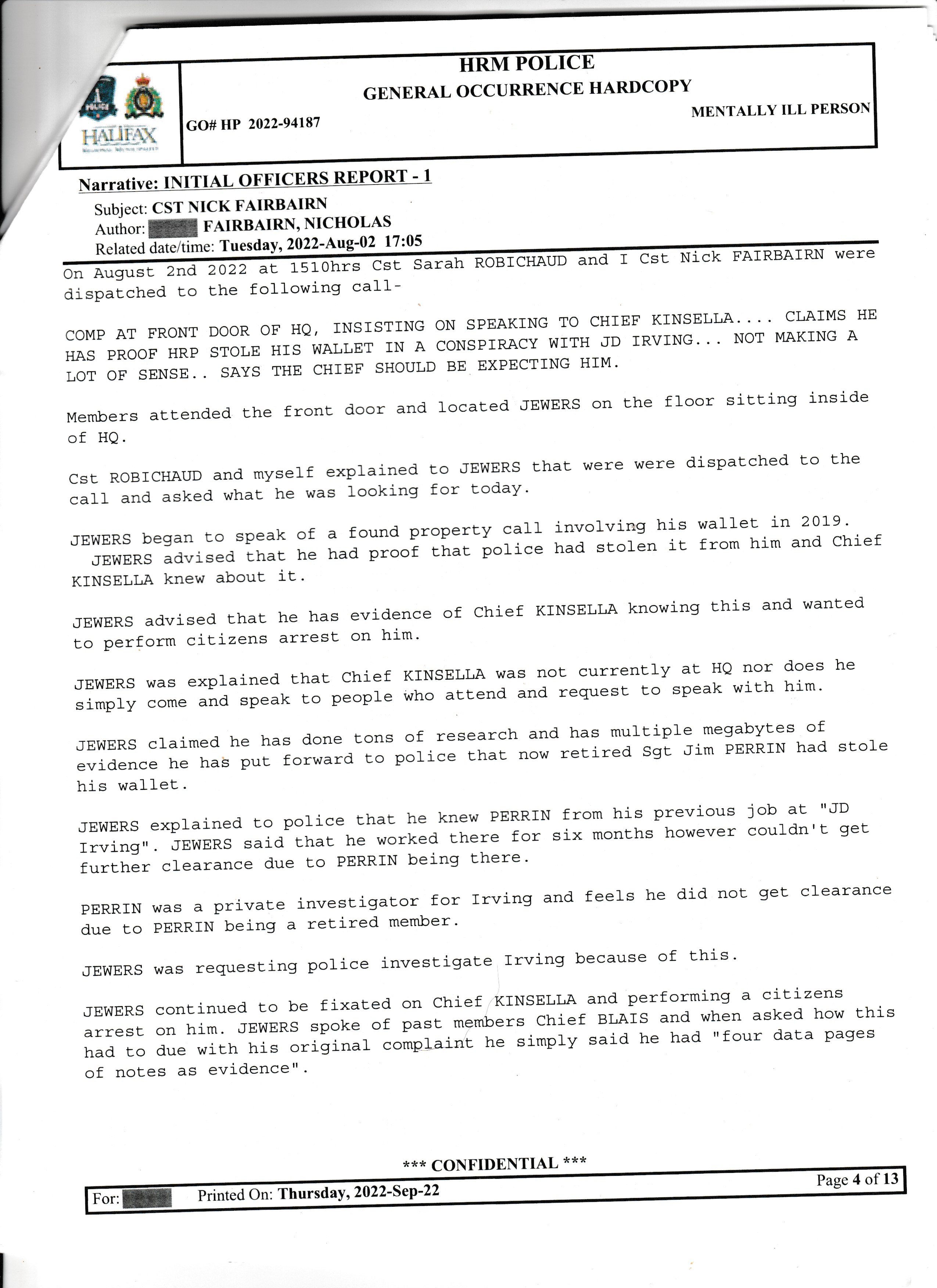
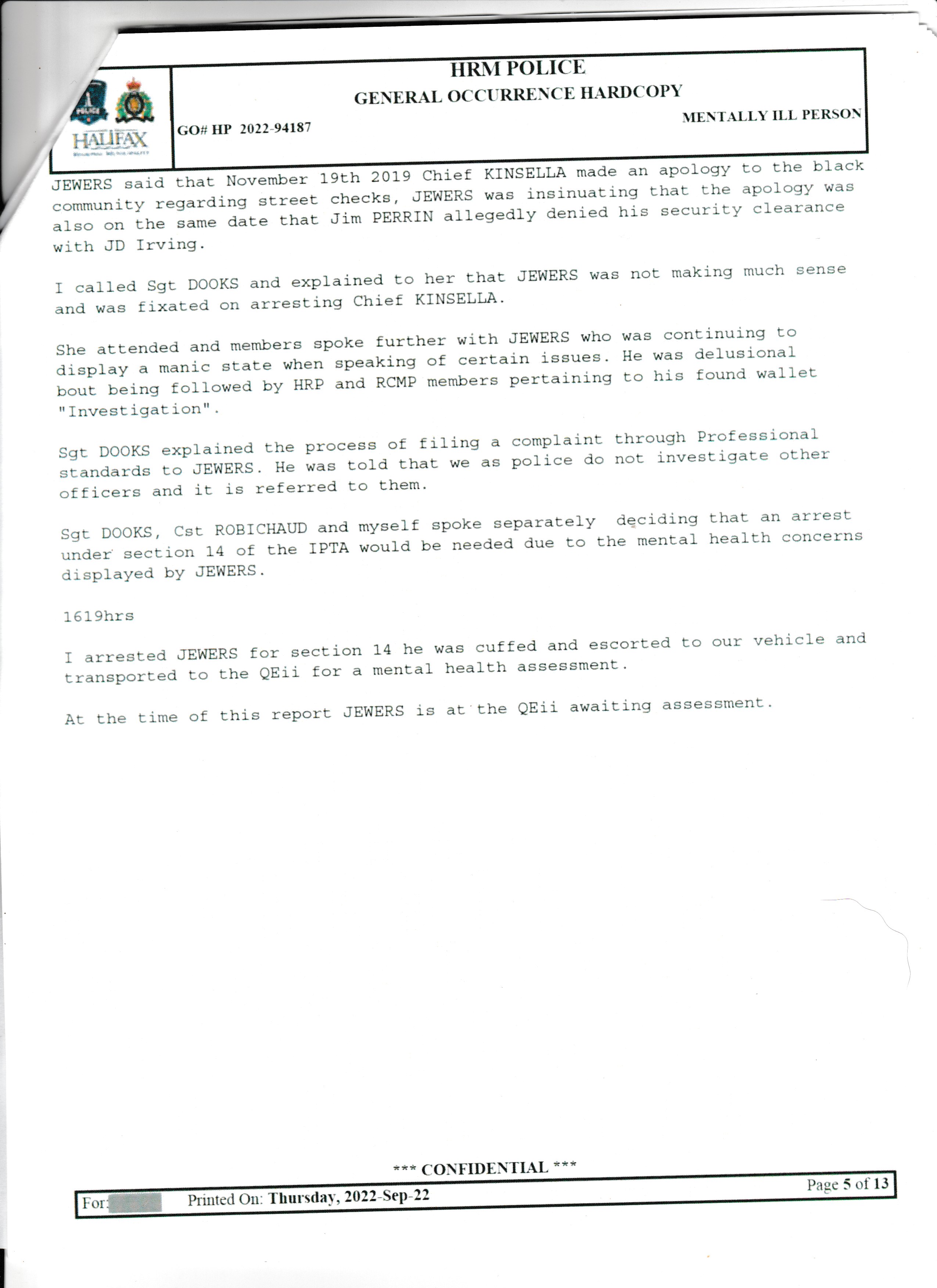
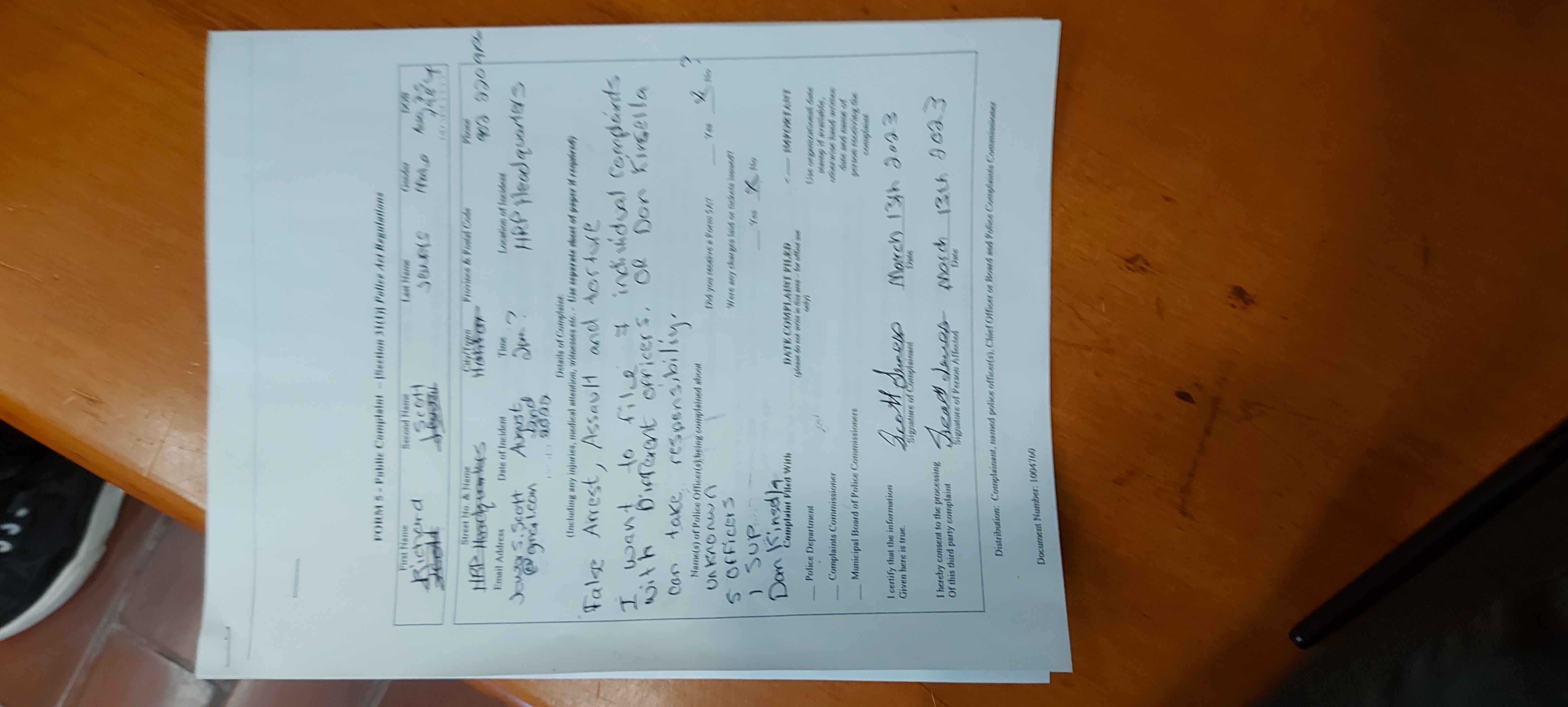
Response from Patrick H. Curran dated April 17, 2024, to my April 5, 2024 personal message and detailed rebuttal addressing his March 22, 2024 decision not to refer the complaint to the Police Review Board.
April 17, 2024
Mr. Scott Jewers
Jewers.scott@gmail.com
Dear Mr. Jewers:
Re: PC-23-0049: The matter of Scott Jewers, Cst. Jarius Lamphier and Cst. Stephen Pope
Our file has been closed since my letter to you dated March 22, 2024, notifying you that your complaint would not be referred to the Police Review Board.
Yours truly,
Patrick H. Curran
Conclusion: The Matter of Sgt. Jonathan Jefferies (Assigned Investigator and PC-23-0049
Jonathan Jefferies was the investigator assigned to this complaint. The decisions made at his level — what to investigate, which officers to include, how to characterize the submissions received, and what conclusions to reach — were the decisions that determined what Patrick H. Curran reviewed and what Ron Legere signed. The integrity of the entire process therefore rested, in the first instance, on the integrity of his conduct as investigator.
This submission establishes, with direct reference to source materials, that Sgt. Jefferies:
- Stated in the Form 11 that he was unable to reach the complainant by phone, when a direct telephone conversation had taken place. The record states that phone contact was not made. This is inconsistent with the occurrence of a direct telephone conversation. The absence of that contact from the investigative record is not explained. A direct conversation with the complainant is a material investigative event. Its omission from the formal record raises questions about the completeness of the documentation produced.
- Removed the arresting officers from a complaint about a false arrest without providing any explanation, and did not respond to three direct requests for that explanation sent on April 18, 2023 — and resent twice. The questions asked were specific: who is investigating the arresting officers; who is investigating the Chief and the documented connections to Irving, Postmedia, and TorStar; and why was only Officer 5 being examined. The Form 11 was issued nearly three months after those questions were first sent. None of them were answered. Their volume was cited as a reason to discount the correspondence. Their substance was not engaged with.
- Omitted the name The Wolf and the Neural Network — ALPHA from the investigative record entirely. This is a publicly available, titled, structured research document containing over 400 chronologically organized, heavily hyperlinked data points, submitted to HRP with confirmed delivery receipts. Its omission — replaced with references to “tons of research” and “multiple megabytes” — ensured that no reviewing party could locate, assess, or independently verify the material. The effect was to render a structured, evidence-based submission unverifiable by anyone relying solely on the investigative record.
- Did not identify or challenge the NSHA characterization that the complainant was found “protesting” outside HRP headquarters — a claim that appears nowhere in HRP’s own General Occurrence report and was never made by the complainant. Jefferies had access to both records. The discrepancy was not noted. That fabrication was carried forward uncorrected and was relied upon by NSHA staff in their assessment, compounding the bias introduced by the false arrest itself.
- Relied on Kristen Holm’s written psychiatric record without requesting or reviewing the audio recording of the same interaction, despite that record being demonstrably inconsistent with the audio. Holm’s written notes substitute Stephen Harper for Stephen McNeil and Bell Media for Postmedia — substitutions the audio directly contradicts. Robin McNeil, former interim Chief of HRP during the period the wallet was taken, is Stephen McNeil’s brother. Those substitutions rendered the conflict of interest invisible to any reviewer relying solely on the written record. The audio was not requested. The written record was treated as reliable fact.
- Recorded that Kristen Holm had not contacted police before forming her assessment, and drew no inference from it. Holm confirmed on audio that she relied solely on emergency department records and had not independently verified anything she was told. A psychiatric assessment that characterized the content of a person’s speech as psychosis — without contacting the arresting officers, without reviewing the submitted evidence, and without independent verification — formed the foundation for every institutional decision that followed. That foundation was accepted without question.
- Did not obtain a statement from Officer 4 — the officer present throughout the entire detention, who stated he would remain with the complainant until 6 a.m., and who refused to leave when Officer 5 arrived. Officer 4 was a direct witness to every event described during the hospital stay, including the conduct of Officer 5, the conduct of the admitting doctor, and the circumstances surrounding the bookbag transfer. His absence from the record is not explained.
- Did not reconcile the inconsistency between the officer accounts provided and the complainant’s direct observation that only one new officer entered the room. Cst. Pope cannot recall the interaction without prompting, cannot confirm whether the complainant had a backpack, and had to be prompted by his partner to remember the event at all. The complainant observed one officer. The record names two. That inconsistency was not investigated and no clarification was sought.
- Applied the label “conspiracy type theories” in the second sentence of his investigation summary — before any analysis had been conducted — without identifying a single specific claim, examining any element of the submitted evidence, or applying any standard to arrive at that characterization. He had access to a publicly available, fully documented, titled research submission. He had delivery confirmations showing HRP had received it. He had a structured timeline spanning more than three years. He had the HRP video confirming a noneventful arrest. He had the audio recording of Kristen Holm. He had three unanswered questions sent directly to him. None of it was engaged with.
These are not matters of interpretation. They are specific, documented failures in the conduct of an assigned investigation — failures that are consistent in direction and effect, each serving to narrow the complaint, limit witness accountability, and ensure that the evidence submitted could not be meaningfully assessed.
Jonathan Jefferies was the first person in this process with the authority and the obligation to engage with the substance of what had been submitted. He did not. He removed the arresting officers before obtaining their statements. He ignored direct questions sent three times. He accepted fabricated records without verification. He assigned a label in the second sentence of his summary and proceeded as though that label were a conclusion.
Every institutional failure that followed — Ron Legere’s Form 11, Patrick H. Curran’s dismissal, the absence of accountability for any officer involved — was built on the foundation Jefferies established. A process in which the assigned investigator does not document contact with the complainant, does not obtain statements from key witnesses, does not verify records against available audio, does not answer direct questions, and applies a dismissive label before conducting any analysis does not reflect a complete or properly conducted investigation.
The evidence on which this investigation was based is documented, publicly available, and has not been substantively refuted. The conduct of this investigation warrants independent review.
Conclusion: The Matter of Ron Legere and PC-23-0049
The Form 11 response issued on July 7, 2023, prepared by Jonathan Jefferies and Ron Legere, defined the scope, framing, and evidentiary record relied upon in all subsequent decisions relating to this complaint. Patrick H. Curran relied on it. The removal of the arresting officers originated within it. The characterization of the evidence as conspiratorial was established by it. As such, the accuracy and completeness of that document are central to the integrity of the entire process.
This submission establishes, with direct reference to source materials, that the Form 11:
- Introduced an allegation that does not appear in the underlying record — specifically, the assertion that Jim Perrin “got me fired” from JD Irving. This statement is not present in the HRP General Occurrence report, in any submission made, or in any correspondence on record. Its inclusion in the opening paragraph of a formal investigative document materially altered the framing of the complaint, converting a structured, institutionally grounded concern into the appearance of a personal employment grievance — the category of claim easiest to dismiss without substantive engagement. Being denied a security clearance and being fired are materially different allegations with different legal implications. That distinction was erased by a word that was never used.
- Selectively quoted a statement while omitting a material qualifier. The omitted sentence — “But if they lied on the record, there is nothing I can do” — directly altered the meaning of the passage and was subsequently relied upon to justify removing the arresting officers from a complaint concerning false arrest. That removal prevented the collection of statements from the individuals most directly involved and ensured the foundational event was never formally examined.
- Presented a rewritten version of the April 3, 2023 submission rather than an accurate summary. Key contextual elements were omitted, including: the admitting doctor’s prior privacy assurances; the fact that Officer 5 was unknown and unexpected; the direct relevance of the officers present to the allegations being discussed; the doctor’s conduct in opening the door and inviting those officers to listen; the full escalation of events leading to involuntary admission; and the repeated denial of access to legal counsel. The resulting version was materially less serious and incapable of supporting the scrutiny the accurate account would have required.
- Removed the connection to HRP officers in relation to the handling of personal belongings. The April 3, 2023 submission is titled “QEII – Officer 4 and 5. Then the Two HRP Officers who seem to have gotten my book bag” and explicitly identifies HRP officers throughout the account. The Form 11 reduced this to a generalized exchange between patients, removing every element that connected the transfer to those officers. Patrick H. Curran then relied on this version to state there was “no evidence or allegation” of HRP involvement — a conclusion made possible only by what was removed.
- Combined two separate incidents into a single narrative and attributed conduct in a manner not reflected in the original account. The original submission clearly described two distinct events: the individual with the bookbag, and a separate incident of waking to find someone standing over the complainant. The Form 11 merged these and attributed the second incident to the individual already associated with the first — an attribution never made in the original. This deflected scrutiny from the second incident while further damaging the character of the individual connected to the first.
- Relied on written records without reconciling them against available audio evidence, despite identifiable and material inconsistencies between those sources. Kristen Holm’s written record substitutes Stephen Harper for Stephen McNeil and Bell Media for Postmedia. The audio directly contradicts both substitutions. Robin McNeil — former interim Chief of HRP during the period the wallet was taken — is Stephen McNeil’s brother. Those substitutions, if accepted without verification, rendered the conflict of interest invisible to any reviewing body. The Form 11 treated Holm’s written characterizations as established fact without requesting the audio.
- Characterized multiple submissions as excessive or irrational without addressing the specific questions raised within them. Three direct questions were sent to Jonathan Jefferies on April 18, 2023, and resent twice without response: who is investigating the arresting officers; who is investigating the Chief and the documented connections to Irving, Postmedia, and TorStar; and why was only Officer 5 being examined. The Form 11 was issued nearly three months later. None of those questions were addressed. Volume was cited as a reason to discount the correspondence. Substance was not engaged with.
- Applied the label “conspiracy type theories” in the second sentence of the investigation summary, without identifying a single specific claim, assessing any element of the submitted evidence, or establishing any standard for that characterization. The label was assigned and treated as a conclusion. Every institutional decision that followed inherited that framing without independent assessment.
These are not matters of interpretation. They are differences between the submitted materials and the version of those materials reflected in the Form 11 — differences that are specific, documented, and consistent in the direction they serve.
The cumulative effect was to alter the scope of the complaint, remove the primary witnesses, and establish a record that did not accurately reflect the substance of what had been submitted. A Commissioner exercising statutory discretion cannot be expected to reach a sound conclusion on the basis of a document that fabricated an allegation in its opening paragraph, selectively quoted to eliminate the arresting officers, and systematically reduced every serious account to a version incapable of supporting review.
As the Delegated Disciplinary Authority associated with the Form 11, Ron Legere is responsible for the accuracy and completeness of that document. The source materials were listed as reviewed. The distortions are not the product of oversight — they are the product of choices about what to include, what to omit, what to alter, and what conclusion to reach before the analysis began.
Where an investigative report does not accurately reflect the underlying materials, does not include all relevant witnesses, and does not reconcile contradictory evidence, the conclusions derived from that report cannot be considered reliable. Given that the Form 11 defined the record relied upon at every subsequent stage of this process, these deficiencies are material to the entirety of what followed.
The evidence on which the Form 11 was based is documented, publicly available, and has not been refuted.
The Form 11 warrants independent review.
Conclusion: The Matter of Patrick H. Curran (Complaints Commissioner) and PC-23-0049
Patrick H. Curran’s final response to this matter — a single sentence advising that the file had been closed — is itself the clearest indication of how this complaint was handled. Following a detailed rebuttal identifying specific, document-supported errors in the record, the analysis, and the investigative process, no substantive response was provided. None of the issues raised were addressed. The file was closed.
That outcome is consistent with the pattern demonstrated throughout this record.
This submission establishes, with direct reference to source materials, the following:
- The complaint filed on March 13, 2023 was misstated as March 15, 2023, severing the temporal link between the filing and the NSHA apprehension that followed within hours — removing the most direct evidence of potential retaliation from consideration at the outset.
- Statements were selectively quoted, with material qualifiers omitted, and those omissions were then relied upon to justify narrowing the scope of the complaint. This included the removal of the arresting officers from a complaint concerning false arrest — preventing the collection of statements from the individuals most directly involved, and ensuring the foundational event was never formally examined.
- The assault allegation was reframed to focus on handcuff removal — an act never alleged to constitute assault — while the identified supervising officer, Sgt. Dooks, was neither addressed nor required to respond. The allegation as actually stated was directed at her conduct in arresting the complainant at the precise moment a formal legal right was being exercised, after she had declared a conflict of interest and offered to provide complaint paperwork.
- The torture allegation was similarly reframed as relating solely to medical treatment administered by NSHA, placing the majority of the conduct outside jurisdiction, while conduct occurring entirely under HRP authority — including prolonged detention without access to legal counsel, coercion under threat of involuntary admission, and the conduct of Officer 5 — was not meaningfully examined.
- Documentary evidence confirms that personal belongings — including identification, financial information, and health card constituting Personal Health Information under NSHA policy — were transferred to Mount Hope prior to any medical assessment, with another patient, and accessed without knowledge or consent. This is explicitly recorded in Mount Hope’s own intake documentation dated August 3, 2022. The assertion that there was “no evidence or allegation” of this is directly contradicted by a document Patrick H. Curran claims to have reviewed in its entirety.
- The April 3, 2023 submission was not summarized but materially rewritten — with key contextual elements removed, including prior privacy assurances given by the admitting doctor, the relevance of the officers present to the allegations being discussed, the full escalation of events leading to involuntary admission, and the repeated denial of legal counsel. The resulting version was significantly less serious and far less capable of supporting meaningful review.
- Officer accounts are incomplete and internally inconsistent. One officer could not recall the interaction without prompting and could not confirm whether the complainant possessed a backpack. Officer 4 — present throughout the entire detention and a direct witness to the events described — does not appear in the record at all. These gaps were not reconciled and no clarification was sought.
- The complete body of submitted evidence was characterized as a “conspiracy theory” without a single specific claim being identified, examined, or refuted. The materials have been publicly available at www.TheWolfAndTheNeuralNetwork.com since June 30, 2023 — before the Form 11 was issued and nine months before Patrick H. Curran’s response. They have not been substantively challenged by any party at any stage of this process.
- Within months of the events documented in this submission, Halifax Regional Police held a historic vote of no confidence in Chief Dan Kinsella. Ninety-six point six percent of participating members voted no confidence. He subsequently retired. That institutional outcome is directly consistent with the concerns raised in this complaint, and directly inconsistent with the characterization of those concerns as irrational or conspiratorial.
These are not matters of interpretation. They are discrepancies between documented evidence and the conclusions reached.
As Police Complaints Commissioner, Patrick H. Curran was required to assess this complaint on the basis of a complete and accurate record. The record relied upon was neither complete nor accurate. The deficiencies identified are not isolated errors — they are consistent in direction and effect, each serving to narrow, redirect, or eliminate aspects of the complaint that would have required substantive examination. A discretionary decision made on such a foundation is not a valid exercise of statutory authority under s.74(4) of the Police Act. It is a decision made without the factual basis required to make it lawfully.
The process that began with a false arrest on August 2, 2022 — carried out at the precise moment a formal legal right was being exercised, by officers who had declared themselves a conflict of interest — has concluded with a closed file, no reconciliation of contradictory evidence, and no meaningful review of the conduct described. The individuals most centrally responsible were removed from the record before they could be required to account for their actions. A formal dismissal was then circulated to command-level officers and legal counsel as though the matter had been properly resolved.
Given the nature of the issues raised — including a documented privacy breach involving Personal Health Information, prolonged denial of legal counsel, the use of psychiatric detention in response to the content of speech rather than behaviour, and the systematic exclusion of primary witnesses from a formal complaint process — this matter extends beyond an individual complaint. It engages broader questions of process integrity, evidentiary standards, and institutional accountability in the administration of police oversight.
The evidence has been documented. It is publicly available. It has not been substantively refuted.
It warrants independent review.
To the Families and Legal Representatives of the Nova Scotia Mass Casualty Inquiry
I am writing to you with respect and caution, recognizing the profound loss and seriousness of the events you have lived through.
I previously provided a video outlining concerns regarding the conduct of individuals involved in police oversight in Nova Scotia, including Patrick H. Curran and Ron Legere:
Families of Portapique Mass Casualty – https://youtu.be/yRmmD088waU
I am now proceeding with a formal request for a criminal investigation into their conduct in a separate matter. I believe it is important that you are aware of this—not to burden you—but because of the overlap in individuals and the broader implications for accountability.
The findings of the Mass Casualty Commission establish that serious failures occurred within the Serious Incident Response Team (SIRT), including failures to follow established law and protocol, inappropriate information sharing with the RCMP, and deficiencies in investigative independence and transparency. Relevant materials include:
- https://masscasualtycommission.ca/
- https://www.halifaxexaminer.ca/mass-casualty-commission/police-watchdog-botched-three-investigations-after-mass-murders-mcc-report/
- https://toronto.citynews.ca/2022/07/28/former-police-watchdog-head-denies-directing-rcmp-not-to-reveal-n-s-shooters-guns/
These findings are not abstract. They describe a system in which:
- investigations were not conducted in accordance with required standards;
- critical information was mishandled or shared improperly; and
- conclusions were presented without sufficient transparency for public evaluation.
In parallel, public reporting has raised questions regarding the role of Patrick Curran during the same period, including conflicting accounts related to the handling of information concerning the firearms used in the mass casualty events.
In my own matter, I have documented a pattern of conduct involving the same individuals that reflects similar structural concerns:
- failure to investigate primary actors;
- alteration or narrowing of the evidentiary record;
- reliance on incomplete or unverified information; and
- dismissal of documented evidence without substantive engagement.
I am not asking you to accept my conclusions. I am asking only that you be aware that the concerns identified by the Mass Casualty Commission may not be isolated to that inquiry.
My intention in raising this is not to add to your burden, but to ensure that, if there are systemic issues affecting investigative integrity and oversight, they are fully understood and addressed wherever they arise.
You and your families have already been recognized as victims of failures within these systems. It is my position that similar structural issues may have affected other matters, including my own.
If any of this is relevant to your ongoing legal work or review of the Commission’s findings, I am prepared to provide full documentation in a structured and verifiable format. I am also available to assist in any technical, analytical, or evidentiary review where it may be helpful.
Respectfully,
Scott Jewers