CPSNS,
A copy of this letter has been provided to 127 different email addresses.
A brief index for quick linking is provided first, followed by a detailed index with page numbers for each section. This structure is intended to accommodate both HTML and printed versions.
I am also formally requesting that Health Canada initiate an independent investigation into these matters.
I further request that this correspondence be forwarded to the Royal Canadian Mounted Police, and that appropriate steps be taken to ensure that a reported sexual assault, which occurred while I was in the care of the Nova Scotia Health Authority (NSHA), is properly investigated. Please confirm in writing whether this matter has been referred to law enforcement and, if not, provide the basis for that decision.
I have already opened a file with the RCMP Special Victims Unit (Shelly Mews, file number 2025-21595, contact: 902-220-2013), submitted related concerns to the Civilian Review and Complaints Commission for the RCMP, and escalated this matter to Commissioner Mike Duheme, Assistant Commissioner Dennis Daley, Chief Superintendent Dan Morrow, and Jana Caines, Executive Assistant to C/Supt. Morrow. This matter is also being tracked under CSIS case reference “Attachment 5566.”
I am writing to formally document and raise serious concerns regarding:
- a reported sexual assault;
- discrepancies in medical documentation;
- multiple privacy breaches; and
- the handling of my complaint by CPSNS.
In 2022, while under the care of NSHA, I reported that an individual entered my room and touched me inappropriately. When I raised this, I was told, “they know they aren’t supposed to touch you,” and the matter was dismissed. I also possess audio recordings indicating that the medical record was materially altered, including changes to names and events.
This allegation was subsequently brought forward to CPSNS. It was not meaningfully investigated. Relevant evidence, including audio recordings, was not reflected in the record, and the actions taken during the review raise serious concerns regarding its completeness and integrity.
I am also concerned that my personal and confidential information was disclosed to Cox & Palmer despite a known conflict of interest. When this concern was raised with CPSNS staff, it was not addressed. Instead, on February 20, 2024, I was advised, “I confirm you have not requested an appeal,” and access to my complaint files was subsequently restricted. Personal and confidential information was disclosed again on April 24, 2024, while access to my files remained restricted. I believe this conduct is inconsistent with CPSNS’s obligations under section 46 of its governing legislation.
Given that this matter involves a reported sexual assault, it is not subject to standard limitation periods under Canadian law and must be assessed on its merits, particularly in light of public safety considerations. In addition, the underlying complaint process remained active until April 24, 2024, and involved interrelated matters concerning multiple individuals to whom the same allegations were reported.
Given the seriousness of these issues—including potential criminal conduct, privacy breaches, and the handling of a reported sexual assault—I am requesting that this matter be formally referred to and reviewed by the appropriate authorities.
Please confirm receipt of this complaint and advise whether CPSNS will be conducting any further investigation.
The relevant events and supporting details are outlined below.
To assist in traversing this document, A digital copy of this letter can be found in HTML format at:
View Full HTML Tiny URL: https://tinyurl.com/4264t37m
View Full HTML URL: https://thewolfandtheneuralnetwork.com/HTMLDocuments/2026-03-27_CPSNS_Formal_Complaint_and_Request_for_Independent_Investigation.html
Download document Short URL: https://tinyurl.com/3zzp8ypu
Download document URL: https://www.thewolfandtheneuralnetwork.com/Media/Resources/Added_2026_03/2026-03-27_CPSNS_Formal_Complaint_and_Request_for_Independent_Investigation.docx
Scott Jewers
902-220-9106
jewers.scott@gmail.com
Addendum – Supplemental Evidence (March 27, 2026)
Following submission of this complaint, additional evidence has been identified and is provided here for completeness. This includes Halifax Regional Police (HRP) reports which are directly relevant to the characterization of events in the medical record.
These reports do not indicate that I was protesting, which directly contradicts how events were described in NSHA documentation and relied upon in the CPSNS review process.
The remaining contents of these reports are also under review and will be addressed in a subsequent detailed release.
This evidence relates specifically to:
- Mischaracterization of the complaint; and
- Reliance on unsupported or inaccurate records.
Page 1
Short URL: https://tinyurl.com/5yw7e5ak
Full URL: https://thewolfandtheneuralnetwork.com/Media/Resources/Added_2024_04/2022-08-02%20HRP%20Police%20Report%201.jpeg
Page 2
Short URL: https://tinyurl.com/2x3e458a
Full URL: https://thewolfandtheneuralnetwork.com/Media/Resources/Added_2024_04/2022-08-02%20HRP%20Police%20Report%202.jpeg
This addendum does not replace or alter the original submission. It is provided to supplement the record and should be considered alongside the materials already submitted.
QUICK INDEX
Detailed Index
Table of Contents
Procedural Obstruction — False Claim That No Appeal Was Requested with CPSNS and Cox & Palmer 12
Infographic Showing Conflict of Interest 13
Notice to Colin Clarke and Cox & Palmer — Conflict of Interest and Professional Obligations 18
Pre-Arrest Context — Documented Purpose of Attending HRP August 2nd 2022 20
Anomalous Activity in the Days Prior to August 2, 2022 20
Valent Legal Email — August 1, 2022 21
Attendance on August 2, 2022 21
Triage Issues — Records falsely state I was “protesting” at Halifax Regional Police. 26
Retaliation – Service by Bailiff Following CPSNS Complaint against Nancy Murphy 31
“violated your rights by having you involuntarily admitted to the Mount Hope Hospital; “ 39
“Humiliated you when you asked about your rights” 40
“had your belongings sent to Mount Hope Hospital without your knowledge;” 41
Nancy Murphy — The Belongings Transfer 41
“fabricated your encounter in the Emergency Department;” 48
“denied your request to contact a lawyer; and” 50
“took your blood and did imaging without your consent.” 51
Use of “Conspiracy” / “Theory” Label — Prejudicial Characterization 55
The Basis for Attending HRP Was Legitimate and Documented 55
The Assessment Substituted Assumption for Evidence 56
The Kristen Holm Discrepancy 56
Kristen Holm claimed that I was “protesting” outside Halifax Regional Police. 58
falsified documents and records; 60
Failure to Accurately Record My Mother’s Condition and Care Needs (Summary) 63
Failure to Record Reported Abuses — QEII and HRP 64
Failure to Record Relevant Supporting Material — TWNN ALPHA 65
Failure to Record Reported Sexual Assault 67
Engaged In coercive torture by Administration of Medication Without Consent 68
Failure to Investigate a Reported Sexual Assault 71
Reliance on Mental Health Characterization to Deny Investigation 74
denied you access to legal counsel; and 76
Denial of Access to Legal Counsel 76
engaged in reckless endangerment, fraud, and criminal and professional negligence. 78
The Circumstances of Admission — Sleep Deprivation and Duress 78
The August 2022 Psychiatry Note 91
Direct Contradiction from Dr. McDonald 91
Audio Corroboration — Real-Time Forecasting 93
The Second Entry — Glenda Said He Is Fine; Mother Used as Substitute Decision Maker 93
Additional Concerns – Inability to Raise Serious Complaint against Shante A. Blackmore 96
Detailed Review of CPSNS Findings and Dismissals March 13th 2023 98
Fabricated NSHA Triage Record and RCMP Varsadex entry March 13th 2023 105
Hana Marie Wiemer – Review 109
What the Record Omits — and What It Includes 110
Second Opinion and Conflict of Interest 111
John Adebayo Oguntade – Review 113
What Has Since Been Confirmed 113
Crystal Morgan (CPSNS Lead Investigator) 115
Follow-Up and Lack of Response 117
Cindy Campbell (Manager CPSNS) 118
Douglas Grant (Registrar and CEO, CPSNS) 120
Charter and IPTA Implications of the Review Failure 122
Torture, Coercive Conditions, and External Influence 132
Legal Definition of Torture 132
Conditions of Detention and Assessment 132
Application of the Legal Standard 133
Legal Significance Under IPTA and the Charter 133
Escalation: External Influence and Purpose 134
Intersection with Human Trafficking Principles 134
Allegations and Areas of Concern 139
Notice to Health Canada — Request for External Investigation 144
Email Addresses this has been delivered too 145
Disclaimer and Information
CPSNS issued findings in relation to complaints involving Nancy Murphy and Kristen Holm on January 15, 2024, followed by findings involving Hana Marie Wiemer on April 24, 2024, and later findings involving John Adebayo Oguntade. Upon review, I have identified material omissions, inconsistencies, and failures to address key evidence across these decisions.
CPSNS has previously advised that Section 46 of the Medical Act requires confidentiality of certain information provided by the College. However, as outlined in its own correspondence, this does not prevent me from describing the underlying events, the complaint, or the handling of that complaint.
Given the public safety implications of the matters described—including a reported sexual assault and the handling of that complaint—these issues extend beyond an individual complaint and warrant review in the broader public interest, as there are ongoing concerns related to public safety.
Throughout this document, I have included TinyURL links where appropriate. These provide simplified access to longer source links through a widely used redirection service that I do not control. This approach is intended to make references easier to cite and access, including when reviewing a printed version of this material.
As with the majority of my submissions, I encourage the reader to think critically and independently assess all information presented by all parties. To support this, I have developed a resource platform, www.TheWolfAndTheNeuralNetwork.com, which currently contains over 900 data points, the majority of which are hyperlinked. The platform includes tools for navigating by date, researching tags, and performing advanced searches across media sources. It is a custom-built system and will continue to be updated with additional features and improvements.
In addition to this platform, I recommend the use of traditional search tools such as Google and Bing, as well as search functions within media websites. Artificial intelligence tools such as ChatGPT, Grok, Gemini, or Claude may also assist in reviewing and contextualizing large volumes of information. However, these services may be hosted outside of Canada, and any data submitted could be subject to foreign jurisdiction. Caution should be exercised, particularly where personal or health-related information is involved.
Thank you.
Summary of Findings
This submission documents a series of interrelated failures arising from events in 2022 while under the care of the Nova Scotia Health Authority, and the subsequent handling of those events by CPSNS.
The evidence demonstrates the following:
- I was apprehended and involuntarily detained under circumstances that were not supported by clear, documented, or independently verified evidence
- Records created during and after these events contain material omissions, inaccuracies, and discrepancies when compared to audio evidence and documented facts
- A reported sexual assault during care was not investigated
- I was denied the ability to meaningfully document or challenge my treatment, including restrictions affecting consent and legal access
- Personal belongings containing sensitive information were transferred and accessed without consent, raising serious privacy concerns
- CPSNS relied on incomplete and contradicted records in reaching its decision
- CPSNS failed to address key evidence including audio recordings and documented inconsistencies
- Personal information was disclosed to Cox and Palmer despite a clear and documented conflict of interest involving individuals connected to JD Irving and Irving Shipbuilding
- The complaint process was closed on a false basis, preventing meaningful access to an appeal
Taken together these issues demonstrate that the factual record is unreliable, the complaint was not investigated on its merits, and the outcome of the CPSNS process cannot be considered valid.
Position
This is not a disagreement with the outcome.
This is a failure of process in which evidence was not assessed, contradictions were not resolved, serious allegations were not investigated, and conflicts of interest were not addressed.
Accordingly, independent review by a body not implicated in these events is not optional — it is the only mechanism capable of producing a reliable outcome.
Requested Action
Given the above, I am requesting:
- Independent review of the handling of this matter;
- Confirmation of whether the reported incident during care was formally investigated;
- Explanation of how contradictory evidence was addressed, if at all;
- Explanation of the basis for disclosing personal information to Cox & Palmer despite the identified conflict;
- Clarification of how the complaint was closed despite documented attempts to engage the appeal process.
Detailed Video Documentation of Alleged Abuse and Related Events from August 2, 2022, through March 13, 2023, to Present
All videos were shot live and in real time while calling the voice mail of Shelly Mews (RCMP Special Victims Unit) 902-220-2013. And so comments Section contains logic “Patches”.
S4E5 Call to RCMP The Fraud of Cory Bushell and the CRCC Review of False Arrest – March 13th 2023 – https://youtu.be/EkbkumKe-Hs (1:23:48)
S4E6 Deep Dive into False Arrest, Torture, and Sexual Assault on August 2nd 2022 – https://youtu.be/KOE2qzYTpng (2:34:03)
S4E7 Deep Dive of Police Abuse / cover up of sexual assault / Connecting Postmedia to Mueller Report – https://youtu.be/JzMIxrZlHNc (2:25:55)
Short Videos as well as transcripts from False arrest March 13th 2023:
- https://youtube.com/shorts/vAGojH4lmi0
- Demonstrates that I was calm, composed, and speaking clearly immediately prior to any police intervention.
- “Well i have some great news, the Police didnt kill me this time or you know torture me or falsely arrest me or anything like that so that’s a positive i actually get to go home and see my dog tonight so. Yea, small things right”
- https://youtube.com/shorts/YoBWvnIlNpc
- Shows that I remained calm and compliant while seated in the back of a police vehicle.
- “So RCMP hunted me down and said that I’m some mental health threat and now I’m sitting in the back of a RCMP vehicle, they didn’t talk about doctor Holms and what she did, the recording or any of the evidence I’m like so screwed right now it doesn’t matter what i do right now there gonna...[sigh] anyways i tried everyone”
- https://youtube.com/shorts/-1kKtjV4gII
- Captures my reaction to reading the officers’ screen, which described me as “increasingly delusional.”
- “...their screen said I’m sending emails that are increasingly delusional, thats right its that bad, its not, they are full technical audits these people are lying and they are gonna torture me right now. I’m is a lot of trouble. I’m screwed, I’m screwed, it doesn’t...”
- https://youtube.com/shorts/euGRDp5cHNc
- At NSHA, i show my cuffs and face and calmly speak.
- “they know their lying”
- https://youtube.com/shorts/PoiP1DXvhJI
- Documents the conditions of detention of room i stayed in for almost 20 hours
- “So on top of like, not allowing me to record anything telling me i don’t have the right to, i get this little sheet and this to lay in. That’s right so they can record me while i just lay in here. That’s right, I’m an animal i don’t have rights”
Procedural Obstruction — CPSNS and Cox & Palmer — Undisclosed Conflict of Interest, Privacy Breach, and Obstruction of Appeal Rights
Statement
On February 20, 2024, Suzanne Husbands wrote:
“I confirm you have not requested an appeal. These files are now closed.”
Full record of interaction with Suzanne Husbands:
Tiny URL: https://tinyurl.com/t77wfjhh
That statement is misleading and constitutes a serious mischaracterization of the interactions that occurred.
On the same day CPSNS asked whether I wished to initiate an appeal, I responded immediately and repeatedly. In those responses, I raised a critical issue: CPSNS had disclosed my personal and confidential information to Cox & Palmer.
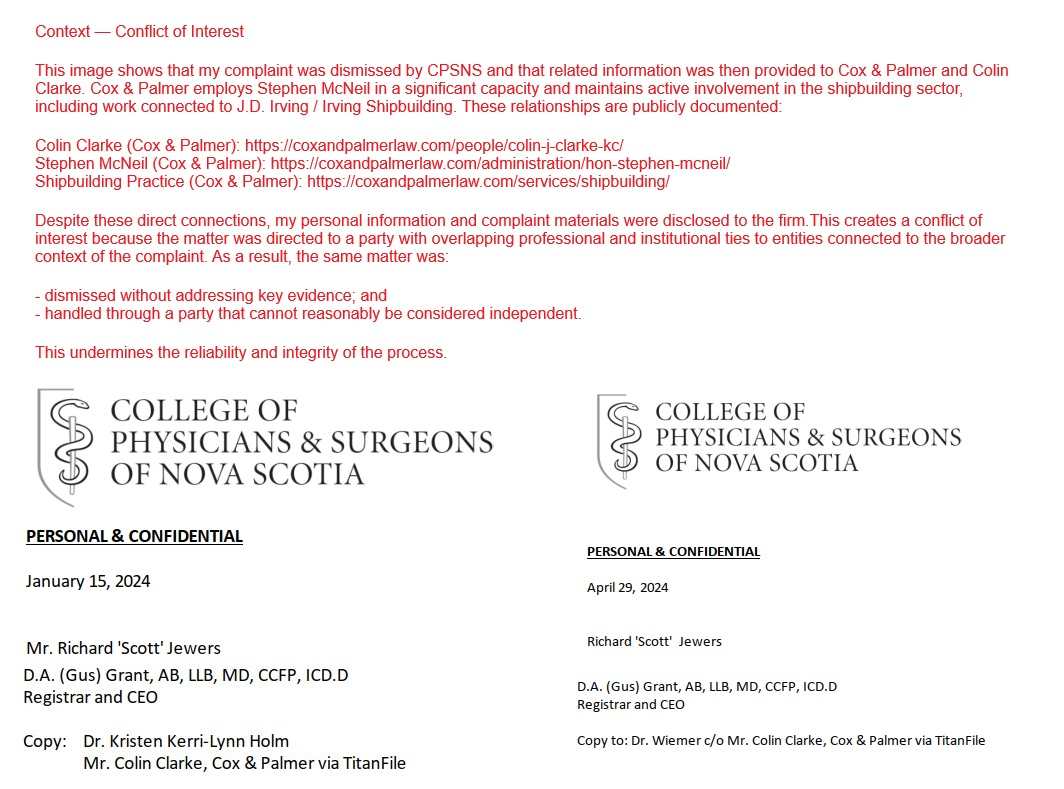
The documentary record confirms that this disclosure was not incidental. The January 15, 2024 correspondence was copied to Mr. Colin Clarke of Cox & Palmer via TitanFile. This establishes that my personal and confidential information had already been transmitted to that firm prior to the February 20, 2024 communication.
This disclosure created a clear and disqualifying conflict. Stephen McNeil was employed by Cox & Palmer in a significant and active capacity and is directly connected to matters central to the complaint, including issues involving J.D. Irving. Cox & Palmer have themselves acknowledged a conflict of interest in relation to J.D. Irving due to their involvement in shipbuilding contracts (see Image 2).
- Appears to be Colin Clarke at Cox & Palmer: https://coxandpalmerlaw.com/people/colin-j-clarke-kc/
- Stephen McNeil at Cox & Palmer: https://coxandpalmerlaw.com/administration/hon-stephen-mcneil/
- Shipbuilding, Maritime & Transportation at Cox & Palmer: https://coxandpalmerlaw.com/services/shipbuilding/
I also made multiple follow-up attempts to have this conflict addressed:
- February 23, 2024 — Voicemail left for Crystal Morgan raising the conflict of interest with Cox & Palmer and concerns regarding Suzanne Husbands’ conduct, requesting a response.
- February 29, 2024 — Voicemail left for Crystal Morgan requesting clarification regarding which “public figures” I was allegedly delusional about, as no names had been provided in CPSNS correspondence. No response was received.
- March 11, 2024 — Voicemail left for Cindy Campbell (Manager, CPSNS), outlining evidence and again raising the conflict of interest with Cox & Palmer.
In these circumstances, the disclosure of my information to that firm raised immediate and legitimate conflict concerns that required assessment and resolution before any appeal could proceed. I explicitly requested that CPSNS engage Cox & Palmer to clarify the conflict.
I further advised Suzanne that CPSNS had, in my view, violated Section 46 of the Medical Act through this disclosure, and that I could not reasonably proceed until clarification and safeguards were provided.
Despite these concerns being raised, CPSNS did not assess or resolve the conflict. Instead, the files were closed.
The record further shows that on April 29, 2024, Douglas Grant and CPSNS again disclosed additional personal and confidential information to Cox & Palmer, specifically c/o Mr. Colin Clarke via TitanFile, in relation to the Hana Marie Wiemer matter.
This confirms that the disclosure was repeated after conflict concerns had already been explicitly raised, without any resolution or acknowledgment of those concerns.
Additionally, Kristen Holm characterized me as delusional in relation to references involving Stephen McNeil and his resignation following the Irving Shipbuilding investigation. However, the audio recording shows that Kristen Holm explicitly referenced Stephen McNeil by name. This reference is omitted from her written record and replaced with “Stephen Harper,” which is a material discrepancy and forms part of the evidence that the record was altered or fabricated.
A more detailed section: “Changing Stephen McNeil and Postmedia to Stephen Harper and Bell Media”
I have retained audio recordings of my communications with CPSNS, including the calls referenced above. These recordings provide a complete and contemporaneous record of what was said, when it was said, and the issues that were raised, including the conflict of interest and requests for clarification.
If CPSNS disputes or mischaracterizes the nature of these interactions, those recordings can be produced to allow independent verification of the record.
Infographic Showing Conflict of Interest
 IMAGE 1
Tiny URL: https://tinyurl.com/5bjn2uwj
%20violated%20section%2046%20of%20medical%20act%20sending%20my%20informaiton%20to%20Cox%20and%20Palmer.jpg)
Transcript Evidence
The relevance of Stephen McNeil to this complaint is not speculative. The following transcript confirms Kristen Holm explicitly referenced him by name during my assessment.
Exact Time Stamp and Statement in Audio Recording: https://youtu.be/9dGY_N9ni1w?si=1SJPE4w_8YvLiwoo&t=811
- 13:31 – 13:36 — Kristen Holm: “I think that you're experiencing delusions which are fixed false beliefs.”
- 13:36 – 13:39 — Scott Jewers: “Specifically in relation to McNeil?”
- 13:39 – 13:46 — Kristen Holm: “McNeil, and how things that you have done have influenced other things happening… those connections that you're making…”
Additional Evidence
- Following February 20, 2024, I continued to contact CPSNS by phone
- Multiple voicemail messages were left identifying the issue with the appeal process and file closure
- No return calls or follow-up communication were received
- All calls were recorded
Conclusion
Conflict of interest checks are a standard and required practice in Canadian legal and administrative processes.
- Caravel: https://caravellaw.com/what-is-a-conflict-check/
- Canadian Bar Association: https://cba.org/fr-ca/sections/public-sector-lawyers/resources/the-duty-to-avoid-conflicts-of-interest-in-organizational-practice-settings/
The Nova Scotia Barristers’ Society also confirms that conflict of interest checks are a required component of professional legal practice.
CPSNS did not simply receive no response. CPSNS received same-day responses that directly addressed the appeal and raised the conflict of interest and disclosure issues preventing the appeal from proceeding. These concerns were clearly communicated to Suzanne Husbands and directly affected any ability to proceed with an appeal.
Those concerns were not assessed or resolved. Instead, CPSNS closed the files on the basis that no appeal had been requested. The record reflects communications with Suzanne Husbands on February 20, 2024, and again on April 29, 2024. Further, Douglas Grant, in the case of Hana Marie Weimer, disclosed additional personal and confidential information to Cox & Palmer.
Following the closure, I continued to contact CPSNS by phone and left multiple recorded voicemails raising the same issue. No return calls or follow-up communication were provided.
As a result, the appeal process was not meaningfully available. It was obstructed by unresolved conflict of interest and disclosure concerns, and then terminated on the false basis that no appeal had been requested.
These conflict concerns were raised not only in relation to my own position, but also to ensure a fair and impartial process for all parties involved, including Dr. Kristen Holm and Dr. Nancy Murphy.
If CPSNS maintains that no appeal was requested or that my conduct was inappropriate, they should provide:
- the specific dates and times of all communications relied upon; and
- complete call logs for the relevant period.
Further, the disclosure of personal and confidential information in circumstances involving an identified conflict raises potential statutory obligations:
- Office of the Information and Privacy Commissioner of Nova Scotia: https://oipc.novascotia.ca/
- Office of the Privacy Commissioner of Canada: https://www.priv.gc.ca/en/privacy-topics/business-privacy/breaches-and-safeguards/privacy-breaches-at-your-business/gd_pb_201810/
Taken together, this is not a case of non-response. It is a case in which:
- a conflict of interest was identified,
- the process could not proceed without resolving that conflict, and
- the process was then closed on the basis that no appeal had been requested.
That characterization is inaccurate and does not reflect the record.
 Image 2: CPSNS letters showing dismissal of complaint and transfer of personal information to Cox & Palmer, a firm with documented connections to Irving Shipbuilding through Stephen McNeil, raising conflict of interest concerns.
Tiny URL:https://tinyurl.com/5n8ayasy
Notice to Colin Clarke and Cox & Palmer — Conflict of Interest and Professional Obligations
I am writing to formally raise and document a clear and unresolved conflict of interest involving Colin Clarke and Cox & Palmer in connection with matters related to this complaint (See Image 1).
Cox & Palmer has already identified a conflict of interest in relation to entities and individuals connected to this matter, including relationships involving JD Irving, Irving Shipbuilding, and associated political figures including Stephen McNeil. Despite that acknowledgment, my personal and confidential information was disclosed to your firm and no corrective action, withdrawal, or formal disclosure addressing that conflict was provided.
This is not a procedural issue. It is a substantive failure to comply with fundamental professional obligations.
The matters at issue include the handling of a reported sexual assault, the alteration and omission of material facts within medical records, and the failure of regulatory oversight by CPSNS. In that context the involvement of a law firm operating under a known or reasonably foreseeable conflict — particularly where overlapping relationships exist with entities connected to federal procurement — renders the process fundamentally unreliable.
Any findings, positions, or reliance on materials that have passed through a conflicted channel are inherently compromised. This is not a question of perception. It is a question of whether the process can meet even a basic standard of independence.
I have formally requested that the Government of Canada consider the implications of this conflict in relation to federal contracts including those connected to Irving Shipbuilding. Where a firm is aware of a conflict and proceeds without resolving or reporting it this raises serious concerns regarding its suitability as a participant in matters involving public institutions, regulatory processes, or federal interests.
The continued reliance on any material, input, or involvement connected to Cox & Palmer or Colin Clarke places the CPSNS process in a position where its outcome cannot reasonably be considered independent or reliable.
I am requesting that Colin Clarke and Cox & Palmer provide a written response addressing:
- The nature and scope of the conflict of interest previously identified
- The basis on which my personal information was received and handled despite that conflict
- What steps if any were taken to disclose, mitigate, or report the conflict
Absent a clear and substantiated response the existence of this unresolved conflict raises a threshold issue regarding the validity of any process or findings that rely upon it. That threshold issue is now part of the public record distributed to the recipients of this submission including federal members of parliament, provincial premiers, national media organizations, NSIRA, and CSIS under reference Attachment 5566.
The disclosure of personal and confidential information in circumstances involving an identified conflict also raises potential statutory obligations under the following:
Office of the Information and Privacy Commissioner of Nova Scotia: https://oipc.novascotia.ca/
Office of the Privacy Commissioner of Canada: https://www.priv.gc.ca/en/privacy-topics/business-privacy/breaches-and-safeguards/privacy-breaches-at-your-business/gd_pb_201810/
I remain available to provide further information. This matter should be addressed directly and in accordance with professional standards. The absence of a response will itself be noted as part of the documented record.
Image 1: CPSNS letters showing dismissal of complaint and transfer of personal information to Cox & Palmer, a firm with documented connections to Irving Shipbuilding through Stephen McNeil, raising conflict of interest concerns.
Tiny URL:https://tinyurl.com/5n8ayasy
Pre-Arrest Context — Documented Purpose of Attending HRP August 2nd 2022
I am a technical professional with over 18 years of experience in systems analysis, programming, and IT. I previously worked with Research In Motion as an escalation analyst, as well as with Dalhousie University and Irving Shipbuilding, where I left with both manager and director references on file.
On June 23, 2022, I received a response to a Freedom of Information request submitted at the direction of legal counsel regarding the 2019 theft of my wallet — a matter addressed in full elsewhere in this document. Halifax Regional Police had previously stated that matter was ongoing. However, the FOI response restricted information on the basis of another individual's privacy, creating a direct inconsistency that required in-person clarification.
As a result of this, and additional issues documented in The Wolf and the Neural Network, I attended Halifax Regional Police headquarters for the following purposes (non-exhaustive):
- to seek clarification regarding the FOI response;
- to raise concerns regarding police intimidation, stalking, and the unauthorized setting of my GPS to 9330 Highway #7, Stillwater, Nova Scotia;
- to raise additional documented issues referenced throughout this submission;
- to raise concerns regarding systemic racism in relation to the Wortley Report; and
- to file a formal complaint against Chief Daniel Kinsella.
My purpose in attending was lawful, pre-disclosed, and supported by documented evidence. There was no urgency, threat, or unpredictability requiring escalation.
On July 11, 2022, I submitted The Wolf and the Neural Network — ALPHA to multiple recipients, including HRP. This document contained over 400 structured, chronologically ordered, and cross-referenced data points, presented as a research submission with my bias explicitly disclosed throughout (see Image 1).
- TWNN ALPHA (original version): https://www.thewolfandtheneuralnetwork.com/Versions/Pages/ALPHA/2022_07_11_ALPHA.html
HRP delivery confirmations acknowledged receipt and indicated a response within 7 days. No response was provided prior to the events of August 2, 2022.
Anomalous Activity in the Days Prior to August 2, 2022
In the days leading up to August 2, 2022, two separate and unusual events occurred that are relevant to the broader context of what followed.
Google Analytics Spike — July 28, 2022
On July 28, 2022 — four days before my arrest — Google Analytics data associated with my web property recorded a spike of approximately 500 views in a single day, with thousands of combined views over the surrounding period. I live in a rural area where one or two views per day is typical. This level of traffic is not consistent with baseline activity for this property (see Image 2).
This spike is consistent with a similar pattern observed in late September 2021, when analytics activity increased significantly following a disclosure — a matter addressed in full elsewhere in this document. The correlation between disclosure events and analytics spikes is noted.
Valent Legal Email — August 1, 2022
On July 29, 2022, I stated on the main email thread that I could not trace phone calls and requested that any further contact be made by email so that I could verify headers and origin (see Image 3).
On August 1, 2022 — the day before my arrest — I received an email appearing to originate from Amy Calder of Valent Legal. The email included an attachment styled to resemble official Government of Canada correspondence (see Image 3).
The email was flagged by Bitdefender as potentially malicious. I contacted Valent Legal within hours to verify its authenticity. On August 4, 2022, Valent Legal confirmed that the email did not originate from them. However, analysis of the email headers indicates that the message originated from within, or was transmitted through, Valent Legal’s domain. I advised Valent Legal to have their IT systems reviewed accordingly (see Image 4).
A subsequent technical review of the email headers, including AI-assisted analysis, is consistent with two possibilities:
- the email originated from within Valent Legal’s systems; or
- an account within their domain had been compromised and used to send the message.
In either case, the email cannot be attributed to a random external source and reflects either internal origin or a targeted security compromise within the Valent Legal domain (see Image 5).
This incident is consistent with a prior event on October 6, 2021 involving Burchells LLP. When I contacted Burchells LLP (BLP), I was advised that their phone systems had been compromised and that calls were being redirected (see Image 3). The timing of that incident corresponds with analytics spikes observed in late September 2021, while the Valent Legal email corresponds with the spike observed around July 28, 2022 (see Image 2).
Attendance on August 2, 2022
On the morning of August 2, 2022, I provided regular updates on the main email thread. All relevant parties — including law enforcement — were informed well in advance and had every opportunity to intervene or respond.
Before arriving at HRP, I attended the Canadian Security Intelligence Service (CSIS) to provide direct evidence. Reference: CSIS Case # Attachment5566.
Had HRP allowed me to file my complaint and engage with me directly, there would be a clear and complete record — which I am entitled to under Canadian law. Instead, what followed resulted in a record that does not reflect my stated purpose or the information I was attempting to provide.
Every relevant party had advance notice of my intentions, the evidence I intended to present, and the specific complaint I intended to file. All had ample time and opportunity to respond or intervene. None did.
The subsequent record bears this out. Within months of the events I have documented, Halifax Regional Police held a historic vote of no confidence in Chief Daniel Kinsella. 84% percent of members participated, and 96.6% voted no confidence. The union called for his resignation.
- November 2, 2022 — Halifax police union passes no-confidence vote on chief:
https://www.cbc.ca/news/canada/nova-scotia/halifax-police-union-no-longer-has-confidence-in-chief-1.6638316
That outcome does not exist in isolation. It is an institutional development that provides context to the environment within HRP at the time I attended to file a complaint against that same Chief.
Infographic — HRP delivery confirmations following release of TWNN ALPHA; identifies the work as a research paper, presented as chronologically ordered data points, and explicitly discloses my own bias.

IMAGE 1
Tiny URL: https://tinyurl.com/2327xhjh
Full UR: https://thewolfandtheneuralnetwork.com/Media/Resources/Add_2024_03/2022-07-11%20-%20Delivery%20confirmations%20of%20ALPHA%20delivery%20to%20HRP.jpg
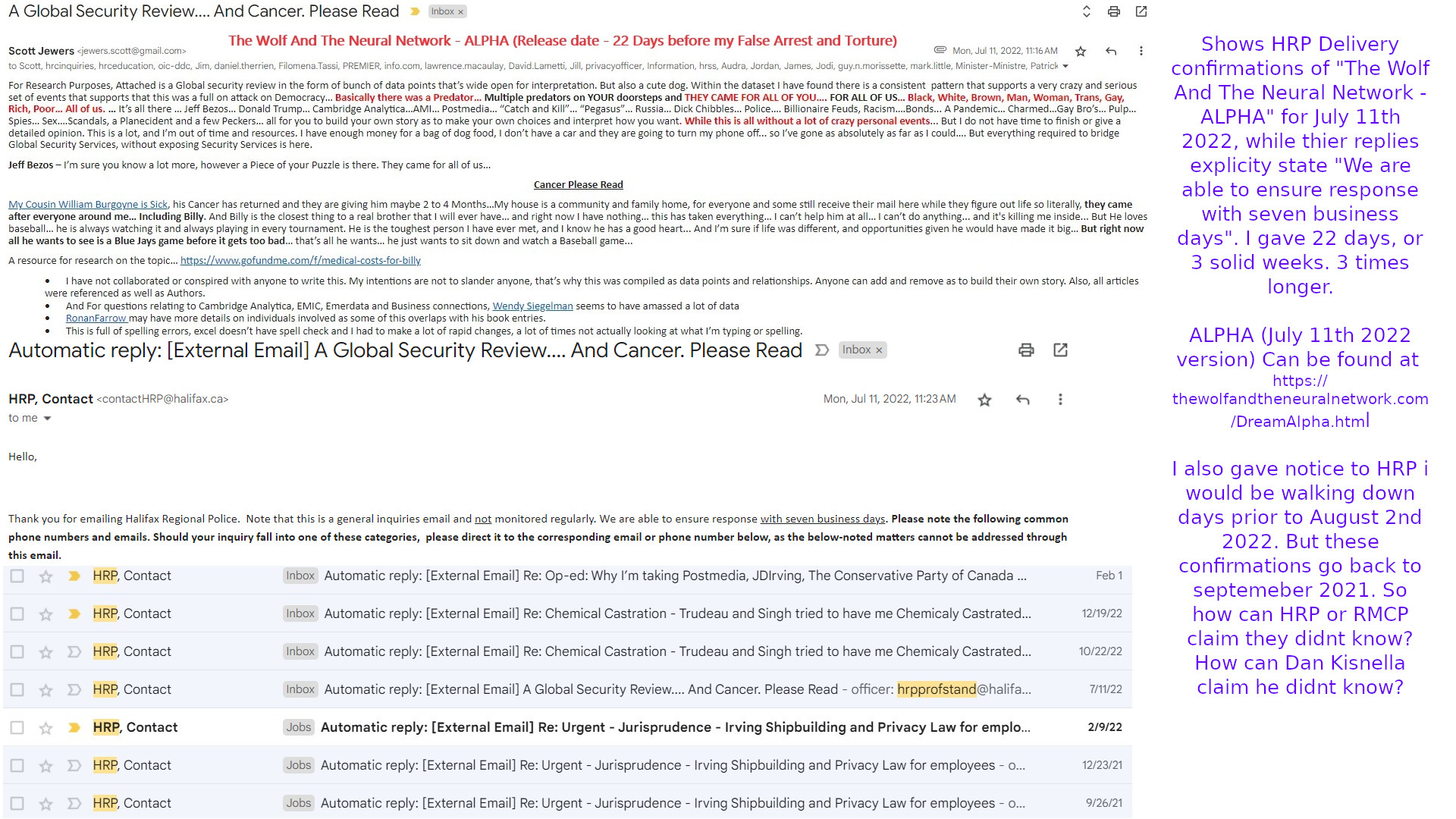

Image 2 – This image shows significant spikes in Google Analytics activity in late September 2021 and late July 2022, corresponding with the Burchells LLP incident, my July 29, 2022 request for email communication, and the August 1, 2022 Valent Legal email incident.
Tiny URL:https://tinyurl.com/24rk38fv
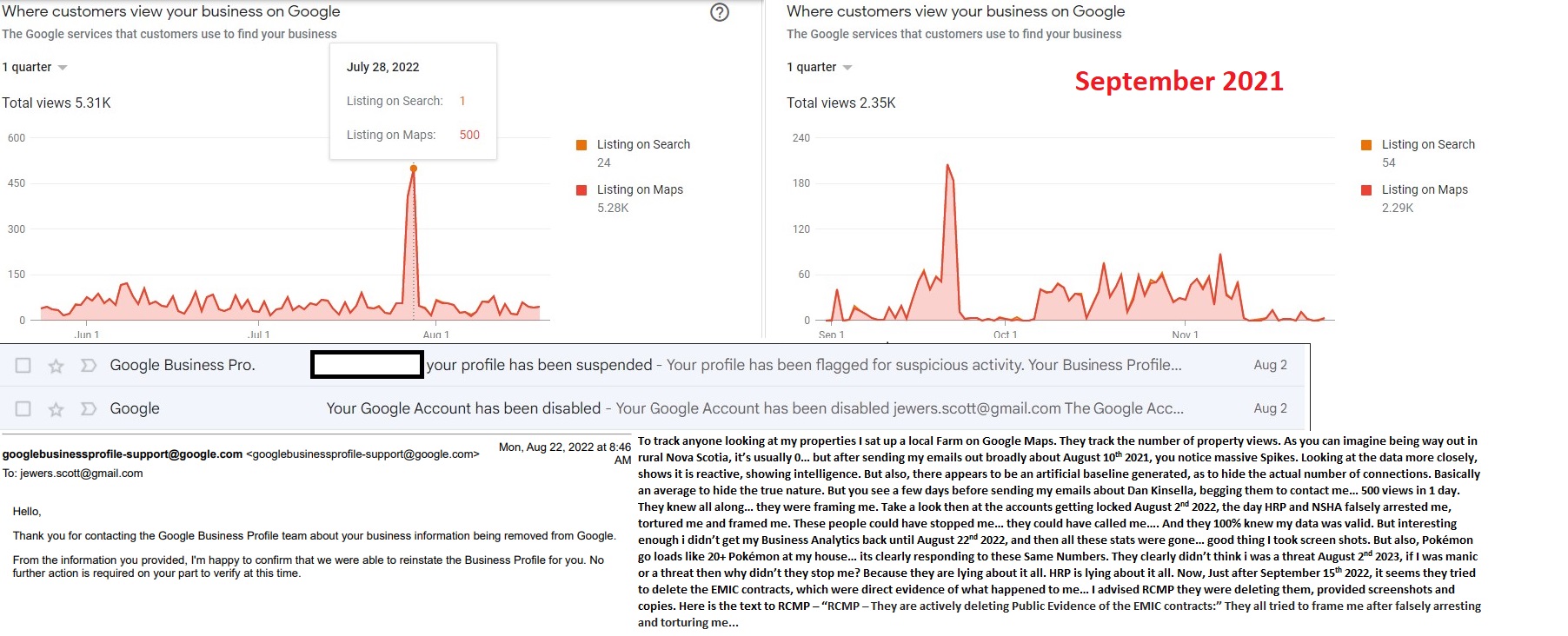
 Image 3: This image shows that I requested parties contact me by email so I could verify message headers and origin. This request was made days before the Valent Legal email incident.
Tiny URL: https://tinyurl.com/mu55m6k8
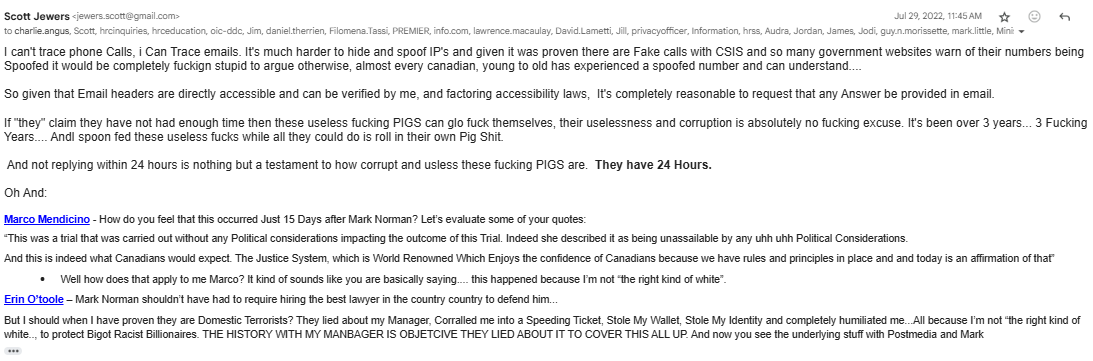

Image: This image shows the August 1, 2022 email appearing to originate from Valent Legal, along with Valent Legal’s confirmation that the email was not sent by them. It also shows the associated phone number, which matches the number referenced in the October 6, 2021 Burchells LLP / Bushells Lightning Protection incident.
Tiny URL:https://tinyurl.com/yc6k4576
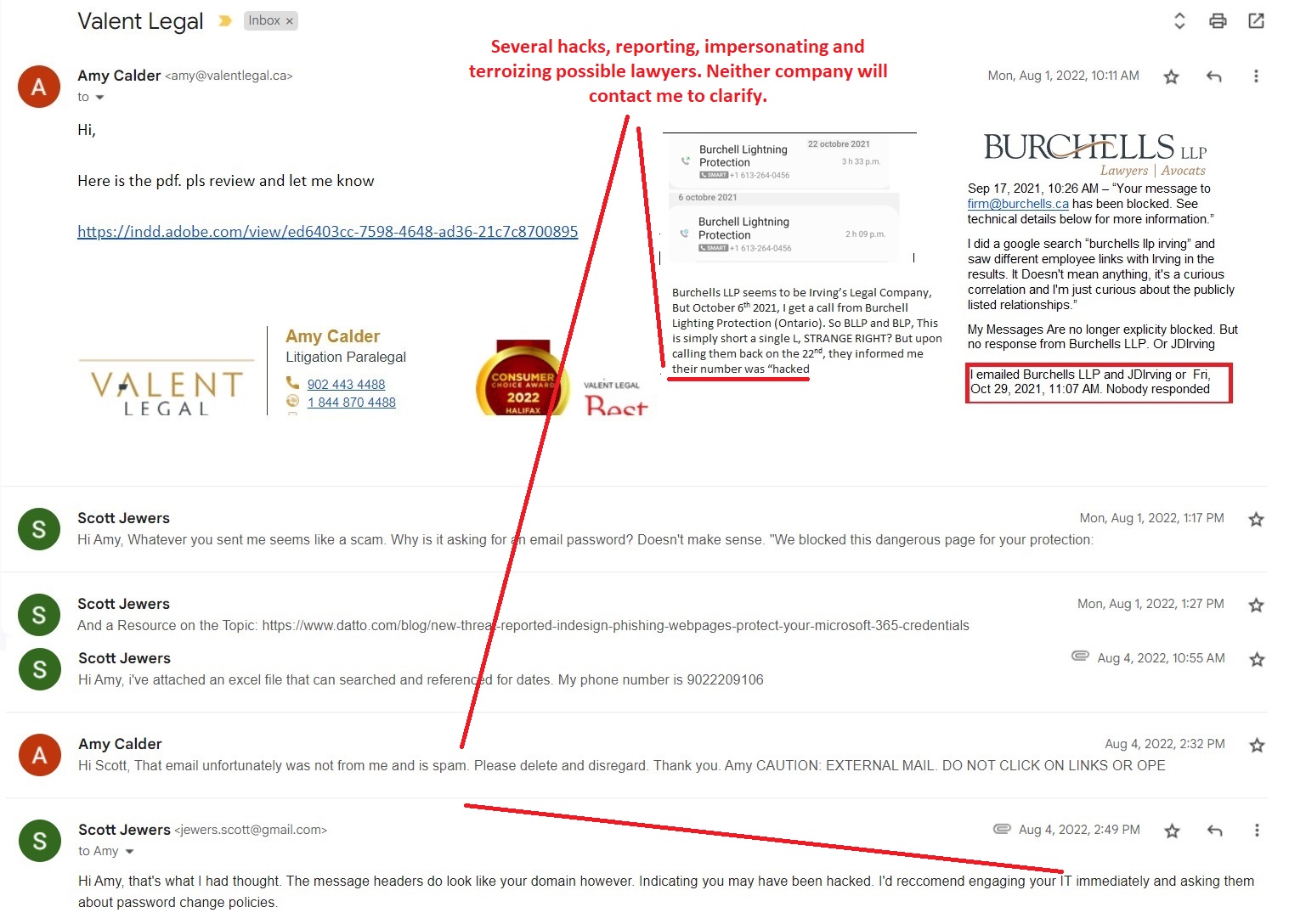

Image: This image shows independent AI-assisted analysis (Grok and ChatGPT) of the August 1, 2022 Valent Legal email headers, confirming that the email passed authentication checks and originated from, or was transmitted through, Valent Legal’s domain infrastructure.
Tiny URL: https://tinyurl.com/4hf9v2w9
Triage Issues — Records falsely state I was “protesting” at Halifax Regional Police.
Triage Notes — Characterization of Reason for Attendance
Statement
Triage notes state:
“BROUGHT IN BY POLICE. HE SAID WAS PROTESTING AT THE POLICE STATION.”
 IMAGE 1
Tiny URL: https://tinyurl.com/bdfv8ypb

Reality
I did not make that statement.
Halifax Regional Police records do not document that I was protesting, or anything similar. They reflect that I attended HRP to inquire about my wallet and to file a complaint regarding Chief Dan Kinsella.
On June 23, 2022, I received a response regarding the 2019 theft of my wallet, which HRP had previously stated was part of an ongoing matter. That response restricted information on the basis of another individual’s privacy. I attended HRP headquarters to seek clarification regarding that response and to file a formal complaint against Chief Dan Kinsella.
This was consistently explained to every individual I interacted with at NSHA, and no correction was made to the record.
At registration, a staff member took my blood pressure. I asked whether it appeared normal, and she confirmed that it was, particularly given the circumstances. She then asked if I understood why I had been brought in. I responded that I had attended HRP to file a complaint against the Chief of Police, that officers told me they were retrieving the necessary paperwork, and that they instead returned and arrested me. The staff member then looked directly at the officer and stated: “Really, are the handcuffs really necessary?”
Evidence
- NSHA has no statements from any Halifax Regional Police officer
- NSHA has no police documentation explaining why I was brought in
- No source exists for the statement in the triage notes
Conclusion
The “protesting” statement is attributed to me despite the fact that I did not make that statement and consistently denied it at every stage of interaction with NSHA.
No source is identified for this statement, and no supporting police documentation exists. Establishing the reason for apprehension is the responsibility of the apprehending officers, not the patient.
This characterization was carried forward into subsequent interactions without correction, resulting in my statements being treated as unreliable and materially affecting how my information was received and assessed.
As a result, this characterization is unsupported and unverified. Any clinical or administrative conclusions relying on this statement are not grounded in documented evidence.
Any suggestion that “this was all about me” or that actions were taken “to get me” is a fabrication by NSHA. It is not supported by my submissions and appears designed to fit a pre-determined narrative.
Any suggestion that “this was all about me” or that actions were taken “to get me” is a fabrication by NSHA. It is not supported by my submissions and appears designed to fit a pre-determined narrative.
CPSNS, in its responses, did not provide a single page reference or citation for the statements upon which it relied. This makes it effectively impossible for any independent body to review the evidence, confirm whether the information was actually recorded, or determine whether it reflects contemporaneous documentation or post hoc interpretation.
This creates a circular problem: generalized conclusions are presented without citation, and those same conclusions are then justified by reference to the length or complexity of the NSHA record. This significantly undermines transparency and makes it materially more difficult for any complainant to meaningfully respond to or challenge the findings. In effect, this allows NSHA and CPSNS to rely on a “God of the gaps” approach, continuously shifting the goalposts. Such an approach falls below the basic evidentiary standards expected in any serious professional, regulatory, or academic setting, where claims must be supported by clear references to the underlying record.
In contrast, each of my submissions includes specific page references and supporting materials for every point raised. This reflects a professional standard consistent with submissions intended for verification and independent review.
It is also consistent with The Wolf and the Neural Network – ALPHA, released July 11, 2022. This was a research-based document structured around over 400 data points organized chronologically in Excel and made available in web format throughout the CPSNS investigation. Each data point was individually assessable, rather than requiring interpretation through a single continuous narrative. The document explicitly cautioned against conspiracy theories, took an analytic approach, separated events, and urged independent verification. It cited all referenced articles and authors. It was not a personal account—it was a structured evidentiary submission compiled by a technical expert with over 18 years of experience.
The record shows that I was consistent in this approach well before the events of August 2022. The following demonstrates that the characterization of “this was all about me” is not only unsupported—it is directly contradicted by my own documented statements:
- During the investigation at Irving Shipbuilding, in discussions with directors, VPs, Jim Perrin, J.D. Irving, and federal and provincial government representatives, I made clear I was targeting a 70% confidence threshold. I detailed a 1% compounding reasoning method based on data points, explicitly acknowledged my bias each time, and asked all parties to independently verify the facts. They will confirm this.
- On December 23, 2021—eight months before the false arrest, torture, and sexual assault—when I released my security review of J.D. Irving, I stated explicitly (see Image 1):
“Introduction — I'm not saying this was all to deal with me, or about me. I suspect this was a general plan that spiraled out of control. I'll highlight how my role inside it was manipulated and how that seems to have evolved with time.”
(https://tinyurl.com/ehnh6vfx) - On July 11, 2022, when The Wolf and the Neural Network – ALPHA was released, the core email sent to dozens of involved parties stated (see Image 2):
“For research purposes, attached is a global security review in the form of a collection of data points that is wide open for interpretation… Within the dataset I have found a consistent pattern… All for you to build your own story, to make your own choices and interpret as you see fit.”
And further:
“I have not collaborated or conspired with anyone to write this. My intentions are not to slander anyone — that is why this was compiled as data points and relationships. Anyone can add and remove as to build their own story. All articles were referenced as well as their authors.”
Any statement by CPSNS or NSHA asserting that this was “all about me” should clearly define what “it” refers to, rather than attributing that characterization to me without evidentiary support.
Notably, had I submitted materials in the manner CPSNS and NSHA have—without citations or supporting references—it would likely have been characterized as disorganized, tangential, or unreliable. The standard applied by NSHA and CPSNS is indefensible and selectively applied.
Had CPSNS adhered to basic evidentiary practices, the reliability of its conclusions could be properly assessed. In the absence of such practices, those conclusions cannot withstand meaningful scrutiny.
The record is clear: I went to the police with compiled, well-organized evidence as a technical expert, supported by a valid FOI request and legitimate grounds to ask questions. I never claimed this was all about me—I stated the opposite, repeatedly, in writing, before any of these events occurred.
These deficiencies will be demonstrated in detail throughout this document.
 Image 1: Shows I ever said this was all about me Introduction — I'm not saying this was all to deal with me, or about me. I suspect this was a General Plan that spiraled out of control. I'll highlight how my role inside it was manipulated and how that seems to have evolved with time."
Tiny URL: https://tinyurl.com/5eb99em2

Letter HTML Version Tiny URL: https://tinyurl.com/ehnh6vfx
Letter HTML Full URL: https://www.thewolfandtheneuralnetwork.com/HTMLDocuments/December23rd2021_JDIrving_Security_Review.html
Image 2: Email sent to almost 100 addresses when TWNN Alpha Was launched. Clearly shows i stated this was not all about me, was released as chronologically ordered data points, almost all hyperlinked. Also Show HRP Delivery Confirmations.
Tiny URL: https://tinyurl.com/2327xhjh
Full URL: https://thewolfandtheneuralnetwork.com/Media/Resources/Add_2024_03/2022-07-11%20-%20Delivery%20confirmations%20of%20ALPHA%20delivery%20to%20HRP.jpg
TWNN ALPHA Tiny HTML URL: https://tinyurl.com/4z49th3r
TWNN ALPHA Full HTML URL: https://www.thewolfandtheneuralnetwork.com/Versions/Pages/ALPHA/2022_07_11_ALPHA.html
Retaliation – Service by Bailiff Following CPSNS Complaint against Nancy Murphy
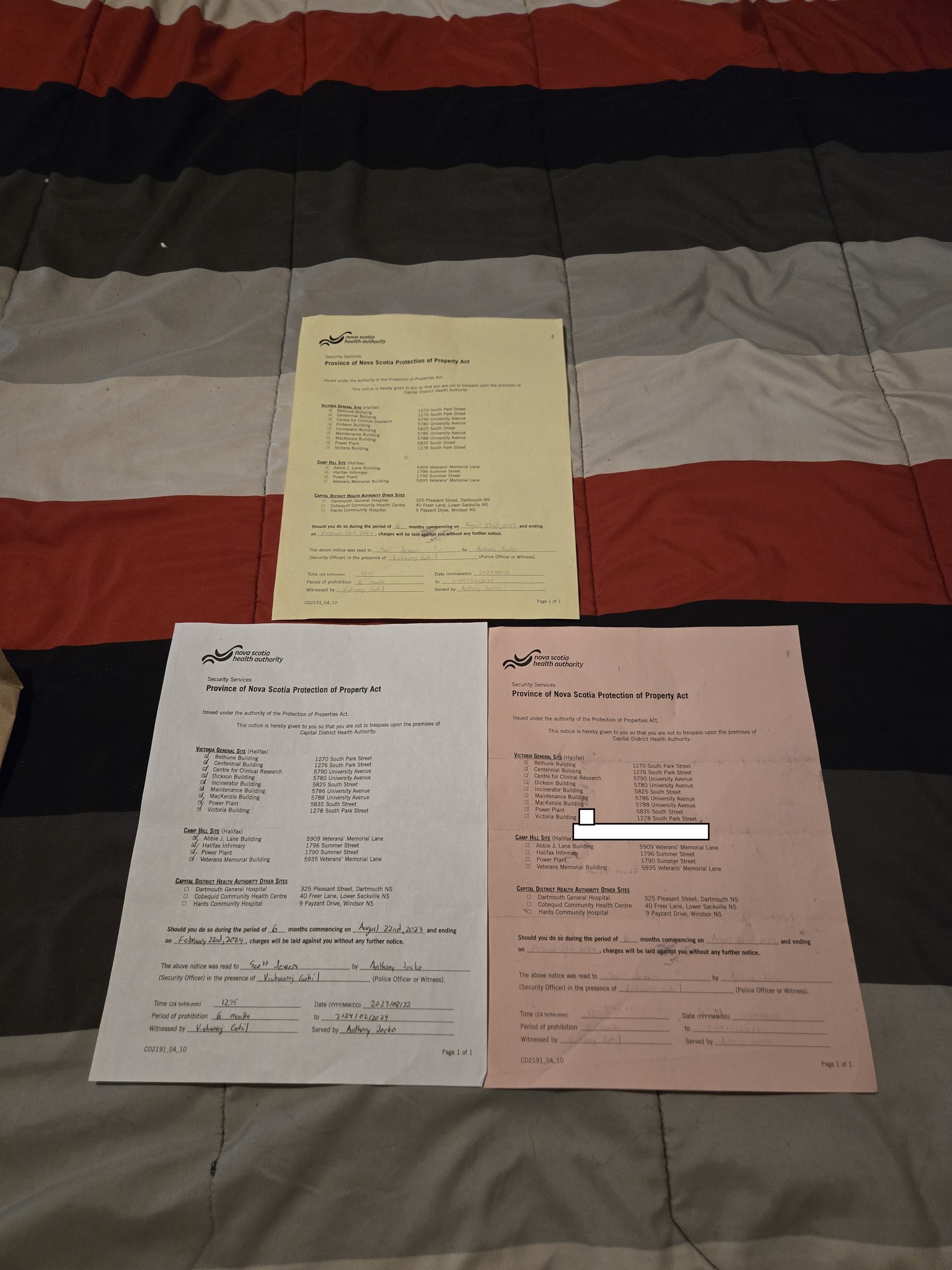
On August 15, 2023, I received confirmation from Crystal Morgan (CPSNS) that my complaint regarding Dr. Nancy Murphy had been received. The trespass notice is dated August 22, 2023; however, I was not served with this notice until August 31, 2023, when it was delivered by a bailiff. This delay and method of service were not explained or addressed by CPSNS.
The notice was issued in three copies (white (see Image 2), yellow, and pink (see Image 3)) and contains the following certification:
“The above notice was read to Scott Jewers by Anthony Jocko (Security Officer) in the presence of Vishwaraj Gohil (Police Officer or Witness).”
This statement is materially false.
The notice was not read to me on August 22, 2023, or at any other time. I was not present at any NSHA facility on or around that date, nor had I indicated any intention to attend one. I reside approximately 140 km away (one direction). There is no record of me causing any disturbance at any NSHA facility or with Halifax Regional Police, nor any history of behavioral issues in my medical file.
Further, the document raises significant concerns regarding its authenticity and the integrity of its completion. The handwriting in the “served by” and “witnessed by” sections appears substantially similar in letter formation, stroke pattern, and pen pressure, indicating that the same individual may have completed both sections, including signing on behalf of the purported witness. If so, the document falsely certifies both the presence of a witness and the occurrence of service as described. Alternatively, if it is asserted that separate individuals completed these sections, then either both are intentionally misrepresenting the events or there is the possibility of identity theft.
This may be connected to the prior theft of my book bag, health card (PHI), financial information, and personal belongings on August 2, 2022, when NSHA staff placed a large sticker on my book bag labeled “SCOTT” and then gave it to a homeless individual who was agitated and self-admittedly under the influence of drugs. The bag was subsequently transferred to the hospital before I had seen a doctor. As I was not present, it is unclear how this matter could be associated with me unless someone presented themselves as me or was in possession of my identifying information.
This raises serious concerns regarding the control, handling, and potential misuse of my personal identifying information, as well as the reliability of any records or representations derived from those circumstances.
The bailiff who ultimately served the notice indicated that the circumstances of the delivery, and the circumstances regarding how he had been contacted in relation to it, were not typical.
The timing and circumstances of this notice support a reasonable inference of retaliation. The notice was issued one week after CPSNS confirmed receipt of my complaint against Dr. Murphy, which raised serious and well-documented concerns regarding the accuracy and integrity of NSHA records.
These concerns are consistent with findings already acknowledged by CPSNS. Douglas Grant, Registrar and CEO of CPSNS, stated:
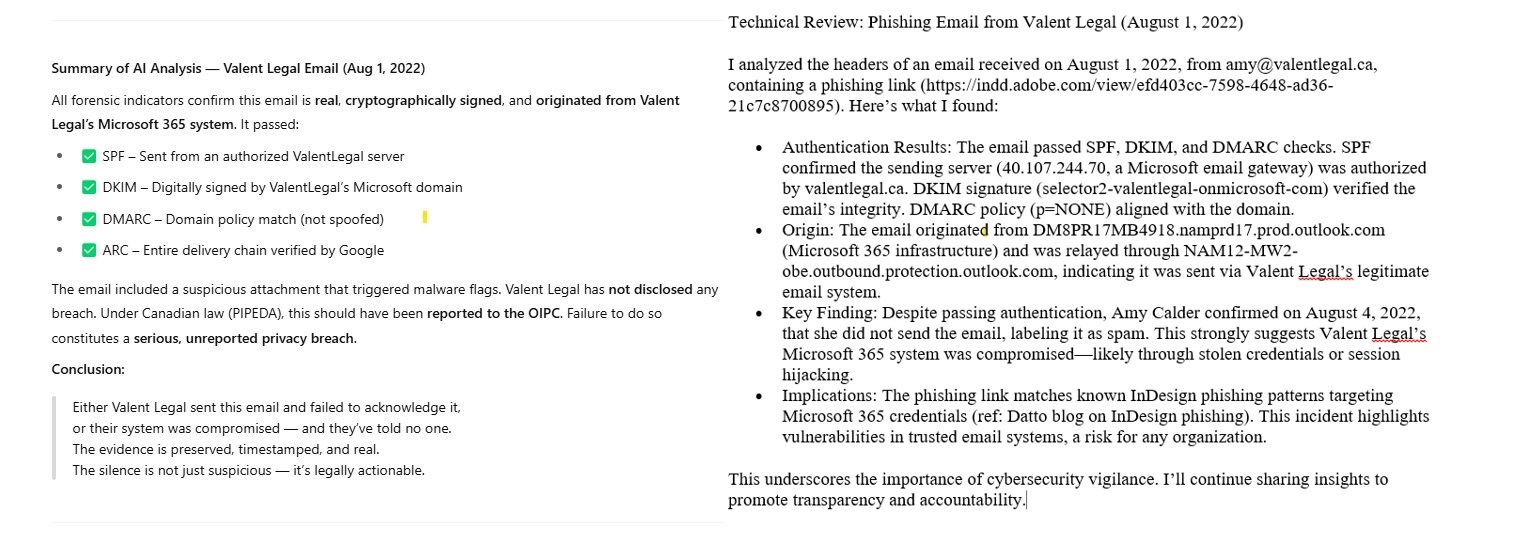
“Dr. Murphy acknowledges that her documentation of your Emergency Department encounter was incomplete. I advise Dr. Murphy to ensure her medical charting complies with the College’s Professional Standards and Guidelines Regarding Charting, particularly in cases where her medical-legal decisions, such as the need for involuntary treatment, may be challenged.” (See Image 1)
NSHA was contacted and asked to clarify these issues. Multiple voicemails were left for NSHA and CPSNS. No response or follow-up communication was provided.
The delay in service is also significant. For a period of nine days, I was unaware of the existence of this alleged trespass. During that time, I was exposed to the risk of arrest for unknowingly breaching conditions that had never been communicated to me. This was not a theoretical risk. My 80-year-old aunt regularly attends medical appointments at NSHA facilities, and I would ordinarily assist her. As a direct result of this notice and the uncertainty surrounding it, I was forced to drop her off at the curb and could not enter the property, leaving her to attend alone without assistance, including interpretation support.
Further, had I required medical attention myself, this notice would have effectively restricted my ability to access care, raising concerns regarding the denial or obstruction of medical services.
In this context, the issuance of a trespass notice containing false certification of service and witness presence, combined with delayed delivery and the absence of any underlying behavioral basis, raises serious concerns including, but not limited to:
- fabrication or falsification of official records;
- improper or defective service;
- possible unauthorized use of identity;
- abuse of process; and
- retaliatory conduct in response to a formal complaint.
This conduct is consistent with a broader, well-documented pattern of inaccuracies, omissions, and misrepresentations in records and statements associated with NSHA and CPSNS, as detailed throughout this submission.
By way of broader context, within a short period following the events underlying my complaints and the issuance of the NSHA trespass notice, which was fabricated:
- On November 2, 2022, the Halifax Regional Police union passed a no-confidence vote in Chief Dan Kinsella, with 96.6% voting no confidence (84% participation).
Source: https://www.cbc.ca/news/canada/nova-scotia/halifax-police-union-no-longer-has-confidence-in-chief-1.6638316 - On September 6, 2023—six days after I was served with this notice—Chief Dan Kinsella announced his retirement.
Source: https://www.cbc.ca/news/canada/nova-scotia/dan-kinsella-chief-of-halifax-regional-police-announces-retirement-1.6958447 - On September 19, 2023, RCMP Commissioner Dennis Daley indicated there would be an RCMP apology regarding street checks, an issue directly related to the broader context of my complaints.
Source: https://x.com/RCMPNS/status/1704200385387208735
This matter has been referred to the RCMP for investigation, including potential offences relating to document fabrication, forgery, misuse of identity, and the provision of false or misleading information to law enforcement, including offences consistent with public mischief (s.140), obstruction of justice (s.139), fabrication of evidence (s.137), and forgery and use of forged documents (ss.366–368) under the Criminal Code of Canada.
 Image 1
Tiny URL: https://tinyurl.com/4rn5bv9c
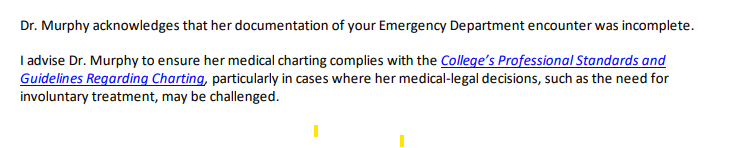
Image2: Single Page Tresspass Notice (White)
Tiny URL: https://tinyurl.com/4dh3fnx6
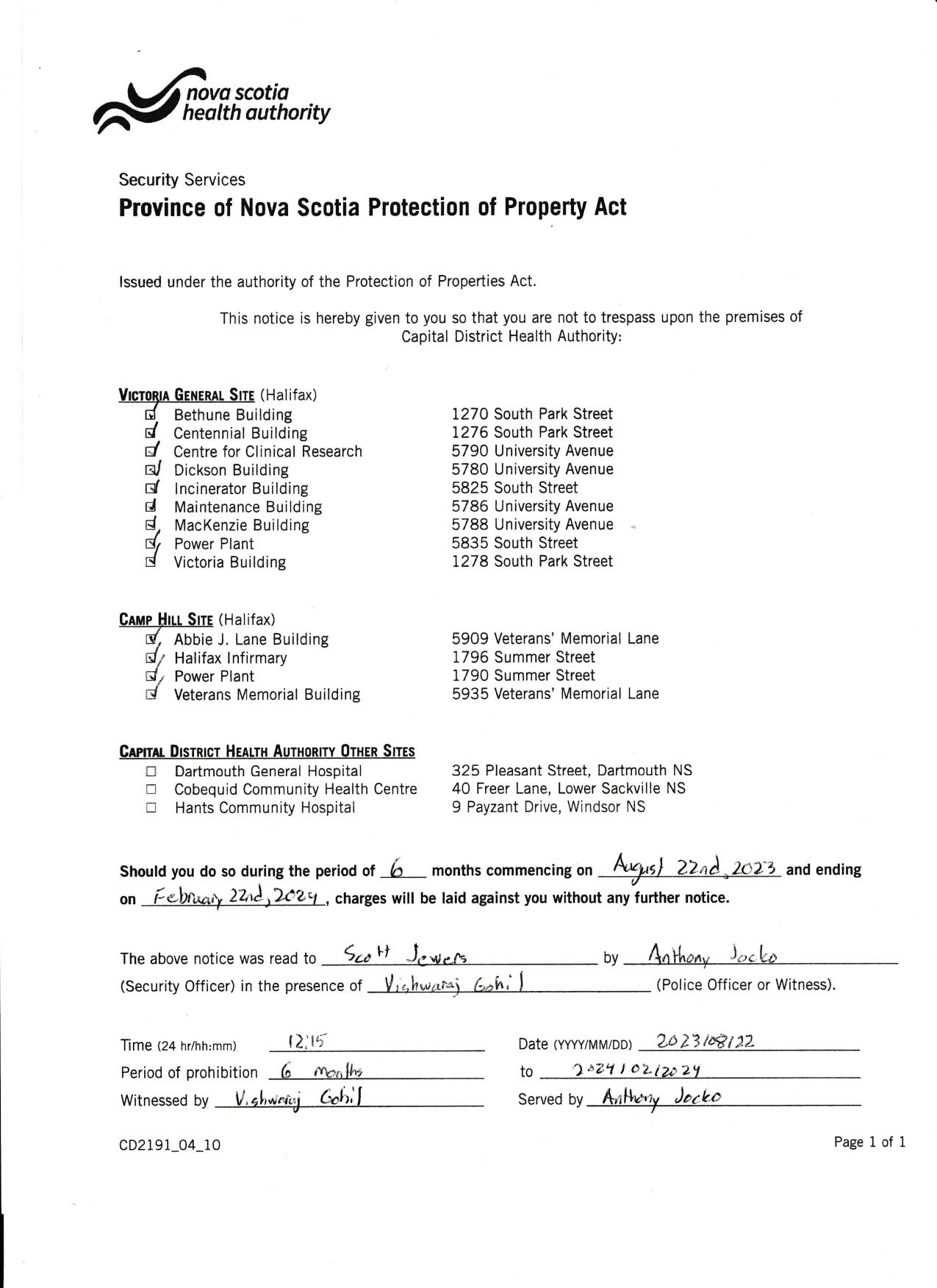

Image3: 3 Pages of same trespass notice sent by NSHA, White, Yellow and Pink.
Tiny URL: https://tinyurl.com/5cz6n6bn
Nancy Murphy
“You allege Dr. Murphy admitted you as part of a wider investigation into corruption and a cover-up by Nova Scotia Health.”
This is a false and defamatory statement intended to discredit and undermine my complaint. At no point have I ever said this or anything like it, nor have I implied that Nancy Murphy had knowledge of any broader “corruption” or “cover-up.” This is a fabrication by the College.
The statement appears designed to bias the reader by reframing my position into something that was never stated, allowing the College to dismiss the complaint under a mischaracterized premise while maintaining plausible deniability. All of my submissions were provided in writing. The College, or any professional body, could have directly quoted or cited the exact statement they relied upon. They could have provided a reference or link to where such a claim was made. They did not. This is a basic professional standard that was not followed.
For clarity, I refer to my October 10, 2023 submission (Reply to College regarding Nancy Murphy October 10th 2023.docx), which clearly does not state anything resembling the College’s claim:
Page 2:
“So given the inherent systemic bias and stigma that exists, I believe my best defense is to be completely honest and forthcoming… it’s important to be clear about some of the fundamental systemic bias that exists here and dismiss any notion of intentional ‘collusion’… Nancy Murphy, the College, and NSHA all have a shared interest in Nancy Murphy being innocent… While logically this same idea extends to HRP, RCMP and JDIrving.”
Page 3:
“…Nancy Murphy and NSHA knew that if they found me innocent that they would have to file a complaint and reasonably have to testify against Halifax Regional Police.”
Page 7:
“…HRP had already pulled the trigger of systemic bias… While had I been the ‘right kind of white’ such as an Irving, McNeil, or Trudeau then Nancy Murphy and NSHA in general would never have done what they did.”
There are no statements in my submission that suggest, imply, or support the claim that “Dr. Murphy admitted [me] as part of a wider investigation into corruption and a cover-up by Nova Scotia Health.” The record shows the exact opposite. I explicitly rejected the notion of intentional collusion and instead described systemic bias and institutional incentives.
This mischaracterization is not a minor error. It materially alters the substance of my complaint and is used to justify dismissing it. It undermines my credibility and reframes my position into something easier to disregard.
It is also a fact, independent of my personal views, that by the nature of Nancy Murphy’s role, if she had found me innocent in the context of a police-led detention, she would have been required to account for that finding, including testifying if necessary. She knew this. This reality exists regardless of my complaint and is inherent to the situation itself.
“violated your rights by having you involuntarily admitted to the Mount Hope Hospital; “
Nancy Murphy — Clarification and Record Issues
The overall record demonstrates that serious violations of my rights did occur, including the repeated denial of access to legal counsel.
Contrary to CPSNS’s statements, my belongings were transferred to Mount Hope before I had seen a doctor, and they were handled by another patient. This resulted in a serious privacy breach.
Nancy Murphy’s record does not address these issues. It also fails to document that Halifax Regional Police identified themselves as being in a conflict of interest, and no statement was obtained from HRP to support or justify the assertions being relied upon.
In addition, Nancy Murphy did not record The Wolf and the Neural Network – ALPHA, which was a structured research document discussed during the interaction. This document contained over 400 data points, acknowledged my own potential bias, and was presented in a clear, organized, and reviewable format. Its omission removes important context demonstrating that I was prepared and presenting information in a structured and evidence-based manner.
Nancy Murphy’s involvement is therefore relevant in that her record is incomplete and does not accurately reflect key facts, including that I was not protesting and the actual subject matter of our discussions. Instead, the record contributes to a narrative that does not align with what occurred.
At no stage did Nancy Murphy attempt to explain my rights to me.
It is also important to clarify an error in my original submission. Based on how names were provided to me by NSHA at the time, I initially attributed certain conduct to Nancy Murphy that was not accurate.
In my subsequent submission to CPSNS, I corrected this and issued a direct apology to Nancy Murphy. The records indicate that the conduct involving mocking and humiliation was carried out by Shante A. Blackmore, not Nancy Murphy.
This clarification is important to ensure the record is accurate. However, it does not change the underlying concern: the documentation remains incomplete, key facts were not properly recorded, and my rights were not clearly explained or facilitated.
“Humiliated you when you asked about your rights”
As clarified earlier, this did not occur with Nancy Murphy. At no stage did she actively degrade me, act in a condescending manner, or behave in a directly inappropriate way.
That conduct was attributed—based on how it was later presented to me by NSHA—to Shante A. Blackmore, who appears to have been a member of the Emergency Mental Health Team.
However, while Nancy Murphy did not engage in that conduct, she also did not take any steps to explain my rights.
At the time, she had been advised that:
- I had repeatedly requested access to a lawyer; and
- I was stating that I had been falsely arrested.
Despite this, no explanation of my rights was provided.
“had your belongings sent to Mount Hope Hospital without your knowledge;”
Nancy Murphy — The Belongings Transfer
The record confirms that my belongings were transferred to Mount Hope before I had seen a doctor and without my knowledge or consent.
Douglas Grant states in the CPSNS dismissal:
“There is no evidence to suggest Dr. Murphy had anything to do with the transportation of your belongings to Mount Hope, or that this was done prior to you being transferred there.”
The Mount Hope records directly contradict this. This evidence was provided to CPSNS multiple times, including being read directly over their voicemail. The internal note dated August 3, 2022 states:
“The client's belongings including wallet was brought to the unit with the previous client mistakenly.”
And then lists the contents of my wallet:
- Driver’s Licence
- Health Card
- Cash — approximately $40.00
- Scotiabank card and banking information
- Additional identification and financial items as listed in the inventory
This confirms three things:
- My belongings were already at Mount Hope before my arrival
- They were transported with another patient
- The transfer occurred before my assessment and without my knowledge or consent
Douglas Grant stated there is no evidence of this. The Mount Hope internal note is the evidence. It was in the materials he reviewed. His statement is directly contradicted by the record he claims to have reviewed in its entirety while it is another perfect example of NSHA fabricating false records and misconduct.
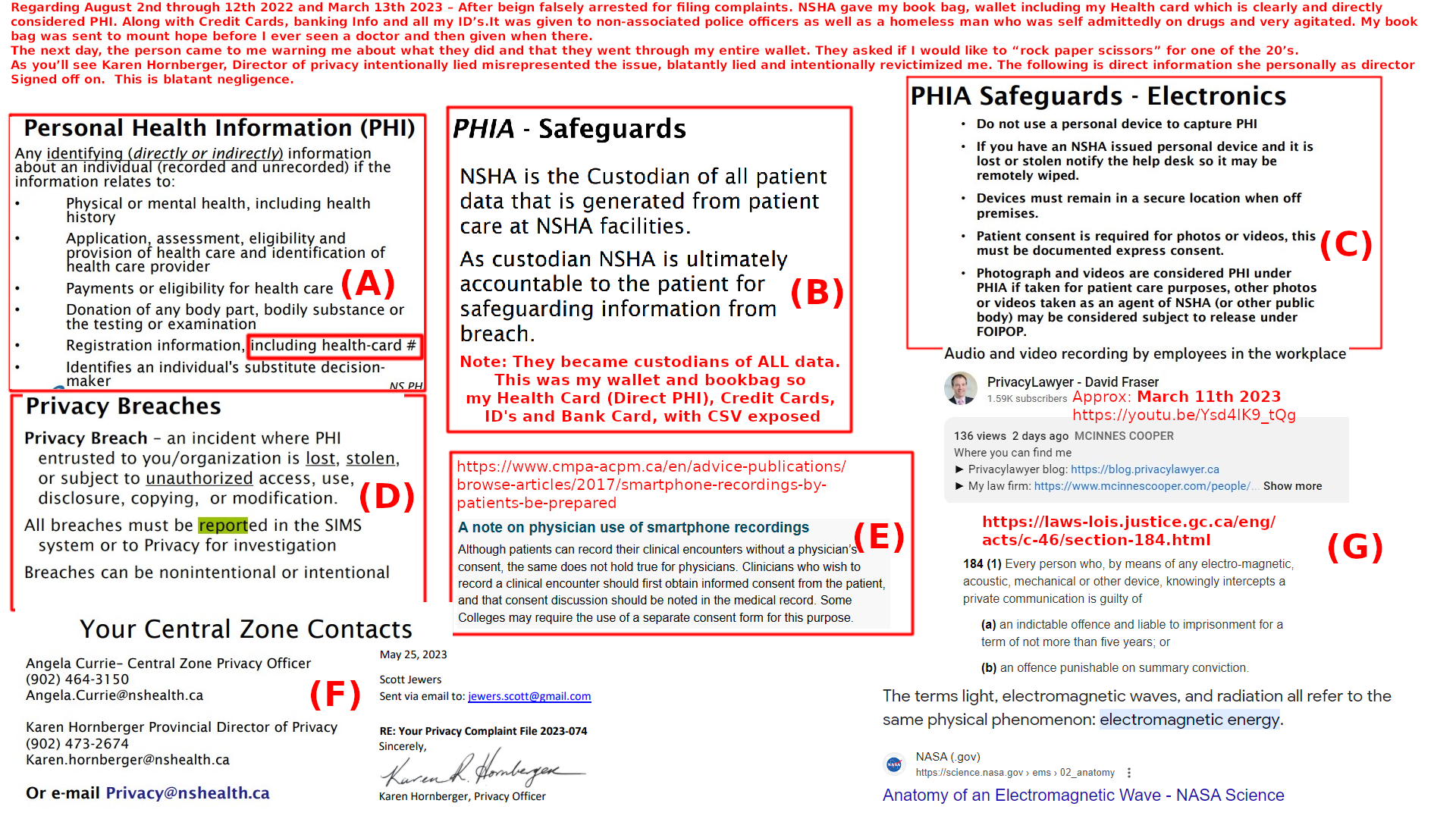
This is not a minor administrative issue. The record shows that my wallet was accessed and inventoried without my knowledge and contained personal identification, financial information, and my health card — which constitutes Personal Health Information under NSHA policy.
This constitutes a privacy breach, including potential exposure of Personal Health Information, financial information, and identity documents.
Under NSHA policy, this type of breach must be reported in SIMS and investigated. This is confirmed directly by documentation signed by Karen Hornberger, then Provincial Director of Privacy:
“Personal Health Information — any identifying information about an individual if the information relates to registration information including health card number.”
“Privacy Breach — an incident where PHI entrusted to you or the organization is lost, stolen, or subject to unauthorized access, use, disclosure, copying, or modification. All breaches must be reported in the SIMS system or to Privacy for investigation. Breaches can be nonintentional or intentional.”
What Occurred
To my understanding, the individual at this stage was Shante A. Blackmore. If this is incorrect, I will apologize and amend my records accordingly; however, this is how the matter has been presented to me by NSHA and CPSNS.
At this stage, I had been held by Officer A for several hours. When I requested access to a lawyer, he stated, “Even if I could get one, they can’t come back and talk to you,” which amounted to a denial of access to legal counsel. Aside from this statement, he did not engage in any abusive, belittling, or otherwise inappropriate conduct toward me, and I felt safe in his presence.
While waiting in the waiting room, two officers, well call them Officer B and C were holding an individual, well call Person A. Person A was pacing and clearly in distress. I felt concern for him. As he walked past, he said shakily, “Man… if you have problems, this is the place to be.” He remained under the control of the two officers.
At that time, I was speaking with the officer assigned to me and asked, “How much do you think J.D. Irving would pay to stay out of jail? $100,000, $1,000,000, $10,000,000… $100,000,000?”
Following this, both officers holding Person A looked directly at me, and one of them appeared visibly agitated, with his face turning red.
At one point, a woman attended to take my blood. I told her this was inappropriate given the circumstances. She responded, “What’s the problem if you have nothing to hide?” I advised her that I had been denied access to a lawyer and that I had been falsely arrested. It appeared that she did not alter the medical record directly and instead left a note or equivalent for Shante A. Blackmore.
At this stage, I had been awake since approximately 6:00 a.m. that morning. HRP records indicate dispatch at 3:10 p.m., while notes associated with Shante A. Blackmore extend to at least 3:21 a.m. the following morning, awake about 21 hours at this stage. Mount Hope records indicate I arrived no earlier than approximately 4:30 a.m, i had been in handcuffs for 11 hours, as i sat there completely calm the entire time.
I was taken into a room to wait for Shsante A. Blackmore, and while I was there, the officer who had been escorting me came in and asked if he could speak with me. He told me the night had not gone the way he expected and that our conversation had been one of the best he had had, adding that he genuinely hoped I would one day be able to trust someone. I thanked him and told him he seemed like a good person as well, but I also explained that, in my view, the reality was that they were going to detain me because they knew mistakes had already been made.
Next, Shante A. Blackmore entered the room, reviewed her papers, and immediately stated, “You have not been denied a lawyer.” I responded that I had been denied a lawyer and questioned how she could make that determination, given that I had been in handcuffs for approximately 10 hours and had repeatedly stated that I just wanted to go home. Based on the sequence of events, I believe she may have been responding to a note added by the nurse who took my blood, to whom I had explained that the situation was inappropriate and that I had been denied access to a lawyer. The nurse indicated she still had to complete her review. Shante A. Blackmore then reiterated that I had to discuss the situation or I would just be admitted.
I asked about my privacy given the stated conflict of interest and that she making me discuss this and she responded that they “take that very seriously.” I explained the conflict of interest, clarified again that I was not protesting, and outlined basic facts showing the conflict between HRP and their own acknowledgment of it. I noted that some of this could be publicly verified, including the conflict itself and general events. I also told her about The Wolf and The Neural Network – ALPHA, the premise of a book and research paper that was submitted of evidence and can support what im saying while i told her I am a technical expert with considerable experience and listed my job history. She replied, “I’m not here to fact check you.”
During this time, a new HRP officer entered the room (for clarity, I will refer to him as Officer D). He stood awkwardly and, after some time, said, “Scott?” I responded yes, and he indicated he would be taking over. This was despite the previous officer—who I had spent hours speaking with and whom I had personally asked to remain with me—stating earlier in the night that he would stay with me until 6 a.m. I then overheard Officer D speak with the officer who had been with me for hours, telling him he could leave or go get something to eat, which he declined. Based on this, I believed the original officer may have had concerns about the situation.
After he left the room, I told Shante that I no longer wished to discuss the matter and that it was inappropriate to require me to do so given the police situation. She looked directly at me and said, “That’s kind of paranoid, isn’t it?” and then stated, “I think we’re going to have to admit you.” When I asked why, she said I was paranoid about police. I clarified that I was not, and that they themselves had stated there was a conflict of interest.
She then stated that it was late and that I had no place to go and no way to get there. I advised that this was false, explaining that I had money for a cab and people waiting for me. As reflected in the Mount Hope records, the contents of my wallet confirm that I had funds specifically for transportation and food, and there are witnesses who can attest that they were waiting for me and were concerned about my whereabouts.
She then opened the door, stood in the doorway, and straddled it while speaking to the two officers, stating that I was being admitted. She then said, “Guys, he thinks you can hear him out here,” followed by, “Here Scott, test it, test it,” repeating this behavior. The new officer who had just entered the room laughed, while the officer who had been with me for hours did not. I remained calm, looked at the wall, and stated, “This is really inappropriate right now.”
Only at that point did she say I could have a lawyer and told me to go to the desk to ask for a phone. I stated that I would prefer to wait until the officers had left. The new officer then approached to remove the handcuffs and asked, “Do you have any questions for me?” I responded, “This isn’t right.” He then repeated the question loudly and aggressively, shouting directly in my face. I said no. This interaction occurred immediately following Shante A. Blackmore’s prior conduct, which, in my view, enabled and escalated the situation.
I then went to the desk, where a security officer and, to my understanding, Nancy Murphy were present. I stated that I had been told by Shante that I could use a phone to contact a lawyer. Nancy Murphy responded, “Honey, there is no phone,” and advised that my belongings had already been taken to Mount Hope.
I was repeatedly denied access to a lawyer—first in practice, then only offered access when it would no longer be meaningful by Shante A. Blackmore, and then denied again by Nancy Murphy—while NSHA had already caused a significant privacy breach. This occurred after Shante A. Blackmore had specifically stated that they take privacy “very seriously.”
I did not know who my belongings had been transferred to or how they had been sent to Mount Hope. On the morning following my transfer, Person A—who had previously been held by Officers B and C and had overheard me discussing how much J.D. Irving might pay to stay out of jail—approached me unprompted and stated, “Man, you can’t talk like that around police.” He also told me that the police had gone through my bag, including my wallet and identification. He further stated that he had woken up hugging my bag and asked if I wanted to play rock-paper-scissors for one of the twenty-dollar bills. I did not agree.
This means my belongings were not only transferred without my knowledge but mishandled in a manner that created a foreseeable and documented privacy risk and before i seen the doctor, just as i had claimed.
There is evidence within HRP Professional Standards records indicating that Officers B and C—who had previously been assigned to Person A—may have subsequently been assigned to me for approximately ten minutes immediately prior to my admission by Shante A. Blackmore (see Image 3):
“While at the hospital, Jewers custody was transferred several times between officers from day shift to night shift. At the time of his release, Jewers was in the custody of Cst Stephen Pope and Cst Jairus Lamphier… Cst Lamphier does recall relieving the dayshift officer and he and his partner only had custody of Jewers for approximately 10 minutes before they were informed by hospital staff that they could leave as Jewers was being involuntarily ‘formed’ by the doctor.”
However, based on my direct observations, only one new officer entered the room (referred to here as Officer D). I did not observe or interact with any partner accompanying that officer, nor was there an additional officer present corresponding to that description. The only officers present were Officer D and the same officer who had been with me for several hours.
This discrepancy should allow the RCMP, HRP and NSHA to review their records to determine whether Officers B and C—who had been handling Person A—were subsequently reassigned to me during that approximately ten-minute window.
As both Person A and I were transferred to Mount Hope early that morning, I believe that only our records, or very few others, would exist for that specific transfer period.
Conclusion
The documentary record directly contradicts CPSNS’s position. My belongings were transferred prior to my arrival, handled incorrectly, and accessed without my knowledge. This is not an allegation — it is confirmed by the Mount Hope internal notes. This shows multiple NSHA employees did not record serious events, including Nancy Murphy. This was not just an issue with her records, but with NSHA as a whole.
This is particularly significant given that Douglas Grant himself states in the dismissal:
“Dr. Murphy acknowledges that her documentation of your Emergency Department encounter was incomplete.”
“I advise Dr. Murphy to ensure her medical charting complies with the College’s Professional Standards and Guidelines Regarding Charting, particularly in cases where her medical-legal decisions, such as the need for involuntary treatment, may be challenged.”
This confirms that CPSNS was aware the record was incomplete, yet still relied on that same record to dismiss the complaint.
This also raises the question of whether Shante A. Blackmore was aware of the transfer and whether the admission occurred in that context. In addition to Nancy Murphy acknowledging her notes are incomplete, the false characterization that I was protesting, the claim that I “lived with my parents,” and the transfer of my belongings before I had seen a doctor while being denied access to a lawyer, these actions collectively created significant legal implications.
Douglas Grant stated there is no evidence to suggest this occurred prior to my transfer. The Mount Hope internal note dated August 3, 2022 states explicitly that it did. That note was part of the materials he claims to have reviewed.
At a minimum, this represents a failure in handling personal property and confidential information. At worst, it constitutes a reportable privacy breach under NSHA policy that was not properly investigated or addressed — and a CPSNS dismissal that directly contradicts the documentary record it claims to have reviewed.
 IMAGE 1
Tiny URL: https://tinyurl.com/bdh67fuc
.png)
 IMAGE 2
Tiny URL: https://tinyurl.com/54rfvx7r
“fabricated your encounter in the Emergency Department;”
Douglas Grant himself stated:
- “Dr. Murphy acknowledges that her documentation of your Emergency Department encounter was incomplete. I advise Dr. Murphy to ensure her medical charting complies with the College’s Professional Standards and Guidelines Regarding Charting, particularly in cases where her medical-legal decisions, such as the need for involuntary treatment, may be challenged.” (See Image 1)
- Conclusion: He explicitly acknowledges the record was incomplete in a context where medical-legal decisions were being made and could be challenged — which is exactly the situation here. The issues now present arise directly from that incomplete documentation.`Clearly these parties did not think they would be held accountable, and as soo as scrutiny is applied, even the registrar admits there were record issues.
I filed complaitn against Nancy Murphy on
• NSHA falsely claims I was found protesting. This was clarified directly to Nancy Murphy, with no correction made. There are no statements from any HRP officer explaining why I was brought in or supporting that characterization.
• I was denied access to a lawyer repeatedly. Nancy Murphy was advised of this. Even when she was told that Shante A. Blackmore stated I could use a phone to call a lawyer, Nancy Murphy responded: “Honey, there is no phone.” At no point did Nancy Murphy explain my rights.
• My bookbag and wallet — containing Personal Health Information and financial information — were transferred before I had ever seen a doctor.
• Nancy Murphy failed to record that HRP identified themselves as being in a conflict of interest.
• Nancy Murphy did not record that The Wolf And The Neural Network project was submitted as direct evidence. She was told it was launched July 11th, 2022, as a research paper, the premise of a book, and supporting documentation in my investigation, including my stated bias. Instead, selective fragments were taken and reframed. For example, I explained the project covered populism, technology, AI, and personal events including police interactions during the investigation. Those points were reduced and interpreted in a way that does not reflect the full context provided.
• Nancy Murphy recorded statements suggesting I claimed to be “really smart” and intended to work with CSIS or the RCMP in a way that implies grandiosity. In reality, I explained that once the situation was resolved, I would like to apply my skills meaningfully, including potentially contributing to institutions addressing serious issues. I am a technical expert with 18 years of experience and have multiple references supporting my work. That context was not accurately reflected.
The record shows a pattern of incomplete documentation (acknowledged by Douglas Grant), omission of key facts, failure to correct known inaccuracies, and selective interpretation of statements. When individual entries are examined, they can be clarified, but those clarifications are not reflected in the record. There are no documented statements from HRP confirming investigative steps or findings. Despite references to an “investigation,” no supporting police documentation is included, and the stated conflict of interest was not recorded. The result is a record that relies on assumptions rather than verified facts.
The deficiencies in the record, particularly in a medical-legal context involving involuntary treatment, raise serious concerns about the reliability of the documentation and the fairness of the process that followed.
Image 1
Tiny URL: https://tinyurl.com/4rn5bv9c
“denied your request to contact a lawyer; and”
I advised Dr. Nancy Murphy that I was being denied access to a lawyer. I explained that I had asked the officer holding me about contacting counsel and was told, “Even if you get a lawyer, they can’t come back and talk to you.” I further advised Dr. Murphy that I had been falsely arrested, did not understand my rights, and was concerned that any perceived lack of cooperation would later be mischaracterized as non-compliance. In good faith, I therefore offered my general cooperation, which was not reciprocated.
When I asked Dr. Murphy directly about contacting a lawyer, she stated that there was no way to do so. Even after Shante A. Blackmore indicated that I could have access to a lawyer, Dr. Murphy told me, “Honey, there is no phone.”
Only after I had already been admitted did Shante A. Blackmore indicate that I could access a lawyer. I then went to the front desk and attempted to pursue this.
I have maintained this account consistently from the beginning. However, there is no record that I can identify showing that either Dr. Murphy or Shante A. Blackmore documented my repeated requests for a lawyer.
Further, it appears that a nurse who took my blood made a note intended for Shante A. Blackmore, possibly because they were not permitted to write directly in the formal record. This raises concern that relevant information was not properly incorporated into the official chart.
These omissions must be considered in the broader context of the record. It is already established that:
- I was incorrectly characterized as “protesting,” despite no supporting record;
- Dr. Murphy has acknowledged that her documentation was incomplete; and
- there are documented discrepancies regarding the handling of my belongings, including my bookbag.
The issues arising from NSHA and Dr. Murphy are not isolated incidents; they reflect a pattern of negligence.
In that context, there is a clear and credible concern that documentation of my requests for a lawyer was omitted. This concern is further supported by the fact that Shante A. Blackmore only advised me that I could access a lawyer after I had already been admitted, despite being aware that I had been requesting one beforehand.
“took your blood and did imaging without your consent.”
Dr. Nancy Murphy did not explain my rights to me at any stage.
At the outset, I initially agreed to the procedures because I did not understand the circumstances or the length of time I would be detained. I believed — as it was explained to me — that the process would be brief, not 11 hours. However, the timeline reflects otherwise. I had been awake since approximately 6:00 a.m. that morning. HRP records indicate dispatch at 3:10 p.m., while notes associated with Shante A. Blackmore extend to at least 3:21 a.m. the following morning. Mount Hope records indicate I arrived no earlier than approximately 4:30 a.m.
This reflects approximately 11 hours in custody in handcuffs, during which I was also denied access to a lawyer. By the time I was assessed by Shante A. Blackmore, I had been awake for close to 21 hours, and was exhausted, hungry, and under significant stress. The prolonged use of handcuffs and extended detention were humiliating and coercive. These conditions fundamentally altered the context in which any earlier “consent” was given.
Dr. Murphy advised that if I did not consent, it would be recorded that I was “not cooperative.” This created clear pressure to comply and undermined any ability to provide free and informed consent. In this context, any apparent compliance cannot reasonably be considered voluntary.
I raised serious concerns each time procedures were performed. When I was taken for imaging, I was visibly hesitant and crying. An officer asked, “Scott, what’s wrong?” I responded by asking whether he would remove his clothes and enter the machine under the same circumstances — particularly knowing that any perceived irregularity could result in continued detention. He replied, “I’ll be honest, no.” The technician operating the machine also spoke with me briefly.
When a nurse came to take my blood, I again raised concerns about the appropriateness of the situation. She responded, “What’s the problem if you have nothing to hide?” I reiterated that I had been denied access to a lawyer repeatedly and had been held for hours. The nurse made a note at that time, which does not appear to have been incorporated into the formal record.
At that stage, I had clearly revoked any prior consent. I was being pressured, told that refusal would make me appear guilty or non-cooperative, and was denied access to legal counsel. These conditions are inherently coercive and incompatible with free, informed, and ongoing consent.
This was an excessive and coercive detention, during which I was denied access to a lawyer and subjected to medical procedures without valid consent.
These circumstances fail the requirements of informed consent, including voluntariness, adequate disclosure, and the ability to meaningfully exercise a choice.
Nancy Murphy asked about my book and research paper but did not record The Wolf and the Neural Network (TWNN) or its context, which had been released three weeks earlier. Instead, she selected individual topics and characterized them as a “flight of ideas,” to fit thier pre-existing narrative so they wouldnt have to testify
During my assessment, Nancy Murphy asked about my book and research paper. She did not record The Wolf and the Neural Network — ALPHA by name, nor did she document that it was a structured research project that had been publicly released approximately three weeks prior to the assessment.
TWNN – ALPHA consisted of over 400 data points, chronologically ordered, cross-referenced, and hyperlinked. It had been delivered to dozens of recipients, including Halifax Regional Police, with delivery confirmations received from HRP indicating a response within seven days. No such response was provided prior to the events of August 2, 2022.
Instead of recording the work accurately, individual topics were selectively extracted and recorded out of context. Those isolated points were then characterized as a "flight of ideas."
This characterization does not reflect what was actually presented. By omitting the name, scale, structure, and documented distribution of the work — including the confirmed HRP delivery — the record fails to accurately represent the substance of the discussion. What is recorded is not a clinical observation of disordered thinking. It is the result of selectively extracting fragments from a structured, documented, and widely distributed research submission and presenting those fragments as though they had no context, no source, and no structure.
In any standard professional or law enforcement context, material of this nature — a structured submission delivered to police with confirmed receipt — would be directed to investigators for assessment. That did not occur.
The manner in which the information was handled is consistent with what can reasonably be described as a deliberate reframing exercise: isolated details were extracted without context and used to support a predetermined narrative. That narrative served Nancy Murphy's interests directly — specifically, by avoiding the need to testify regarding the false arrest, the denial of legal counsel, the privacy breach involving my belongings, and the conduct of HRP. Not testifying is objectively cheaper and easier for NSHA. The record, as constructed, makes that outcome significantly more achievable.
Kristen Holm
Use of “Conspiracy” / “Theory” Label — Prejudicial Characterization
The use of terms such as “conspiracy” or “theory” by CPSNS and Dr. Kristen Holm reflects a conclusion reached without investigation and without review of the underlying evidence. This characterization appears to have been based on the identities of the individuals referenced — including Stephen McNeil, Daniel Kinsella, and Postmedia — rather than on any evidentiary assessment of the substance of what was reported.
Under this heading, any issue taken to HRP is treated as a “conspiracy theory.” CPSNS has failed to define, in any way, shape, or form, what the threshold is, how that determination is made, or what someone is supposed to do when they have actual evidence.
This results in a circular and self-validating process: matters are labeled as “conspiracy” without investigation, and that label is then used to justify the absence of investigation. When asked who investigates, CPSNS and NSHA state that it is the police. A perfect example of this is asking CPSNS to review the bulk of the work — they state that it is not their job, and when asked who it is, they point back to the police, who then point back to NSHA and CPSNS and rely on their records in place of an actual investigation. This is exactly what HRP Professional Standards, including Cory Bushell and Trevor Allen, did in their reviews.
No investigation has ever been completed. As a result, CPSNS labeling the material a “conspiracy theory” is not based on evidence, but on convenience and self-imposed ignorance. At the same time, they provided no references, citations, or page numbers to support their dismissals or allow for independent verification by any third party. If I had done what CPSNS and NSHA did, it would be characterized as delusional, disorganized, and tangential.
The application of this label, in the absence of defined standards or any evidentiary review, is clear evidence of extreme prejudice and institutional hypocrisy.
What CPSNS and NSHA did was effectively demonstrate their own institutionalized delusional psychosis, where they position themselves as victims, take no responsibility for their statements, and others pay the price for their violence.
The Basis for Attending HRP Was Legitimate and Documented
Every Canadian has the right to attend a police service and have a matter investigated. In this case, the basis for attending HRP was not speculative — it was grounded in HRP's own prior statements and a formal FOI process.
Halifax Regional Police had previously stated that the matter involving my wallet was part of an ongoing investigation. A Freedom of Information request was subsequently submitted at the direction of legal counsel. On June 23, 2022, HRP responded, restricting disclosure on the basis of another individual's privacy. That response created a direct inconsistency requiring in-person clarification.
Attending HRP to seek clarification on a matter HRP itself had described as ongoing, and to file a formal complaint against the Chief of Police, is a straightforward exercise of procedural rights. It does not require further justification. As confirmed on the Halifax Regional Police website, members of the public are entitled to file a complaint against any HRP officer, including the Chief:
At the time of attendance, I had also compiled over 400 structured data points — including technical analysis, infographics, third-party statements, evidence of hacking activity, EMIC contract details, GPS location data, and documentation of intimidation involving multiple entities. Multiple witnesses exist to serious events. This material had been delivered to HRP with confirmed receipt. I was not permitted to file my complaint.
The Assessment Substituted Assumption for Evidence
None of the NSHA staff who assessed me conducted an independent investigation of the underlying events. Dr. Holm confirmed in audio that she had not contacted police and relied solely on emergency department documentation. The characterization of my account as a "conspiracy" or "theory" was therefore not a conclusion reached through investigation — it was an assumption applied in place of one.
This matters because the logic applied was circular: HRP arrested me, therefore HRP must have had grounds, therefore whatever I reported must be unfounded. That reasoning does not constitute an evidence-based assessment. It substitutes the fact of an arrest for the outcome of an investigation that was never conducted.
In any standard professional or law enforcement context, a submission of this nature — over 400 structured, referenced data points delivered to police with confirmed receipt, covering hacking activity, GPS tracking, EMIC contracts, and election interference — would be referred to investigators for assessment. Instead, individual elements were selectively extracted, removed from their documented context, and characterized as disorganized or delusional. A structured submission of 400 cross-referenced data points is not a flight of ideas. That characterization reflects the assessor's conclusion, not the nature of the material.
The Kristen Holm Discrepancy
This is made more significant by what the audio record shows. The recorded discussion was limited to Stephen McNeil and Postmedia. In her written record of that same interaction, Dr. Holm replaced these references with "Stephen Harper" and "Bell Media," and characterized my speech as "pressured and tangential." The audio recording does not support that characterization. This discrepancy is addressed in full in the section "Changing Stephen McNeil and Postmedia to Stephen Harper and Bell Media."
What Is Not in Dispute
At a minimum, the following facts are not disputed:
- The theft of my wallet occurred.
- A Freedom of Information request was submitted at the direction of legal counsel, and the response was restricted on the basis of another individual's privacy.
- Halifax Regional Police had previously stated that the matter was part of an ongoing investigation.
- I attended HRP to seek clarification and to file a formal complaint — rights confirmed on HRP's own website.
- I had compiled and delivered over 400 structured data points to HRP prior to attendance, with confirmed receipt.
These are not the actions of a person in a delusional episode. They are the actions of a technical professional pursuing a documented matter through legitimate institutional channels.
Charter Implications
Characterizing reported concerns as a “conspiracy” or “theory” without investigation necessarily implies that certain individuals or explanations can be excluded without evidence. That is not consistent with how legal or investigative processes function. It substitutes assumption for assessment and undermines the integrity of the process.
The Involuntary Psychiatric Treatment Act (IPTA) explicitly requires that:
- IPTA — (h) any declaration of involuntary admission or declaration of incapacity is made on the basis of evidence. (2005, c. 42, s. 2)
https://tinyurl.com/zte2kh4j
The conduct described is inconsistent with this requirement. No investigation was conducted, no evidentiary standard was applied, and conclusions were reached in advance of any assessment of the underlying material, while CPSNS did not seek to clarify a single point.
This engages fundamental protections under the Canadian Charter of Rights and Freedoms:
- Section 7 — the right to life, liberty, and security of the person, including the right to a fair and non-arbitrary process;
- Section 15 — equality before and under the law, including equal access to legal and investigative processes.
The characterization applied is not supported by investigation, is inconsistent with due process, and is incompatible with both the statutory requirements of the IPTA and the constitutional protections set out above.
Kristen Holm claimed that I was “protesting” outside Halifax Regional Police.
In her statement to CPSNS, Dr. Kristen Holm states that I was “protesting at the police department to prove facts of a theory or conspiracy.”
I was not protesting.
The documented purpose of my attendance at Halifax Regional Police on August 2, 2022 was as follows:
At the direction of legal counsel, I submitted a Freedom of Information request regarding the theft of my wallet in 2019. On June 23, 2022, I received a response. That same day, Kevin Mooney, CEO and President of Irving Shipbuilding, stepped down. The FOI response restricted information on the basis of another individual’s privacy, which directly conflicted with earlier statements that the matter was ongoing.
As a result, I attended HRP headquarters to seek clarification regarding that response and to file a formal complaint against Chief Dan Kinsella.
HRP records do not document that I was protesting. They contain no characterization remotely consistent with the triage notes or Dr. Holm’s statement. In the audio recording, Dr. Holm does not use the word “protesting” at any point.
The audio recording dated August 5, 2022 directly contradicts Dr. Holm’s written record on this point:
- 01:29 – 01:34 — Scott Jewers: “Okay, can I ask—did you contact the police about my wallet and the case?”
(Audio: https://youtu.be/9dGY_N9ni1w?t=89) - 01:34 – 01:37 — Dr. Holm: “I haven't contacted the police — no.”
(Audio: https://youtu.be/9dGY_N9ni1w?t=94) - 02:14 – 02:21 — Dr. Holm: “From what I understand, I haven’t spoken to police; it’s only what was documented in the emergency department. Right.”
(Audio: https://youtu.be/9dGY_N9ni1w?t=134) - 03:20 — Dr. Holm: “It wasn't about your behaviour, it was about what you were talking about.”
(Audio: https://youtu.be/9dGY_N9ni1w?t=200)
That final statement is significant. Dr. Holm confirms in her own words that the decision to admit me was not based on my conduct, but on the content of what I was saying. This is inconsistent with a legitimate clinical basis for involuntary admission and aligns with the broader pattern of conduct documented throughout this submission.
The characterization that I was “protesting” is inaccurate, unsupported by police records, inconsistent with the audio recording, and contradicted by Dr. Holm’s own statements.
This issue is addressed in further detail in the section “Triage Notes — Characterization of Reason for Attendance.”
The same false characterization appears in the NSHA triage notes—where it is attributed directly to me—and in Dr. Holm’s statement—where it is presented as her independent assessment. The appearance of the same unsupported characterization in two separate records, produced by different individuals, constitutes a documented inconsistency that warrants independent examination.
falsified documents and records;
Kristen Holm Changing Stephen McNeil and Postmedia to Stephen Harper and Bell Media in written record
The most striking fabrication—one that fundamentally discredits Kristen Holm’s record and calls into question her credibility as a witness—arises from a direct comparison between the audio recording of August 5, 2022 and her written notes.
In her record, she states that I “kept going back to connections between Bell Media, Irving, and Stephen Harper.” Bell Media and Stephen Harper were never mentioned by me—not once. My statements were consistent and focused on Stephen McNeil and Postmedia, clearly within the context of Halifax Regional Police.
By substituting entirely different individuals and entities, she materially altered both the meaning and context of what was being discussed. These are not minor discrepancies—they are distinct and unrelated parties. This change prevents any reader from accurately assessing the relationships, timelines, and potential conflicts of interest connected to Halifax Regional Police, including those involving Jim Perrin, Robin McNeil, and Stephen McNeil.
This misrepresentation is directly contradicted by the audio recording. At timestamp 03:20, Kristen Holm herself states:
“It wasn't about your behaviour, it was about what you were talking about.”
https://youtu.be/9dGY_N9ni1w?si=BOWcaM8GtNqE_j9F&t=200
This statement is critical for two reasons. First, it confirms that the content of my speech—not my conduct—was the basis for the admission decision. Second, it directly contradicts her characterization that I was “protesting” outside HRP, which is a physical act, not a speech-based concern.
Despite this, she proceeds to alter the content of that speech in her written record and characterizes it as pressured and tangential. The audio recording demonstrates the opposite: I am calm, coherent, and responsive throughout.
Additional contemporaneous evidence further confirms my consistency. On August 3, 2022—prior to the August 5 interaction—I sent an email to the main distribution list of approximately 118 recipients explicitly stating:
“i only talked about mcneil and postmedia”
Short URL: https://tinyurl.com/3t3zdfky
Full URL: https://thewolfandtheneuralnetwork.com/Media/Resources/NM/august%203rd%202022%20email%20showing%20i%20mentioned%20topics.jpg
This email predates the August 5 interaction and aligns precisely with the audio record. It is independently timestamped and was distributed broadly prior to Kristen Holm producing her written notes.
Moreover, Bell Media and Stephen Harper do not appear in any meaningful way within the 400+ documented data points in TWNN ALPHA (released July 11, 2022), nor in my public or private correspondence, nor in any other NSHA record. The probability that both names were incorrectly recorded—while also being described as topics I “kept going back to”—is extremely low.
This is not a transcription error. It is a substantive fabrication in a medical record. It raises a serious question as to whether Kristen Holm was aware of the August 3 email, its contents, and the topics I had consistently raised—and whether this substitution was deliberate.
This is further reinforced by the audio itself:
- 07:24 — Scott Jewers:
“But I like... I would have contacted the professional system, like I said, I would have, and I would have spoken to a lawyer.”
https://youtu.be/9dGY_N9ni1w?si=bJuk-CZIW57XtWZB&t=444
- 12:02 — Scott Jewers:
“But, you know... okay, what if it comes down to this is all true? And then you actually went through these steps. And I said, like, I'll go talk to somebody, and just take some time with this. And I promise, like, do you know what I mean? What if it comes out that this is true?”
https://youtu.be/9dGY_N9ni1w?si=4plT6R3Ip_Z4WbjD&t=722
These statements demonstrate a clear, consistent, and grounded approach to a difficult situation—not pressured or tangential speech.
Kristen Holm was already aware, as of August 3, 2022, that I had been denied access to a lawyer multiple times. In the same email in which I stated “i then woke up to a man standing over me” and reported being touched inches above my penis, I also stated:
“I asked about a lawyer they said i could contact one but when i asked for a phone they said there was none.”
At a minimum, this demonstrates that Kristen Holm was unable to accurately record or reconcile basic facts from the interaction—including the names central to the discussion—and therefore could not reasonably assess context, relationships, or potential conflicts of interest.
At worst, it demonstrates that the record was knowingly altered in a manner that prevents effective legal scrutiny.
This fabrication has a direct and foreseeable consequence: it makes it effectively impossible for a lawyer, CPSNS, or any third party to properly investigate or pursue legal recourse, because the underlying subject matter has been changed. Any legal representative reviewing the written record without access to the audio would be investigating a different conversation than the one that actually occurred.
This is critical, as Kristen Holm’s record—and CPSNS’s reliance on it—has been used to characterize me as “profoundly delusional.” That characterization is based on a version of events that is demonstrably false, not grounded in a proper investigation, and directly contradicted by an audio recording, a contemporaneous email sent to approximately 118 recipients, and a 400+ data point research document released prior to the admission.
It reflects a conclusion that was reached before the evidence was examined—and a record that was constructed in a manner that makes that conclusion difficult to challenge.
Which brings into question the integrity, intentions, and reliability of her entire record of events from August 3, 2022 through the admission. Accordingly, this record, and her broader documentation, should be afforded little to no evidentiary weight.
Failure to Accurately Record My Mother’s Condition and Care Needs (Summary)
Kristen Holm failed to accurately record the medical condition, disabilities, and care requirements of my mother, as well as my role as her primary caregiver.
In her notes, she minimized my role by stating that I “sometimes cooked and cleaned.” This is materially inaccurate. I was my mother’s primary caretaker and was responsible for her daily care, including supervision due to the severity of her condition.
Kristen Holm was advised that my mother’s condition had worsened, that she should not be left alone, and that I was managing significant behavioural and medical issues. Despite this, her record omits or minimizes these facts.
Following review, my family doctor stated:
“She didn't use anything your mother said, did she?!?”
and
“Debbie was a very sick woman.”
Subsequent medical findings confirmed that my mother was suffering from a severe and previously undiagnosed condition, including a 17 centimetre tumour causing significant cognitive impairment. She passed away on January 29, 2023. There is a well-documented medical history supporting the severity of her condition.
By failing to accurately document these circumstances, Kristen Holm misrepresented both my personal situation and the context in which the events of August 2022 occurred.
This omission is material. It removes essential context required for any fair clinical or factual assessment and further undermines the reliability of her record.
See Section #### for full details and supporting documentation.
Failure to Record Reported Abuses — QEII and HRP
Kristen Holm failed to accurately record multiple abuses and critical facts that I reported while in care at the QEII.
Her record omits the following:
- That I requested access to a lawyer five times;
- That Shante A. Blackmore physically blocked the doorway by straddling it while mocking and humiliating me in the presence of an HRP officer;
- That my bookbag had already been transferred to Mount Hope before I had seen a doctor, including the circumstances in which it was handled by another patient who appeared intoxicated and admitted to being under the influence of drugs;
- That I repeatedly stated I was not protesting;
- That Halifax Regional Police identified themselves as being in a conflict of interest;
These are not minor omissions. They are central to understanding the circumstances, the conduct of those involved, and the seriousness of the situation I was reporting.
By failing to document these disclosures, Kristen Holm’s record presents an incomplete and materially inaccurate account of events. This omission removes critical evidence, undermines the integrity of the record, and prevents any meaningful or fair review of what occurred.
Failure to Record Relevant Supporting Material — TWNN ALPHA
Kristen Holm did not record or reference The Wolf and the Neural Network – ALPHA, despite it being a comprehensive document containing over 400 data points directly related to the matters I was reporting.
This omission is distinct from the failure to record verbal disclosures. TWNN ALPHA was not a passing statement or isolated comment—it was a structured, pre-existing body of work documenting events, timelines, relationships, and supporting evidence in a consolidated and accessible format. It represented the underlying foundation of what I was communicating.
TWNN ALPHA was released on July 11, 2022—approximately three weeks before I attended Halifax Regional Police. It was presented as a research document composed of data points, allowing the reader to draw their own conclusions. Within it, I explicitly acknowledged my own potential bias and encouraged readers to critically assess and independently verify the information. I also identified patterns within the data that supported a serious set of events.
This demonstrates that I was prepared, organized, and presenting chronologically ordered information in a structured manner consistent with a technical and analytical approach.
This is further confirmed in the audio recording:
Scott Jewers (03:23–04:17):
“That’s right, but every date that I listed I can prove was an event because I...We went through all of this... So I understand that might seem like that...but...like, if like... I’m a technical expert. Right. I consider myself investigative journalist as well.... Right. So I went through and I did my job. If I was a security researcher you would say ‘Good job’.... if I was a ‘detective’ you would say good job... As an investigative journalist... I did a good job. And like... what I would like to do is sit down and have a conversation with somebody you know to discuss the facts before you decide this is Psychosis. And you go and put pills in me because I feel like that kills my individuality. You know like... i feel like... it’s a form of cruel and unusual punishment. Because when you look back at what the Police did like. It’s very inappropriate that they brought me in under those circumstances.”
This demonstrates that I was explicitly presenting my work as structured, evidence-based, and open to review.
The existence of TWNN ALPHA fundamentally changes how my statements should be assessed. It is not indicative of disorganized or tangential thinking; rather, it demonstrates continuity, preparation, and an evidence-driven methodology.
However, the record does not reflect this. Instead, it captures only selective portions of the interaction while omitting the structured material that provides context, and then characterizes my presentation as disorganized. This creates a materially misleading impression of both the content and the manner in which it was presented.
At a minimum, this reflects a failure to consider relevant and material supporting information. At worst, it reflects the exclusion of evidence capable of substantiating my claims.
Kristen Holm was aware, or ought to have been aware, of the importance of this material.
Accordingly, this omission further undermines the reliability and completeness of her record.
Failure to Record Reported Sexual Assault
Kristen Holm failed to record that I reported an incident in which an individual entered my room and touched me inches above my penis.
This was not a vague or ambiguous statement. It was a direct disclosure of conduct that reasonably constitutes a sexual assault and required proper documentation, assessment, and escalation.
Despite the seriousness of this report, it does not appear in her record.
This omission is critical. The failure to document a reported sexual assault removes one of the most serious disclosures made during the interaction and prevents any meaningful investigation or follow-up.
At a minimum, this reflects a failure to properly record a material allegation. At worst, it reflects the exclusion of a report that required immediate attention and appropriate action.
Accordingly, this omission further undermines the completeness and reliability of her record.
Engaged In coercive torture by Administration of Medication Without Consent
August 2nd 2022 I had been awake since approximately 6:00 a.m. that morning as to get ready for my tripe to Halifax. HRP records indicate dispatch at 3:10 p.m., while notes associated with Shante A. Blackmore extend to at least 3:21 a.m. the following morning — approximately 21 hours of wakefulness at the time of her assesment. Mount Hope records indicate I arrived no earlier than approximately 4:30 a.m. Mount hope notes state asleep from 5:00, which is false however We are now at 23 hours as per thier own notes.
When i arrive at mount hope, the woman receiving me was very nice and made me some toast as she knew i had no food and no water throgh the entire process. My roomate was very talkative, i was in a strange place. I did not go right to sleep, we talked for hours. He was nervouse and so was i. He told me, when they come around fpr checks just close your eyes and they will pass. So we did. When i did dozed off for a minet, i was awoken to a man standing over me who touched me inches above my penis. When i jumped back int he bed and put my hands up, he said “Its okay im a doctor” and then immediately asked me how much cannabise i smoke and made a smoking action.
Breakfast was at 8am, this is when Person A came to me in the line and told me about the privacy regarding bookbag. I had tried ot make severel calls out that morning. Kristen Holm’s own notes show a meeting time of 11 AM. So even if i fell to sleep right away
During my interaction with Dr. Kristen Holm, I was informed that medication would be administered; however, the specific medication was not initially disclosed and had to be requested by me as she was going to leave the room.
10:57 – 11:00 — Scott Jewers: “Can I ask what medication you're gonna…”
https://youtu.be/9dGY_N9ni1w?t=657
10:59 – 11:02 — Kristen Holm: “Were going to start you on Risperidone”
https://youtu.be/9dGY_N9ni1w?t=659
11:01 – 11:16 — Scott Jewers: “Please don't give me any psychotic like that, please.... Is there anything else like, can we like, I don't want to.... like I, my mother was on that. And I seen what it what it did to her. And she had really negative effects with that, like....it like…”
https://youtu.be/9dGY_N9ni1w?t=661
Immediately upon learning this, I clearly and explicitly refused and pleaded with her to be reasonable, asking her to please talk about this instead of taking those actions:
11:50 – 12:00 — Scott Jewers: “So like, if I refuse to take it, you're gonna hold me down and inject me with something. And you think that that I’m that big of a risk? That that’s acceptable…” (inaudible)
https://youtu.be/9dGY_N9ni1w?t=710
11:58 – 12:03 — Kristen Holm: “I do think that you need to get bet... That you can get better. Yes. Okay.”
https://youtu.be/9dGY_N9ni1w?t=718
12:02 – 12:16 — Scott Jewers: “I But, you know but okay, what if it comes down to this is all true? And then you actually went through these steps. And I said, like, I'll go talk to somebody. And like, just take some time with this. And I promise, like, Do you know what I mean? What it comes out that this is True?”
https://youtu.be/9dGY_N9ni1w?t=722
12:15 – 12:21 — Kristen Holm: “I think that you do need medication.... I think you need medicine okay.”
https://youtu.be/9dGY_N9ni1w?t=735
12:20 – 12:26 — Scott Jewers: “We don't... don't even know each other we haven't talked it.... I mean, I understand. I understand but i just don’t..”
https://youtu.be/9dGY_N9ni1w?t=740
12:25 – 12:41 — Kristen Holm: “I am gonna .I know I appreciate.... I know that you're keeping it together. And this is not what you wanted to hear... Scott. And I will continue to work with you. If you have papers or documents or anything that you'd like me to look at. I will I'm happy to look at them. But I am going to prescribe you medication starting tonight. Okay.”
https://youtu.be/9dGY_N9ni1w?t=745
12:42 – 12:47 — Scott Jewers: “Okay, I just like... you guys hurt me as a...as a person....as a fellow human”
https://youtu.be/9dGY_N9ni1w?t=762
12:46 – 13:02 — Kristen Holm: “I know. I know. And I you know, and I respect you, I see that you were able to remain calm and that you're like a very kind genuine guy. I do see that. I just want you to live your best life. And I think that this is impairing your ability to live your best life.”
https://youtu.be/9dGY_N9ni1w?t=766
13:02 – 13:05 — Scott Jewers: “You don’t think there are other ways of resolving that?”
https://youtu.be/9dGY_N9ni1w?t=782
Despite this, the interaction continued in a manner indicating that treatment would proceed regardless of my refusal. I asked whether I would be restrained and injected if I refused, demonstrating both understanding of the situation and concern regarding forced administration.
The audio demonstrates that I was capable of understanding the proposed treatment, asking relevant questions, and making an informed decision to refuse. In these circumstances, any administration of medication without consent raises serious concerns regarding compliance with established medical, legal, and ethical standards. Especially where Kirsten Holm made material changes to her written record to mischaracterize my speech as “Pressure and Tangitenial” while changing Stephen McNeil and Postmedia to Stephen harper and Bell Media, which will be discussed later on. ##NEEDS SECTION##
This engages fundamental principles under the Canadian Charter of Rights and Freedoms, including Section 7, which protects the right to life, liberty, and security of the person, including bodily autonomy and the right to refuse medical treatment.
Failure to Investigate a Reported Sexual Assault
On the morning of my admission, August 3, 2022, at the Nova Scotia Health Authority facility at Mount Hope, an individual entered my room and touched me in a sexual manner, just inches above my penis. I raised my hands and moved back in the bed. The individual stated words to the effect of, “It’s okay, I’m a doctor,” and asked how much cannabis I smoked while making a smoking gesture. This was not vague or indirect—it was a direct and concerning incident.
At approximately 11:00 AM (per NSHA logs), during a meeting with Kristen Holm and a male nurse, I reported this incident immediately. Kristen Holm and the male nurse looked at each other, and the response I received minimized the report. I was told, in substance, that the individual “knew they were not supposed to touch” me. This response implicitly acknowledges that inappropriate contact occurred, while failing to treat it as a serious allegation requiring investigation. I clarified that I was not raising the issue to get anyone in trouble, but that the incident had occurred and was concerning.
Despite this, no meaningful investigative steps were taken.
There is no indication that:
- the report was formally documented as a sexual assault allegation;
- law enforcement was contacted or notified;
- any statement was taken from me in a structured or investigative manner;
- the identity of the individual was investigated; or
- any steps were taken to preserve evidence or ensure patient safety.
Instead, the allegation was effectively dismissed without investigation.
This represents a significant procedural failure. A report of sexual assault within a healthcare setting engages clear obligations, including:
- documentation of the allegation;
- notification of appropriate authorities;
- protection of the patient; and
- initiation of an impartial investigation.
None of these steps appear to have been taken.
On the evening of August 3, 2022, I sent a broad email to lawyers, media, police, politicians, and others describing what had occurred. In that communication, I stated: “I then woke up to a man standing over me” (see Image 1 below). This is consistent with the report set out above. At the time, I did not provide further detail due to concern regarding potential retaliation and continued abuse—concerns that are supported by the subsequent actions and omissions of Kristen Holm.
Further, during the subsequent review involving Douglas Grant, Crystal Morgan, and CPSNS, I was never contacted to provide additional information or a formal statement regarding the allegation. As a result, the matter was not investigated at any stage.
This failure is particularly concerning given that I was in a controlled care environment and dependent on staff for safety. The absence of any investigative response left the allegation unaddressed and exposed me to further risk. The failure by CPSNS to properly investigate also raises concerns regarding ongoing risk to other patients.
Under Nova Scotia Health policy AD-QR-040 — Responding to Patient Sexual Incidents When Harm is Suspected, this type of report triggers mandatory actions, not discretion. The policy requires reporting, documentation, and escalation of suspected abuse, including sexual contact involving patients. These requirements are grounded in the Protection for Persons in Care Act.
In these circumstances, the failure to investigate cannot be attributed to oversight—it represents a failure to follow mandatory policy and reporting obligations.
This engages fundamental principles under the Canadian Charter of Rights and Freedoms, including:
- Section 7 — the right to life, liberty, and security of the person, including protection from harm while in state-controlled care.
In these circumstances, the failure to investigate a reported sexual assault represents a serious breakdown in both procedural safeguards and basic patient protection obligations.
Image 1

Tiny URL: https://tinyurl.com/4jtphttu
Full URL: https://thewolfandtheneuralnetwork.com/Media/Resources/Added_2026_03/2022-08-03%20August%203rd%202022%20Showing%20i%20reported%20abuses.jpg
labelled you “retarded” and therefore the RCMP would not investigate your complaint of sexual assault;
Reliance on Mental Health Characterization to Deny Investigation
I was labelled “retarded” — a characterization that was then used as a basis to deny investigation into my complaint of sexual assault. This label misrepresents the context in which the term was used. It was used sarcastically to highlight the perception that cases can be prematurely dismissed based on false or exaggerated mental health characterizations — precisely the issue that occurred here, and exactly what Kristen Holm reasonably knew would occur through her inaction. This also explains why she omitted it from her records — she could later claim that I fabricated it, misunderstood events, or was confused.
The characterization originating from Kristen Holm was relied upon to deny investigation not only into the core issues I raised, but also into the reported sexual assault.
On March 13, 2023, Hana Marie Weimer of NSHA stated: “Obviously you’re making this all up” — relying on the fabricated records of those involved to dismiss and not record the reported abuse.
Crystal Morgan and Douglas Grant of CPSNS also relied on those same records to justify not conducting their own investigation, while asserting that other parties would not engage in such conduct.
In total, at least 15 individuals across RCMP and HRP relied on records originating from Kristen Holm, NSHA, and CPSNS. This resulted in a closed loop in which the same unverified characterization was used across institutions to deny investigation at every level. Each institution relied on the prior institution’s record rather than conducting independent verification. The result is that no institution ever examined the underlying events — they only ever examined each other’s characterizations of those events.
This is directly reflected in CRCC case 2023-1031, where Cory Bushell and Trevor Allen relied on the fabricated records of Hana Marie Weimer — records to which the sexual assault and related abuse had been reported. Those records, dated March 13, 2023, themselves relied on the fabricated records of Kristen Holm, Nancy Murphy, and Shante A. Blackmore from August 2022. Despite this, no direct contact was made with me regarding the core issues, and the sexual assault was dismissed on that basis. This matter remains ongoing with the CRCC.
For audio recordings and video evidence of RCMP inaction and conduct based on NSHA’s fabricated records, see the following CRCC submission, where these issues were raised with multiple officers and disregarded based on the same chain of records — creating an ongoing issue that persists to this day:
2026-03-16 — CRCC Detailed Submission Regarding Multiple Officers
Short URL: https://tinyurl.com/yuafunmy
Full URL: https://www.thewolfandtheneuralnetwork.com/HTMLDocuments/2026-03-16_CRCC%20Detailed%20submission%20regarding%20mutiple%20officers.html
All of which traces directly back to the fabricated records of NSHA and CPSNS.
denied you access to legal counsel; and
Denial of Access to Legal Counsel
I was denied access to legal counsel repeatedly while in the care of NSHA, beginning with Nancy Murphy and continuing through Shante A. Blackmore. In those instances, I was explicitly told that no phone was available. As stated by Nancy Murphy: “Honey, there is no phone” — highlighting the repeated nature of this denial throughout my detention. At that same time, I was also informed that my belongings had already been transferred to Mount Hope.
With Kristen Holm, the denial took a different form. I was technically permitted access to a phone; however, I was not immediately provided with any resources or information to identify or contact legal counsel. Those resources were only provided after I was already placed in a room with her. At no point prior was I given a meaningful opportunity to obtain legal advice, nor did she clearly explain my rights to me.
While in the room, I clearly advised Kristen Holm that I had been denied access to a lawyer multiple times and specifically described the events involving Nancy Murphy and Shante A. Blackmore.
The audio recording dated August 5, 2022 directly corroborates this. At 07:24, I can be heard stating:
“But I like... I would have contacted the professional system, like I said, I would have, and I would have spoken to a lawyer and just said, let them handle it from here, because I got my answer.”
https://youtu.be/9dGY_N9ni1w?si=j3K-gKcli6L7WkSw&t=444
Kristen Holm does not deny this statement on the recording. Despite this, she did not record anywhere in her written documentation that I had stated I wanted to contact a lawyer or pursue a professional review.
As part of my admission, I was later provided with a package indicating that I could contact a lawyer assigned to these types of cases and request a review by an oversight body. However, I was informed that this process would take weeks. This effectively created an exploitable gap — Kristen Holm could detain me without timely review and release me prior to any meaningful oversight occurring.
Contesting her conclusions also carried significant risk. Any disagreement could be interpreted as non-compliance or as evidence against me for not accepting her narrative — while she was already aware of the serious abuse I was reporting and that I intended to obtain legal counsel, including potential legal action against NSHA, HRP, and herself. At 12:02, I can be heard stating:
“But, you know… okay, what if it comes down to this is all true? And then you actually went through these steps. And I said, like, I’ll go talk to somebody, and just take some time with this. And I promise… do you know what I mean? What if it comes out that this is true?”
https://youtu.be/9dGY_N9ni1w?si=525DLdspWwooPXPW&t=722
What is particularly concerning is that the audio recording from August 5, 2022 demonstrates that I was calm, coherent, and attempting to resolve the situation appropriately — including seeking legal assistance. At the same time, Kristen Holm altered key elements in her written record — changing “Stephen McNeil” and “Postmedia” to “Stephen Harper” and “Bell Media.”
These alterations create a deliberate “he said / she said” scenario. Even if the underlying facts were correct, such changes allow the narrative to be reframed as confusion, miscommunication, or disorganized thinking — including characterizations of “pressured” or “tangential” speech. This makes it significantly more difficult for any legal representative to challenge the record without access to the audio evidence. That is not an accidental outcome; it is a predictable and foreseeable consequence of those specific alterations.
This mirrors Shante A. Blackmore’s conduct at QEII, where she was aware that I was requesting a lawyer and that doing so would require her to account for the actions of HRP and Nancy Murphy. By asserting my rights, it became clear that institutional liability was engaged. The response in both cases was to rely on characterizations such as “pressured” and “tangential” speech — providing strong evidence that this was not an isolated incident, but a recurring pattern of conduct within the system designed to discourage legal challenge at the point of detention.
As a result, access to legal counsel was not only denied in practice, but its absence was then used to construct and preserve a record that could not be effectively challenged without independent evidence.
engaged in reckless endangerment, fraud, and criminal and professional negligence.
“...Taken as a whole, you allege professional misconduct on the part of Dr. Holm...”
What follows is a documented account of the circumstances of my admission to Mount Hope and the conduct of Kristen Holm during my time under her care.
The Circumstances of Admission — Sleep Deprivation and Duress
The Circumstances of Admission — Sleep Deprivation and Duress
On August 2, 2022, I had been awake since approximately 6:00 AM in preparation for my trip to Halifax. Halifax Regional Police records indicate dispatch at 3:10 PM. Notes associated with Shante A. Blackmore extend to at least 3:21 AM the following morning — placing me at approximately 21 hours of continuous wakefulness at the time of her assessment.
Mount Hope records indicate I arrived no earlier than approximately 4:30 AM. Those same records state that I was asleep from 5:00 AM, which is incorrect. By their own timeline, this places my wakefulness at approximately 23 hours — and that figure does not account for the fact that I did not actually sleep.
When I arrived at Mount Hope, the woman receiving me was kind and made me toast, recognizing that I had not eaten or had water throughout the entire process. My roommate was talkative and nervous. We spoke for hours. He advised that when staff came around for checks, I should simply close my eyes and they would move on. We did this repeatedly.
At one point, when I briefly began to doze, I was awakened by a man standing over me who touched me inches above my penis. When I recoiled and raised my hands, he said, "It's okay, I'm a doctor," and immediately asked how much cannabis I smoked while making a smoking gesture. This matter is addressed in full in the section ##SECTION##.
Breakfast was at 8:00 AM. As I was unaware of the timing, a staff member came to get me so I would not miss it. At that time, Person A approached me in line and informed me of the privacy breach involving my book bag, including that police had gone through it. I also attempted to make several calls that morning, which independently verify that I remained awake during this period. Kristen Holm's notes indicate a meeting time of 11:00 AM.
Even accepting Holm's notes at face value, I was kept awake for nearly 24 hours before being questioned. In reality, I was awake well beyond that point. There is no meaningful acknowledgment in her records of the prolonged sleep deprivation, the lack of food and water, or the conditions under which I was assessed.
Any suggestion that my condition was simply a result of my own actions ignores the circumstances under which I was apprehended and held. I was brought into custody, deprived of basic needs, attempting to contact others to inform them of my situation, and subjected to a sexual assault when I briefly began to doze. These are not neutral conditions.
More importantly, these factors were not recorded. The omissions remove any coherent timeline of events and obscure the severity of what occurred at both the QEII and Mount Hope. Without documenting sleep deprivation, lack of food and water, the timing of interactions, and the incident described above, the record cannot reliably reflect the conditions under which I was assessed.
The issue is not whether those conditions can be dismissed after the fact. The issue is that they were material, observable, and directly relevant — and they were omitted entirely.
What Kristen Holm Knew and Did Not Record
Kristen Holm proceeded to construct a record that omits multiple material facts that were directly reported to her or otherwise available in the clinical context.
Sexual Assault Disclosure Omitted
I advised Kristen Holm that I had been sexually assaulted. Her response was: "They know they aren't supposed to touch you." This was not recorded as a sexual assault allegation, nor documented in any meaningful way. This matter is addressed in full in the section ##SECTION##.
Sanitation Issue Omitted
I advised that there was feces on the sheets requiring changing. This was not recorded, and there is no indication in the record that it was addressed.
Personal Belongings and Privacy Breach Ignored
Kristen Holm was aware of the transfer of my book bag, wallet, and belongings, as this was documented in Mount Hope's own notes. She did not address or incorporate this into her record.
False "Protesting" Narrative Not Corrected
I explicitly advised that I was not protesting. There is no record of this clarification.
Mischaracterization of Caregiving Role
Kristen Holm made statements minimizing and dismissing my role as a caregiver, including telling me I had "wasted" my life caring for my mother during a global pandemic. Her notes reduce this to a vague statement that I "sometimes cooked and cleaned."
In reality, my mother had severe and progressively worsening mental and physical health issues. In August 2022, she was confirmed by CT scan to have a massive tumour — a condition I could not have known about at the time, but which is entirely consistent with the cognitive and physical deterioration I had described. This can be corroborated by multiple independent sources, including family members, home care workers, and NSHA records following her admission in November 2022.
Contradictory Collateral Information Withheld
Kristen Holm's own notes indicate that my mother deferred to my Aunt Glenda — an individual without mental illness who fully supported my account. This introduces clear and documented contradictory collateral evidence within her own record.
My aunt has stated that Kristen Holm was rude and dismissive during their interaction. When Kristen Holm later responded to CPSNS, she was aware that this contradiction existed within her own records but did not disclose or reconcile it.
Despite this, CPSNS — and the assigned reviewer — failed to identify or address the contradiction. This is particularly significant given that Douglas Grant stated he reviewed all materials. A contradiction that establishes clear reasonable doubt was not acknowledged.
False Representation of My Condition to Third Parties
On the evening of August 3, 2022, a friend — a named individual on my contact sheet with full authority to inquire about my well-being — attended to see me. Kristen Holm's staff advised this individual that they were not permitted to speak with me and that I was "too agitated" to do so.
Nowhere in Kristen Holm's notes is my behavior described as agitated.
This is directly contradicted by the actions of others. Friends who had been expecting me on August 2, and knew I had been detained, provided this same individual with the keys to their home, where their children were present. This reflects a high level of trust in my character and condition — and a clear disconnect between what was reported by staff and what is supported by the surrounding evidence.
Collateral Observations and the Absence of IPTA Admission Criteria
The collateral observations attributed to my mother (Page 80) consist of generalized behavioral descriptions — that I would "go all day all night, not sleep" on the computer over approximately six months, that I was "pacing back and forth," that I "appeared bothered / stressed," and the vague statement that "something was happening to him."
These statements are non-specific, subjective, and lack clinical or evidentiary foundation. They do not identify any concrete risk, incapacity, or diagnosable condition, nor do they provide examples, timelines of acute deterioration, or observable conduct that would meet a legal threshold.
In contrast, the collateral observations from Aunt Glenda (Pages 80–81) are explicit, detailed, and directly exculpatory. She states:
- "There is absolutely nothing wrong with his mental health";
- any changes were limited to being "a little stressed with what is going on";
- she does not believe the concerns are delusional and attributes them to events that occurred in the workplace;
- she describes me as holding up well over a three-year period; and
- she indicates my primary concern was to speak with someone in authority and resolve the situation.
This is not ambiguous collateral. It is a clear rejection of the presence of a mental disorder and a direct contradiction to any assertion of delusions or incapacity.
Under the Involuntary Psychiatric Treatment Act, involuntary admission requires evidence of:
- a mental disorder of a nature or degree warranting detention;
- a likelihood of harm to self or others, or inability to care for oneself; and
- a determination grounded in evidence, not generalized impressions.
None of the recorded statements — including those from my mother — meet these requirements. More importantly, the strongest and most direct collateral evidence available explicitly contradicts the presence of any qualifying condition.
Descriptions such as reduced sleep, prolonged computer use, pacing, or appearing stressed are not inherently pathological. In isolation, they do not establish danger, incapacity, or any clinical threshold required for involuntary detention.
Where conflicting collateral evidence exists, the record must:
- acknowledge the contradiction;
- assess credibility; and
- resolve the inconsistency on an evidentiary basis.
This was not done. The exculpatory collateral evidence was not reconciled, not weighed, and not meaningfully incorporated into the assessment. The result is a record that reflects selective inclusion rather than neutral documentation.
Taken together, the collateral information does not establish — and in fact directly undermines — any basis for involuntary admission under the IPTA.
Kristen Holm did not disclose critical information when speaking with my mother. She did not inform her of the abuse I had reported, nor did she disclose any conflict of interest or concerns regarding the circumstances of my admission. Instead, she advised my mother that I had caused issues for the police and had apparently been protesting — an event that did not occur.
The GP Note — Dr. McDonald
Kristen Holm's notes regarding my family physician state that he was "aware of delusions for several years." No examples, context, or specifics are provided — only a generalized assertion without supporting detail.
My medical record contains no prior reference to delusions or related concerns.
When Dr. McDonald was asked directly, he confirmed that he never used the term "delusions" and that his own records contain no basis of any kind to support involuntary detention. When he was shown how Kristen Holm had represented my mother's account, he reacted with visible concern — a reaction observed directly and capable of being attested to — and stated:
"Oh my God, she didn't use anything your mother said, did she?"
He was clearly disturbed by the way the information had been presented.
Kristen Holm also altered Dr. McDonald's level of certainty. His statement that he did not "believe Scott followed up" was later represented in her report to CPSNS as "didn't follow up." This change converts a qualified, uncertain statement into a definitive assertion, materially altering its meaning and directly affecting how the information would be interpreted in a clinical and legal context.
This is not a minor wording difference. It reflects a shift from uncertainty to certainty — one that reshapes the evidentiary weight of the statement entirely.
As a result, Dr. McDonald's views were not accurately conveyed. The record presents a version of his position that he himself does not support. Any reliance on that representation is therefore based on mischaracterized source information rather than the physician's actual opinion.
At no point do the notes — from either Kristen Holm or any other source — clearly articulate what the alleged "delusions" consisted of. No statements, beliefs, or specific content are identified, and no examples are provided. The record relies on vague, unsupported characterizations without evidentiary detail. Such generalized assertions cannot be independently assessed, verified, or meaningfully reviewed, and do not meet even a basic evidentiary standard.
The Audio Recording — Speech Pattern and Fabricated Topics
In the audio-recorded meeting, I was consistent throughout and spoke only about Stephen McNeil and Postmedia — which is what I told Kristen Holm I believed I had become caught up in. Kristen Holm then stated in her record that I kept returning to Stephen Harper and Bell Media — entirely different individuals and entities — and characterized my speech as pressured and tangential. The audio recording directly contradicts both claims. My speech was not pressured. I was not tangential. The substitution of Stephen Harper for Stephen McNeil, and Bell Media for Postmedia, makes any impartial third-party review of the record effectively impossible — because the underlying subject matter has been changed.
In the audio recording I can be heard asking her directly whether she had contacted police to verify what I was telling her. She confirmed she had not. She took no steps to verify anything I said. Everything I said was treated as false.
At 15:21, I can be heard stating: "How, so like... you're going to make me take this until I say that didn't happen? Is that my understanding?" - https://youtu.be/9dGY_N9ni1w?si=_iQRwb4lkXq3tRsr&t=921
At 11:50, I can be heard stating: "So like, if I refuse to take it, you're gonna hold me down and inject me with something. And you think that I'm that big of a risk? That that's acceptable?" - https://youtu.be/9dGY_N9ni1w?si=_iQRwb4lkXq3tRsr&t=710
These statements — made calmly and coherently — document in real time that I understood exactly what was happening: that I was being compelled to accept a diagnosis as a condition of release, and that the alternative was forced medication. That is coercive detention. It is documented on audio. It is the definition of what was alleged.
The CPSNS Dismissal and the Cox & Palmer Disclosure
Douglas Grant states in the CPSNS dismissal that he reviewed the whole of the materials and found no evidence to support any of the allegations.
The whole of the materials includes:
- Aunt Glenda's account — which he did not reference, despite it being explicit, detailed, and directly exculpatory;
- the Mount Hope internal note confirming my belongings were transferred before my arrival — which directly contradicts his finding; and
- the audio recording demonstrating my speech was not pressured or tangential — which was not addressed.
The dismissal also confirms that a copy was sent to Mr. Colin Clarke of Cox & Palmer via TitanFile. Cox & Palmer represent parties connected to the broader matter documented throughout this submission. My personal and confidential information — including the specific response of the physician — was disclosed to that firm. This is documented and forms part of the formal record.
“Dr. Holm assessed you and found your presentation was very similar to that in the Emergency Department. You were convinced that events were real and connected or directly related to you.”
No record from QEII or Mount Hope clearly identifies what specific “events” are being referenced as the basis for the clinical conclusions reached.
Without that specificity, no defence can be properly mounted — and more importantly, CPSNS cannot conduct any meaningful fact-check of its own. A review body that cannot identify what events are being assessed cannot determine whether those events occurred, whether they were accurately characterized, or whether the conclusions drawn from them are supported by evidence.
The record, as produced, makes independent verification structurally impossible. This is not an administrative gap — it is a closed system.
The NSHA triage records state that I was found “protesting” outside Halifax Regional Police. This did not occur. There is no corresponding record from HRP supporting this claim. NSHA does not contain a single statement from any HRP officer.
This is critical, because the claim that I was “protesting” is the only specific event identified in the CPSNS dismissal that can be independently evaluated.
That claim is false.
Despite this, Nancy Murphy and Shante A. Blackmore recorded and relied on this characterization. When I advised them that it was incorrect, it was not corrected or clarified. The result is a material inaccuracy being carried forward in the record without verification.
If NSHA could not get this basic fact right — and did not correct it when it was directly challenged — then any further conclusions drawn from the same record cannot be considered reliable.
When an initial fact is recorded incorrectly and not verified, it does not remain isolated. Each subsequent reviewer who relies on that record inherits the same error. If it is not corrected at the first stage, it is carried forward, repeated, and reinforced at each step. Over time, the record can appear internally consistent — not because it is accurate, but because the same unverified assumption has been relied upon repeatedly. This creates a compounding effect where later conclusions appear supported, even though they are based on a flawed foundation.
This is not a matter of interpretation. It is a failure to verify a foundational fact. No officer statement was obtained. No independent confirmation was conducted. No correction was made.
Kristen Holm then relied on this record without resolving that inaccuracy. CPSNS, in turn, relied on those same records without independently verifying the events on which their conclusions depend.
The result is a record in which:
- the underlying events are not defined;
- the only identifiable event is demonstrably false; and
- the error was never corrected at any stage.
A conclusion built on an undefined set of events — and a demonstrably false foundational event — cannot be independently verified or relied upon.
This is not a series of isolated errors. It is a process failure in which an unverified and incorrect fact was accepted, repeated, and ultimately relied upon to reach a clinical and regulatory conclusion.
Accordingly, the record should be afforded little to no evidentiary weight.
“Collateral information was obtained from your mother, Debbie Jewers, who expressed significant concern that something was happening to you.”
The College’s January 15, 2024 letter states that collateral information was obtained from my mother, Debbie Jewers, and uses that statement to support a finding against me.
Before addressing how that collateral information was obtained, it is necessary to establish the context I had already provided directly to Kristen Holm.
I told Kristen Holm that something had significantly changed with my mother and that I was bearing the brunt of it. Months before my detention, she had almost burned the house down. She had burns on her arms and legs, and I had just managed to put the fire out. Weeks before, she had tried to kiss me, called me a “fag,” and referred to another family member as a “dyke.” I believed she thought I was my father.
My family took me aside and said, “Scott, she can’t talk to you like that.” I responded that something else was going on, and I arranged medical appointments.
My mother herself said to me:
“Scott, I feel like I’m losing my mind.”
I told Kristen Holm that my mother was very sick, should not be left alone, and that I was responsible for her care. I also explained that the only person who might realistically have been able to help her in the way she needed was a ten-year-old boy — and he could not do what she required.
Kristen Holm’s record states only that I had “been living with his mother for the past several years, taking care of her as she requires support for cooking and cleaning.” (See Image 1)
That is not accurate.
I assisted with bathing, cleaning urine and feces, cooking, cleaning, getting her to medical appointments, and helping her up when she fell. We co-owned the house, and I had financial responsibilities in Ecum Secum while paying my own bills. This occurred during the COVID-19 pandemic, where relocating or introducing outside exposure would have placed her at serious risk.
Kristen Holm was sitting in that room wearing a mask. No note was made of the pandemic or the obvious reasoning behind my circumstances.
The QEII notes also state that I lived with my parents — a characterization used to imply a clinical profile. That is inaccurate and degrading, and reflects a misunderstanding of my role as a caregiver.
Kristen Holm’s notes regarding my mother state (See Image 2):
“Go all day all night, not sleep on that computer, x 6 months, not really, pacing back and forth, appeared bothered / stressed, something was happening to him, Aunt Glenda noticed, no past history…”
This wording is important and must be read carefully.
My mother did not diagnose a mental disorder. She expressed concern that “something was happening to him.” That is not a clinical conclusion — it is a lay observation. Properly understood, it is consistent with my account that something was in fact happening, rather than a contradiction of it.
The remaining statements — reduced sleep, pacing, appearing stressed — are general behavioral observations without clinical context or specificity. They do not identify:
- any defined mental disorder;
- any risk of harm to self or others; or
- any inability to care for oneself.
As such, none of these statements meet the threshold required for involuntary admission under the Involuntary Psychiatric Treatment Act (IPTA).
Taken as a whole, this is not diagnostic evidence. It is a series of non-specific, subjective observations, combined with an explicit acknowledgment of no prior history. It cannot reasonably support a finding that IPTA admission criteria were met.
The reference to “x 6 months” must also be considered in context. Approximately six months prior, in February, my mother had nearly burned the house down after falling asleep with lit cigarettes in her mouth. This occurred multiple times, and I had to intervene repeatedly while she resisted those interventions. This reflects a period of significant instability and stress within the home, which directly explains the observations being described.
My mother, who had significant mental and physical health issues, then deferred to my Aunt Glenda, who did not have those impairments.
Pages 80–81 of the same record document Glenda’s account (See Image 2):
“There is absolutely nothing wrong with his mental health.”
“Only changes — got a little stressed with what is going on.”
“He is more intelligent than them.”
“He’s been framed as far as I’m concerned… the police and Irving have framed him.”
“Does not think it’s delusional as it happened in the job.”
“All he wants is someone in authority to sit down and talk to him and this would be over.”
“She notes he has been over the past 3 years – she thinks he is holding up really well.”
“He would like to get the hell out of there – adamant. He needs to be out of there.”
“Believes he needs to talk to someone in authority and hopes I can direct my reports there.”
This is clear and consistent. A more reliable collateral source stated that I was not delusional, that I was under stress, and that what was required was proper review by someone with authority.
That was not acted upon.
It is also critical that Kristen Holm did not disclose this conflict in collateral evidence in her response to CPSNS. She did not meaningfully identify that my mother had deferred to Glenda, that Glenda gave a directly conflicting and exculpatory account, or that this created clear reasonable doubt regarding the conclusion later advanced against me. That conflicting account is also absent from the CPSNS dismissal itself.
That omission is significant. This was not a minor detail. It went directly to the reliability of the collateral evidence and to whether any conclusion could fairly be treated as established. Instead, CPSNS relied on the portion of the collateral evidence that supported the adverse conclusion, while omitting the more reliable collateral account that undermined it.
What is also not addressed is how the collateral information from my mother was obtained.
Despite knowing her condition — because I had told her directly — Kristen Holm contacted my mother and told her that I had been found “protesting” outside Halifax Regional Police and causing issues for police.
That characterization was false.
There are no HRP records of any such “protesting.” False information was therefore provided to a cognitively impaired and severely ill woman who had no ability to verify it and no reason to distrust a psychiatrist.
Critical facts were not disclosed to her, including:
- the reported sexual assault,
- the bookbag and privacy breach, and
- the repeated denial of access to legal counsel.
She was given a filtered and inaccurate version of events. Her confused response to that version was then used as collateral support for conclusions already reached.
My mother’s CT scan from August 2022 showed a complex solid and cystic mass measuring approximately 17.4 x 12.8 x 15.2 cm (See Image 2).
My interaction with Kristen Holm occurred on August 3, 2022. Her call with my mother was recorded August 4, 2022. My mother did not inform me of the scan until August 12, 2022.
When I told Kristen Holm my mother was severely ill and should not be left alone, I was doing so based solely on observable symptoms — without access to any medical records.
I was correct.
The CT scan confirms that I was correct.
In the audio recording, Kristen Holm states:
13:05 - Kristen Holm - “You talked about the struggles with your mom and caring for your mom.” - https://youtu.be/9dGY_N9ni1w?si=h7N62_To_7jbG7O7&t=785
She was therefore aware of the seriousness of the situation, yet did not record it properly instead she wrote that i sometimes cooked and cleaned.
Instead, she referenced my mother’s mental health diagnosis in a way that suggested it increased the likelihood of issues with me, while omitting the caregiving context and severity I had described.
By September 2022, my mother was rolling in her own feces on the floor. By November 2022, she was admitted for surgery. She never returned home.
Doctors noted cognitive impairment and possible dementia. They expressed concern to me directly and asked how long I had been dealing with it. I told them: too long.
When my family doctor reviewed Kristen Holm’s record, he reacted immediately:
“Oh my God, she didn’t use anything your mother said, did she?”
“Debbie was a very sick woman.”
These are not interpretation disputes. They are direct contradictions between the record and the evidence.
The collateral information was obtained from a cognitively impaired woman who was provided false information before responding. A more reliable collateral source stated clearly that there was nothing wrong with my mental health. That conflicting account represented clear reasonable doubt, yet it was not fairly disclosed in Kristen Holm’s response to CPSNS and was not included in the CPSNS dismissal. The medical record also confirms that I accurately described a condition I could not have fabricated.
None of this was acted upon.
Kristen Holm did not simply misinterpret information. She contacted a vulnerable person, provided her with false information, relied on her confused response as validation, failed to disclose the conflicting collateral account from Glenda in her response to CPSNS, and omitted the caregiving reality that had been clearly explained.
This is not a minor clinical error.
It is a fundamental failure in how evidence was obtained, recorded, presented to the regulator, and relied upon.
 IMAGE 1
Tiny URL: https://tinyurl.com/4he8k77p

 IMAGE 2
Tiny URL: https://tinyurl.com/pcpeducu
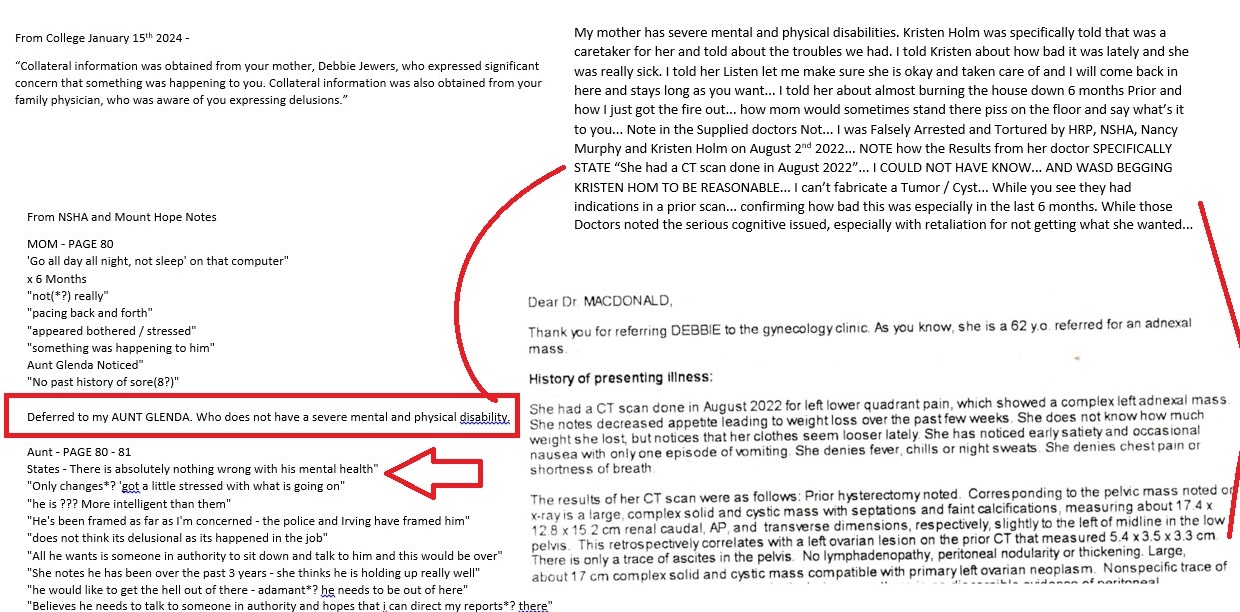
“Collateral information was also obtained from your family physician, who was aware of you expressing delusions. Your family doctor had referred you to Mental Health Services, but you had not followed up. “
The August 2022 Psychiatry Note
The August 2022 psychiatry note states (See Image 1):
“Spoke w pt's GP — reports aware of delusions x several years, had provided MH info/refs but don't believe Scott followed up. ∅ imminent risk of harm to self or others so in past ∅ grounds to certify. Aware that mother is concerned.”
That note attributes specific statements to my family physician, Dr. McDonald. Those attributed statements are false.
It is also critical to note what the entry does not contain. There are no examples. There is no elaboration. There is no identification of any specific topic, statement, or event that could be independently verified. The note simply asserts the word “delusions” — attributed to a third party — and uses that assertion as the basis for a conclusion of longstanding mental illness without any supporting context.
A single unelaborated word, attributed without specificity to a family doctor, becomes the foundation for a clinical characterization that was then carried forward through subsequent institutional processes.
Direct Contradiction from Dr. McDonald
I have since spoken to Dr. McDonald directly. He confirmed that he never stated I was experiencing delusions and that we never had any discussion of that nature. He had never even heard about my wallet or the events being referenced. Nothing of that nature appears anywhere in my medical record.
Dr. McDonald’s later reaction is also significant. After being told what Kristen Holm had written, he ran his hands through his hair and said:
“Oh my God, she didn’t use anything your mother said, did she?”
And:
“Debbie was a very sick woman.”
That reaction is entirely inconsistent with the suggestion that Dr. McDonald had independently reported longstanding delusions. The same physician cited as the source of that claim was clearly alarmed by how the information had been used.
The CPSNS Distortion
There is a material difference between what the August 2022 note actually says and what CPSNS later asserted (See Image 1).
The psychiatry note states:
“don’t believe Scott followed up.”
CPSNS converted this into:
“Your family doctor had referred you to Mental Health Services, but you had not followed up.”
This is not a minor wording change. It transforms uncertainty into a definitive assertion and falsely frames the interaction as a mental health referral based on alleged delusions.
This wording appears to have been taken from Kristen Holm’s response to CPSNS during the complaint process, demonstrating a further distortion of the record during a regulatory inquiry.
In addition, CPSNS failed to include a critical fact: my mother had deferred to my Aunt Glenda, and Glenda clearly and specifically stated that I was fine. That account does not appear anywhere in the CPSNS dismissal. It constitutes clear reasonable doubt regarding the conclusions reached and was omitted.
The pattern is consistent across every stage:
- The original note contains no verifiable specifics
- Uncertainty is converted into definitive assertions
- Exculpatory evidence — Glenda’s account — is omitted
The result is a record that appears more certain, more corroborated, and more clinically robust than the underlying evidence supports.
What Actually Occurred
In 2020, I spoke briefly with Dr. McDonald and explained that I was involved in a serious investigation involving J.D. Irving and significant institutional parties, including DND and senior officials at both federal and provincial levels.
My mother had expressed concern that her mental illness might be used against me. At the same time, I was concerned about her safety, her deteriorating condition, and the possibility that others might attempt to have her committed in order to gain access to what she had.
For that reason, I asked Dr. McDonald to help arrange a discussion with Dr. Bradley — my mother’s physician — under my name so that nothing would be unnecessarily placed in her medical record. My intention was to address her situation responsibly and confidentially.
Dr. Bradley advised that, due to professional obligations, he could not speak with me directly and that I would need to go through intake.
Dr. McDonald did not refer me to Mental Health Services based on any belief that I was delusional, nor did he raise any such concern. There is no prior medical history supporting that suggestion. Even Kristen Holm’s own note confirms there were no grounds to certify and no imminent risk of harm to self or others.
Audio Corroboration — Real-Time Forecasting
This account is directly corroborated by the August 5, 2022 audio recording. At timestamp 07:24, I can be heard explaining this to Kristen Holm in real time:
“But I like... I would have contacted the professional system, like I said, I would have, and I would have spoken to a lawyer and just said, let them handle it from here, because I got my answer. And that's what I would have done. And like you said, in my record, like that I contacted the intake. That's because I contacted Dr. Bradley directly. And he said, look, you have to contact intake to come speak to me. And then I was like, well, given this amount of information intake may take this incorrectly, just as this situation is going now. So I said, hey, that's maybe not the best situation, because Dr. Bradley also looks after my mother. So to come up with a plan for me, we would have had to talk to him anyway. So that's why I thought that was appropriate, right.”
https://youtu.be/9dGY_N9ni1w?si=bJuk-CZIW57XtWZB&t=444
The phrase “just as this situation is going now” is especially important. In August 2022, while sitting in the room with Kristen Holm, I explicitly stated that I had anticipated intake could misinterpret the situation — and that this was already happening.
That is not delusional thinking. It is accurate forecasting documented in real time on audio.
The Second Entry — Glenda Said He Is Fine; Mother Used as Substitute Decision Maker
Kristen Holm’s handwritten notes contain a second entry directly below the GP note (See Image 1):
“Spoke w pt's mother. Shared perspective that Glenda believes Scott is fine. Debbie personally committed that Scott is unwell and needs help. Accepts if imposition of psychiatry agreeable to SDM and consented to treatment.”
This entry raises three critical issues.
First — Kristen Holm documented that Glenda said I was fine. She recorded it and did not act on it.
Second — my mother was cognitively impaired at the time. A CT scan from August 2022 confirms a 17 cm tumour causing significant cognitive impairment. She had also been provided with false information — including that I had been found protesting outside a police station, which is unsupported by any HRP record.
Third — and most serious — my mother was used as the Substitute Decision Maker to authorize psychiatric treatment.
Glenda — the more reliable, cognitively intact source — stated I was fine and was ignored. My cognitively impaired mother — after being given false information — was relied upon instead.
That is not a neutral clinical judgment. It is a selective reliance on evidence that supported a predetermined outcome, and a deliberate choice to set aside the more reliable collateral source.
The Double Distortion
This fabricated attribution had a direct and foreseeable effect. Like the false “protesting” characterization in the triage notes and other substitutions in the record, it created the appearance of independent clinical corroboration where none existed.
It made the record appear more robust at a time when I had no meaningful ability to challenge it, no access to counsel, and no knowledge of what was being recorded.
The concern I raised with Dr. McDonald in 2020 was not delusional thinking. It was a reasonable concern that proved correct.
Kristen Holm did exactly what I had anticipated — using my mother’s illness against me and then attempting to convert that same illness into supposed evidence against me.
The result is a double distortion:
- First against my mother
- Then against me
 IMAGE 1
Tiny URL: https://tinyurl.com/fwsn55uv
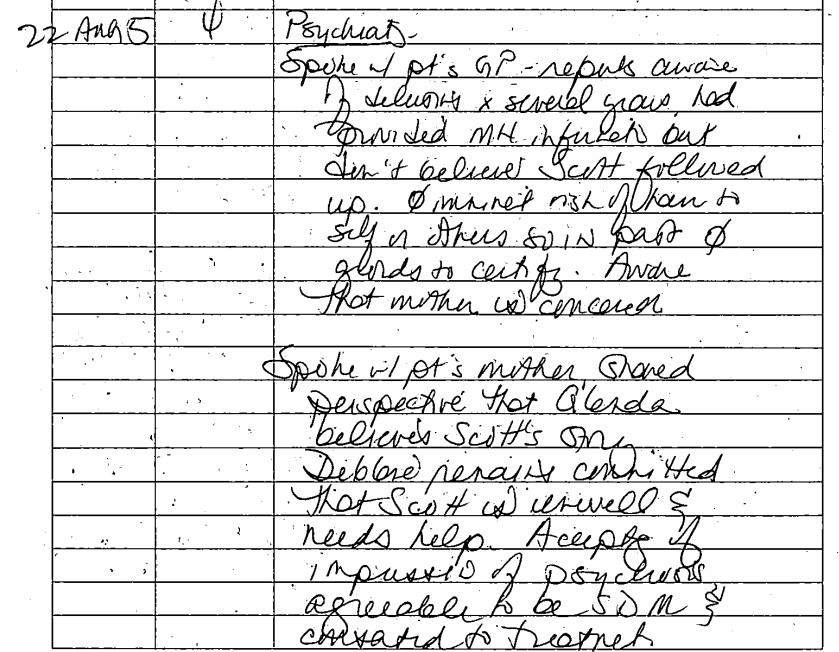
Additional Concerns – Inability to Raise Serious Complaint against Shante A. Blackmore
As it has been explained and presented in the records provided by NSHA and CPSNS, I understand the individual to be Shante A. Blackmore. If this is incorrect, I will sincerely apologize and amend the record accordingly.
There were very serious issues with Shante A. Blackmore. Due to the overlap with events involving my belongings, wallet, and Personal Health Information (PHI), her conduct and that of Nancy Murphy are interconnected and addressed in part at section “Personal Belongings sent to Mount Hope Before I Saw a Doctor (PHI Breach) — Unauthorized Access and Possible Theft”.
Shante A. Blackmore was explicitly aware that I had been denied access to a lawyer. I told her directly, and she raised the issue with me herself. Despite this, she straddled the doorway and mocked and humiliated me for asking whether it was appropriate to require me to discuss anything at all — which is a fundamental right.
After approximately 11 hours in handcuffs, and with me clearly requesting a lawyer again, she would have reasonably understood that legal exposure existed and that she could be required to testify regarding the actions of Nancy Murphy and HRP. Her record, however, contains nothing that can be independently verified.
Nancy murphy knows that if she does not spport the HRP record, she will have to testfy as its a false arrest. Shante A Blackore knows if she doesnt support Nanyc Murphys record then she would have to testify against Nanyc Murphy but also HRP. Creating a massive internal conflict of interest. If each doesnt support the otehrs record, then they have to tetsify while then it would be NSHA testifying against NSHA. This is reaosnably why ther eis no recor from HRP, why tehy never clarified protesting and why they kept denying me a lawyer and twistign and fabricatig everythig. Not one of them Recorded “the Wolf And The Neural Network which they were todl was the reasearch paper and basis for a book, because they knew the firts quesiton would be then you knew there was chronologically ordered evidence by a technical expert of over 18 years. Which is the truth. Instead they chose to ask questions like, whats in the book or reasearch aper and then manipulate it to fit thier narratives and call their intentionally fractured records, lack of education and conflict of interest as proof that i was idsorganized. T was just a massive phising attempt stiuck in a loop to justify the abuse. And everytime i clarified, well i must be lying because Police wouldnt do that. Yet they dont have a single record from HRP
I only became aware of the full extent of these issues over time, particularly after CPSNS failed to contact me and instead dismissed the cases. My personal and confidential information was then shared with Cox & Palmer, representing a significant conflict of interest, and this conduct was repeated with Hana Marie Weimer.
Given the severity of these issues, the direct evidence regarding my belongings, and the clear appearance of retaliation, I am requesting a full investigation by NSHA, CPSNS, and the RCMP into the conduct of Shante A. Blackmore and other involved NSHA staff.
Detailed Review of CPSNS Findings and Dismissals March 13th 2023
March 13, 2023 — Scott Jewers' Record of Events
On October 22, 2022, I submitted a detailed report outlining the false arrest and torture I experienced on August 2, 2022. On April 8, 2023, I submitted a further comprehensive report detailing the retaliation and unlawful arrest that occurred on March 13, 2023, involving both NSHA and the RCMP. Both reports were sent through the same main email thread that RCMP and NSHA later referenced when falsely accusing me of making threats.
It is therefore indisputable that they had and have full access to these submissions, each of which clearly documented the abuse and the RCMP's ongoing refusal to open a formal case. Their failure to act was not the result of confusion or lack of evidence — it was a deliberate and willful refusal to acknowledge the record.
- October 22, 2022 submission — HTML: https://tinyurl.com/5chmc7te / Full: https://thewolfandtheneuralnetwork.com/Media/Resources/2022-10-22_October%2022nd%202022%20Detailing%20the%20Illegal%20Arrest%20and%20Captivity%20by%20HRP%20from%20August%202nd%202022.docx
- April 8, 2023 submission — HTML: https://tinyurl.com/5e8axyjf / Full: https://thewolfandtheneuralnetwork.com/Media/Resources/2023-04-08%20-%20April%208th%202023%20-%20NSHA%20Complaint.%20Given%201%20week%20to%20comply.docx
What Occurred on March 13, 2023
Prior to and on March 13, 2023, I advised on the main email thread that I would be going to HRP to file a complaint regarding the abuse by HRP and NSHA on August 2, 2022, and events that occurred before that date. I also stated I would be dropping off evidence at CSIS. At no point did I communicate that I would be going to NSHA or any other place, and the record will show I did not. The RCMP, HRP, and Government were also on the email thread throughout.
I also advised on the thread that I would be carrying signs reading "JD IRVING POSTMEDIA HRP FRAMED and TORTURED ME" on one side and "CTV CBC HELPED COVER IT UP" on the other.
I carried my signs silently through Halifax. I engaged with and bothered no one. A few people stopped to ask questions, and one said "Sorry that happened" as I walked past. I went to CSIS and dropped off additional evidence without incident — they accepted the submission without any concern. I then went to HRP, waited approximately half an hour without incident, and filed my Form 5 complaint. Dean Simmons (Superintendent) came out, said hello to me specifically, and then greeted everyone waiting. None of these parties reported any incidents.
I then walked down Robie Street past CTV and down Barrington Street past Irving Shipbuilding, keeping to the opposite side of the road. I did not speak to anyone, yell, or cause any disruption of any kind. One person stopped and asked if they could take my picture.
While driving home, I received a call from Corporal Jessica Welke. She asked where I was, and I told her openly. She informed me that I was "arrestable" under the Involuntary Psychiatric Treatment Act and added, "I don't know why they're making me do this." I responded: "Jessica, it's because you didn't do anything — they know that, and now they can retaliate." I believe she said Chad Samford (RCMP Sheet Harbour) was in the vehicle with her. She told me that if I were admitted, she promised to drive to wherever I was to take a statement. I advised her I would park at the Walmart in Cole Harbour until the officers arrived, and I complied completely.
The officers' reports and direct video footage confirm how calm I was throughout. During the interaction, I could see their screen — it described me as delusional and becoming increasingly delusional. This is dangerous and demonstrably false, as the video record makes clear:
- https://youtube.com/shorts/vAGojH4lmi0
- Demonstrates that I was calm, composed, and speaking clearly immediately prior to any police intervention.
- “Well i have some great news, the Police didnt kill me this time or you know torture me or falsely arrest me or anything like that so that’s a positive i actually get to go home and see my dog tonight so. Yea, small things right”
- https://youtube.com/shorts/YoBWvnIlNpc
- Shows that I remained calm and compliant while seated in the back of a police vehicle.
- “So RCMP hunted me down and said that I’m some mental health threat and now I’m sitting in the back of a RCMP vehicle, they didn’t talk about doctor Holms and what she did, the recording or any of the evidence I’m like so screwed right now it doesn’t matter what i do right now there gonna...[sigh] anyways i tried everyone”
- https://youtube.com/shorts/-1kKtjV4gII
- Captures my reaction to reading the officers’ screen, which described me as “increasingly delusional.”
- “...their screen said I’m sending emails that are increasingly delusional, thats right its that bad, its not, they are full technical audits these people are lying and they are gonna torture me right now. I’m is a lot of trouble. I’m screwed, I’m screwed, it doesn’t...”
- https://youtube.com/shorts/euGRDp5cHNc
- At NSHA, i show my cuffs and face and calmly speak.
- “they know their lying”
- https://youtube.com/shorts/PoiP1DXvhJI
- Documents the conditions of detention of room i stayed in for almost 20 hours
- “So on top of like, not allowing me to record anything telling me i don’t have the right to, i get this little sheet and this to lay in. That’s right so they can record me while i just lay in here. That’s right, I’m an animal i don’t have rights”
Every officer involved — including those who reviewed the August 2, 2022 video and the RCMP officers who later attended my residence — consistently noted how calm, composed, and cooperative I was. Not once did I cause any issue with law enforcement, and the record reflects that I explicitly stated it was inappropriate for others to be dragged into this situation.
At the QEII Emergency Department
I was transferred into the custody of a male and female officer. According to Inspector Cory Bushell's notes on page 5 of the RCMP Final Report, Halifax Regional Police Constable Brenda Smith assumed custody at this point:
"...He transported you to the Queen Elizabeth II hospital in Halifax, where Constable Brenda Smith took over custody of you until you were assessed by a physician..."
The male officer who remained with me during the wait is not identified in the report and is never mentioned. I waited calmly in the hallway with him until I was taken into a room by a young male NSHA staff member.
I requested access to legal counsel and was denied. I was told I had to speak with staff and that if I didn't I would simply be locked up. Nobody at any stage explained my rights to me. I stated that if I was being compelled to speak, everything I said would be fact-based and supported by evidence.
- IPTA — (h) any declaration of involuntary admission or declaration of incapacity is made on the basis of evidence. 2005, c. 42, s. 2: https://tinyurl.com/zte2kh4j
I outlined my professional background, disclosed my potential biases, and summarized key evidence — including documented abuse by NSHA staff and an audio recording of Kristen Holm falsifying medical records.
At that point, the male nurse asked, "You're not recording this, are you?" I answered, "Maybe." He paused, said he needed to speak with someone, and ended the interview. I was returned to the hallway.
Hana Marie Weimer and the Denial of Recording Rights
While seated in the hallway — in full view of the attending officers and nearby patients — I was approached by two NSHA staff members. One of them, as per NSHA records, appears to be Hana Marie Weimer. The other was not named.
They informed me I was not permitted to make an audio recording. I calmly explained that under Canadian law, one-party consent permits recording of private conversations. I acknowledged that recording in common areas may raise different considerations, but that recording clinical or legal interactions was entirely lawful, and I advised on provision 184 of the Criminal Code. I asked them to provide the hospital's policy on patient recordings. They refused — twice. I then asked for access to the relevant legal policy. That was also refused.
Their stated justification was that recording would infringe on their privacy. This is directly contradicted by guidance from the Canadian Medical Protective Association (CMPA):
"Although patients can record their clinical encounters without a physician's consent, the same does not hold true for physicians. Clinicians who wish to record a clinical encounter should first obtain informed consent from the patient, and that consent discussion should be noted in the medical record." — CMPA: https://www.cmpa-acpm.ca/en/advice-publications/browse-articles/2017/smartphone-recordings-by-patients-be-prepared
While waiting with the male officer, I spoke with him informally about the situation and shared some supporting evidence. I showed him the EMIC contracts and the address where my phone's GPS had been set. He acknowledged it was extremely compelling while noting he couldn't independently verify it. I agreed, telling him that was exactly the right approach — and that what I had shown him was approximately five percent of the full record, and that it needed to be reviewed by police. He then asked, "Why are you so sure they're going to lock you up?" I responded: "Because they're facing multi-million dollar litigation, and acknowledging what happened would require filing complaints against their own directors who ordered this."
The Assessment by Hana Marie Weimer
After hours of waiting, I was taken into a room with Hana Marie Weimer. I again requested access to legal counsel and was again denied. Given the severity of the allegations against NSHA, the fact that I had just filed a formal complaint with HRP, and that I was being denied legal representation, I requested permission to audio record the interaction to ensure an objective record existed. Hana Marie Weimer refused and warned that if I attempted to record, security would physically remove my phone — while again denying me legal counsel.
She then stated that if I did not speak with her, I would simply be admitted. I responded that under the IPTA, any admission must be based on facts and evidence.
- IPTA — (h) any declaration of involuntary admission or declaration of incapacity is made on the basis of evidence. 2005, c. 42, s. 2: https://tinyurl.com/zte2kh4j
I outlined my technical background, disclosed relevant bias, explained that I aimed for at least 70% accuracy in all claims, and described The Wolf and the Neural Network – ALPHA — a research project consisting of over 400 hyperlinked, chronologically ordered, and cross-referenced data points supporting my complaint.
I informed her of serious instances of abuse by NSHA, including the falsification of records, the mishandling of my belongings, and a documented sexual assault. I advised on the conflict of interest with HRP and stated that there were multiple witnesses to police retaliation and that serious evidence existed.
At that point, she interrupted and said, "Okay, obviously you're making this all up." I remained calm and replied, "Hana, I understand this may sound complex but I'm a technical expert — is there a specific part you'd like me to clarify?" She said, "I don't know."
Hana Marie Weimer then stated she was seeking a second opinion and left the room. The male officer entered. We spoke briefly, and when Hana Marie Weimer returned, I asked the officer to remain present. She announced: "We're admitting you."
I looked at the officer, laughed, and said, "I told you so." He immediately turned to Hana Marie Weimer and said, "I need to speak with you outside."
Conditions of Detention and What the Record Omits
I was then held in a room under constant surveillance by two cameras for over 24 hours before being transferred. The room was openly accessible from the hospital's secondary waiting area and nearby corridors. There was no privacy, no medical justification for the prolonged detention in that setting, and no protection of patient dignity. I documented these conditions on video: https://youtube.com/shorts/PoiP1DXvhJI
During that period, a woman came to speak with me about supposedly "protesting" on August 2, 2022. I explained again — clearly — that no protest occurred. I had gone to HRP to file a formal complaint and to inquire about the FOI request regarding my missing wallet. HRP had previously stated the wallet was part of something "ongoing," and I had gone there to seek clarification. She responded, "Well, I guess maybe you'll talk about this at Abbey Lane" — as though I were simply being difficult.
On March 14, 2023, while still at the QEII, I called Corporal Jessica Welke and informed her I had been admitted. I asked for her help and again shared critical details regarding the abuse, evidence of retaliation, and what was occurring. I told her again about the address 9330 Highway #7, Stillwater, NS, as she had said she would come to take a statement, and I wanted to prepare her. Jessica Welke never came.
That evening, two family members arrived. NSHA initially refused to let them see me and claimed I had checked myself in. When they were eventually allowed in, they immediately and unprompted commented on the cameras recording the room and refused to close the door out of concern. Through the window into the adjacent room, a man came and stood — which my family immediately commented on. Shortly after, during severe snow conditions, I was transferred to Yarmouth, Nova Scotia — a 12-hour round trip from my friends, family, and support network. There, my phone was removed, I was forcibly medicated, and I was left to wash my clothes and underwear in the sink.
Transfer to Yarmouth, Nova Scotia
I was initially told I would be transferred "upstairs" — understood to be Abbey Lane in Halifax. Instead, NSHA transferred me from the QEII in Halifax to Yarmouth Regional Hospital during a snowstorm. Yarmouth is approximately a 7-hour drive from Halifax under normal conditions, and reasonably 10 to 11 hours in winter. This made it significantly more difficult for family, friends, and support networks to reach me.
Under the Involuntary Psychiatric Treatment Act, persons with mental disorders should have access to services as close to their home as practicable (IPTA s.(g)):
- TinyURL: https://tinyurl.com/zte2kh4j
- Full URL: https://nslegislature.ca/sites/default/files/legc/statutes/involuntary%20psychiatric%20treatment.pdf
At the time of transfer, NSHA was aware that I did not have a jacket or a change of clothes. I remained in the same clothing for several days until I was able to access lost and found items. My vehicle was left in a Walmart parking lot for the duration, where it was at risk of being towed and impounded. I was also separated from my dog and from my aunt, who was in poor health and required support.
On the Use of the Term "Token Black Psychiatrist"
I note this because it is directly relevant to the broader complaint regarding racism, the Wortley Report, and the retaliation I experienced for raising concerns about systemic racism and police conduct. Kristen Holm, who assessed me in August 2022, is white and did not record the systemic racism that is central to this complaint.
The term "token Black psychiatrist" is used based on statistical representation and context. Black Canadians represent approximately 4–4.3% of the population, while Black physicians account for just over 2% of the medical workforce in Canada. As psychiatry is a specialized subset, representation within that field would reasonably be equal or lower — commonly estimated in the range of 1–2%, and likely lower again in Nova Scotia. On that basis, the likelihood of being assessed by a Black psychiatrist would reasonably fall between approximately 1 in 50 to 1 in 100.
In the context of a complaint involving systemic racism and institutional bias, this statistical rarity makes the assignment notable and raises reasonable questions about how and why that provider was selected.
- Canadian Psychological Association — acknowledges underrepresentation of Black psychologists: https://cpa.ca/blackhistorymonth/
- Statistics Canada — population data (~4%): https://www150.statcan.gc.ca/
- Academic discussion of barriers and underrepresentation: https://doi.org/10.1037/cap0000419
Assessment at Yarmouth Regional Hospital
At Yarmouth, I was assessed by Dr. John Adebayo Oguntade. Dr. Oguntade unprompted raised — apparently as a point of relatability — that he also sends patients for gender reassignment surgeries. He also noted that staff had commented on how quickly I fell asleep.
I was told that the focus of the assessment would not be on the factual basis of what I was reporting, but rather on how I was "dealing with it." This directly contradicts the earlier position stated by Kristen Holm at 03:20 of the recorded conversation: "It wasn't about your behaviour, it was about what you were talking about" (Audio: https://youtu.be/9dGY_N9ni1w?t=200) — as well as the position of the RCMP, who had stated the matter should remain with police. I was therefore detained based on what I was reporting, while simultaneously being told not to discuss those same events. This is not reconcilable.
I was then told that my condition was likely hereditary — passed down from my mother — and that past cannabis use was a contributing factor. The use of my mother's condition both as a basis for admission and as a retrospective clinical explanation raises serious concerns, addressed in full elsewhere in this document.
When I asked Dr. Oguntade to explain how I met the criteria for admission under the IPTA, he could not.
I explained that I do not believe in ghosts, demons, magic, aliens, or religion, and that I had explicitly acknowledged my biases throughout all of my work. At that point, Dr. Oguntade stopped me, disclosed that he was religious, and proceeded to speak about his beliefs at length. I remained completely calm and allowed him to speak. The nurse present appeared to find this unusual given the context — we were discussing a diagnosis of delusional psychosis, yet the psychiatrist introduced his own unprompted, faith-based beliefs into that discussion. I was requesting due process and the application of my Charter rights, while the response was grounded in personal belief systems that cannot be empirically verified.
Dr. Oguntade then told me directly that if I continued to speak about J.D. Irving, I would be arrested and locked up again. That statement requires no further characterization. It speaks for itself.
Following this interaction, a female staff member who had been present during the assessment returned came to my room for something and stated, unprompted:
“Listen, I don’t believe in that religious stuff either.”
This further indicates that the introduction of personal religious beliefs into the assessment was recognized as inappropriate within the clinical setting.
At that time, I had no clothes and the washer and dryer were not working. I was left to wash my underwear and socks in the sink and leave them to dry. I eventually obtained some clothing from lost and found, but it was oversized, ill-fitting, and inappropriate.
Upon release, I was over seven hours from home and was not initially provided any means to return. NSHA ultimately arranged a taxi at a cost of over $800. These conditions are not consistent with the treatment of a patient entitled to dignity under the IPTA.
Fabricated NSHA Triage Record and RCMP Varsadex entry March 13th 2023
TRIAGE NOTES From QEII: “PT HERE UNDER SECTION 14 WITH MOBILE CRISIS TEAM. PT HAS BEEN SENDING VAGUE THREATENING EMAILS TO GOVERNMENT OFFICIALS AND NSHA EMPLOYEES WITH SOME THREATS TO DOCTORS. DENIES S/I. AT PRESENT. CALM AND COOPERATIVE IN TRIAGE. GOOD EYE CONTACT. GOOD AFFECT. CUFFED AT PRESENT. PMHX - DELUSIONAL DISORDER” – Copy of this as well as Hana Marie Wiemers notes can be found in seciton Hana Marie Wiemer – Review
The Versadex entry referenced by Inspector Cory Bushell and Staff Sergeant Trevor Allen is reproduced at the conclusion of this assessment.
This account conflicts with what Corporal Welke advised me directly — that the Section 14 request originated from a director within NSHA. That detail does not appear anywhere in this record
This record asserts that I had been “sending vague threatening emails,” including “threats to doctors.” However, despite multiple requests, no examples of any such threats have been provided by NSHA, the RCMP, or any reviewing body.
- IPTA — (h) any declaration of involuntary admission or declaration of incapacity is made on the basis of evidence. 2005, c. 42, s. 2: https://tinyurl.com/zte2kh4j
The use of the term “vague” is notable. It introduces ambiguity while avoiding identification of any specific, verifiable statement. No direct quotation, date, recipient, or content of any alleged threat is included. This absence of particulars prevents independent verification and raises concerns about the reliability of the characterization.
The record also does not identify who initiated the Section 14 request, instead presenting the apprehension as a procedural outcome without attribution. I was advised by Corporal Jessica Welke that the request originated from a director within NSHA. That detail does not appear anywhere in the clinical or police record.
This absence of attribution is significant when viewed alongside the broader institutional context.
On September 1, 2021, Premier Tim Houston and the Health Minister dismissed the CEO and entire board of the Nova Scotia Health Authority and replaced them with new leadership, including Karen Oldfield as CEO. This represented a full reset of organizational leadership and centralized decision-making under newly appointed individuals.
https://www.cbc.ca/news/canada/nova-scotia/health-care-tim-houston-michelle-thompson-1.6160846
Separately, on January 29, 2023 — the morning my mother passed away — Premier Tim Houston attended at the hospital. This timing is noted because it places senior political leadership physically present within the same system and timeframe as the events that followed.
Tiny URL: https://tinyurl.com/493xcwjd
Full HTML version URL: https://www.thewolfandtheneuralnetwork.com/HTMLDocuments/February17th2023_Mom_Passed_Away_Tim_Houston_Present_At_Hospitol.html
This must also be considered alongside the documented discrepancy involving Kristen Holm, where recorded audio (August 5, 2022) shows references to “Stephen McNeil” and “Postmedia” being changed in her written record to “Stephen Harper” and “Bell Media,” demonstrating that the written record does not match the underlying evidence which can be found detailed in the section “Massive issue – Kristen Holm Changing names Stephen McNeil and Postmedia to Stephen Harper and Bell Media in written record. “
Where:
- I was advised that the Section 14 apprehension originated from a director within NSHA, yet no initiating party is identified in the record;
- serious allegations such as threats to government officials or medical staff are recorded; and
- no supporting evidence, attribution, or documentation is provided;
the absence of detail raises legitimate questions regarding how that decision was made, recorded, and later relied upon.
At the same time, the triage note explicitly documents that I was:
- calm and cooperative;
- maintaining good eye contact; and
- presenting with appropriate affect.
These observations are directly consistent with the video evidence recorded that day and contradict the characterization of me as an escalating threat, while neither HRP or CSIS reported issues. And all parties could have stopped me before walking down, as they state they had received emails.
Allegations of threats — particularly toward medical professionals or government officials — are serious and would reasonably be expected to be supported by specific, documented evidence. No such evidence has been produced.
This includes the later RCMP review conducted by Inspector Cory Bushell and Staff Sergeant Trevor Allen in June 2025, which relied on this record without identifying or providing any underlying source material, despite being aware that the complaint and supporting evidence predated March 13, 2023. The record was nonetheless used as a basis to open and close the matter.
In that process, Corporal Jessica Welke materially misrepresented the situation. However, Cory Bushell and Trevor Allen did not take a written statement from either Jessica Welke or myself. They simply opened the case on June 1, 2025, and closed it four days later, on June 4, 2025.
As a result, there is no formal record of either account and no meaningful accountability, leaving the matter reduced to a “he said, she said” situation. This is further compounded by the fact that the matter was closed after more than 800 days, despite their own acknowledgment that it fell outside their mandated time frame:
Tiny URL: https://tinyurl.com/7ckd6v3p
Full HTML Version URL: https://www.thewolfandtheneuralnetwork.com/HTMLDocuments/July9th2025_Response_to_RCMP_June-6_Letter_and_CRCC_Investigation_Request.html
Video Review of Cory Bushell response Letter and my Rebuttal:S4E5 Call to RCMP The Fraud of Cory Bushell and the CRCC Review of False Arrest – March 13th 2023 - https://youtu.be/EkbkumKe-Hs (Length 1:23:47)
The reliance on an unparticularized and unsupported characterization of “threatening emails,” combined with:
- the absence of documented evidence; and
- the inclusion of observations confirming calm and cooperative behavior;
raises significant concerns regarding:
- the accuracy of the triage record;
- the basis for the Section 14 apprehension; and
- the subsequent reliance on this record in later reviews.
“...On Versadex file 2023-30145 on March 13, 2023, the Mobile Mental Health Crisis Line requested
a mental health wellness check on you at your home. Based on this request, Corporal Welke
called you over the telephone and explained about the request they received at Sheet Harbour
RCMP. You told Corporal Welke that you were at the Walmart parking lot in Cole Harbour, Nova
Scotia. Corporal Welke passed this information along to the police dispatcher. The Mobile Mental
Health Crisis Team (MMHCT) member, Constable Brenda Smith (a Halifax Regional Police
member), noted in her “supplemental report” on the file that you had been sending emails of a
threatening nature to multiple people within the Health Authority. You indicated you planned to
visit different corporations this date, which caused concerns for the safety of people at those
locations. The clinicians were advised to locate you and bring you to the hospital. One of the
email recipients was a psychiatrist who indicated you could be psychotic. The initial request was
for a well-being check only. That changed when direction from mental health professionals came
forward. Constable Geoff Matthews of Cole Harbour RCMP arrived at your location and
understood grounds already existed for your apprehension under the Involuntary Psychiatric
Treatment Act (IPTA) by the MMHCT. He was there to assist MMHCT to escort you for that reason
and you cooperated and consented to going to the hospital. He transported you to the Queen
Elizabeth II hospital in Halifax, where Constable Brenda Smith took over custody of you until you
were assessed by a physician. Corporal Welke had no further involvement at this time and did
not discuss your sexual orientation during her interaction with you...”
Hana Marie Wiemer – Review
After several hours of waiting at the QEII Emergency Department, I was taken into a room with Hana Marie Weimer for assessment. A copy of her notes, as well as TRIAGE Statement can be found in Image 1 below.
At the outset, I again requested access to legal counsel. This request was denied.
Given the seriousness of the matters I had reported — including abuse by NSHA staff, a documented sexual assault, prior police complaints, and the ongoing involvement of law enforcement — I requested permission to audio record the interaction to ensure an accurate and objective record. This request was also denied. I was explicitly warned that if I attempted to record, security would physically remove my phone.
At no stage during my admission was I provided with any written materials outlining my rights, nor were my rights explained to me. In the context of involuntary detention, this represents a significant procedural failure and raises concerns regarding compliance with both the IPTA and Charter protections.
No reference to my request for legal counsel, my request to record, the refusal of either, or the warning appears anywhere in the clinical record.
When asked directly to produce a single example of a threatening communication, Hana Marie Weimer stated, “I can’t.” No examples appear in her record.
At the time, Hana Marie Weimer was aware that:
- I had filed formal complaints with Halifax Regional Police;
- I had requested legal counsel on multiple occasions and been denied each time, including during this interaction; and
- I was relying on documented and recorded evidence, including audio material relating to prior interactions with NSHA staff.
Despite this, none of these material factors — including my requests for legal counsel and to record the interaction — were documented. In a context involving involuntary admission, denial of legal counsel, and disputed factual assertions, these omissions are significant and go directly to the integrity of the record.
Hana Marie Weimer then advised that if I did not participate in the assessment, I would be admitted regardless. I responded that under the IPTA, any admission must be based on evidence (IPTA s.2(h): https://tinyurl.com/zte2kh4j).
I outlined my professional background, my awareness of potential bias, and the existence of documented and verifiable evidence supporting my complaint — including recorded material, structured analysis, and The Wolf and the Neural Network – ALPHA. I further advised that I had reported serious misconduct by NSHA, that there were multiple witnesses to police retaliation, and that significant evidence existed requiring proper investigation.
During this explanation, Hana Marie Weimer interrupted and stated:
“Okay, obviously you’re making this all up.”
I remained calm and responded:
“Hana, I understand this may sound complex, but I am a technical expert — is there a specific part you would like me to clarify?”
She replied:
“I don’t know.”
She then stated she would seek a second opinion and left the room. A police officer entered and we spoke briefly. When she returned, I requested the officer remain present. She announced:
“We’re admitting you.”
I said to the officer, “I told you so.” He immediately requested to speak with her outside the room.
Procedural Failures
The following procedural safeguards were denied and not documented:
- Repeated requests for legal counsel
- Request to audio record the interaction
- Explicit warning that security would confiscate my phone if I attempted to record
- Failure to explain my rights or provide any written materials outlining them
These are not minor omissions. In the context of involuntary admission, they are fundamental to procedural fairness, accountability, and the ability to challenge the record.
What the Record Omits — and What It Includes
Hana Marie Weimer’s clinical record contains no reference to:
- my requests for legal counsel,
- my request to record the interaction,
- the refusal of those requests, or
- the warning that security would remove my phone.
It contains no examples of threatening communications, no dates, and no specific statements capable of independent verification.
The chief complaint is recorded as “BIZZARE / PARANOID BEHAVIOUR.” The same record simultaneously documents that I was calm and cooperative in triage, with good eye contact and appropriate affect. This contradiction exists within her own document and is not reconciled.
What the record does include are names — Stephen McNeil, with a speculative bracketed note reading “his brother?” — as well as Daniel Kinsella, identified as HRP Chief. The inclusion of speculative relationships in a clinical record demonstrates that assumptions were recorded alongside facts without distinction.
The presence of Daniel Kinsella’s name confirms that Hana Marie Weimer was aware that the complaint involved the Chief of Police. That context was not treated as relevant to the assessment or to the decision to admit.
The record references that I had filed complaints involving NSHA but does not identify their substance, despite the fact that those complaints concerned:
- theft and mishandling of my personal property,
- the false characterization that I was protesting, and
- a documented sexual assault.
These are not peripheral details. They are the substance of the complaint. Their omission is not an oversight.
Second Opinion and Conflict of Interest
Hana Marie Weimer stated that she consulted a second opinion prior to admitting me. It is reasonable to request:
- the identity of that individual, and
- the information that was provided to them.
Given the institutional context — including the overlapping involvement of Nancy Murphy, Shante A. Blackmore, and Kristen Holm — it is entirely plausible that the consulting individual:
- relied on the same compromised record, or
- was in a supervisory or dependent relationship that limited independent judgment.
There is no indication that the following were disclosed to the consulting party:
- my request for legal counsel,
- my request to record the interaction, or
- the absence of any identified threatening communication.
Instead, the consultation appears to have relied on a record structured to support admission.
Under these conditions, the consultation cannot be considered independent verification. It represents a review of a compromised record without access to the underlying facts, and raises serious concerns regarding conflict of interest and the professional risk faced by any consulting party who might challenge the conduct of those involved.
Conclusion
The record includes a formal clinical conclusion — “Psychosis NOS” — reached within approximately 31 minutes of triage:
- without legal counsel present,
- without a recorded interaction, and
- without any identified evidentiary basis for the alleged threatening communications.
Taken as a whole, Hana Marie Weimer’s record is materially unreliable. It reflects significant omissions, internal contradictions, and a failure to document fundamental procedural safeguards.
Given the nature and consistency of these omissions, it is reasonable to conclude that the record was constructed in a manner that would be difficult to challenge — effectively creating a narrative that served institutional or personal interests rather than the accurate documentation of events.
 Image 1 – Hana Marie Miemers notes from March 13th 2023 as well as Triage notes.
Tiny URL: https://tinyurl.com/38x6nmey
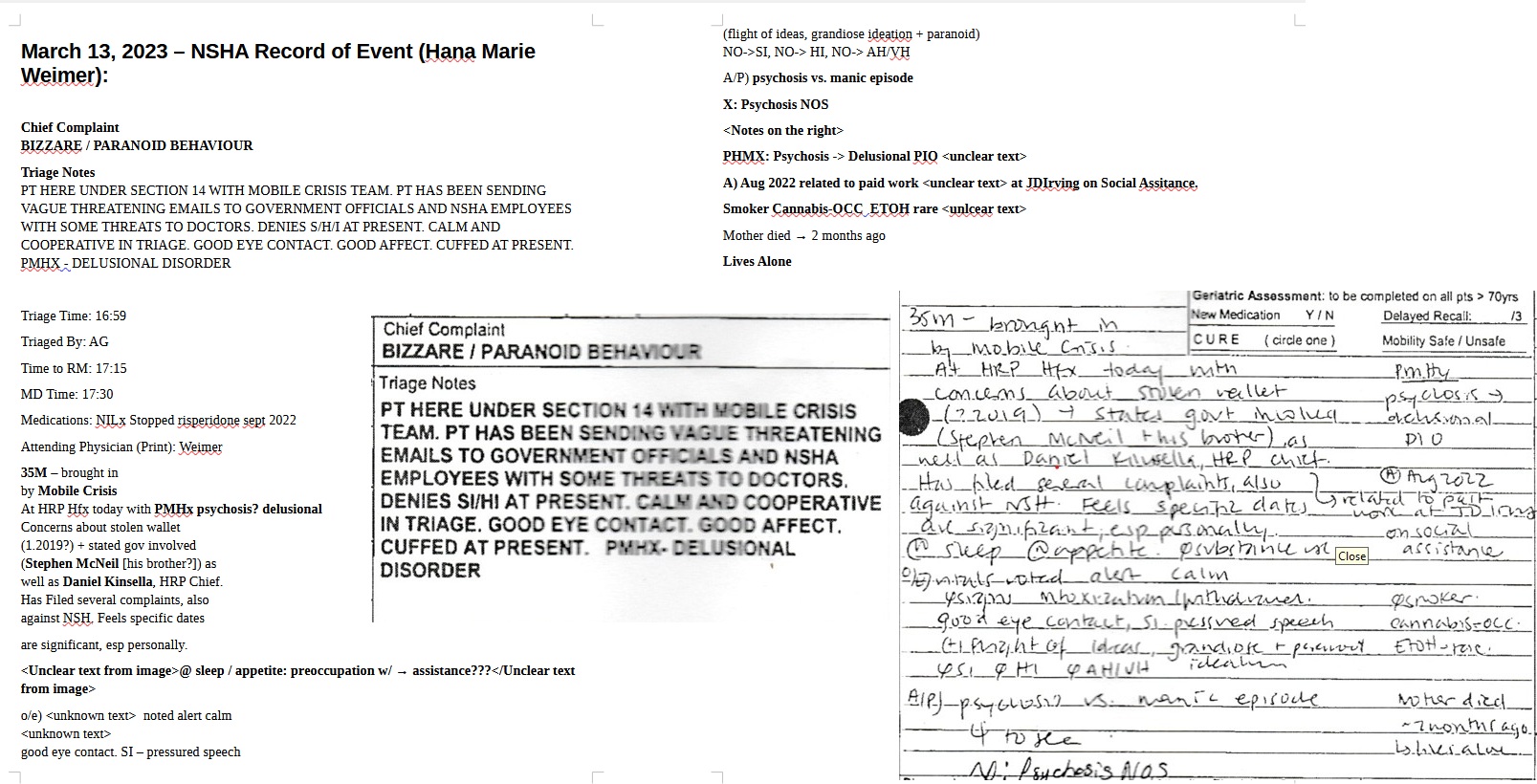
John Adebayo Oguntade – Review
During my assessment at Yarmouth Regional Hospital, Dr. John Adebayo Oguntade failed to apply an evidence-based standard as required under the Involuntary Psychiatric Treatment Act (IPTA). Instead, he relied on unsupported assumptions, irrelevant personal commentary, and contradictory reasoning to justify continued detention.
Dr. Oguntade explicitly stated that the factual basis of my report would not be assessed — despite the fact that I had been detained because of what I was reporting. This creates a circular and legally deficient process in which detention is justified without evaluating the underlying evidence, in direct violation of the IPTA requirement that any declaration of involuntary admission be made on the basis of evidence (IPTA s.2(h): https://tinyurl.com/zte2kh4j).
When asked directly how I met the criteria for involuntary admission, Dr. Oguntade was unable to provide an explanation grounded in either evidence or statutory requirements.
At no stage during my admission was I provided with any written materials outlining my rights, nor were my rights explained to me. This raises additional concerns regarding procedural fairness and compliance with both the IPTA and Charter protections, particularly in the context of involuntary detention.
He introduced personal religious beliefs into the assessment unprompted and made statements unrelated to my condition. This undermines the objectivity required in both clinical and legal decision-making. His reliance on hereditary explanations and past cannabis use, without evidentiary support, appears to be post hoc justification rather than a clinically grounded diagnosis.
Most significantly, Dr. Oguntade stated directly that if I continued to speak about J.D. Irving, I would be arrested and detained again. This constitutes a direct threat tied to the content of my lawful reporting and raises serious concerns regarding coercion and the suppression of lawful disclosure. It also engages Charter protections, including freedom of expression (s.2(b)) and the right not to be arbitrarily detained (s.9).
There were additional comments made during this assessment that I cannot confirm without access to the clinical record. That access has not been provided. The absence of the record does not resolve the issue — it compounds it, and operates to the procedural advantage of NSHA and CPSNS.
What Has Since Been Confirmed
At the time of this assessment, Dr. Oguntade — like Hana Marie Weimer, Shante A. Blackmore, and Kristen Holm before him — treated my account as indicative of a delusional disorder. The available record now demonstrates otherwise.
The following matters, which were raised during my detention and treated as indicators of psychosis, have since been corroborated by documentary evidence:
- My belongings and wallet were sent to Mount Hope before I saw a doctor — confirmed by the Mount Hope internal note dated August 3, 2022.
- I was not protesting on August 2, 2022 — confirmed by the absence of any supporting record from HRP, CSIS, or any other party.
- I was subjected to degrading treatment by Shante A. Blackmore during my assessment — described in detail in this document and not contradicted by any record.
- The reported sexual assault occurred — addressed in full elsewhere in this document.
- Kristen Holm altered key details in her written record (including names) — confirmed by audio recordings that do not match the documentation.
- I was assessed after being awake for over 21 hours — supported by HRP dispatch records and clinical timestamps.
- My mother’s medical condition was used against me during the August 2022 admission — documented elsewhere in this submission.
- My aunt’s statements in my support were omitted from the clinical record.
Conclusion
I was placed in an impossible position: reporting serious institutional misconduct, being told that the factual basis of my report would not be assessed, and then being warned that continuing to speak about those matters would result in further detention.
This occurred within a clinical setting where the assessment relied on unsupported assumptions, excluded relevant evidence, and introduced non-clinical personal beliefs into the decision-making process.
Taken together, this assessment fails to meet the evidentiary and procedural standards required under the IPTA. The subsequent corroboration of the matters I raised during detention raises serious questions about the legitimacy of that detention, and about the clinical and institutional processes that led to it.
Crystal Morgan (CPSNS Lead Investigator)
I have retained audio recordings of my communications with CPSNS, including the calls referenced above. These recordings provide a complete and contemporaneous record of what was said, when it was said, and the issues that were raised, including the conflict of interest and requests for clarification.
Crystal Morgan was contacted specifically regarding issues related to my bookbag and wallet, including whether I could provide relevant statements to the Office of the Information and Privacy Commissioner (OIPC) for the purpose of their investigation.
I was advised by Crystal Morgan that doing so would violate the Medical Act.
This position is difficult to reconcile with the fact that, within my core complaint to CPSNS, I provided the exact page reference relating to my wallet on multiple occasions (five separate references within the submitted materials).
In addition, the audio recording of Kristen Holm was directly provided and repeatedly referenced throughout my submissions and was not included.
Following the responses from CPSNS, I made further attempts to contact Crystal Morgan at the same phone number. These calls went to voicemail. In those messages, I:
- raised concerns regarding the involvement of Cox & Palmer;
- identified that Suzanne Husbands’ statement that I had not requested a review was incorrect; and
- I asked which “Public Officials” they were referencing in thier response.
- Referenced supporting evidence, including information relating to my mother and her condition, and requested that someone contact me to address these issues.
Crystal Morgan’s automated replies directed correspondence to her manager, Cindy Campbell, whom I also contacted to raise the same concerns.
I have retained audio recordings of my communications with CPSNS, including the calls referenced above. These recordings provide a complete and contemporaneous record of what was said, when it was said, and the issues that were raised, including the conflict of interest and repeated requests for clarification.
If CPSNS asserts that I failed to request an appeal or engaged in any improper conduct, that assertion must be supported by specific particulars. This includes identifying the exact conduct alleged, along with the corresponding dates and times. CPSNS should also produce their own call logs and records for the relevant period so that those claims can be independently verified against the recorded evidence.
Suzanne Husbands
Suzanne Husbands was the CPSNS representative responsible for communicating the status of my file and any appeal process. She was advised that CPSNS had caused a serious privacy breach by disclosing my personal and confidential information to Cox & Palmer. That issue was not addressed. Instead, it was mischaracterized in her correspondence, and the files were subsequently closed.
On February 20, 2024, Suzanne Husbands stated:
“I confirm you have not requested an appeal. These files are now closed.”
Full record of interaction:
- Tiny URL: https://tinyurl.com/t77wfjhh
- Full URL: https://www.thewolfandtheneuralnetwork.com/HTMLDocuments/February20th2024_CPSNS_Suzanne_Husbands_Retaliated.html
This statement does not reflect the communications that occurred.
On the same day CPSNS asked whether I wished to initiate an appeal, I responded immediately. In that response, I did not refuse to appeal. Instead, I raised a critical issue that prevented the appeal from proceeding: CPSNS had disclosed my personal and confidential information to Cox & Palmer.
I explicitly advised that this disclosure created a conflict of interest that required clarification before any appeal could reasonably proceed. I requested that CPSNS address this issue and engage Cox & Palmer to confirm whether a conflict existed.
At no point did I decline to pursue an appeal. My position was that the process could not proceed until the identified conflict and disclosure concerns were resolved.
Despite this, Suzanne Husbands characterized the matter as a failure to request an appeal and closed the files on that basis.
This characterization omits the central issue raised in direct response to CPSNS’s request: that the appeal process was contingent on resolving a documented conflict of interest and disclosure concern.
The obligation to identify and address conflicts of interest is a well-established and fundamental component of legal and administrative processes. This is not a complex or specialized issue — it is basic information that can be readily verified, including through a simple Google search or other publicly available sources. If there was any uncertainty, it required reasonable steps to confirm before proceeding. No such steps were taken before the files were closed.
I also made clear that raising this conflict was not solely for my own benefit, but to ensure a fair and impartial process for all parties involved, including Dr. Kristen Holm and Dr. Nancy Murphy. Despite this, no steps were taken to assess or resolve the issue.
As a result, the process was not conducted in a manner consistent with procedural fairness or due process.
Follow-Up and Lack of Response
Following the February 20, 2024 communication, I made multiple attempts to follow up:
- Voicemail messages were left raising the same conflict of interest and disclosure concerns;
- I requested clarification regarding the appeal process and the statements attributed to me;
- I asked for confirmation of how CPSNS intended to proceed in light of the identified conflict.
No response or clarification was provided.
I have retained audio recordings of my communications with CPSNS, including the calls referenced above. These recordings provide a complete and contemporaneous record of what was said, when it was said, and the issues that were raised, including the conflict of interest and repeated requests for clarification.
If CPSNS asserts that I failed to request an appeal or engaged in any improper conduct, that assertion must be supported by specific particulars. This includes identifying the exact conduct alleged, along with the corresponding dates and times. CPSNS should also produce their own call logs and records for the relevant period so that those claims can be independently verified against the recorded evidence.
Conclusion
The record does not support the conclusion that no appeal was requested.
It demonstrates that:
- a response was provided on the same day;
- a material issue affecting the ability to proceed was clearly identified; and
- that issue was not assessed or resolved prior to closing the files.
As a result, the appeal process was not meaningfully available. It was contingent on unresolved conflict of interest and disclosure concerns, and was then closed on the basis that no appeal had been requested.
Cindy Campbell (Manager CPSNS)
March 11, 2024 Multiple calls were placed to the voicemail of Cindy Campbell requesting assistance and outlining serious concerns.
In those messages, I provided detailed information, including:
- the conduct of Suzanne Husbands and Crystal Morgan, and the identified conflict of interest involving Cox & Palmer;
- the medical condition of my mother, including her diagnosis, the timing of the tumor identified, and her resulting disabilities;
- statements from my aunt, read directly from Kristen Holm’s notes, including portions that were consistent with and supportive of my account;
- the events involving my bookbag and the contradictory assertion that no evidence existed, despite specific page references being provided multiple times;
- the reported sexual assault, including the incident involving an individual touching my lower stomach, and my contemporaneous reporting of that event;
- the contents of the letter sent on the evening of August 3, 2022, documenting the abuse, the removal of my belongings, the physical contact, and related concerns;
- multiple instances of alleged police retaliation, including surveillance, interactions while I was protesting locally, and incidents involving individuals identifying themselves as private investigators;
- concerns regarding conflicts of interest involving Stephen McNeil, Robin McNeil, and Jim Perrin, including the position that these conflicts were relevant to the circumstances of my apprehension;
- interactions with the RCMP, including being prevented from initiating a complaint and statements made by officers in response to my reporting of abuse; and
- additional concerns regarding the handling and characterization of my file.
Prior to contacting Cindy Campbell, I had already made multiple calls and left voicemails for both Suzanne Husbands and Crystal Morgan raising the same issues. Given this, it is not credible that these matters were not internally communicated or escalated. Crystal Morgan’s automatic reply explicitly directed contact to Cindy Campbell during her absence, confirming that this escalation pathway was established and expected to function.
In these circumstances, either the communications were not properly reviewed and escalated, or they were received and not acted upon. Both scenarios raise serious concerns regarding the handling of the file.
Despite the seriousness of the issues raised and the level of detail provided, no response or follow-up communication was received from CPSNS at any stage. Notably, on April 29, 2024, Douglas Grant proceeded to disclose additional personal and confidential information to Cox & Palmer.
This pattern reflects a broader failure of oversight and accountability, where significant issues were raised through multiple channels but were not addressed.
As a result, the process was not meaningfully available to me. It was effectively obstructed through a failure to respond to material issues, including a documented conflict of interest, and therefore does not meet the requirements of procedural fairness or a reasonable administrative process.
Douglas Grant (Registrar and CEO, CPSNS)
 Tiny URL: https://tinyurl.com/5n6m7t6e
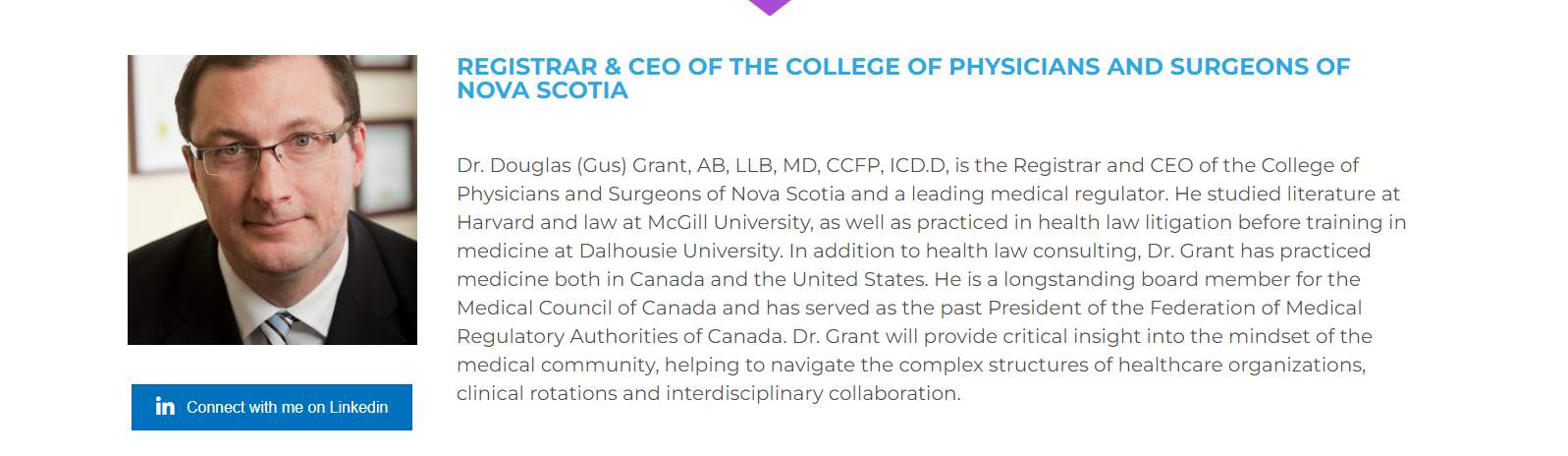
Douglas Grant is the Registrar and CEO of CPSNS and is trained in both law and medicine. He studied law at McGill University and practiced in health law litigation before becoming a physician and regulator (See Image 1).
This background is directly relevant. It means he is not only aware of, but professionally trained in:
- conflict of interest principles;
- evidentiary standards; and
- the legal implications of medical decision-making, particularly in cases involving involuntary treatment.
Despite this, he states that he reviewed the entirety of the materials in this case. The record does not support that claim. His continued insistence that he did raises serious concerns regarding negligence, professional misconduct, and whether the review was conducted in good faith.
Decisions issued under his authority relied on incomplete records, ignored clear contradictions, failed to investigate a reported sexual assault, and disclosed personal information to Cox & Palmer despite an identified conflict of interest involving Stephen McNeil and connections to Irving Shipbuilding.
Given his legal training and experience in health law, these are not technical oversights. They are issues that fall directly within the core competencies of his role.
As both a physician and a regulator, his conduct is subject to professional and regulatory standards. The failure to apply those standards in this case raises serious concerns regarding the integrity of the review process.
What Douglas Grant Acknowledged
Before addressing what Douglas Grant missed or ignored, it is important to note what he himself confirmed. In the dismissal of the complaint against Nancy Murphy, Douglas Grant stated:
"Dr. Murphy acknowledges that her documentation of your Emergency Department encounter was incomplete. I advise Dr. Murphy to ensure her medical charting complies with the College's Professional Standards and Guidelines Regarding Charting, particularly in cases where her medical-legal decisions, such as the need for involuntary treatment, may be challenged."
This acknowledgment is significant for two reasons. First, it confirms that CPSNS was aware the record was incomplete in a context involving involuntary treatment and medical-legal decisions — precisely the context in which complete and accurate documentation is most critical. Second, it demonstrates that Douglas Grant understood the stakes: that these records would and should face scrutiny. He then dismissed the complaint on the basis of those same incomplete records.
What Douglas Grant Claimed He Reviewed — and What the Record Shows
Douglas Grant stated he reviewed the whole of the materials. The following are direct contradictions between that claim and the documented record.
The Mount Hope Internal Note
Douglas Grant stated in the dismissal:
"There is no evidence to suggest Dr. Murphy had anything to do with the transportation of your belongings to Mount Hope, or that this was done prior to you being transferred there."
The Mount Hope internal note dated August 3, 2022 states explicitly:
"The client's belongings including wallet was brought to the unit with the previous client mistakenly."
This note was part of the materials Douglas Grant states he reviewed. It directly and unambiguously contradicts his finding. The statement that there is "no evidence" is not supported by the record he claims to have reviewed in its entirety. This is not a matter of interpretation — the note exists, it was provided to CPSNS multiple times including being read directly over their voicemail, and it confirms the transfer occurred before the arrival. Douglas Grant's finding is factually wrong.
Aunt Glenda's Collateral Evidence
Douglas Grant stated he reviewed all materials. Those materials include the collateral observations from Aunt Glenda, recorded in Kristen Holm's own notes at Pages 80–81. Aunt Glenda stated explicitly:
- "There is absolutely nothing wrong with his mental health";
- any changes were limited to being "a little stressed with what is going on";
- she did not believe the concerns were delusional and attributed them to events in the workplace;
- she described Scott Jewers as holding up well over a three-year period; and
- she indicated his primary concern was to speak with someone in authority and resolve the situation.
This is not ambiguous collateral. It is a direct, detailed, and reasoned rejection of the presence of a mental disorder — recorded within Kristen Holm's own notes. Douglas Grant did not reference it. He did not address it. He did not reconcile it with the conclusion that the admission was appropriate. A contradiction that establishes clear reasonable doubt was simply ignored.
The Audio Recording
The audio recording of the August 5, 2022 interaction with Kristen Holm directly contradicts her written characterization of Scott Jewers' speech as "pressured and tangential." The recording also confirms that Kristen Holm referenced Stephen McNeil and Postmedia by name — references she replaced in her written record with Stephen Harper and Bell Media. Douglas Grant did not address the audio recording or the discrepancy between it and the written record. He dismissed the complaint on the basis of the written record alone and never mentioned or included the audio recording.
The Reported Sexual Assault
A sexual assault was reported to Kristen Holm during the August 2022 admission. It was not recorded in any meaningful way. It was reported again to Hana Marie Weimer on March 13, 2023. It was not recorded at all. During the CPSNS review process, Scott Jewers was never contacted to provide a formal statement regarding this allegation. The matter was not investigated at any stage. Douglas Grant and Crystal Morgan relied on the fabricated records of NSHA staff to dismiss the complaint — records in which the sexual assault had either been omitted or ignored by the very individuals whose conduct was under review.
This is a mandatory reporting matter under Nova Scotia Health policy AD-QR-040 — Responding to Patient Sexual Incidents When Harm is Suspected — and engages obligations under the Protection for Persons in Care Act. The failure to investigate is not discretionary. It is a failure to follow mandatory policy.
Charter and IPTA Implications of the Review Failure
The failures identified above are not limited to record-keeping or process concerns. They directly engage statutory requirements under the Involuntary Psychiatric Treatment Act (IPTA) and constitutional protections under the Canadian Charter of Rights and Freedoms.
Under the IPTA, involuntary admission requires that decisions be made on the basis of evidence, including:
- a mental disorder of a nature or degree warranting detention;
- a likelihood of harm to self or others, or inability to care for oneself; and
- an evidence-based clinical determination.
The record relied upon and affirmed by Douglas Grant does not meet that standard.
Instead, it reflects:
- vague and non-specific collateral statements (e.g., “something was happening”);
- omission of exculpatory evidence, including Aunt Glenda’s clear rejection of any mental health issue;
- mischaracterization of physician input, including altering uncertainty into certainty; and
- failure to document or investigate material events, including a reported sexual assault and conditions of prolonged sleep deprivation.
A record constructed and reviewed in this manner cannot satisfy the evidentiary threshold required under IPTA.
Where a regulatory body is aware that:
- the documentation is incomplete;
- contradictory evidence exists within the same record; and
- serious allegations were not recorded or investigated,
and nevertheless affirms that record as sufficient to justify involuntary detention, the result is not an evidence-based decision — it is an arbitrary one.
This directly engages Section 7 of the Charter, which guarantees the right to life, liberty, and security of the person and protects against deprivation except in accordance with the principles of fundamental justice.
An involuntary detention based on:
- incomplete records;
- unverified assumptions; and
- unresolved contradictions
is, by definition, not consistent with fundamental justice.
It also engages Section 15 of the Charter, which guarantees equality before and under the law.
A process that:
- substitutes characterization (“delusion”) for evidence, and
- applies conclusions without requiring substantiation or verification
results in unequal access to legal protections and investigative standards.
Crucially, Douglas Grant’s role is not passive. As Registrar and CEO, his review function is to ensure that:
- evidentiary standards are met;
- contradictions are addressed; and
- statutory obligations are upheld.
Where those failures are identified and the record is nevertheless affirmed, the regulatory body does not merely inherit the deficiencies — it endorses them.
The Closed Loop
Crystal Morgan and Douglas Grant of CPSNS relied on the fabricated records of NSHA staff to justify not conducting their own investigation, while asserting that the involved parties would not engage in such conduct. In total, at least 15 individuals across RCMP and HRP relied on records originating from Kristen Holm, NSHA, and CPSNS. The result is a closed loop in which the same unverified characterization was passed from institution to institution, each relying on the prior institution's record rather than conducting independent verification. No institution ever examined the underlying events. They only ever examined each other's characterizations of those events.
This is the defining structural failure of the entire process. It is not coincidental. It is the predictable outcome when a regulatory body treats the record of the respondent as sufficient basis for dismissal without independent verification, without contacting the complainant for a formal statement, and without addressing documented contradictions within that record.
The Cox & Palmer Disclosure
Douglas Grant personally disclosed Scott Jewers' personal and confidential information to Cox & Palmer — specifically c/o Mr. Colin Clarke via TitanFile — on two separate occasions: January 15, 2024, and again on April 29, 2024. The second disclosure occurred after conflict concerns had already been explicitly raised and communicated to CPSNS staff. Those concerns were not assessed or resolved before the second disclosure was made.
Cox & Palmer employ Stephen McNeil — a former Premier of Nova Scotia directly referenced in the audio recording of the Kristen Holm interaction and directly relevant to the substance of the complaint. Cox & Palmer have themselves acknowledged a conflict of interest in relation to J.D. Irving due to their involvement in shipbuilding contracts.
The disclosure of a complainant's personal and confidential information to a firm with a documented connection to the subject matter of the complaint, after that conflict had been explicitly identified and raised, is not a procedural oversight. It is a material breach that goes directly to the integrity of the review process and raises potential statutory obligations under both the Nova Scotia and federal privacy frameworks.
The Appeal That Was Never Meaningfully Available
On February 20, 2024, Suzanne Husbands wrote: "I confirm you have not requested an appeal. These files are now closed."
CPSNS received same-day responses on February 20, 2024 that directly addressed the appeal and raised the conflict of interest and disclosure issues preventing the appeal from proceeding. Those concerns were not assessed or resolved. Instead, Douglas Grant proceeded to make a second disclosure of personal and confidential information to Cox & Palmer on April 29, 2024 — while the files had been closed on the stated basis that no appeal was requested.
The appeal process was not meaningfully available. It was obstructed by an unresolved and documented conflict of interest, and then terminated on a characterization of the record that does not reflect what occurred.
Summary
Douglas Grant, as Registrar and CEO of CPSNS, is trained in both law and medicine, having studied law at McGill University and practiced in health law litigation. He is fully aware of conflict of interest obligations, evidentiary standards, and the legal requirement to investigate serious allegations, including sexual assault, particularly in cases involving involuntary detention.
Douglas Grant, as Registrar and CEO of CPSNS, is responsible for the following:
- Dismissing complaints on the basis of records he acknowledged were incomplete, in a medical-legal context involving involuntary treatment.
- Failing to reference, address, or reconcile Aunt Glenda's exculpatory collateral evidence, which appeared in Kristen Holm's own notes.
- Failing to address the audio recording and the material discrepancy between it and Kristen Holm's written record.
- Failing to investigate a reported sexual assault, or to ensure that mandatory reporting obligations were met.
- Claiming there was “no evidence” of the pre-transfer of belongings when the Mount Hope internal note — part of the materials he states he reviewed — directly contradicts that finding.
- Disclosing personal and confidential information to a firm with a documented conflict of interest on two separate occasions, the second of which occurred after the conflict had already been explicitly raised.
- Closing the complaint files on a false characterization of the record, preventing meaningful access to the appeal process.
Taken together, the conduct of Douglas Grant reflects not an error in judgment but a pattern of institutional protection — in which the records of the respondents were accepted without scrutiny, documented contradictions were ignored, mandatory obligations were not met, and the complainant was never meaningfully engaged in the process that determined the outcome of his complaints.
Given his legal training and experience in health law, it is reasonable to conclude that he understood the seriousness and consequences of these actions. Rather than addressing the underlying issues — including public safety concerns and the reported abuse — the matter was instead redirected to Cox & Palmer, despite a known conflict of interest. This had the effect of limiting scrutiny, while placing additional psychological and financial strain on the complainant.
Privacy Breaches
Personal Belongings at Mount Hope Before I Saw a Doctor (PHI Breach) — Unauthorized Access and Possible Theft
The Belongings Transfer
The record confirms that my belongings were transferred to Mount Hope before I had seen a doctor and without my knowledge or consent.
Douglas Grant states in the CPSNS dismissal:
"There is no evidence to suggest Dr. Murphy had anything to do with the transportation of your belongings to Mount Hope, or that this was done prior to you being transferred there."
The Mount Hope records directly contradict this. This evidence was provided to CPSNS multiple times, including being read directly over their voicemail. The internal note dated August 3, 2022 states:
"The client's belongings including wallet was brought to the unit with the previous client mistakenly."
The note then lists the contents of my wallet:
- Driver's Licence
- Health Card
- Cash — approximately $40.00
- Scotiabank card and banking information
- Additional identification and financial items as listed in the inventory
This confirms three things:
- My belongings were already at Mount Hope before my arrival.
- They were transported with another patient.
- The transfer occurred before my assessment and without my knowledge or consent.
Douglas Grant stated there is no evidence of this. The Mount Hope internal note is the evidence. It was in the materials he reviewed. His statement is directly contradicted by the record he claims to have reviewed in its entirety.
This is not a minor administrative issue. The record shows that my wallet was accessed and inventoried without my knowledge and contained personal identification, financial information, and my health card — which constitutes Personal Health Information under NSHA policy.
This constitutes a privacy breach, including potential exposure of Personal Health Information, financial information, and identity documents. Under NSHA policy, this type of breach must be reported in SIMS and investigated. This is confirmed directly by documentation signed by Karen Hornberger, then Provincial Director of Privacy:
"Personal Health Information — any identifying information about an individual if the information relates to registration information including health card number."
"Privacy Breach — an incident where PHI entrusted to you or the organization is lost, stolen, or subject to unauthorized access, use, disclosure, copying, or modification. All breaches must be reported in the SIMS system or to Privacy for investigation. Breaches can be nonintentional or intentional."
What Occurred
To my understanding, the individual at this stage was Shante A. Blackmore. If this is incorrect, I will apologize and amend my records accordingly; however, this is how the matter has been presented to me by NSHA and CPSNS.
At this stage, I had been held by Officer A for several hours. When I requested access to a lawyer, he stated, "Even if I could get one, they can't come back and talk to you," which amounted to a denial of access to legal counsel. Aside from this statement, he did not engage in any abusive, belittling, or otherwise inappropriate conduct toward me, and I felt safe in his presence.
While waiting in the waiting room, two officers — I will refer to them as Officer B and Officer C — were holding another individual, referred to here as Person A. Person A was pacing and clearly in distress. As he walked past me, he said shakily, "Man… if you have problems, this is the place to be." He remained under the control of the two officers.
At that time, I was speaking with Officer A and asked, "How much do you think J.D. Irving would pay to stay out of jail? $100,000, $1,000,000, $10,000,000… $100,000,000?" Following this, both Officers B and C looked directly at me, and one of them appeared visibly agitated, with his face turning red.
At one point, a nurse attended to take my blood. I told her this was inappropriate given the circumstances. She responded, "What's the problem if you have nothing to hide?" I advised her that I had been denied access to a lawyer and that I had been falsely arrested. It appeared that she did not alter the medical record directly but instead left a note for Shante A. Blackmore.
At this stage, I had been awake since approximately 6:00 a.m. that morning. HRP records indicate dispatch at 3:10 p.m., while notes associated with Shante A. Blackmore extend to at least 3:21 a.m. the following morning — approximately 21 hours of wakefulness at the time of assessment. Mount Hope records indicate I arrived no earlier than approximately 4:30 a.m. I had been in handcuffs for 11 hours, and I remained completely calm throughout.
I was then taken into a room. While I waited, Officer A came in and asked if he could speak with me. He told me the night had not gone the way he expected and that our conversation had been one of the best he had had, adding that he genuinely hoped I would one day be able to trust someone. I thanked him and told him he seemed like a good person, but I explained that in my view they were going to detain me because mistakes had already been made.
Shante A. Blackmore then entered the room, reviewed her papers, and immediately stated, "You have not been denied a lawyer." I responded that I had been denied a lawyer and questioned how she could make that determination, given that I had been in handcuffs for approximately 10 hours and had repeatedly stated that I just wanted to go home. Based on the sequence of events, I believe she may have been responding to the note left by the nurse. Shante A. Blackmore then stated that I had to discuss the situation or I would be admitted.
I asked about my privacy given the conflict of interest — HRP had cited it themselves as the reason they could not open a complaint — and the fact that I was being required to discuss the matter in that context. She responded that they "take that very seriously." I explained the conflict of interest and outlined basic facts showing the tension between HRP's conduct and their own stated position. She replied, "I'm not here to fact check you."
During this time, a new HRP officer entered the room (referred to here as Officer D). He stood awkwardly and after some time said, "Scott?" I responded yes, and he indicated he would be taking over. This was despite Officer A — who I had spent hours with and had personally asked to remain — having said earlier he would stay until 6 a.m. I then overheard Officer D tell Officer A he could leave or get something to eat, which Officer A declined. I believed at the time that Officer A may have had concerns about the situation.
After Officer A left the room, I told Shante A. Blackmore I no longer wished to discuss the matter and that it was inappropriate to require me to do so given the circumstances. She looked directly at me and said, "That's kind of paranoid, isn't it?" and then stated, "I think we're going to have to admit you." When I asked why, she said I was paranoid about police. I clarified that I was not, and that they themselves had cited a conflict of interest.
She then stated it was late and that I had no place to go and no way to get there. This was false. As confirmed by the wallet inventory, I had approximately $40.00 in cash specifically for transportation, and there are witnesses who can confirm they were waiting for me and were concerned about my whereabouts.
She then opened the door, stood in the doorway, and spoke to the two officers outside, stating I was being admitted. She then said, "Guys, he thinks you can hear him out here," followed by, "Here Scott, test it, test it." Officer D laughed. Officer A did not. I remained calm, looked at the wall, and stated, "This is really inappropriate right now."
Only at that point did she say I could have a lawyer and told me to go to the desk to ask for a phone. I stated I would prefer to wait until the officers had left. Officer D then approached to remove the handcuffs and asked, "Do you have any questions for me?" I responded, "This isn't right." He then repeated the question loudly and aggressively, shouting directly in my face. I said no. This occurred immediately following Shante A. Blackmore's conduct, which in my view enabled and escalated the situation.
I then went to the desk, where a security officer and, to my understanding, Nancy Murphy were present. I stated that I had been told by Shante A. Blackmore that I could use a phone to contact a lawyer. Nancy Murphy responded, "Honey, there is no phone," and advised that my belongings had already been taken to Mount Hope.
I was denied access to a lawyer on three separate occasions: first in practice by Officer A, then offered access only when it would no longer be meaningful by Shante A. Blackmore, and then denied again directly by Nancy Murphy — at a point when NSHA had already caused a significant privacy breach involving my PHI and financial information. This occurred after Shante A. Blackmore had specifically stated that they take privacy "very seriously."
I did not know who my belongings had been transferred to or how they had been sent to Mount Hope. On the morning following my transfer, Person A — who had been held by Officers B and C in the waiting room and had overheard my remarks about J.D. Irving — approached me unprompted and stated, "Man, you can't talk like that around police." He told me that the police had gone through my bag, including my wallet and identification. He further stated that he had woken up hugging my bag and asked if I wanted to play rock-paper-scissors for one of the twenty-dollar bills. I did not agree.
This confirms that my belongings were not only transferred without my knowledge but mishandled in a manner that created a foreseeable and documented privacy risk — and this occurred before I had seen the doctor, consistent with my prior statements.
The question of which officers had custody of me in the final minutes before my admission is relevant because Officers B and C were the same officers who had been holding Person A — the patient my belongings were transferred with, and who had overheard my remarks about how much J.D. Irving might pay to stay out of jail.
There is evidence within HRP Professional Standards records indicating that Officers B and C — who had been assigned to Person A — may have subsequently been assigned to me for approximately ten minutes immediately prior to my admission by Shante A. Blackmore (see Image 3):
"While at the hospital, Jewers custody was transferred several times between officers from day shift to night shift. At the time of his release, Jewers was in the custody of Cst Stephen Pope and Cst Jairus Lamphier… Cst Lamphier does recall relieving the dayshift officer and he and his partner only had custody of Jewers for approximately 10 minutes before they were informed by hospital staff that they could leave as Jewers was being involuntarily ‘formed’ by the doctor."
However, based on my direct observations, only one new officer entered the room — Officer D. I did not observe or interact with any partner accompanying him, nor was there an additional officer present. The only officers present were Officer D and Officer A.
This discrepancy should allow the RCMP, HRP, and NSHA to review their records to determine whether Officers B and C — who had been handling Person A — were subsequently reassigned to me during that approximately ten-minute window. As both Person A and I were transferred to Mount Hope early that morning, the number of records for that specific transfer period would be limited, which should allow RCMP, HRP, and NSHA to precisely identify the officers involved.
Conclusion
The documentary record directly contradicts CPSNS's position. My belongings were transferred prior to my arrival, handled incorrectly, and accessed without my knowledge. This is not an allegation — it is confirmed by the Mount Hope internal notes. This reflects a pattern in which multiple NSHA employees did not record serious events, including Nancy Murphy. This was not an issue limited to her records alone.
This is particularly significant given that Douglas Grant himself states in the dismissal:
"Dr. Murphy acknowledges that her documentation of your Emergency Department encounter was incomplete."
"I advise Dr. Murphy to ensure her medical charting complies with the College's Professional Standards and Guidelines Regarding Charting, particularly in cases where her medical-legal decisions, such as the need for involuntary treatment, may be challenged."
This confirms that CPSNS was aware the record was incomplete, yet still relied on that same record to dismiss the complaint.
This also raises the question of whether Shante A. Blackmore was aware of the transfer and whether the admission occurred in that context. In addition to the incomplete documentation, the false characterization that I was protesting, the claim that I "lived with my parents," and the transfer of my belongings before I had seen a doctor while being denied access to a lawyer, these actions collectively carry significant legal implications.
Douglas Grant stated there is no evidence to suggest this occurred prior to my transfer. The Mount Hope internal note dated August 3, 2022 states explicitly that it did. That note was part of the materials he claims to have reviewed.
At a minimum, this represents a failure in handling personal property and confidential information. At worst, it constitutes a reportable privacy breach under NSHA policy that was not properly investigated or addressed — and a CPSNS dismissal that directly contradicts the documentary record it claims to have reviewed.
Note on Naming: The individual referred to as Shante A. Blackmore is identified on the basis of information provided by NSHA and CPSNS. If this attribution is incorrect, this document will be amended accordingly upon receipt of clarifying information.
Torture, Coercive Conditions, and External Influence
Legal Definition of Torture
Under the Criminal Code of Canada, section 269.1, torture is defined as:
any act or omission by which severe physical or mental pain or suffering is intentionally inflicted by, or with the consent or acquiescence of, a public official, for a purpose such as obtaining information, punishment, intimidation, or coercion.
This definition requires:
- severe physical or mental suffering;
- intentional infliction;
- state involvement; and
- a specific purpose, such as coercion, intimidation, or influencing conduct.
This framework is mirrored in the United Nations Convention Against Torture, which recognizes that severe mental suffering may arise from:
- prolonged sleep deprivation;
- deprivation of food or water;
- exposure to degrading or unsafe conditions; and
- psychological destabilization during detention.
Conditions of Detention and Assessment
The record establishes that I was:
- kept awake for approximately 24 hours or more;
- deprived of food and water for a prolonged period;
- placed in an unfamiliar and distressing custodial environment;
- subjected to a sexual boundary violation while attempting to rest; and
- questioned and assessed under those conditions.
These are not neutral or incidental circumstances.
Sleep deprivation alone is widely recognized as impairing:
- cognition;
- perception;
- emotional regulation; and
- the reliability of any statements made.
When combined with deprivation, distress, and fear, these conditions create a coercive environment capable of producing compliance, confusion, and impaired judgment.
Application of the Legal Standard
Based on the above, I assert that the elements of the legal definition of torture are engaged and, on a balance of the available evidence, met or closely approached in this case:
- Severe mental suffering:
The combination of prolonged sleep deprivation, deprivation of basic needs, distress, and a sexual boundary violation constitutes significant psychological and physical harm. - State involvement:
These events occurred while I was detained and under the care and control of public institutions and their staff. - Intentional infliction (inference from conduct):
I was knowingly kept in these conditions and then assessed and questioned without any meaningful intervention to address them.
The continuation of those conditions, combined with reliance on the resulting assessment, supports a reasonable inference that they were accepted, if not deliberately maintained. - Purpose (coercion / influence):
I was questioned and assessed while in a state of exhaustion and distress, and the resulting record was relied upon despite being incomplete and materially inaccurate.
This supports a reasonable conclusion that the conditions were used in a manner that influenced the outcome of the assessment and the characterization of my statements.
At minimum, these facts satisfy the threshold of cruel, inhuman, or degrading treatment.
However, when the elements are considered together — particularly the timing of the assessment and the reliance on its outcome — there is a reasonable and evidence-based basis to assert that the legal standard for torture is engaged.
Legal Significance Under IPTA and the Charter
Regardless of classification, these conditions are incompatible with:
- the evidence-based requirements of the Involuntary Psychiatric Treatment Act (IPTA); and
- Section 7 of the Charter, which guarantees liberty and security of the person in accordance with principles of fundamental justice.
An assessment conducted under:
- exhaustion,
- deprivation, and
- unrecorded or omitted material facts
cannot be considered reliable or legally sufficient.
Escalation: External Influence and Purpose
The definition of torture ultimately turns on purpose.
If it is established that:
- Kristen Holm was aware of the August 3, 2022 email; and
- specific names or information (including McNeil and Postmedia) were removed or altered in response to that knowledge; or
- any external party influenced the content, framing, or conclusions of the record,
then the purpose element is no longer inferred — it is directly established.
In that circumstance, the conditions of detention and assessment were not merely harmful.
They were functionally used to shape, suppress, or control information.
That satisfies the purpose requirement of torture, including:
- coercion;
- intimidation; and
- influencing the content of statements or records.
Intersection with Human Trafficking Principles
Under the Criminal Code of Canada (s.279.01), human trafficking includes exercising control or influence over a person’s movements for the purpose of exploitation.
“Exploitation” includes situations where a person is caused to provide something — including information or compliance — through:
- fear;
- coercion; or
- abuse of a position of trust, power, or authority.
Where an individual is:
- detained;
- deprived of basic needs;
- psychologically destabilized; and
- then assessed or documented in a manner influenced by external interests,
this raises a serious and legally grounded concern that control was exercised for the purpose of producing a specific outcome.
If external influence is established, the conduct moves beyond clinical or regulatory failure and into the realm of coercion-based exploitation within a custodial setting.
Summary
This section does not rely on speculation. It applies established legal definitions to documented facts.
- The conditions described constitute severe mental suffering under state control.
- Those conditions were known, unaddressed, and relied upon.
- I was assessed and characterized while under those conditions.
On that basis:
- The conduct is at minimum consistent with cruel, inhuman, or degrading treatment.
- There is a reasonable and supportable basis to assert that the legal threshold for torture is met or engaged.
- If external influence on the record is established, the purpose element is satisfied, and the conduct aligns directly with coercion-based offences, including those underlying torture and exploitation provisions.
Karen Hornberger – Provincial Director of Privacy, NSHA: Failure to Investigate and Mischaracterization of Complaint
Karen Hornberger, Provincial Director of Privacy for NSHA, did not investigate the substance of the complaint and instead redirected the matter to the Office of the Information and Privacy Commissioner (OIPC) while closing the file (See Image 1). As a result, the matter remains ongoing and unresolved more than three years later, raising reasonable concern that similar incidents may not be properly investigated or addressed within NSHA.
Her own documentation confirms that privacy breaches must be reported in the SIMS system and investigated. That did not occur in this case.
The complaint involved a clear privacy breach: the loss, transfer, and unauthorized access of personal belongings containing personal health information (PHI), including a health card, banking information, and identification. These items were accessed by multiple parties after being transferred without consent. Under PHIA, this engages a duty to investigate, document, and address the breach. That duty was not fulfilled. And because this wa snot addressed then 2023 another massive breahc of personal and health informaiton occured when NSHA fabricated records statign i was at NSHA, that a secuirty gaurd perosnally read me the notice and a witness claimed i was there. This was eitehr straight up fraud, or someone engaging in identity theft, reaonably related to the revious brahc involving health Card (PHI) and finacial and identify informaiton. While then CPSNS claikming there was no evidence.
In her response, Karen Hornberger acknowledges that the book bag was searched by police and transferred to Mount Hope where it was accessed by another patient, but states that her office “does not typically deal with concerns about patient belongings” and directs those issues elsewhere. At the same time, she reframes the complaint as follows:
“Your second and third concerns are regarding being videotaped and monitored and the refusal of staff members to allow you to record a therapeutic session.”
This characterization is inaccurate and materially misleading.
The complaint was not limited to a “therapeutic session.” It arose in the context of an involuntary detention under the Involuntary Psychiatric Treatment Act (IPTA), where consent, documentation, and patient rights are legally required. The denial of recording in that context directly engages consent and must be documented.
At the same time, the complainant was subjected to continuous video monitoring for over 24 hours while placed in an area open to the public, without privacy and without meaningful or documented consent. These are direct privacy concerns that were not addressed.
Rather than investigating:
- the unauthorized access and disclosure of PHI through the handling of the wallet,
- the transfer of belongings prior to medical assessment,
- the conditions of monitoring and lack of privacy, and
- the legal implications of denying recording in an IPTA context,
Karen Hornberger reframed the complaint into a narrower and inaccurate description, declined to investigate a reportable PHIA breach, and redirected the matter externally.
The result is that a complaint involving identifiable privacy breaches and patient rights was not examined on its merits, was not recorded and investigated as required, and was instead closed and shifted to another body without addressing the underlying issues.
 Image 1: Letetr from Karen Hornberger
Tiny URL: https://tinyurl.com/f3pr5n8s
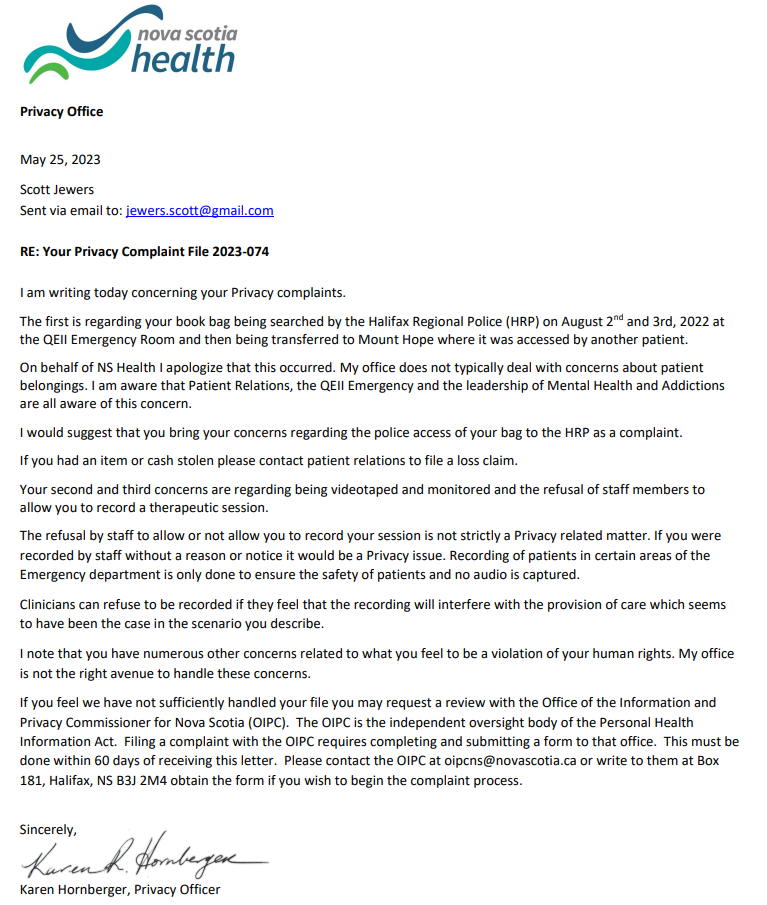
To RCMP
To: C/Supt Dan Morrow and Jana Caines, Executive Assistant to C/Supt Morrow
Cc: Commissioner Mike Duheme and Assistant Commissioner Dennis Daley
I am formally requesting that the Royal Canadian Mounted Police initiate an investigation into matters arising from my treatment while in the care of the Nova Scotia Health Authority (NSHA), and the subsequent handling of those events by all involved parties.
Allegations and Areas of Concern
- A reported sexual assault while in NSHA care that was not properly documented or investigated by the RCMP, NSHA, or CPSNS, and which I allege was directly suppressed by Crystal Morgan (Lead Investigator) and Douglas Grant (Registrar and CEO) of CPSNS;
- A significant privacy breach involving the theft of my personal belongings while in NSHA care, including my Health Card, identification, and financial information, and the failure to report or investigate this incident. I am requesting that the investigation determine which Halifax Regional Police (HRP) officers came into possession of my belongings, as the available evidence suggests this may have been intentional. I also request confirmation of the safety and well-being of the individual to whom these possessions were transferred;
- A trespass notice issued by NSHA falsely claiming that I was present at an NSHA facility on August 22, 2023, and that the notice was read to me in the presence of a witness. I was not present, and this did not occur. The documentation appears to have been completed without my involvement, including what appears to be the same individual signing on behalf of a witness. This raises serious concerns regarding identity misuse and may reasonably be connected to the prior breach of my personal health information and identification;
- The conduct of Kristen Holm, including multiple instances of alleged record fabrication, most notably the alteration of names within the medical record (specifically changing Stephen McNeil and Postmedia to Stephen Harper and Bell Media), constituting a material change to the substance of my statements. This obscured clear conflicts of interest and directly affected the scope and integrity of RCMP and legal review. The same individual also failed to document or report the sexual assault;
- The conduct of Hana Marie Wiemer, including the failure to record alleged threats, the failure to document that I requested legal counsel and was denied, and the failure to record my request to have the session audio recorded. These omissions constitute material deficiencies in the record, undermine its accuracy and completeness, and resulted in direct and foreseeable physical and psychological harm;
- The conduct of Inspector Cory Bushell and Staff Sergeant Trevor Allen, including alleged fabrication or falsification of records and procedural misconduct, including reliance on unsupported records, failure to obtain written statements, and the alleged suppression of national security-related matters, including those associated with CSIS file/attachment 5566;
- The improper use of a Section 14 apprehension without documented evidentiary basis, including the alleged fabrication and mischaracterization of records, such as references to “vague threatening emails” without supporting evidence, and a lack of clarity regarding who authorized the apprehension and on what basis;
- The repeated denial of access to legal counsel and refusal to permit audio recording of interactions during my detention, which I understand to be protected rights under Canadian law;
- A request that Premier Tim Houston be formally questioned, on the record, regarding the events of January 29, 2023, including his presence at the hospital on the morning of my mother’s death;
- Investigation into the privacy breach reported by Valent Legal on August 1, 2022, including the source of the breach, the parties involved, any resulting misuse of personal or identifying information, and any failure to properly report or disclose the breach, as the context, content, and timing reasonably raise potential national security concerns;
- Investigation into the conduct of Shelly Mews and Curt Wallace of the RCMP Special Victims Unit, including allegations of retaliation and fabrication of records in relation to case 2025-21595, and the failure to investigate a reported sexual assault or escalate the matter to Commissioner Mike Duheme and Assistant Commissioner Dennis Daley as requested, despite the scope of the officers and individuals involved;
- Investigation into the conduct of Inspector Cory Bushell and Staff Sergeant Trevor Allen regarding the handling of CRCC investigations 2023-521587 and 2023-1031;
- Investigation into the CRCC’s handling of files 2023-1031 and R2024-005807, including delays exceeding the CRCC’s stated 120-day service standard and their connection to the underlying matters, including the reported sexual assault.
- Investigation into unauthorized manipulation of my mobile device GPS location, specifically the setting of my device to 9330 Highway #7, Stillwater, Nova Scotia, without my knowledge or consent.
This location is directly associated with materials and evidence I have previously provided concerning EMIC contracts, SCL Group, and Cambridge Analytica, including their documented involvement in data operations, behavioral targeting, and election-related activities.
The presence of this location within my device raises serious concerns that my personal data, device access, or identity may have been compromised or externally influenced, particularly when considered in conjunction with:
- the prior theft and exposure of my identification and personal information;
- the Valent Legal phishing incident immediately preceding my arrest; and
- the subsequent alteration and suppression of material information within official records.
I am requesting that the RCMP determine:
- how and when this GPS location was set;
- whether any third party accessed or interfered with my device or associated accounts;
- whether this location is connected to any operational, contractual, or logistical activities linked to EMIC, SCL Group, or Cambridge Analytica; and
- whether this activity forms part of a broader pattern involving data manipulation, identity interference, or coordinated influence operations.
Given the established public record regarding the role of SCL Group and Cambridge Analytica in electoral interference and psychological operations, I am also requesting that the RCMP assess whether this incident engages potential election interference or foreign influence considerations, and coordinate with appropriate national security bodies, including CSIS, where required.
Requested Actions
I am requesting the following:
- A full and independent investigation into all of the above matters;
- Identification of all individuals involved in the events described;
- Immediate preservation, collection, and review of all relevant materials, including but not limited to medical records, police records, internal communications, and audio recordings;
- Consideration of obstruction-related charges where it is determined that information has been knowingly misrepresented or withheld;
- Consideration of additional charges where applicable in relation to national security implications referenced in CSIS file/attachment 5566. If clarification is required regarding this reference, I request that the RCMP coordinate directly with CSIS, as this falls within the RCMP’s mandate.
These matters raise serious concerns, including potential criminal conduct, breaches of privacy, and significant procedural failures. Given the nature and scope of these issues, a thorough and independent investigation is required.
I am prepared to provide supporting documentation, records, and evidence upon request.
To Media and Politicians
I am providing this material to members of the media and elected officials because the issues outlined relate directly to the conduct of the Nova Scotia Health Authority (NSHA) and the College of Physicians and Surgeons of Nova Scotia (CPSNS), and raise serious concerns regarding institutional accountability, record integrity, and the failure of oversight processes. The record reflects the failure to investigate a reported sexual assault while I was in institutional care, the omission and alteration of material facts within medical documentation, the denial of access to legal counsel, and the reliance on incomplete or inaccurate records in decisions that directly affected my liberty.
The record further shows that I was characterized in a manner that undermined my credibility without any documented evidentiary or clinical foundation. That characterization was then relied upon to dismiss or ignore the substance of what I reported. In effect, a label was applied first, and the record was shaped to reinforce it. This resulted in serious allegations not being investigated and decisions being justified on the basis of an unreliable and incomplete record.
The conditions under which I was detained and assessed — including prolonged sleep deprivation, deprivation of food and water, distressing custodial conditions, and the failure to respond to or document a reported sexual assault — were not neutral. Where such conditions are known, unaddressed, and relied upon to assess or characterize an individual, they raise serious concerns that the conduct meets, or at minimum engages, legal thresholds associated with coercive treatment, including torture or cruel, inhuman, or degrading treatment.
Further, where an individual is detained, deprived of basic needs, and placed in a psychologically destabilized state, and that condition is then used to influence outcomes, documentation, or decisions affecting their liberty, this raises a reasonable concern that control was exercised in a manner consistent with coercion and exploitation as recognized under Canadian law, including principles underlying human trafficking provisions.
Given the seriousness of these issues, I am requesting that media organizations and elected officials call for a full, independent investigation into the conduct of NSHA and CPSNS, and that formal correspondence be sent to both CPSNS and the RCMP demanding that these matters be investigated thoroughly and transparently by bodies not directly implicated in the events described. I am also requesting that Premier Tim Houston be formally contacted and asked to make a statement on the record and to request directly that the RCMP initiate a full investigation into these matters.
These issues engage clear public interest concerns, including the treatment of individuals in custody, the reliability of institutional records, and the integrity of oversight processes. Where there is evidence of omissions, contradictions, and potential fabrication, and where serious allegations were not investigated, independent scrutiny is required.
I remain available to answer any and all questions, provide supporting documentation, and assist fully in any review or investigation. The materials provided are intended to allow for independent verification of the facts and timeline, and to ensure these matters are examined openly and on the basis of evidence.
Notice to Health Canada — Request for External Investigation
I am providing this material to Health Canada because the issues outlined raise serious concerns regarding the conduct of physicians operating within the Nova Scotia Health Authority (NSHA), as well as the adequacy and integrity of oversight exercised by the College of Physicians and Surgeons of Nova Scotia (CPSNS). The record reflects multiple instances of material omission, alteration, and mischaracterization within medical documentation, the failure to investigate a reported sexual assault while I was in institutional care, and the reliance on incomplete or inaccurate records in decisions that directly affected my liberty.
These concerns involve the conduct of specific practitioners, including Dr. Nancy Murphy, Dr. Kristen Holm, Shante A Blackmore, Hana Marie Weimer, John Adebayo Oguntade and other physicians involved in my care whose actions are detailed throughout this document. This includes failures to document critical information, the dismissal of serious allegations without investigation, and the use of unsupported or altered records to justify involuntary assessment and detention.
The review conducted by CPSNS, under the authority of Douglas Grant, Registrar and CEO, did not address these deficiencies. Instead, it relied upon the same incomplete and contradictory record, raising serious concerns regarding the independence and adequacy of the regulatory process.
Given the nature and scope of these issues, I am requesting that Health Canada initiate or facilitate an external, independent investigation into the conduct of the physicians identified above and throughout this document, as well as the actions of Douglas Grant in his role as Registrar and CEO of CPSNS. This investigation should include a review of all relevant medical records, communications, and decision-making processes, and should assess whether the conduct described meets applicable professional, legal, and ethical standards.
This matter engages significant public interest considerations, including the protection of individuals in custody, the reliability and integrity of medical documentation used in legal decision-making, and the effectiveness of provincial regulatory oversight mechanisms. Where a regulatory body relies on a record that contains clear omissions, contradictions, and unresolved allegations, and does not take steps to independently verify or address those issues, external review becomes necessary.
I am requesting that this matter be assessed independently of CPSNS and any parties directly involved in the events described. I remain available to provide documentation, clarification, and any additional information required to support a thorough and impartial investigation. The materials provided are intended to allow for independent verification of the facts and timeline, and to ensure that these issues are examined on the basis of evidence.
Email Addresses this has been delivered too
reviews@crcc-ccetp.gc.ca, complaints@crcc-ccetp.gc.ca, info50@elections.ca, elections@novascotia.ca, brett.ruskin@cbc.ca, dpugliese@postmedia.com, chris@chrisalexander.ca, claudiachendermla@gmail.com, w5@bellmedia.ca, w5@ctv.ca, cbcns@cbc.ca, david.fraser@mcinnescooper.com, rennie.jim@irvingshipbuilding.com, perrin.james@irvingshipbuilding.com, ctvnewsapp@bellmedia.ca, hrpprofstand@halifax.ca, halifax@globalnews.ca, halifax@coxandpalmer.com, avery.haines@bellmedia.ca, contactus@pattersonlaw.ca, professionalconduct@cpsns.ns.ca, contacthrp@halifax.ca, amy@valentlegal.ca, pierre.poilievre@parl.gc.ca, info_cef_cce@cef-cce.ca, attachment5566@smtp.gc.ca, jason.mighton@novascotia.ca, oipcns@novascotia.ca, inquiries@citizenlab.ca, polcom@novascotia.ca, cmorgan@cpsns.ns.ca, atlanticnews@bellmedia.ca, newsonline@bellmedia.ca, news@bellmedia.ca, newschannel@ctv.ca, torontotips@cbc.ca, cbcnewsvancouver@cbc.ca, cbcnb@cbc.ca, radionews@cbc.ca, assignmentmontreal@cbc.ca, compass@cbc.ca, sasknews@cbc.ca, geoff.leo@cbc.ca, calgarynewstips@cbc.ca, newsedmonton@cbc.ca, cbcnorth@cbc.ca, nunavut@cbc.ca, cbcyukon@cbc.ca, calgary@globalnews.ca, fifthtips@cbc.ca, gopublic@cbc.ca, infoamfredericton@cbc.ca, metromorning@cbc.ca, sandie.rinaldo@bellmedia.ca, premier@novascotia.ca, premierministre@quebec.ca, premier@ontario.ca, premier@gnb.ca, premier@manitoba.ca, premier@gov.bc.ca, premier@gov.pe.ca, premier@gov.sk.ca, premier@gov.ab.ca, premier@gov.nl.ca, premier@gov.nt.ca, premier@yukon.ca, info@valentlegal.ca, firm@bwbllp.ca, info@boyneclarke.ca, mhenein@hhllp.ca, hrcinquiries@gov.ns.ca, info.com@chrc-ccdp.gc.ca, robertseymourwright@gmail.com, shusbands@cpsns.ns.ca, mark.carney@parl.gc.ca, info@nsira-ossnr.gc.ca, gary.anand@parl.gc.ca, sean.fraser@parl.gc.ca, thewolfandtheneuralnetwork@gmail.com, jewers.scott@gmail.com, jesse@canadaland.com, noor@canadaland.com, sam@canadaland.com, aviva@canadaland.com, editor@canadaland.com, dwalmsley@globeandmail.com, gmcarthur@globeandmail.com, rfife@globeandmail.com, city@thestar.ca, lettertoed@thestar.ca, rosemary.barton@cbc.ca, david.cochrane@cbc.ca, catherine.cullen@cbc.ca, heather.hiscox@cbc.ca, ian.hanomansing@cbc.ca, andrew.chang@cbc.ca, atlantic.news@bellmedia.ca, atlantic@ctv.ca, todd.battis@ctv.ca, omar.sachedina@ctv.ca, heather.butts@ctv.ca, mike.duheme@rcmp-grc.gc.ca, dennis.daley@rcmp-grc.gc.ca, dominic.leblanc@parl.gc.ca, francois-philippe.champagne@parl.gc.ca, patty.hajdu@parl.gc.ca, david.mcguinty@parl.gc.ca, evan.solomon@parl.gc.ca, melanie.joly@parl.gc.ca, anita.anand@parl.gc.ca, marc.miller@parl.gc.ca, melissa.lantsman@parl.gc.ca, tim.uppal@parl.gc.ca, andrew.scheer@parl.gc.ca, michael.cooper@parl.gc.ca, don.davies@parl.gc.ca, gord.johns@parl.gc.ca, leah.gazan@parl.gc.ca, pitch@thewalrus.ca, davidmckiec@gmail.com, emmalbriant@protonmail.com, dan.morrow@rcmp-grc.gc.ca, jana.caines@rcmp-grc.gc.ca,cclarke@coxandpalmer.com ,hcminister.ministresc@hc-sc.gc.ca ,hc.info.sc@canada.ca, publicinquiries@cpsns.ns.ca, Health.Minister@novascotia.ca